
BuddhistCatholicContemplativeEvangelicalGeneral ChristianHinduJewishLatter-day SaintMuslimNew VisionsProgressive Christian
Beliefs
- Buddhist
- Catholic
- Contemplative
- Evangelical
- General Christian
- Hindu
- Jewish
- Latter-day Saint
- More Voices
- Muslim
- New Visions
- Pagan
- Progressive Christian
Topics
- Religion News
- Food and Religion
- Sports and Religion
- Religious Art
- Religious Music and Entertainment
- Religious Events
- History and Religion
- Style and Religion
- Politics and Religion
- Women in Religion
- Recreation Outdoors and Religion
- Business Finance and Religion
- Careers Workplace and Religion
- Education and Religion
- Family Parenting and Religion
- Health Fitness and Religion
- Home and Religion
- Relationships and Religion
- Technology and Religion
- Travel and Religion
Columnists
- Buddhist Columnists
- Business Finance and Religion Columnists
- Careers Workplace and Religion Columnists
- Catholic Columnists
- Contemplative Columnists
- Education and Religion Columnists
- Evangelists Columnists
- Family Parenting and Religion Columnists
- General Christian Columnists
- Health Fitness and Religion Columnists
- Hindu Columnists
- History and Religion Columnists
- Home and Religion Columnists
- Jewish Columnists
- More Voices Columnists
- Latter Day Columnists
- Muslim Columnists
- New Visions Columnists
- Nonreligious Columnists
- Pagan Columnists
- Politics and Religion Columnists
- Progressive Columnists
- Recreation Outdoors and Religion Columnists
- Relationships and Religion Columnists
- Religion News Columnists
- Religious Art Columnists
- Religious Events Columnists
- Religious Music and Entertainment Columnists
- Sports and Religion Columnists
- Style and Religion Columnists
- Technology and Religion Columnists
- Travel and Religion Columnists
- Women in Religion Columnists
Resource Library
- 2026 Calendar
- Library of World Religions
- The 100 Most Holy Places on Earth
- Patheos Answers
- Podcasts
- Videos
- Faith Leaders Database
- Anglican Episcopalian
- Bahai
- Baptist
- Buddhism
- Christianity
- Confucianism
- Eastern Orthodoxy
- Hinduism
- Holiness and Pentecostal
- ISKCON
- Islam
- Judaism
- Lutheran
- Methodist
- The Church of Jesus Christ of Latter-day Saints
- New Age
- Paganism
- Presbytarian and Reformed
- Protestantism
- Religion Behind the Scenes
- Roman Catholic
- Scientology
- Shia Islam
- Sikhism
- Sufism
- Sunni Islam
- Taoism
- Zen
- See all religions
Research Tools
 Ad-Free & Subscriber Log-In Subscription Support
Ad-Free & Subscriber Log-In Subscription Support
Follow Patheos 

- Trending:
- Forgiveness
- |
- Marriage
- |
- Consciousness
- |
- Death Penalty
- |
- Election
- |
- Halloween
 Dowsing for Divinity
-
Books
- Home
- Pagan
- Pagan sacred texts
Pagan sacred texts
Last updated on: December 26, 2014 at 12:28 pm by Yvonne Aburrow
Pagan sacred texts 2014-12-26T12:28:06-05:00 Yvonne Aburrow
Patheos Explore the world's faith through different perspectives on religion and spirituality! Patheos has the views of the prevalent religions and spiritualities of the world.
The status of sacred texts in Paganism is complicated and disputed. A friend on the UK Unitarians Facebook group asked me if there are any Wiccan texts that are universally accepted. My response was:
No, absolutely not. Some people have started referring to “the” Book of Shadows as if it was a single text, but there should be an unique Book of Shadows for every Wiccan, as it is meant to be a record of rituals performed (this is possibly the reason for the name ‘Book of Shadows’, as the text is but a shadow of the actual ritual). There are “standard” features of the initiation ritual, so that initiations can be seen as valid if you move to another coven, but apart from that, there is some variation between groups and lineages. Text is not primary.
There are many texts that people hold in high esteem, but they are not doctrinal statements or anything. One such text is The Charge of the Goddess written by Doreen Valiente. The phrase “all acts of love and pleasure are My rituals” (spoken by the Goddess) has been used to support the inclusion of LGBT, kinky and polyamorous people in Wicca, however. And quite right too!
In other Pagan traditions, sacred texts are part of the tradition, but not held to provide dogma or doctrine (there is no dogma or doctrine in Pagan traditions, though there is near-consensus on many issues, such as the immanence of the Divine and/or deities). There is no single text for each tradition that holds the same status as the holy books of the three Abrahamic religions, the “People of the Book”.
In Heathenry, the Eddas, the Hávamál and the sagas provide important sources for the (re-)construction of rituals, practices, and beliefs, but personal gnosis is also important. It was within the Heathen and polytheist community that the ideas of substantiated and unsubstantiated personal gnosis first arose. A personal spiritual gnosis or experience can be verified by referring it to the experience of others, or to an ancient textual source. For instance, if I have an insight that Óðinn is the deity of blogging, this would be a UPG until I had either cross-referenced it with an ancient textual source, or with someone else’s personal gnosis.
The concepts of SPG and UPG are useful because they mean that we can differentiate different types of knowledge. Just as C G Jung distinguished between different levels of symbol, from personal symbols, to cultural symbols, to universal symbols or archetypes, so we can have different levels of theological knowledge, from the personal to the universal. That is why theology can never be complete; it is open-ended and poetic, personal and contextual.
Other reconstructionist polytheisms also have texts that are important, but no single canonical sacred text. In Hellenic reconstructionism, the Odyssey, the Homeric hymns, the Orphic hymns, Hesiod’s Theogony, and so on, are all important, but not regarded as revealed truth. In Religio Romana, Roman writings from antiquity are important, along with the calendar of ancient Roman festivals.
In Druidry, there is likewise no single sacred text, though the Triads are held in high esteem, and so is the Mabinogion.
In Wicca, different initiatory lineages have slightly different versions of the core rituals. Gerald Gardner gave out three different Books of Shadows to three different priestesses, each of whom went on to found a lineage. In America, different lineages are not interchangeable, so if you are initiated into one lineage and then want to transfer to another, you have to be re-initiated into the new tradition, and you then receive its version of “the” Book of Shadows. In Britain, once you are initiated into one lineage, that initiation is valid for all other lineages, and different covens and lineages will add their own rituals to their Book of Shadows (which is increasingly likely to be in electronic form, rather than copied out by hand). The structure for setting up the ritual (calling the quarters etc) is very similar from one group to another and has certain words that get repeated, but these vary. I experience these as ways in to a ritual state of mind – familiar tracks that run into the unconscious.
All these texts are used in an interactive way, however. Readers are in dialogue with these texts, relating them to their own experiences of the numinous, and working out what to keep and what to discard as we navigate through the contemporary world. Experience is more important than text for most Pagans.
Once, John Male said to me that if all the Pagan books were destroyed, and all the Pagans too (Gods forbid), then Paganism would still survive, because it is written in the land. It is natural for human beings to relate to the land around us, and the plants, animals, and birds. As Elinor Prędota writes over at A Sense of Place, the land is made of stories. Many Pagans have enthusiastically picked up on the idea of the Book of Nature, “a religious and philosophical concept originating in the Latin Middle Ages which views Nature as a book to be read for knowledge and understanding”. Natural philosophers (early scientists) used this idea as a justification for scientific investigation, arguing that God wanted humans to understand Nature. Many Pagans view Nature as a “book” wherein we can read the sources of our ethics and our mythology.
Science fiction, fantasy, and other literature has also been inspirational for many Pagans, particularly Puck of Pook’s Hill by Rudyard Kipling, The Mists of Avalon by Marion Zimmer Bradley, and the Discworld novels of Terry Pratchett (who has been jokingly referred to as a Pagan theologian, although he is not a Pagan). Neil Gaiman’s American Gods is also very popular. However, none of these works would be seen as canonical texts; they are sources of inspiration, not dogma.
I think this fluid and interactive relationship with texts is an important feature of contemporary Pagan traditions. In the Jewish tradition, every verse of the Torah is said to have seventy different meanings; in Islam, every verse of the Qu’ran is said to have seven thousand layers of meaning. Both these sayings point to the importance of interpreting texts in the context of history, culture, and experience, and not taking them literally. Liberal Christians have long regarded the Bible as a record of humanity’s relationship with the Divine, not a text dictated by God and intended to be taken literally.
We have all seen the dangers of people taking texts literally – let’s hope Pagans don’t slide down the same slippery slope. We currently pride ourselves on not having a single holy book, but rather having many sources of inspiration, including the Book of Nature. We also interpret our texts and our traditions in the light of our own experience, deriving different theologies and symbolism from them. This diversity is a source of strength.

Next Post
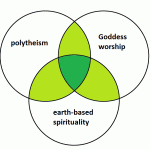
January 11, 2013 Three Legs on the Pagan Cauldron, or Must Pagans Be Polytheists?
Browse Our Archives
Select a Category A Beginner's Guide Announcements Conversations Creative Endarkenment Embodied Spirituality General Interviews My Story News Commentary Pagan Studies Poetry Praxis Related topics Reviews Ritual Sacred Endarkenment Storytime Theology
Select a Month February 2017 December 2016 November 2016 October 2016 September 2016 August 2016 July 2016 June 2016 May 2016 April 2016 March 2016 February 2016 January 2016 December 2015 November 2015 October 2015 September 2015 August 2015 July 2015 June 2015 May 2015 April 2015 March 2015 February 2015 January 2015 December 2014 November 2014 October 2014 September 2014 August 2014 July 2014 June 2014 May 2014 April 2014 March 2014 February 2014 January 2014 December 2013 November 2013 October 2013 September 2013 August 2013 July 2013 June 2013 May 2013 April 2013 March 2013 February 2013 January 2013 December 2012 November 2012
Follow Us!
TAKE THE
Religious Wisdom Quiz
How many plagues did God inflict upon Egypt?
Select your answer to see how you score.
10 14 7 21
Related posts from Dowsing for Divinity

Review of Queer Paganism by Jo Green


A Meditation: The Trees and the Forest

Erotic Religion: The Body and Sex for Wiccans...
TRENDING AT PATHEOS Pagan

When we talk about Greek religion, we often begin with the dodekatheion—the...

I was recently chatting with someone on Instagram. She asked me what...

While there are many people who share their results, the end of...

On July 23, I saw Christopher Nolan's The Odyssey which is Homer’s...

As I write this two big events have just finished up. One...

Restoring the Watershed of Divine Love
Perhaps cooperation is not something we manufacture through legislation, ideology, or moral...
view all Pagan blogs
Ad-Free & Subscriber Log-In Subscription Support
- About Us
- 2026 Calendar
- Videos
- Podcasts
- Library of World Religions
- Faith In Media Tracker
- Advertise With Us
- Write for Us
- Privacy Policy
- Terms of Service
- Do Not Sell My Data
- Contact Us
- Radiant Digital
- Manage Newsletter Subscriptions
- Unsubscribe From Notifications
- Sitemap
Copyright 2008-2026, Patheos. All rights reserved.
Subscription Support Ad-Free & Subscriber Log-In
Follow Patheos