
BuddhistCatholicContemplativeEvangelicalGeneral ChristianHinduJewishLatter-day SaintMuslimNew VisionsProgressive Christian
Beliefs
- Buddhist
- Catholic
- Contemplative
- Evangelical
- General Christian
- Hindu
- Jewish
- Latter-day Saint
- More Voices
- Muslim
- New Visions
- Pagan
- Progressive Christian
Topics
- Religion News
- Food and Religion
- Sports and Religion
- Religious Art
- Religious Music and Entertainment
- Religious Events
- History and Religion
- Style and Religion
- Politics and Religion
- Women in Religion
- Recreation Outdoors and Religion
- Business Finance and Religion
- Careers Workplace and Religion
- Education and Religion
- Family Parenting and Religion
- Health Fitness and Religion
- Home and Religion
- Relationships and Religion
- Technology and Religion
- Travel and Religion
Columnists
- Buddhist Columnists
- Business Finance and Religion Columnists
- Careers Workplace and Religion Columnists
- Catholic Columnists
- Contemplative Columnists
- Education and Religion Columnists
- Evangelists Columnists
- Family Parenting and Religion Columnists
- General Christian Columnists
- Health Fitness and Religion Columnists
- Hindu Columnists
- History and Religion Columnists
- Home and Religion Columnists
- Jewish Columnists
- More Voices Columnists
- Latter Day Columnists
- Muslim Columnists
- New Visions Columnists
- Nonreligious Columnists
- Pagan Columnists
- Politics and Religion Columnists
- Progressive Columnists
- Recreation Outdoors and Religion Columnists
- Relationships and Religion Columnists
- Religion News Columnists
- Religious Art Columnists
- Religious Events Columnists
- Religious Music and Entertainment Columnists
- Sports and Religion Columnists
- Style and Religion Columnists
- Technology and Religion Columnists
- Travel and Religion Columnists
- Women in Religion Columnists
Resource Library
- 2026 Calendar
- Library of World Religions
- The 100 Most Holy Places on Earth
- Patheos Answers
- Podcasts
- Videos
- Faith Leaders Database
- Anglican Episcopalian
- Bahai
- Baptist
- Buddhism
- Christianity
- Confucianism
- Eastern Orthodoxy
- Hinduism
- Holiness and Pentecostal
- ISKCON
- Islam
- Judaism
- Lutheran
- Methodist
- The Church of Jesus Christ of Latter-day Saints
- New Age
- Paganism
- Presbytarian and Reformed
- Protestantism
- Religion Behind the Scenes
- Roman Catholic
- Scientology
- Shia Islam
- Sikhism
- Sufism
- Sunni Islam
- Taoism
- Zen
- See all religions
Research Tools
 Ad-Free & Subscriber Log-In Subscription Support
Ad-Free & Subscriber Log-In Subscription Support
Follow Patheos 

- Trending:
- Forgiveness
- |
- Marriage
- |
- Consciousness
- |
- Death Penalty
- |
- Election
- |
- Halloween
 Dowsing for Divinity
-
Books
- Home
- Pagan
- Maps and signposts on the journey
Maps and signposts on the journey
Last updated on: January 6, 2013 at 2:13 pm by Yvonne Aburrow
Maps and signposts on the journey 2013-01-06T14:13:37-05:00 Yvonne Aburrow
Patheos Explore the world's faith through different perspectives on religion and spirituality! Patheos has the views of the prevalent religions and spiritualities of the world.
Do not follow where the path may lead. Go, instead, where there is no path and leave a trail.
I maintain that truth is a pathless land, and you cannot approach it by any path whatsoever, by any religion, by any sect. That is my point of view, and I adhere to that absolutely and unconditionally. Truth, being limitless, unconditioned, unapproachable by any path whatsoever, cannot be organized; nor should any organization be formed to lead or coerce people along a particular path. … This is no magnificent deed, because I do not want followers, and I mean this. The moment you follow someone you cease to follow Truth. I am not concerned whether you pay attention to what I say or not. I want to do a certain thing in the world and I am going to do it with unwavering concentration. I am concerning myself with only one essential thing: to set man free. I desire to free him from all cages, from all fears, and not to found religions, new sects, nor to establish new theories and new philosophies.
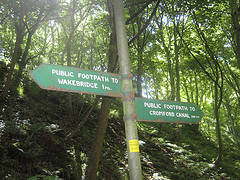
Signpost on Robin Hood Road near Whatstandwell, Derbyshire by Eamon Curry
Stirring stuff, these quotes, and they very much appeal to the individualist in all of us. Don’t be a sheep – be a goat. Be a rugged individual blazing your trail through life. But does this approach to spirituality actually work?
In any other art, whether it is cookery, painting, music, or writing, it works better if you learn the techniques and the traditions before you start to experiment. In order to play jazz, you first have to learn how to play your instrument. In order to create fusion dishes, you need to learn the art of cooking in the two traditions you are going to fuse. To create abstract and experimental art, you first need to learn how to paint, how to work with the materials – the canvas, the brushes, the paint; and you learn that by studying traditional techniques and symbolism and perspective, and then you can play around with them to create something original. The same goes for poetry – learn to write sonnets and haiku and so on before you write blank verse; learn how to use metaphor and alliteration, assonance and rhyme.
So why do we think that religion and spirituality are any different? Why do we think that you can just start at some random point and blaze a new trail in the wilderness? Existing techniques and traditions work because they are based on centuries of experience in navigating the pitfalls of the spiritual journey, exploring the depths of the human psyche, and learning to co-operate with like-minded others on the journey.
Religion means either re-connecting (from Latin religare) or re-reading (from Latin relegere). In other words, we re-connect with the Divine, or Nature, or other people (both human and non-human), or all three. And we re-read, and re-interpret, existing traditions and practices, fitting them into our own context.
No-one is really very clear on what spirituality means – it has been memorably described (by Lucy Bregman) as “a glowing and useful term in search of a meaning” – but I usually define it as the response of awe, wonder, compassion and love to the world around us.
But in order to get anywhere on the spiritual journey, we need to have a clear idea of where we are coming from, and where we are going, and how to get from A to B. If the aim of your spiritual journey is to discover your authentic self, then it will be different to that of someone whose aim is to annihilate the self in the oneness of the Divine. If you started out as an atheist, your journey will be different to that of someone who started out as a member of a Pagan family, who will be different from someone who started out as a Christian. Each of these journeys will contain different obstacles and different advantages.
However, all of them will benefit from the maps and stories left behind by other travellers, because we all have shared experiences as embodied beings, with parents, siblings, lovers, and friends, and we all live on planet Earth. These might be symbol systems, mythology, meditation techniques, values, rituals, theology, ethical systems, and so on. When I read writers from other religious traditions, I am constantly thinking, how do I relate this to my Pagan/Wiccan values, theology, philosophy? If you don’t know what your values, theology, and philosophy are, how do you know how to incorporate ideas from another tradition, or reject them if they don’t fit?
This seems to me to be the core problem with pick-and-mix spirituality, or making it up as you go along. If you don’t have a yardstick to compare new ideas against, how do you know if they are any good? If you pick bits and pieces out of various different systems, how do you know that you have a complete set of tools to “get you there”? Your personal biases might predispose you against some aspect of the toolkit that you might actually need to overcome a particular issue.
Pretty much all magical traditions are agreed that you should work through a single system for at least a year before you start to add things from other traditions. This gives you a good grounding in a tradition, and a sense of what will fit and what will not – and what sits well with you in that tradition, and what you might feel the need to modify.
I have now been practising Wicca for nearly 22 years, and in that time I have also explored other traditions (I have practiced both Druidry and Unitarianism, and read up about Heathenry, polytheism, Hinduism, Buddhism, Christian mysticism, Taoism and Judaism) but my main focus was on how these systems sit with my personal worldview. Having practised Wicca for 22 years, of course my worldview has been shaped by that practice, but my practice has also been shaped by my sexuality, my ethics, and my life experiences. But the fact that I have a grounding in a specific tradition, with its community of practitioners, its techniques, rituals, mythology, symbolism, and history has been of inestimable value to me. This is the case even though I have been immensely frustrated at times with the whole gender binary issue, and the tendency of some Wiccans to be hierarchical and to insist that certain things in the tradition have to be done in a particular way. The autonomy of covens, however, allows me to change the bits that I don’t like, whilst the community of practice and the continuity of tradition makes me think carefully before discarding or selecting or changing things.
A liberal Christian friend of mine told me about an excellent piece of Buddhist wisdom: before enlightenment, the hills were hills, and the valleys were valleys; during enlightenment, the hills were valleys, and the valleys were hills; after enlightenment, the hills were hills and the valleys were valleys, but in a new way. In other words, during enlightenment, everything is true and all systems look the same from the vantage point at the foot of the Bodhi tree; but afterwards, we have to live in the real world once more, and that entails engaging with a particular set of symbols and rituals, and following a particular path. This approach does not deny the validity of other paths; it simply states that this is the right path for me personally, because of where I came from, and where I am aiming to get to. It also means you don’t have to reinvent the wheel, and you have a community of fellow-travellers to learn from, and a set of maps to guide you on your way.
The tradition that you choose, and the ways in which you respond to it and modify it, how you inhabit it, will depend upon your pre-existing value system and worldview. But having a system to follow is valuable because then you are not just flailing about in the bushes trying to find a path; rather you are navigating and negotiating existing paths.
Previous Post

January 3, 2013
Theology Is Not Religious Studies

Browse Our Archives
Select a Category A Beginner's Guide Announcements Conversations Creative Endarkenment Embodied Spirituality General Interviews My Story News Commentary Pagan Studies Poetry Praxis Related topics Reviews Ritual Sacred Endarkenment Storytime Theology
Select a Month February 2017 December 2016 November 2016 October 2016 September 2016 August 2016 July 2016 June 2016 May 2016 April 2016 March 2016 February 2016 January 2016 December 2015 November 2015 October 2015 September 2015 August 2015 July 2015 June 2015 May 2015 April 2015 March 2015 February 2015 January 2015 December 2014 November 2014 October 2014 September 2014 August 2014 July 2014 June 2014 May 2014 April 2014 March 2014 February 2014 January 2014 December 2013 November 2013 October 2013 September 2013 August 2013 July 2013 June 2013 May 2013 April 2013 March 2013 February 2013 January 2013 December 2012 November 2012
Follow Us!
TAKE THE
Religious Wisdom Quiz
True or False: All Scripture is God-breathed and is useful for teaching, rebuking, correcting and training in righteousness.
Select your answer to see how you score.
FALSE TRUE
Related posts from Dowsing for Divinity

A Meditation: The Trees and the Forest

Erotic Religion: The Body and Sex for Wiccans...

TRENDING AT PATHEOS Pagan

I was recently chatting with someone on Instagram. She asked me what...

While there are many people who share their results, the end of...

On July 23, I saw Christopher Nolan's The Odyssey which is Homer’s...

As I write this two big events have just finished up. One...

Restoring the Watershed of Divine Love
Perhaps cooperation is not something we manufacture through legislation, ideology, or moral...

Many UUs don’t pray because of bad experiences in a previous religion,...
view all Pagan blogs
Ad-Free & Subscriber Log-In Subscription Support
- About Us
- 2026 Calendar
- Videos
- Podcasts
- Library of World Religions
- Faith In Media Tracker
- Advertise With Us
- Write for Us
- Privacy Policy
- Terms of Service
- Do Not Sell My Data
- Contact Us
- Radiant Digital
- Manage Newsletter Subscriptions
- Unsubscribe From Notifications
- Sitemap
Copyright 2008-2026, Patheos. All rights reserved.
Subscription Support Ad-Free & Subscriber Log-In
Follow Patheos