
BuddhistCatholicContemplativeEvangelicalGeneral ChristianHinduJewishLatter-day SaintMuslimNew VisionsProgressive Christian
Beliefs
- Buddhist
- Catholic
- Contemplative
- Evangelical
- General Christian
- Hindu
- Jewish
- Latter-day Saint
- More Voices
- Muslim
- New Visions
- Pagan
- Progressive Christian
Topics
- Religion News
- Food and Religion
- Sports and Religion
- Religious Art
- Religious Music and Entertainment
- Religious Events
- History and Religion
- Style and Religion
- Politics and Religion
- Women in Religion
- Recreation Outdoors and Religion
- Business Finance and Religion
- Careers Workplace and Religion
- Education and Religion
- Family Parenting and Religion
- Health Fitness and Religion
- Home and Religion
- Relationships and Religion
- Technology and Religion
- Travel and Religion
Columnists
- Buddhist Columnists
- Business Finance and Religion Columnists
- Careers Workplace and Religion Columnists
- Catholic Columnists
- Contemplative Columnists
- Education and Religion Columnists
- Evangelists Columnists
- Family Parenting and Religion Columnists
- General Christian Columnists
- Health Fitness and Religion Columnists
- Hindu Columnists
- History and Religion Columnists
- Home and Religion Columnists
- Jewish Columnists
- More Voices Columnists
- Latter Day Columnists
- Muslim Columnists
- New Visions Columnists
- Nonreligious Columnists
- Pagan Columnists
- Politics and Religion Columnists
- Progressive Columnists
- Recreation Outdoors and Religion Columnists
- Relationships and Religion Columnists
- Religion News Columnists
- Religious Art Columnists
- Religious Events Columnists
- Religious Music and Entertainment Columnists
- Sports and Religion Columnists
- Style and Religion Columnists
- Technology and Religion Columnists
- Travel and Religion Columnists
- Women in Religion Columnists
Resource Library
- 2026 Calendar
- Library of World Religions
- The 100 Most Holy Places on Earth
- Patheos Answers
- Podcasts
- Videos
- Faith Leaders Database
- Anglican Episcopalian
- Bahai
- Baptist
- Buddhism
- Christianity
- Confucianism
- Eastern Orthodoxy
- Hinduism
- Holiness and Pentecostal
- ISKCON
- Islam
- Judaism
- Lutheran
- Methodist
- The Church of Jesus Christ of Latter-day Saints
- New Age
- Paganism
- Presbytarian and Reformed
- Protestantism
- Religion Behind the Scenes
- Roman Catholic
- Scientology
- Shia Islam
- Sikhism
- Sufism
- Sunni Islam
- Taoism
- Zen
- See all religions
Research Tools
 Ad-Free & Subscriber Log-In Subscription Support
Ad-Free & Subscriber Log-In Subscription Support
Follow Patheos 

- Trending:
- Forgiveness
- |
- Marriage
- |
- Consciousness
- |
- Death Penalty
- |
- Election
- |
- Halloween
 Dowsing for Divinity
-
Books
- Home
- Pagan
- Eros and Psyche
Eros and Psyche
Last updated on: December 26, 2014 at 12:30 pm by Yvonne Aburrow
Eros and Psyche 2014-12-26T12:30:24-05:00 Yvonne Aburrow
Patheos Explore the world's faith through different perspectives on religion and spirituality! Patheos has the views of the prevalent religions and spiritualities of the world.
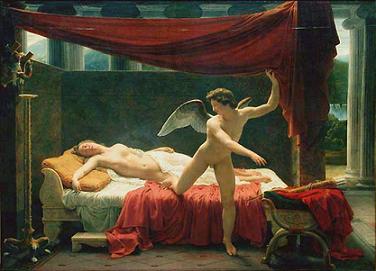
L’Amour et Psyché, by François-Édouard Picot, 1819
Pagan rituals are performed with the whole body as well as the mind and the heart. They have an erotic quality – not overtly, but sublimated and transmuted. Ritual is sensual, and involves all the senses. This erotic aspect of worship is frequently expressed by medieval Christian mystics, Sufis like the poet Rumi, as well as contemporary Pagans.
The mood-swing of Western culture against the body, women and sensuality is said by historians to have begun around 500 BCE and reached its height in about 500 CE. At its worst, it was profoundly anti-women. It had a lasting influence on the Christianity of later centuries.
Bound up with this fear of women, sexuality, and the body was the fear of the dark, which is connected with the feminine, nature, and wilderness and has been denigrated for most of Christian history. In patriarchal culture, the assertive and sexually active female is regarded as dark, dangerous and malevolent, and characterised as a witch. The passive female is elevated as the model for how women should be: quiet, virginal, and modest. In order for patriarchy to function, female sexuality must be suppressed and controlled, and men must be taught to fear it and abuse it; and the wilderness must be conquered and tamed.
Fortunately for us, the mystics frequently rebelled against this anti-women worldview. Their writings were deeply sensual and erotic, and extolled the dazzling darkness of God, the ultimately unknowable and mysterious aspect of the Godhead.
Judaism, on the other hand, never entirely abandoned its respect for the body and for women, and making love remained an act of worship. It was and is obligatory in Judaism to make love on the Sabbath Eve, because making love reunites the exiled Shekhinah with the Godhead. According to many Jewish theologians, the Shekhinah, who is the immanent feminine aspect of the Divine, is exiled in the material world, and seeks to be reunited with the transcendent male Godhead. We can help her by making love and performing acts of kindness, which are known as Tikkun Olam, repairing the world.
Spirituality and sexuality are intertwined. The most profound sexual experiences involve an abandonment of the centrality of the ego and opening up to the beloved other; this can become an opening up to the Divine Beloved. This is reflected in the erotic and spiritual poetry of the Sufis. The Sufis loved the night, which was seen as the time when the soul was most open to the Divine Beloved.
Similarly, the deeply spiritual is also erotic, and opening up and self-abandonment to the Divine can resemble a relationship with a human partner. The ancient Greek story of Eros and Psyche represents the Divine visiting the soul. In India, the story of Krishnapleasuring a thousand cow-girls simultaneously also symbolises the erotic relationship with the Divine. Medieval mystical poetry is full of erotic yearning for the Divine. One meditation on the Song of Songs exclaims “Oh that he would kiss me with the kisses of his mouth”. In the medieval period, among both Jewish and Christian thinkers, the Song of Songs was seen as an allegory of the soul’s relationship with God.
So, how can ritual be erotic without being overtly sexual? How do we entice Eros to visit Psyche?
The erotic can be sensual, involving all five senses. There can be visual elements to ritual: magical tools, the altar, flowers, candlelight, jewellery, pictures.
Ritual can include scent – the smell of flowers, incense, good moist earth, baking bread, wine, fruit. Smell is the most subtle and evocative of all the senses, and smells can transport you instantly to a memory of the past or an intimation of future bliss.
Ritual can include taste – the taste of food, mindfully and appreciatively savoured, shared amongst friends. Many Pagan rituals include the use of food in a ritual context.
Jewish worship in the home includes food, as in the well-known ritual of the Seder (Passover meal) with its various symbolic foods.
Ritual can include touch and movement – hugging, dancing, joining hands, gestures, warming oneself at a fire, anointing with oil and water, ceremonial kissing, the feel of rich earth, planting bulbs, experiencing textures.
Ritual includes sound, but there is not as much singing in Paganism as there could be (presumably a reaction to the singing of hymns in Christianity. The lyrics of Pagan chants are sometimes a bit trite. In Hinduism however, the classical raga form goes through stages, firstly of yearning for the Divine Beloved, making contact, and achieving union. The erotic aspect of this encounter is clearly celebrated in the music.
The erotic aspects of spirituality are present in Paganism (especially Wicca) but not much talked about, because they are so easily misunderstood. The erotic can be sensual, passionate, tender, mysterious, alluring, mystical; it does not have to be explicit or acted upon.
Our rituals are performed with the whole body, not just with mind and heart. This is how we integrate our spirituality with everyday life. As Mary Oliver so memorably put it, “Let the soft animal of your body love what it loves.”
Let us welcome Eros into the bridal chamber of the psyche, for only then can we make the shift from the domination of the ego (the rule of law) to the balance of all aspects of the psyche (the religion of love). Let us descend into our own depths to encounter the darkness and silence, and be dazzled by the unknowable mystery of the Divine.
Previous Post

December 23, 2012
Change
Next Post

December 30, 2012 Interviews of Pagan Studies Scholars; Animism and Radical Individualism
Browse Our Archives
Select a Category A Beginner's Guide Announcements Conversations Creative Endarkenment Embodied Spirituality General Interviews My Story News Commentary Pagan Studies Poetry Praxis Related topics Reviews Ritual Sacred Endarkenment Storytime Theology
Select a Month February 2017 December 2016 November 2016 October 2016 September 2016 August 2016 July 2016 June 2016 May 2016 April 2016 March 2016 February 2016 January 2016 December 2015 November 2015 October 2015 September 2015 August 2015 July 2015 June 2015 May 2015 April 2015 March 2015 February 2015 January 2015 December 2014 November 2014 October 2014 September 2014 August 2014 July 2014 June 2014 May 2014 April 2014 March 2014 February 2014 January 2014 December 2013 November 2013 October 2013 September 2013 August 2013 July 2013 June 2013 May 2013 April 2013 March 2013 February 2013 January 2013 December 2012 November 2012
Follow Us!
TAKE THE
Religious Wisdom Quiz
Who was Jesus' earthly father?
Select your answer to see how you score.
Zechariah Joachim Simeon Joseph
Related posts from Dowsing for Divinity

Review of Queer Paganism by Jo Green


A Meditation: The Trees and the Forest

Erotic Religion: The Body and Sex for Wiccans...
TRENDING AT PATHEOS Pagan

I was recently chatting with someone on Instagram. She asked me what...

While there are many people who share their results, the end of...

On July 23, I saw Christopher Nolan's The Odyssey which is Homer’s...

As I write this two big events have just finished up. One...

Restoring the Watershed of Divine Love
Perhaps cooperation is not something we manufacture through legislation, ideology, or moral...

Many UUs don’t pray because of bad experiences in a previous religion,...
view all Pagan blogs
Ad-Free & Subscriber Log-In Subscription Support
- About Us
- 2026 Calendar
- Videos
- Podcasts
- Library of World Religions
- Faith In Media Tracker
- Advertise With Us
- Write for Us
- Privacy Policy
- Terms of Service
- Do Not Sell My Data
- Contact Us
- Radiant Digital
- Manage Newsletter Subscriptions
- Unsubscribe From Notifications
- Sitemap
Copyright 2008-2026, Patheos. All rights reserved.
Subscription Support Ad-Free & Subscriber Log-In
Follow Patheos