
BuddhistCatholicContemplativeEvangelicalGeneral ChristianHinduJewishLatter-day SaintMuslimNew VisionsProgressive Christian
Beliefs
- Buddhist
- Catholic
- Contemplative
- Evangelical
- General Christian
- Hindu
- Jewish
- Latter-day Saint
- More Voices
- Muslim
- New Visions
- Pagan
- Progressive Christian
Topics
- Religion News
- Food and Religion
- Sports and Religion
- Religious Art
- Religious Music and Entertainment
- Religious Events
- History and Religion
- Style and Religion
- Politics and Religion
- Women in Religion
- Recreation Outdoors and Religion
- Business Finance and Religion
- Careers Workplace and Religion
- Education and Religion
- Family Parenting and Religion
- Health Fitness and Religion
- Home and Religion
- Relationships and Religion
- Technology and Religion
- Travel and Religion
Columnists
- Buddhist Columnists
- Business Finance and Religion Columnists
- Careers Workplace and Religion Columnists
- Catholic Columnists
- Contemplative Columnists
- Education and Religion Columnists
- Evangelists Columnists
- Family Parenting and Religion Columnists
- General Christian Columnists
- Health Fitness and Religion Columnists
- Hindu Columnists
- History and Religion Columnists
- Home and Religion Columnists
- Jewish Columnists
- More Voices Columnists
- Latter Day Columnists
- Muslim Columnists
- New Visions Columnists
- Nonreligious Columnists
- Pagan Columnists
- Politics and Religion Columnists
- Progressive Columnists
- Recreation Outdoors and Religion Columnists
- Relationships and Religion Columnists
- Religion News Columnists
- Religious Art Columnists
- Religious Events Columnists
- Religious Music and Entertainment Columnists
- Sports and Religion Columnists
- Style and Religion Columnists
- Technology and Religion Columnists
- Travel and Religion Columnists
- Women in Religion Columnists
Resource Library
- 2026 Calendar
- Library of World Religions
- The 100 Most Holy Places on Earth
- Patheos Answers
- Podcasts
- Videos
- Faith Leaders Database
- Anglican Episcopalian
- Bahai
- Baptist
- Buddhism
- Christianity
- Confucianism
- Eastern Orthodoxy
- Hinduism
- Holiness and Pentecostal
- ISKCON
- Islam
- Judaism
- Lutheran
- Methodist
- The Church of Jesus Christ of Latter-day Saints
- New Age
- Paganism
- Presbytarian and Reformed
- Protestantism
- Religion Behind the Scenes
- Roman Catholic
- Scientology
- Shia Islam
- Sikhism
- Sufism
- Sunni Islam
- Taoism
- Zen
- See all religions
Research Tools
 Ad-Free & Subscriber Log-In Subscription Support
Ad-Free & Subscriber Log-In Subscription Support
Follow Patheos 

- Trending:
- Forgiveness
- |
- Marriage
- |
- Consciousness
- |
- Death Penalty
- |
- Election
- |
- Halloween
 Seeking Shanti
- Home
- Hindu
- A Hindu’s Practice: Education, Meditation and Self-Realization
A Hindu’s Practice: Education, Meditation and Self-Realization
Last updated on: June 16, 2017 at 2:27 pm by Padma Kuppa
A Hindu’s Practice: Education, Meditation and Self-Realization 2017-06-16T14:27:58-04:00 Padma Kuppa
Patheos Explore the world's faith through different perspectives on religion and spirituality! Patheos has the views of the prevalent religions and spiritualities of the world.
The recent vote by the Senate to confirm Betsy Devos as Secretary of Education bothered me – and not just because I felt she is grossly unqualified for the job. It reminded me that we are in a state of polarization, in partisan or left/right silos, where social media enables us to hear only voices that amplify our feelings. Fear of the “other side” is festered, along with an inability to achieve balance or promote pluralism. To find that equanimity, I realized that I needed not only to unplug from technology and the world, but to withdraw into myself, and to practice meditation.
Hindus are not the first or only people of faith to encourage meditation and reflection; but it is the Hindu concept of self-realization, with the goal of merging one’s self into the [Divine] Self, that I am most familiar with. Whether identified through Greek words id, ego and superego, or Sanskrit words jivatma, atma and paramatma, human consciousness has multiple layers that we must penetrate to get to the Divine as part of our spiritual growth. The mind can be considered dual in nature – with one lower and one higher, which are sometimes at odds with one another. Through mindfulness, we can merge the wisdom of the higher mind with the rationality of the lower mind, to reach enlightenment.
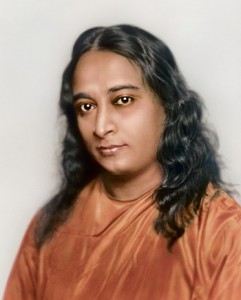
Paramahansa Yogananda
As Paramahansa Yogananda, a great Hindu monk, said, “Self-realization is yoga, or “oneness” with truth — the direct perception or experience of truth by the all-knowing intuitive faculty of the soul.” Paramahansa Yogananda, founder of the Self Realization Fellowship, was born Mukunda Lal Ghosh in 1893, to an affluent Indian family. He became a monk in 1915, gave many lectures and taught people how to attain “direct personal experience of God” and eventually wrote his life story, The Autobiography of a Yogi. According to American Veda author Phil Goldberg, “Published just after World War II, this book remains the most influential memoir of a genuine master of the Vedic tradition ever written. It still inspires tens of thousands of new readers every year. “But Yogananda’s legacy extends beyond that iconic book. He arrived in 1920 and made America his home, establishing the world headquarters of his Self-Realization Fellowship (SRF) in Los Angeles, “the Benares of America.” For the next 32 years, his universal spiritual teachings and his Kriya Yoga practices reached millions.”
Paramahansa Yogananda’s description of Kriya Yoga is in his autobiography. According to the Self Realization Fellowship website:
The actual technique is given to students of the Self-Realization Fellowship Lessons after a preliminary period of study and practice of the three preparatory techniques taught by Paramahansa Yogananda.
Taken together as a comprehensive system, these meditation techniques enable the practitioner to achieve the highest benefits and divine goal of the ancient yoga science.
Decades later, another Hindu guru, Maharishi Mahesh Yogi, also came to the West, and brought with him another path to enlightenment: Transcendental Meditation, or its popular short form “TM.” Mahesh Yogi, who arrived in America right before the cultural and political revolution of the 1960s, said:
The goal of the Transcendental Meditation technique is the state of enlightenment. This means we experience that inner calmness, that quiet state of least excitation, even when we are dynamically busy…. we have a natural and effective means to dissolve even deeply rooted fatigue and stress. This is the way to unfold full value of life.
Even in the first days of meditation we find that our eyes seem to be a little more open, our mind seems a bit more clear. Our feeling towards our friends seems to be more harmonious.
And then, as the practice continues every day, a time will come when we will start living life free from all stresses. We cleanse the awareness of all stresses and strains, leaving the conscious mind completely free in its pure value.
However, I found my path to meditation through the Bhagavad Gita: Chapter 6 is fully focused on Krishna’s explanation of Dhyana Yoga, or the yoga of meditation. And so I turned to the translation of the Gita that my father gave me when I started college, by Swami Swarupananda of the Advaita Ashrama. In Chapter 6 – The Way of Meditation, verses 20-23 provided the essence of what I need to practice.
When the mind, absolutely restrained by the practice of concentration, attains quietude, and when seeing the Self by the self, one is satisfied in his own Self; when he feels that infinite bliss which is perceived by the (purified) intellect and which transcends the senses, and established wherein he never departs from his real state; and having obtained which, regards no other acquisition superior to that, and where established, he is not moved even by heavy sorrow; let that be known as the state, called by the name of Yoga – estate of severance from the contact of pain. This Yoga should be practiced with perseverance undisturbed by depression of heart.
Just as a good night’s sleep, a nutritious meal or a good workout can benefit your mind and body, a good meditation practice can also provide a good foundation to counter life’s daily challenges. It is something I have had to practice – sitting down and emptying your mind of all the day’s stressors does not happen at the flip of a switch. Rather, it is something that happens over time, with persistance – and sometimes it takes a little longer to get to that space where you are free from pressure. The benefit? Being able to come back to deal with the news of the day, however depressing, and react and respond from that place of equanimity. And through sadhana, a more sustained, deeper meditation practice? The hope is to reach a state of bliss, of self-realization.
Previous Post

February 5, 2017
Wisdom from More Than One Guru
Next Post

February 15, 2017 Purushartha: Pursuing the Four Goals of a Human Life
Browse Our Archives
Select a Category acttochange Advocacy african american American Apocalyspse Autism Belief bhagavad gita Bhumi Project Bullying caste caste report Catholic Climate Change conversion Creation Story development dfn Dharma Diversity and Inclusion Divine Feminine Draupadi Education Environment EquityInEducation ethics evangelism Evil faith in the public square genocide God Goddess guru Hijab Hindu Hindu American Hindu American Foundation Hindu practices Holidays Holocaust human rights human trafficking identity India Indian American interfaith Internship Jewish Justice Kashmiri Hindus LGBT LGBT Rights Mahabharata Martin Luther King Jr Celebration meditation MLK Muslim National Day of Prayer NoDAPL Pakistani Hindu Peace Advocacy pluralism Prayer predatory proselytization Religious Freedom SacredSites Sari science self-realization Social Action spock Telugu Truth TSOG Uncategorized Urban monk Vegetarian Vote
Select a Month November 2017 October 2017 September 2017 April 2017 March 2017 February 2017 January 2017 December 2016 November 2016 October 2016 September 2016 August 2016 July 2016 June 2016 May 2016 April 2016 February 2016 January 2016 December 2015 November 2015 October 2015 September 2015 July 2015 June 2015 May 2015 April 2015 March 2015 February 2015 August 2014 July 2014 June 2014 May 2014 April 2014 March 2014 February 2014 January 2014 November 2013 October 2013 September 2013 February 2013 January 2013 December 2012 November 2012 October 2012 September 2012 August 2012 July 2012 June 2012 May 2012 April 2012
Follow Us!
TAKE THE
Religious Wisdom Quiz
What did God send to feed Elijah during the drought?
Select your answer to see how you score.
Camels Ravens Serpent Sheep
Related posts from Seeking Shanti

Hindus in America: Acting on Our Values, Alleviating...

Green Diwali Webinar: Lighting the Way to Protect...

Watching Marshall, Lighting the Diwali Lamp for Dharma

Eclipse-Nirvana: Contemporary Devotional Music by Aks & Lakshmi
TRENDING AT PATHEOS Hindu

Indian Hindu pilot’s valor in line of duty...
There is a hoary maritime tradition that the captain of the...

Movie on Neem Karoli Baba’s life is a...
Neem Karoli Baba’s life (1900-1973) is associated with miracles he made in...

20 Questions to Ask Before an Interfaith Marriage,...
Four questions every interfaith couple should discuss before marriage: Conversion. Will either...

Avadhānam: The Art of Concentration and Intellectual Mastery
What is Avadhānam? In the summer of 2015, during a three-day Sanskrit...

Jesus in the Dharma: Where Christ Fits in...
Where Does Jesus Fit in Hinduism? That’s a question I get often...

Hormuz: A Shared Hindu and Zoroastrian Heritage
Every evening, somewhere in the world, a newsreader utters the words: "The...
view all Hindu blogs
Ad-Free & Subscriber Log-In Subscription Support
- About Us
- 2026 Calendar
- Videos
- Podcasts
- Library of World Religions
- Faith In Media Tracker
- Advertise With Us
- Write for Us
- Privacy Policy
- Terms of Service
- Do Not Sell My Data
- Contact Us
- Radiant Digital
- Manage Newsletter Subscriptions
- Unsubscribe From Notifications
- Sitemap
Copyright 2008-2026, Patheos. All rights reserved.
Subscription Support Ad-Free & Subscriber Log-In
Follow Patheos