
BuddhistCatholicContemplativeEvangelicalGeneral ChristianHinduJewishLatter-day SaintMuslimNew VisionsProgressive Christian
Beliefs
- Buddhist
- Catholic
- Contemplative
- Evangelical
- General Christian
- Hindu
- Jewish
- Latter-day Saint
- More Voices
- Muslim
- New Visions
- Pagan
- Progressive Christian
Topics
- Religion News
- Food and Religion
- Sports and Religion
- Religious Art
- Religious Music and Entertainment
- Religious Events
- History and Religion
- Style and Religion
- Politics and Religion
- Women in Religion
- Recreation Outdoors and Religion
- Business Finance and Religion
- Careers Workplace and Religion
- Education and Religion
- Family Parenting and Religion
- Health Fitness and Religion
- Home and Religion
- Relationships and Religion
- Technology and Religion
- Travel and Religion
Columnists
- Buddhist Columnists
- Business Finance and Religion Columnists
- Careers Workplace and Religion Columnists
- Catholic Columnists
- Contemplative Columnists
- Education and Religion Columnists
- Evangelists Columnists
- Family Parenting and Religion Columnists
- General Christian Columnists
- Health Fitness and Religion Columnists
- Hindu Columnists
- History and Religion Columnists
- Home and Religion Columnists
- Jewish Columnists
- More Voices Columnists
- Latter Day Columnists
- Muslim Columnists
- New Visions Columnists
- Nonreligious Columnists
- Pagan Columnists
- Politics and Religion Columnists
- Progressive Columnists
- Recreation Outdoors and Religion Columnists
- Relationships and Religion Columnists
- Religion News Columnists
- Religious Art Columnists
- Religious Events Columnists
- Religious Music and Entertainment Columnists
- Sports and Religion Columnists
- Style and Religion Columnists
- Technology and Religion Columnists
- Travel and Religion Columnists
- Women in Religion Columnists
Resource Library
- 2026 Calendar
- Library of World Religions
- The 100 Most Holy Places on Earth
- Patheos Answers
- Podcasts
- Videos
- Faith Leaders Database
- Anglican Episcopalian
- Bahai
- Baptist
- Buddhism
- Christianity
- Confucianism
- Eastern Orthodoxy
- Hinduism
- Holiness and Pentecostal
- ISKCON
- Islam
- Judaism
- Lutheran
- Methodist
- The Church of Jesus Christ of Latter-day Saints
- New Age
- Paganism
- Presbytarian and Reformed
- Protestantism
- Religion Behind the Scenes
- Roman Catholic
- Scientology
- Shia Islam
- Sikhism
- Sufism
- Sunni Islam
- Taoism
- Zen
- See all religions
Research Tools
 Ad-Free & Subscriber Log-In Subscription Support
Ad-Free & Subscriber Log-In Subscription Support
Follow Patheos 

- Trending:
- Forgiveness
- |
- Marriage
- |
- Consciousness
- |
- Death Penalty
- |
- Election
- |
- Halloween
 Seeking Shanti
- Home
- Hindu
- India’s Latest Census: Hindus, Christians & Confusion
India’s Latest Census: Hindus, Christians & Confusion
Last updated on: September 14, 2015 at 8:41 pm by Padma Kuppa
India’s Latest Census: Hindus, Christians & Confusion 2015-09-14T20:41:24-04:00 Padma Kuppa
Patheos Explore the world's faith through different perspectives on religion and spirituality! Patheos has the views of the prevalent religions and spiritualities of the world.
As most people of Indian origin know, “American Born Confused Desi” – an ABCD – is a special phrase used to refer to a rather “neither here nor there” mentality that we Indian Americans might have acquired while growing up in America, with parents who are immigrants from India trying to provide an “Indian” environment at home. My parents went a step farther – they moved the family back to India when I was in high school, so that I could have a first hand experience of what it means to be Indian. What I really imbibed from India, particularly during college, was its pluralism. I had friends of different faiths, sampradayas, languages – all living together, freely expressing, practicing and even sharing their faith – without any intent to convert or claim superiority of one faith over another. Looking back at the number of times my Catholic roommate and I went to each others’ houses of worship, my Muslim friend and I visited each other’s homes on our respective holy days, or our Christian neighbors and my family exchanged traditional sweets for Diwali and Christmas, those years in India – and subsequent visits – allowed me to understand what living religious pluralism actually is.
Being in America and particularly a Hindu in America, I have found that being grounded in pluralism helps me balance the various aspects of my identity – not just Indian or American, but being a mother, a wife, a daughter, a community member, an employee, an activist and so on. The Hindu belief that God has many forms, yet is essentially One, the formless Divine, has helped me find peace – and the rich spiritual practices found within the various Hindu sampradayas with their ancient philosophy have been essential to find a way out of the confusion that can come with being an ABCD. I confidently self-identify as a Hindu, and often prefer it to identifying as Indian, something not as common among my Indian immigrant peers.
So when I heard the news about India’s recent census and the resulting social media buzz, I was rather bemused. The Indian Census Bureau just released numbers from its Official Census in 2011, showing a continuing decline in the proportion of Hindus: people identifying themselves as Hindu dropped to 79.79% from 80.46% ten years earlier, which was at about 83% in 1991. While the percentage of Muslims in the population rose from 14.23% from 13.42%, the numbers overall caused a stir within the Indian diaspora community.
Academician and fellow Telugu, Vamsee Juluri was moved by the Indian Census to write about American Hindus and their challenges. Aseem Shukla, my fellow Board member at the Hindu American Foundation, shared a Wall Street Journal article, with the encomium that its interactive feature was the best summary of the issue he had seen, praise that we at the Foundation often can’t offer Western journalists. A college classmate sent me an email of surprise that the proportion of Christians was so low, at 2.3%, given the number of churches we have seen pop up in small villages on our visits to our spiritual homeland over the last 25 years. And yet friend another and I exchanged emails about John Dayal, an Indian Christian political activist, and how Twitter was all abuzz with his comments that Indian Christians underreported themselves – comments that justify duplicitousness.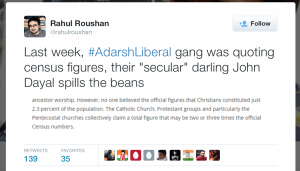
Saying one is a Hindu on Census forms ensures receipt of government-provided benefits called reservations, given to certain underprivileged communities. If the same individual goes to Christian missionary organization, they often receive further aid if they identify as Christian. That this happens has been documented in other parts of the world: Guyanese Hindus called themselves “Christian” to get access to hospitals and schools, but continued holding on to their faith at home, as explained here by Murali Balaji, a scholar and voice from HAF. A study from those at the Lausanne Movement, where they find “it difficult to accept the census as authoritative” reports that the actual number of Christians was 4.8%-5.8% as far back as 2010.
So if the numbers of Christians in India are underreported, I wonder if it is Indian Christians who are confused. I am proud to say I am a Hindu – are they not proud to say they are Christian? True acceptance of Christ comes with it certain expectations of the heart and mind – including acknowledgement that they are followers of Christ and have left Hinduism behind. Or have they?
Previous Post

September 7, 2015
Protecting Pluralism by Protecting Thy Neighbor
Next Post
September 14, 2015 The Pope's Caritas: Evocative of a Hindu's Karuna
Browse Our Archives
Select a Category acttochange Advocacy african american American Apocalyspse Autism Belief bhagavad gita Bhumi Project Bullying caste caste report Catholic Climate Change conversion Creation Story development dfn Dharma Diversity and Inclusion Divine Feminine Draupadi Education Environment EquityInEducation ethics evangelism Evil faith in the public square genocide God Goddess guru Hijab Hindu Hindu American Hindu American Foundation Hindu practices Holidays Holocaust human rights human trafficking identity India Indian American interfaith Internship Jewish Justice Kashmiri Hindus LGBT LGBT Rights Mahabharata Martin Luther King Jr Celebration meditation MLK Muslim National Day of Prayer NoDAPL Pakistani Hindu Peace Advocacy pluralism Prayer predatory proselytization Religious Freedom SacredSites Sari science self-realization Social Action spock Telugu Truth TSOG Uncategorized Urban monk Vegetarian Vote
Select a Month November 2017 October 2017 September 2017 April 2017 March 2017 February 2017 January 2017 December 2016 November 2016 October 2016 September 2016 August 2016 July 2016 June 2016 May 2016 April 2016 February 2016 January 2016 December 2015 November 2015 October 2015 September 2015 July 2015 June 2015 May 2015 April 2015 March 2015 February 2015 August 2014 July 2014 June 2014 May 2014 April 2014 March 2014 February 2014 January 2014 November 2013 October 2013 September 2013 February 2013 January 2013 December 2012 November 2012 October 2012 September 2012 August 2012 July 2012 June 2012 May 2012 April 2012
Follow Us!
TAKE THE
Religious Wisdom Quiz
What was the primary material for writing in biblical times?
Select your answer to see how you score.
Clay tablets Parchment Stone Papyrus
Related posts from Seeking Shanti

Purushartha: Pursuing the Four Goals of a Human...
Wisdom from More Than One Guru

The Story of God: The Proof is in...

The Story of God: Seeking Heaven on Earth
TRENDING AT PATHEOS Hindu

Indian Hindu pilot’s valor in line of duty...
There is a hoary maritime tradition that the captain of the...

Movie on Neem Karoli Baba’s life is a...
Neem Karoli Baba’s life (1900-1973) is associated with miracles he made in...

20 Questions to Ask Before an Interfaith Marriage,...
Four questions every interfaith couple should discuss before marriage: Conversion. Will either...

Avadhānam: The Art of Concentration and Intellectual Mastery
What is Avadhānam? In the summer of 2015, during a three-day Sanskrit...

Jesus in the Dharma: Where Christ Fits in...
Where Does Jesus Fit in Hinduism? That’s a question I get often...

Hormuz: A Shared Hindu and Zoroastrian Heritage
Every evening, somewhere in the world, a newsreader utters the words: "The...
view all Hindu blogs
Ad-Free & Subscriber Log-In Subscription Support
- About Us
- 2026 Calendar
- Videos
- Podcasts
- Library of World Religions
- Faith In Media Tracker
- Advertise With Us
- Write for Us
- Privacy Policy
- Terms of Service
- Do Not Sell My Data
- Contact Us
- Radiant Digital
- Manage Newsletter Subscriptions
- Unsubscribe From Notifications
- Sitemap
Copyright 2008-2026, Patheos. All rights reserved.
Subscription Support Ad-Free & Subscriber Log-In
Follow Patheos