
BuddhistCatholicContemplativeEvangelicalGeneral ChristianHinduJewishLatter-day SaintMuslimNew VisionsProgressive Christian
Beliefs
- Buddhist
- Catholic
- Contemplative
- Evangelical
- General Christian
- Hindu
- Jewish
- Latter-day Saint
- More Voices
- Muslim
- New Visions
- Pagan
- Progressive Christian
Topics
- Religion News
- Food and Religion
- Sports and Religion
- Religious Art
- Religious Music and Entertainment
- Religious Events
- History and Religion
- Style and Religion
- Politics and Religion
- Women in Religion
- Recreation Outdoors and Religion
- Business Finance and Religion
- Careers Workplace and Religion
- Education and Religion
- Family Parenting and Religion
- Health Fitness and Religion
- Home and Religion
- Relationships and Religion
- Technology and Religion
- Travel and Religion
Columnists
- Buddhist Columnists
- Business Finance and Religion Columnists
- Careers Workplace and Religion Columnists
- Catholic Columnists
- Contemplative Columnists
- Education and Religion Columnists
- Evangelists Columnists
- Family Parenting and Religion Columnists
- General Christian Columnists
- Health Fitness and Religion Columnists
- Hindu Columnists
- History and Religion Columnists
- Home and Religion Columnists
- Jewish Columnists
- More Voices Columnists
- Latter Day Columnists
- Muslim Columnists
- New Visions Columnists
- Nonreligious Columnists
- Pagan Columnists
- Politics and Religion Columnists
- Progressive Columnists
- Recreation Outdoors and Religion Columnists
- Relationships and Religion Columnists
- Religion News Columnists
- Religious Art Columnists
- Religious Events Columnists
- Religious Music and Entertainment Columnists
- Sports and Religion Columnists
- Style and Religion Columnists
- Technology and Religion Columnists
- Travel and Religion Columnists
- Women in Religion Columnists
Resource Library
- 2026 Calendar
- Library of World Religions
- The 100 Most Holy Places on Earth
- Patheos Answers
- Podcasts
- Videos
- Faith Leaders Database
- Anglican Episcopalian
- Bahai
- Baptist
- Buddhism
- Christianity
- Confucianism
- Eastern Orthodoxy
- Hinduism
- Holiness and Pentecostal
- ISKCON
- Islam
- Judaism
- Lutheran
- Methodist
- The Church of Jesus Christ of Latter-day Saints
- New Age
- Paganism
- Presbytarian and Reformed
- Protestantism
- Religion Behind the Scenes
- Roman Catholic
- Scientology
- Shia Islam
- Sikhism
- Sufism
- Sunni Islam
- Taoism
- Zen
- See all religions
Research Tools
 Ad-Free & Subscriber Log-In Subscription Support
Ad-Free & Subscriber Log-In Subscription Support
Follow Patheos 

- Trending:
- Forgiveness
- |
- Marriage
- |
- Consciousness
- |
- Death Penalty
- |
- Election
- |
- Halloween
 Seeking Shanti
- Home
- Hindu
- On International Day of Yoga, a Trip Down Memory Lane: The HAF Take Back Yoga Project
On International Day of Yoga, a Trip Down Memory Lane: The HAF Take Back Yoga Project
Last updated on: July 20, 2015 at 9:37 pm by Padma Kuppa
On International Day of Yoga, a Trip Down Memory Lane: The HAF Take Back Yoga Project 2015-07-20T21:37:24-04:00 Padma Kuppa
Patheos Explore the world's faith through different perspectives on religion and spirituality! Patheos has the views of the prevalent religions and spiritualities of the world.
Namaste. International Yoga Day is today, and to celebrate, Suhag & Aseem Shukla, and Sheetal Shah, of the Hindu American Foundation embarked on a trip down memory lane. Over four days, they have shared the story of HAF’s Take Back Yoga Project (TBY). What started as a simple letter to the editor expressing frustration over the hyper-fixation on the physical aspects of yoga and a delinking of yoga from its Hindu roots, ultimately spurred an unprecedented global conversation acknowledging the Hindu roots of yoga.
Many have asked along the way, “Why does yoga’s origin matter?” or “Who owns yoga, anyways?” The answer is quite simple. For all of us, and especially our children, who too often face “caste, cow, and karma” stereotypes in public school textbooks and mass media, the acknowledgement of yoga as a tremendous contribution of ancient Hindus to the world is important. It instills a sense of pride and provides an opening for interfaith engagement which is not defensive or combative, but transformative. And of course, no one owns yoga. Nor does one have to be Hindu to benefit from its practice. Rather, TBY is an effort to promote appreciation for the richness and universality of Hindu teachings.
This is HAF’s TBY story. We’re going on a trip down memory lane…Take Back Yoga memory lane.
The Gita offers the four yogas of bhakti (devotion), jnana (knowledge), karma (action), and raja (concentration), and in so many ways, the strategy and methodology behind TBY drew and continues to draw inspiration from these four paths.
Day 1: TBY and the Path of Devotion


The first day in this series must start with bhakti, because if it were not for our deep, abiding devotion to the teachings and contributions of Hindu Dharma, HAF would not have launched TBY nor would any of us be here today.
In 2008, HAF launched the Take Back Yoga campaign after a concerning exchange with the popular magazine, Yoga Journal. In a letter to Yoga Journal, HAF noted its disappointment at finding countless descriptions of the Upanishads or Gita as “ancient Indian” or “yogic”, but rarely “Hindu.” Shortly after being by Yoga Journal that they avoid the word “Hinduism” because it “carries too much baggage,” HAF released the 1st edition of its paper, Yoga Beyond Asana: Hindu Thought in Practice (the 2nd edition was released in 2014). HAF also took this cause international when we proposed and participated on a panel, entitled, “Yoga: Key to Mind, Body Wellness or Covert Conversion to Hinduism,” at the 2009 Parliament of World Religions held in Melbourne, Australia.
Every year since 2008, TBY has re-emerged in different forms and different angles, providing new opportunities for us to deepen not only our own knowledge, but the knowledge of over 20 million Americans who practice some form of yoga today. It is devotion to the cause of dharma that has been our fuel and ongoing support of HAF the accelerant.
Day 2: TBY and the Path of Knowledge

Love or devotion for our teachings could not be enough to educate the yoga world at large about the Hindu roots of yoga. Careful study of an issue, weighing multiple perspectives, nuancing language, and always being willing to seek out more knowledge have been key ingredients to TBY. The HAF team is fortunate to have life-long students of Hinduism amongst our Executive Council, staff, and Board. We also have had the benefit of drawing from the wisdom of respected swamis, yoga teachers, and scholar-practitioners of religion and ancient Indian history.
The opportunity to test our arguments and refine the language with which we would convey this very obvious, yet forgotten message about yoga came rather quickly. In April of 2010, New Age icon Deepak Chopra tried to deny yoga’s Hindu roots in response to HAF Board member Aseem Shukla’s first introduction of the campaign on Newsweek/Washington Post’s On Faith. A debate ensued, and after the five-essay back and forth went viral, it was aptly titled “The Great Yoga Debate: Shukla vs. Chopra.”
After round one on On Faith with Aseem and the front-page headline on the New York Times, Hindu Group Stirs a Debate over Yoga’s Soul on Thanksgiving Day 2010, Dr. Chopra went for round two. Little did he know that HAF’s Senior Director, Sheetal Shah, and Executive Director, Suhag Shukla, were up for the challenge. Armed with the facts and with a one-two punch, Sheetal on Treehugger.com and Suhag on Huffington Post, rebutted his efforts to twist TBY into a fight about ownership, as opposed to one about acknowledging origins. And we stayed the course. Later that year, HAF’s Executive Council member Ramesh Rao wrote It’s Wrong to Deny Yoga’s Hindu Roots in The Guardian, and then HAF Executive Council Member and now Board member, Padma Kuppa, wrote on Patheos.com about yoga, Our Hindu Inheritance.
As the coverage of TBY broadened, we continued to deepen our own knowledge of not only the history, but also the nuances of yoga and its philosophy. But to sustain a campaign, devotion and knowledge require ACTION or as we know it, karma.
Day 3: TBY and the Path of Action
In the first two years of the TBY campaign, the buzz created was significant — after all, it even ended up on the front pages of the very often Hinduphobic New York Times! But advocacy is an interesting field and dispelling misrepresentation even more so. Right when you think the fight is over, some headline or another pops up. The path of the pleasant would have had us saying, “We’ve done enough on this. Case closed.” But the path of the good compelled us to carry on.
2011 kicked off with action of a different kind — rather than writing about yoga, we started talking about it on camera. HAF’s Sheetal Shah had an opportunity to explain to CNN audiences around the world about the origins of yoga and the purpose behind TBY in a segment called, What is Yoga?.
Just a month later, thanks to the release of a book in which the author claimed that most asanas likely didn’t come from ancient Indian sages, but from European gymnastics, and even likened them to “circus tricks,” Take Back Yoga added another angle to its arguments. Meera Nanda, an Indian author, penned “Not as Old as You Think…nor very Hindu either” in OPEN Magazine, providing a review of this latest theory about yoga. A renewed round of debate arose…this time, then HAF Board Member and now Executive Council member, Swaminathan Venkatraman, convincingly articulated both a historical and scriptural basis in Hinduism for not only yoga, but also the evolution of asana. The Audacity of Ignorance and Disguised Hinduphobia introduced OPEN magazine’s primarily Indian audience to issues Hindu Americans were facing and the points we were raising to promote an understanding about the origins of yoga.
Finally, in March of 2011, we went from print and film to the airwaves, when Sheetal spoke to a national audience on National Public Radio in Has Yoga Strayed Too Far from its Hindu Roots?
The great sage Swami Chinmayananda once said, “Each student may take in one or the other of them as his main path, according to his subjective mental temperament. However, each intelligent student shall discover for himself that whatever be his main path, the other[s] cannot be totally eliminated from his program of self-evolution.” To this end, we have strived to ensure that our actions rest on the foundation of knowledge and devotion; that our devotion is sustained by knowledge and right action; and that our knowledge is utilized in fair, accurate, and respectful ways to promote the cause ofDharma.
Day 4: Yoga and the Path of Concentration

Happy International Day of Yoga! Today the team at HAF joined people all around the world in celebrating one of India and Hinduism’s greatest contributions — yoga.
This is the last leg of this short trip down Take Back Yoga memory lane. But even though the trip may be over, our collective journey to promote a better understanding of Hinduism, including yoga, has just begun and can only continue with sustained focus and effort, or Raja or Dhyana Yoga. And sustained effort is only possible with support.
Four years in, and TBY’s key message about yoga hasn’t wavered: 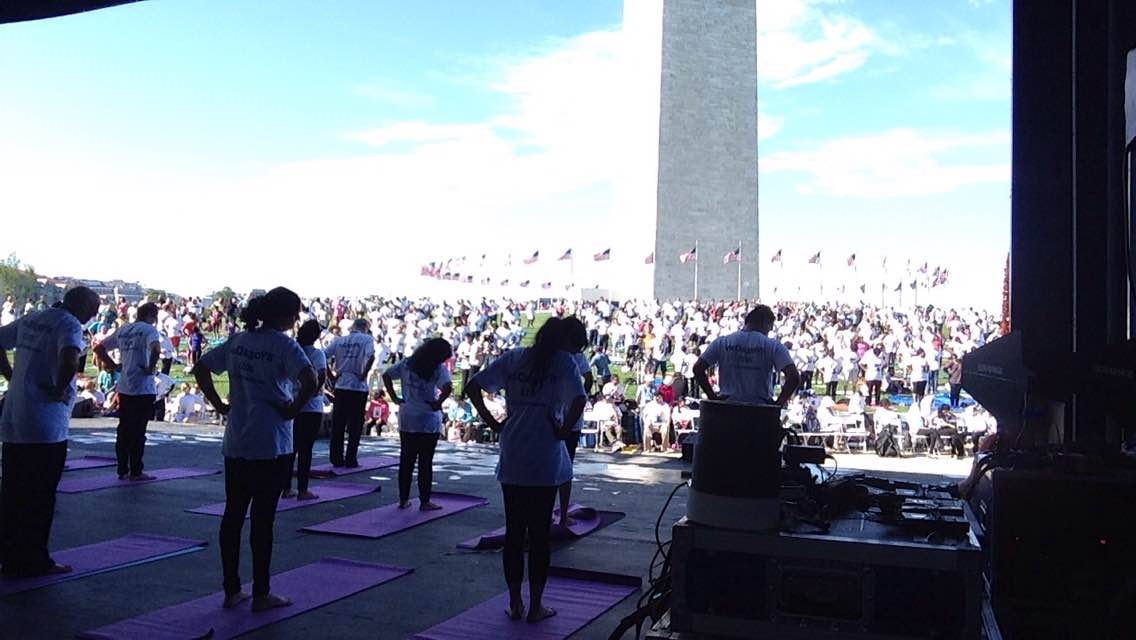
- Yoga is more than just asana
- Yoga is rooted in Hinduism
Four years in, and TBY’s key message has spread thru:
- Print and Web Media
- TV
- Radio
So what other medium is left to build more awareness? How about a Harvard Business School case study? Or books (see here and here)? While some of these academics may not agree with HAF’s stance or are simply studying the campaign as a phenomenon, at least we’re getting them to think more critically, all the while increasing academic accountability. After all, any straw man or ad hominem assertions against the fairly long TBY paper-trail, especially when we’ve made our intentions and goals amply clear, would certainly prove difficult!
TBY has also resulted in strange bedfellows along the way. Many conservative Christians, with whom we are largely at odds with over issues such as predatory proselytization and conversion, wholeheartedly agree that yoga is a Hindu practice — although their reasoning for acknowledging this fact isn’t necessarily flattery, but to warn against its practice. We’ve also struggled with very real dilemmas. For example, if we know that the practice of asana may work to reduce Attention Deficit Disorder (ADHD), and improve general behavior and grades for children, but we’re stating that yoga is rooted in Hinduism, how can we justify yoga in public schools, especially in light of HAF’s church/state advocacy? The solution to this quandary was found by striking a fine balance which we released in the form of an addendum after the highly publicized lawsuit in Encinitas, CA in 2013. We stated, in part:
Under the First Amendment, public schools may offer yoga-based programs, such as asana-only programs, as part of their curriculum because asana alone is not yoga. Public schools should not offer programs that go beyond the instruction of asana and other physical components of yoga. As such, community groups are free to offer more comprehensive yoga programs during non-school hours using school facilities on the same basis as other community groups sponsoring religious and secular programs for youth.
In 2014, TBY travelled the world over again. HAF Senior Director, Sheetal Shah was featured in an Al Jazeera documentary, “Who Owns Yoga?”, and HAF Executive Director, Suhag Shukla on Al Jazeera’s talk show, The Stream.
Shortly after the UN passed a resolution deeming June 21 International Yoga Day at the behest of India’s Prime Minister, Narendra Modi, late last year, TBY came full circle — back to the Washington Post in India’s new prime minister aims to rebrand and promote yoga in India.
Today, HAF members have been participating in various International Yoga Day events across the nation – from an event at the National Mall in DC, to another in Sacramento. And tomorrow, we’ll be joined by over 200 Congressional staff and friends of HAF in our nation’s capital for the Foundation’s “Yoga on the Hill,” where they’ll participate in one of two 30 minute sessions led by world-renowned yoga teacher Eddie Stern of Ashtanga Yoga New York.
HAF’s Take Back Yoga has been a long and fruitful ride. Many have acknowledged the Hindu roots of yoga, but there are still those who haven’t. So there’s still a long road ahead, but sustained by the eternal teachings of yoga, we’ll keep moving forward.
Happy International Yoga Day… Namaste.
Previous Post

May 13, 2015
Another Rite of Passage: Celebrating a Decade of Interfaith Activism
Next Post

June 30, 2015 The Future of Hinduism in America: Publicly Engaging Pluralism for Peace
Browse Our Archives
Select a Category acttochange Advocacy african american American Apocalyspse Autism Belief bhagavad gita Bhumi Project Bullying caste caste report Catholic Climate Change conversion Creation Story development dfn Dharma Diversity and Inclusion Divine Feminine Draupadi Education Environment EquityInEducation ethics evangelism Evil faith in the public square genocide God Goddess guru Hijab Hindu Hindu American Hindu American Foundation Hindu practices Holidays Holocaust human rights human trafficking identity India Indian American interfaith Internship Jewish Justice Kashmiri Hindus LGBT LGBT Rights Mahabharata Martin Luther King Jr Celebration meditation MLK Muslim National Day of Prayer NoDAPL Pakistani Hindu Peace Advocacy pluralism Prayer predatory proselytization Religious Freedom SacredSites Sari science self-realization Social Action spock Telugu Truth TSOG Uncategorized Urban monk Vegetarian Vote
Select a Month November 2017 October 2017 September 2017 April 2017 March 2017 February 2017 January 2017 December 2016 November 2016 October 2016 September 2016 August 2016 July 2016 June 2016 May 2016 April 2016 February 2016 January 2016 December 2015 November 2015 October 2015 September 2015 July 2015 June 2015 May 2015 April 2015 March 2015 February 2015 August 2014 July 2014 June 2014 May 2014 April 2014 March 2014 February 2014 January 2014 November 2013 October 2013 September 2013 February 2013 January 2013 December 2012 November 2012 October 2012 September 2012 August 2012 July 2012 June 2012 May 2012 April 2012
Follow Us!
TAKE THE
Religious Wisdom Quiz
According to Titus, what appeared to all people, bringing salvation?
Select your answer to see how you score.
Jesus Christ The gospel God's mercy The grace of God
Related posts from Seeking Shanti

Hindus in America: Acting on Our Values, Alleviating...

Green Diwali Webinar: Lighting the Way to Protect...

Watching Marshall, Lighting the Diwali Lamp for Dharma

Eclipse-Nirvana: Contemporary Devotional Music by Aks & Lakshmi
TRENDING AT PATHEOS Hindu

Indian Hindu pilot’s valor in line of duty...
There is a hoary maritime tradition that the captain of the...

Movie on Neem Karoli Baba’s life is a...
Neem Karoli Baba’s life (1900-1973) is associated with miracles he made in...

20 Questions to Ask Before an Interfaith Marriage,...
Four questions every interfaith couple should discuss before marriage: Conversion. Will either...

Avadhānam: The Art of Concentration and Intellectual Mastery
What is Avadhānam? In the summer of 2015, during a three-day Sanskrit...

Jesus in the Dharma: Where Christ Fits in...
Where Does Jesus Fit in Hinduism? That’s a question I get often...

Hormuz: A Shared Hindu and Zoroastrian Heritage
Every evening, somewhere in the world, a newsreader utters the words: "The...
view all Hindu blogs
Ad-Free & Subscriber Log-In Subscription Support
- About Us
- 2026 Calendar
- Videos
- Podcasts
- Library of World Religions
- Faith In Media Tracker
- Advertise With Us
- Write for Us
- Privacy Policy
- Terms of Service
- Do Not Sell My Data
- Contact Us
- Radiant Digital
- Manage Newsletter Subscriptions
- Unsubscribe From Notifications
- Sitemap
Copyright 2008-2026, Patheos. All rights reserved.
Subscription Support Ad-Free & Subscriber Log-In
Follow Patheos