
BuddhistCatholicContemplativeEvangelicalGeneral ChristianHinduJewishLatter-day SaintMuslimNew VisionsProgressive Christian
Beliefs
- Buddhist
- Catholic
- Contemplative
- Evangelical
- General Christian
- Hindu
- Jewish
- Latter-day Saint
- More Voices
- Muslim
- New Visions
- Pagan
- Progressive Christian
Topics
- Religion News
- Food and Religion
- Sports and Religion
- Religious Art
- Religious Music and Entertainment
- Religious Events
- History and Religion
- Style and Religion
- Politics and Religion
- Women in Religion
- Recreation Outdoors and Religion
- Business Finance and Religion
- Careers Workplace and Religion
- Education and Religion
- Family Parenting and Religion
- Health Fitness and Religion
- Home and Religion
- Relationships and Religion
- Technology and Religion
- Travel and Religion
Columnists
- Buddhist Columnists
- Business Finance and Religion Columnists
- Careers Workplace and Religion Columnists
- Catholic Columnists
- Contemplative Columnists
- Education and Religion Columnists
- Evangelists Columnists
- Family Parenting and Religion Columnists
- General Christian Columnists
- Health Fitness and Religion Columnists
- Hindu Columnists
- History and Religion Columnists
- Home and Religion Columnists
- Jewish Columnists
- More Voices Columnists
- Latter Day Columnists
- Muslim Columnists
- New Visions Columnists
- Nonreligious Columnists
- Pagan Columnists
- Politics and Religion Columnists
- Progressive Columnists
- Recreation Outdoors and Religion Columnists
- Relationships and Religion Columnists
- Religion News Columnists
- Religious Art Columnists
- Religious Events Columnists
- Religious Music and Entertainment Columnists
- Sports and Religion Columnists
- Style and Religion Columnists
- Technology and Religion Columnists
- Travel and Religion Columnists
- Women in Religion Columnists
Resource Library
- 2026 Calendar
- Library of World Religions
- The 100 Most Holy Places on Earth
- Patheos Answers
- Podcasts
- Videos
- Faith Leaders Database
- Anglican Episcopalian
- Bahai
- Baptist
- Buddhism
- Christianity
- Confucianism
- Eastern Orthodoxy
- Hinduism
- Holiness and Pentecostal
- ISKCON
- Islam
- Judaism
- Lutheran
- Methodist
- The Church of Jesus Christ of Latter-day Saints
- New Age
- Paganism
- Presbytarian and Reformed
- Protestantism
- Religion Behind the Scenes
- Roman Catholic
- Scientology
- Shia Islam
- Sikhism
- Sufism
- Sunni Islam
- Taoism
- Zen
- See all religions
Research Tools
 Ad-Free & Subscriber Log-In Subscription Support
Ad-Free & Subscriber Log-In Subscription Support
Follow Patheos 

- Trending:
- Forgiveness
- |
- Marriage
- |
- Consciousness
- |
- Death Penalty
- |
- Election
- |
- Halloween
 The Secular Spectrum
- Home
- Nonreligious
- Elected officials serve as enforcers of religious faith
Elected officials serve as enforcers of religious faith
Last updated on: March 16, 2018 at 5:37 pm by Rick Snedeker
Elected officials serve as enforcers of religious faith 2018-03-16T17:37:24-05:00 Rick Snedeker
Patheos Explore the world's faith through different perspectives on religion and spirituality! Patheos has the views of the prevalent religions and spiritualities of the world.
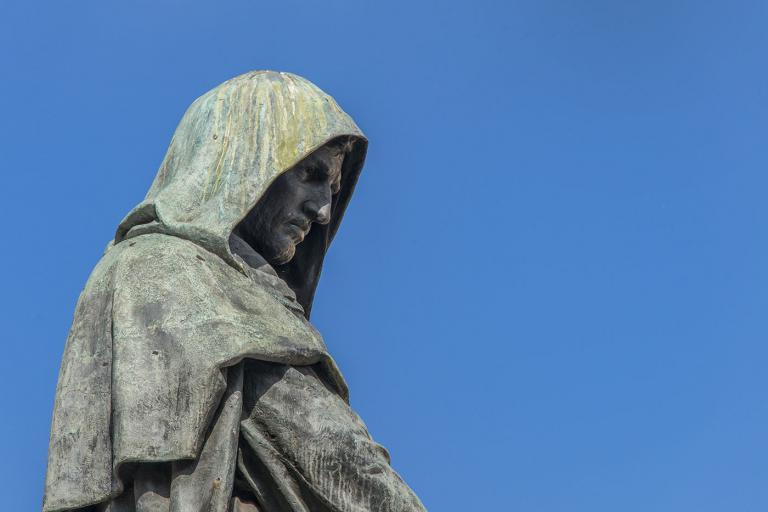
Dorli Photography, statue of Giordano Bruno in Rome. The 16th century Catholic friar philosopher was burned at the stake for promoting cosmological theories (later proved correct) at odds with church doctrine. Flickr.com, CC BY-NC-ND 2.0.
How American Christianity Perpetuates: Reasons #3-5
Public shaming by elected officials.
That sums up reasons No. 3 through 5 for how Christianity endlessly perpetuates in the United States despite its doctrines being entirely speculative.
All three causes were noted in recent posts in the online Patheos Nonreligious hub, including two in Hemant Mehta’s Friendly Atheist blog. Here’s a summary roundup of these latest in my continuing list of religious perpetuators:
Reason #3: Official shaming of people who criticize religious behavior
Joy Behar, the comedienne and co-host of the popular daytime ABC-TV talk show The View, recently landed in hot water after responding to a statement by former Trump aide Omarosa Manigault Newman that Vice President Mike Pence “talks to Jesus and believes Jesus tells him things.” Behar’s follow-up comment:
“It’s one thing to talk to Jesus. It’s another thing when Jesus talks to you … that’s called mental illness.”
Fox News’ Todd Starnes attacked Behar in an op-ed, contending it was understandable a “Christophobe like Behar” would be “dumbfounded” by the idea that people dialogue with invisible divinities. Starnes added that “if hearing the voice of God means (you are) mentally insane,” then he must be crazy himself. He referred to Behar as an “anti-Christian bigot,” implying ABC should fire her from The View.
Vice President Pence also castigated Behar on C-Span and on Fox’s Hannity opinion program, and he later urged her to publicly apologize to the American people:
“To have ABC maintain a broadcast forum that compared Christianity to mental illness is just wrong. It is simply wrong for ABC to have a television program that expresses that kind of religious intolerance.”
Later, on her program Behar offered a mea culpa:
“I was raised to respect everyone’s religious faith, and I fell short of that. So, I sincerely apologize for what I said.”
It’s irrelevant whether the Powers That Be at The View demanded an apology to protect their program’s advertising revenue and/or whether Behar believed she had stepped over the line with her commentary. What’s relevant is that as socio-political commentary, what she said was fair and defensible. Where else but in religion is conversing with phantoms considered rational, sane behavior? And when the leaders who govern us do carry on such a dialogue, it is absolutely fair to question. Freedom of religion does not mean freedom from fair and rational criticism.
Reason #4: Official shaming of people who criticize religious assumptions
When thousands of South Carolina students walked out of classes in peaceful protest on March 14, calling for fewer “thoughts and prayers” and stricter laws on gun ownership, Gov. Henry McMaster publicly castigated them as naïve tools of left-wing liberals. He called the walk-out “shameful.” McMaster’s advice for fixing the problem of school shootings, besides more guns:
“What we should all do and what these students should do … is to pray and to hope for the families of those who were slain.”
A nice sentiment, but appealing to unverified deities is not a very practical or well-advised solution. Shaming these students also will not help. David Hogg, one of the survivors of the recent school shooting in Florida and a spokesman for the nascent student anti-gun movement, warned McMaster in a tweet that “those future voters” who walked out in South Carolina “will not reelect you.”
Reason #5: Official damning of nonbelievers to Hell
The government of Kansas, that bastion of Christian apologetics, is at it again.
When an atheist recently asked to deliver an invocation at a meeting of the Sedgwick County Commissioners—a courtesy long afforded Christians—its elected officials refused. They claimed that such pre-opening remarks can only be given by “religious leaders or clergy members of a religious group with an established presence in Sedgwick County.”
Thus, nonreligious people were officially identified as social pariahs to be shunned and faithful folks as the “in” group to be embraced and privileged. If only Thomas Jefferson was here to weigh in.
But wait, it was worse. At a county staff meeting, Commissioner David Unruh attacked the atheist petitioners, saying:
“If you don’t believe in (God), that’s fine with me. I don’t care, go to hell. It’s fine.”
Noting that the Freedom from Religion Foundation (FfRF) had recently sent a letter to the commission notifying them that blocking atheists from giving invocations was against the law, Unruh was further inspired to trash talk:
“Are we going to get sued by these people who want us to not believe in God. I just keep wondering, why are you (atheists) so exercised about trying to prove to me that something doesn’t exist? It’s logically stupid.”
Curious he should invoke logic. The FfRF doesn’t care about the commissioners’ belief in a netherworld; it just cares whether they believe in the laws of this one.
These three examples show how our elected officials continue to promote religious, mainly Christian, ideology, and rebuke all skepticism—unconstitutionally—at the expense of reason.
Previous Post

March 13, 2018
Why Skydiving Only Feels Like A Religious Experience
Next Post

March 26, 2018 Divorce Ban in Philippines Could Easily Be Us — And Was
Browse Our Archives
Select a Category Ableism Activism Addiction and Recovery Agnosticism Anti-intellectualism Arts Atheism Beauty Catholicism Charles Darwin Children China Christianity Church/State separation churchgoing communication compassionate humanism Creationism critical thinking Culture death disaster response doubt education Egypt Entertainment Environment ethics evolution Existence of God Exploration fear Foundation Beyond Belief Free speech God Health History Human rights humanism identity India Interfaith Islam labels Language LGBT Love Meaning Media Medicine Middle East misconceptions mixed belief marriage Moral argument Morality Myths Near-Death Experience Nonreligious parenting Parody Persecution complex Philosophy Poetry Politics prayer Psychology Rationality Religion religious atheists Religious privilege Republican Party Satire Schools science secular parenting Spirituality The Unpigeonholeables Uncategorized United Kingdom Wonder
Select a Month March 2021 August 2020 March 2020 January 2020 September 2019 July 2019 June 2019 April 2019 February 2019 January 2019 December 2018 November 2018 October 2018 September 2018 August 2018 July 2018 June 2018 May 2018 April 2018 March 2018 February 2018 January 2018 December 2017 November 2017 October 2017 September 2017 August 2017 July 2017 March 2017 February 2017 January 2017 December 2016 November 2016 October 2016 September 2016 August 2016 July 2016 June 2016 May 2016 April 2016 March 2016 February 2016 January 2016 December 2015 November 2015 October 2015 September 2015 June 2015 March 2015 February 2015 January 2015 December 2014 November 2014 October 2014 September 2014
Follow Us!
TAKE THE
Religious Wisdom Quiz
What does "Nain" mean in Hebrew?
Select your answer to see how you score.
Holy place Pleasant Land of God City of refuge
Related posts from The Secular Spectrum

Yasir Qadhi's Elitist Ruse to Conceal the Obscure...

How Religion Can Impact Mental Health in Good...

On Cognitive Dissonance and the Thought Patterns Behind...
Understanding Cultures of Unbelief for Religious
TRENDING AT PATHEOS Nonreligious

Dethroning Jesus and Enthroning Yourself
Jesus Never Asked to Be Worshipped. He Asked to Be Understood. Christianity...

Why Most Christians are Really Paulians and Jobians
I Don't Care, But It Matters Let's get this out of the...

Essential Tips to Successfully Navigate the Selling Process
Selling a house can feel overwhelming, but it doesn’t have to be....

To Make Remote Work Effective, Think About Others
The COVID-19 pandemic forced many companies to rapidly transition to remote work....

Flexibility Is Key to Solving Problems of Tomorrow
The world of work is undergoing a dramatic transformation. The COVID-19 pandemic...
view all Nonreligious blogs
Ad-Free & Subscriber Log-In Subscription Support
- About Us
- 2026 Calendar
- Videos
- Podcasts
- Library of World Religions
- Faith In Media Tracker
- Advertise With Us
- Write for Us
- Privacy Policy
- Terms of Service
- Do Not Sell My Data
- Contact Us
- Radiant Digital
- Manage Newsletter Subscriptions
- Unsubscribe From Notifications
- Sitemap
Copyright 2008-2026, Patheos. All rights reserved.
Subscription Support Ad-Free & Subscriber Log-In
Follow Patheos