
BuddhistCatholicContemplativeEvangelicalGeneral ChristianHinduJewishLatter-day SaintMuslimNew VisionsProgressive Christian
Beliefs
- Buddhist
- Catholic
- Contemplative
- Evangelical
- General Christian
- Hindu
- Jewish
- Latter-day Saint
- More Voices
- Muslim
- New Visions
- Pagan
- Progressive Christian
Topics
- Religion News
- Food and Religion
- Sports and Religion
- Religious Art
- Religious Music and Entertainment
- Religious Events
- History and Religion
- Style and Religion
- Politics and Religion
- Women in Religion
- Recreation Outdoors and Religion
- Business Finance and Religion
- Careers Workplace and Religion
- Education and Religion
- Family Parenting and Religion
- Health Fitness and Religion
- Home and Religion
- Relationships and Religion
- Technology and Religion
- Travel and Religion
Columnists
- Buddhist Columnists
- Business Finance and Religion Columnists
- Careers Workplace and Religion Columnists
- Catholic Columnists
- Contemplative Columnists
- Education and Religion Columnists
- Evangelists Columnists
- Family Parenting and Religion Columnists
- General Christian Columnists
- Health Fitness and Religion Columnists
- Hindu Columnists
- History and Religion Columnists
- Home and Religion Columnists
- Jewish Columnists
- More Voices Columnists
- Latter Day Columnists
- Muslim Columnists
- New Visions Columnists
- Nonreligious Columnists
- Pagan Columnists
- Politics and Religion Columnists
- Progressive Columnists
- Recreation Outdoors and Religion Columnists
- Relationships and Religion Columnists
- Religion News Columnists
- Religious Art Columnists
- Religious Events Columnists
- Religious Music and Entertainment Columnists
- Sports and Religion Columnists
- Style and Religion Columnists
- Technology and Religion Columnists
- Travel and Religion Columnists
- Women in Religion Columnists
Resource Library
- 2026 Calendar
- Library of World Religions
- The 100 Most Holy Places on Earth
- Patheos Answers
- Podcasts
- Videos
- Faith Leaders Database
- Anglican Episcopalian
- Bahai
- Baptist
- Buddhism
- Christianity
- Confucianism
- Eastern Orthodoxy
- Hinduism
- Holiness and Pentecostal
- ISKCON
- Islam
- Judaism
- Lutheran
- Methodist
- The Church of Jesus Christ of Latter-day Saints
- New Age
- Paganism
- Presbytarian and Reformed
- Protestantism
- Religion Behind the Scenes
- Roman Catholic
- Scientology
- Shia Islam
- Sikhism
- Sufism
- Sunni Islam
- Taoism
- Zen
- See all religions
Research Tools
 Ad-Free & Subscriber Log-In Subscription Support
Ad-Free & Subscriber Log-In Subscription Support
Follow Patheos 

- Trending:
- Forgiveness
- |
- Marriage
- |
- Consciousness
- |
- Death Penalty
- |
- Election
- |
- Halloween
 The Secular Spectrum
- Home
- Nonreligious
- Circumcision re-enters genital-mutilation debate
Circumcision re-enters genital-mutilation debate
Last updated on: February 20, 2018 at 6:34 pm by Rick Snedeker
Circumcision re-enters genital-mutilation debate 2018-02-20T18:34:44-05:00 Rick Snedeker
Patheos Explore the world's faith through different perspectives on religion and spirituality! Patheos has the views of the prevalent religions and spiritualities of the world.
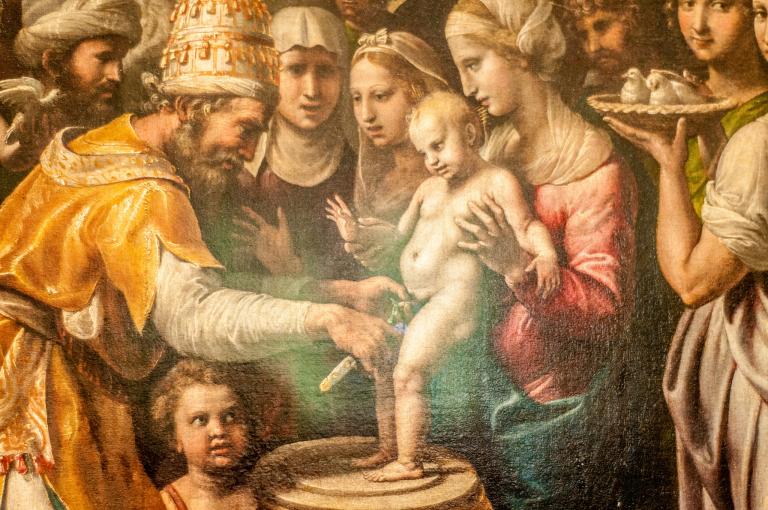
Graeme Churchard, “Circumcision of Christ-Romano,” Flikr.com, CC BY 2.0
During the decades I lived in Saudi Arabia, I eventually stopped noticing the dense black veils that hid the faces of local Muslim women. It was just the way it was, like the endless sandy sabkha (salt flats) in every direction.
Even in the late 20th and early 21st centuries, Saudi women generally accepted their veils as a religious obligation, because Islam’s prophet, Muhammad, apparently required his wives to wear them to avoid the carnal stares of men. Veiling thus had a religious imprimatur.
But I learned that the faith’s holy book, the Quran (dictated by Muhammad), in fact, mandates no such practice. The cultural artifact of veiling is just something Saudi men started demanding of women some vague time back in the day, and it has only acquired the aura of religious necessity over time. One secular explanation was that during the pre-oil era Saudi nomads routinely raided rival tribes and carried off women and treasure; with women veiled, the theory goes, it was much harder to distinguish grapes from raisins.
My point here is that religion and culture are constantly tripping over each other—and often grievously misrepresented—because their histories are often older than current memory. It’s a chicken and egg thing.
Which brings me to male circumcision and, coincidentally, FGM (female genital mutilation). For the uninformed, FGM is a practice whereby various parts of female genitalia are excised, injured or variously refashioned. Although how the practice began is shrouded in time, one reason—as the common removal of the orgasmic clitoris strongly suggests—is to muffle female sexual arousal and hopefully (for men) to reduce the chance of illicit sexual affairs with random men other than husbands. Among the countries where FGM is reportedly practiced, is Saudi Arabia, but apparently only in the Shafi’i school of Sunni Islam prevalent in the country’s mountainous northwest.
Male circumcision (removal of the natural foreskin covering the penis), on the other hand, has acquired little of the global stigma that FGM has. Indeed. A quote from Halimah Al-Warzazi, a U.N. special rapporteur to the U.N. sharply underscores this reality. Ironically, Al-Warzazi’s job in part was to campaign against “traditional practices prejudicial to … children” under the U.N. Convention on the Rights of the Child. Nonetheless, she once said:
“Circumcision of male children does not concern the United Nations.”
Male circumcision has an ancient pedigree in Egypt and among Semitic peoples who lived in Africa and environs, and although not universal and often controversial it gradually became de rigueur for most Jewish, Christian and Muslim men over the centuries. Even South Pacific islanders and Australian aborigines were found to be ardent circumcisers when Europeans first encountered them.
Although FGM is broadly derided today, an estimated 100-140 million women and girls worldwide are current victims of FGM as a traditional womanhood rite, according to the World Health Organization. A 20-year study of FGM sponsored by the United Nations International Children’s Emergency Fund (UNICEF) found the practice prevalent in 29 nations. UNICEF discovered that nearly all young girls—as many as 98 percent—were cut in eight countries, all with Muslim majorities: Somalia (98 percent), Guinea (96), Djibouti (93), Egypt (91), Eritrea and Mali (89), and Sierra Leone and Sudan (88).
So, we have arrived at this point in history where male circumcision has long been an accepted cultural practice—within and without the cultures that perform it; an estimated one in three men worldwide are believed circumcised. Conversely, FGM is commonly demonized by victims and outsiders alike, but extensive international campaigns against it have proliferated in recent years. Both practices have a complex history with both cultural and religious elements (e.g., in Genesis, God orders Abraham to circumcise himself, male household members and slaves).
Oddly, male circumcision is suddenly in the news again—in of all places, Iceland.
The Icelandic parliament is currently considering a bill with broad multi-party and public support that would impose a 6-year prison term on anyone conducting a circumcision for non-medical reasons. If it survives the legislative process, the bill could be enacted into law within several months.
Critics are alarmed by the idea, notably Iceland’s pro-circumcision Muslims, Catholics and Jews, who fear that life for them would be discriminatory and untenable if the ban were passed. They worry the law is a fig leaf for antisemitism and Islamophobia. Cardinal Reinhard Marx, president of the Catholic Church in the European Union, termed the bill a “dangerous attack” on religious freedom. Opponents of the bill also cite treasured cultural traditions circumcision represents for many people.
Silja Dögg Gunnarsdóttir of the centre-right Progressive party proposed the bill after realizing that FGM has been banned in Iceland since 2005. “If we have laws banning circumcision for girls, then we should do so for boys,” she reasonably argued to the British newspaper The Guardian, adding:
“We are talking about children’s rights, not about freedom of belief. Everyone has the right to believe in what they want, but the rights of children come above the right to belief.”
The Council of Europe in 2013 passed a resolution urging 47 member nations to regulate “ritual circumcision” after Germany did so the previous year. In 2016, a British family-court judge ruled that children shouldn’t be circumcised until they are mature enough to decide themselves. So, European public opinion seems to be shifting.
Of course, many societies have long justified these transgressive practices according to vague cultural or religious mandates. But, in essence, they are simply mutilating children without their consent.
Previous Post

February 12, 2018
Heartbreaking Tragedy on Indian Reservation. Few Notice.
Next Post
February 26, 2018 Was God necessary for creation? Science suggests no.
Browse Our Archives
Select a Category Ableism Activism Addiction and Recovery Agnosticism Anti-intellectualism Arts Atheism Beauty Catholicism Charles Darwin Children China Christianity Church/State separation churchgoing communication compassionate humanism Creationism critical thinking Culture death disaster response doubt education Egypt Entertainment Environment ethics evolution Existence of God Exploration fear Foundation Beyond Belief Free speech God Health History Human rights humanism identity India Interfaith Islam labels Language LGBT Love Meaning Media Medicine Middle East misconceptions mixed belief marriage Moral argument Morality Myths Near-Death Experience Nonreligious parenting Parody Persecution complex Philosophy Poetry Politics prayer Psychology Rationality Religion religious atheists Religious privilege Republican Party Satire Schools science secular parenting Spirituality The Unpigeonholeables Uncategorized United Kingdom Wonder
Select a Month March 2021 August 2020 March 2020 January 2020 September 2019 July 2019 June 2019 April 2019 February 2019 January 2019 December 2018 November 2018 October 2018 September 2018 August 2018 July 2018 June 2018 May 2018 April 2018 March 2018 February 2018 January 2018 December 2017 November 2017 October 2017 September 2017 August 2017 July 2017 March 2017 February 2017 January 2017 December 2016 November 2016 October 2016 September 2016 August 2016 July 2016 June 2016 May 2016 April 2016 March 2016 February 2016 January 2016 December 2015 November 2015 October 2015 September 2015 June 2015 March 2015 February 2015 January 2015 December 2014 November 2014 October 2014 September 2014
Follow Us!
TAKE THE
Religious Wisdom Quiz
Which book of the Bible contains the Ten Plagues of Egypt?
Select your answer to see how you score.
Exodus Genesis Deuteronomy Leviticus
Related posts from The Secular Spectrum

Yasir Qadhi's Elitist Ruse to Conceal the Obscure...
Understanding Cultures of Unbelief for Religious

Trump Admin's Prioritization of Religion Over Health Care...

Why Do We Question Vegetarianism When It's a...
TRENDING AT PATHEOS Nonreligious

Dethroning Jesus and Enthroning Yourself
Jesus Never Asked to Be Worshipped. He Asked to Be Understood. Christianity...

Why Most Christians are Really Paulians and Jobians
I Don't Care, But It Matters Let's get this out of the...

Essential Tips to Successfully Navigate the Selling Process
Selling a house can feel overwhelming, but it doesn’t have to be....

To Make Remote Work Effective, Think About Others
The COVID-19 pandemic forced many companies to rapidly transition to remote work....

Flexibility Is Key to Solving Problems of Tomorrow
The world of work is undergoing a dramatic transformation. The COVID-19 pandemic...
view all Nonreligious blogs
Ad-Free & Subscriber Log-In Subscription Support
- About Us
- 2026 Calendar
- Videos
- Podcasts
- Library of World Religions
- Faith In Media Tracker
- Advertise With Us
- Write for Us
- Privacy Policy
- Terms of Service
- Do Not Sell My Data
- Contact Us
- Radiant Digital
- Manage Newsletter Subscriptions
- Unsubscribe From Notifications
- Sitemap
Copyright 2008-2026, Patheos. All rights reserved.
Subscription Support Ad-Free & Subscriber Log-In
Follow Patheos