
BuddhistCatholicContemplativeEvangelicalGeneral ChristianHinduJewishLatter-day SaintMuslimNew VisionsProgressive Christian
Beliefs
- Buddhist
- Catholic
- Contemplative
- Evangelical
- General Christian
- Hindu
- Jewish
- Latter-day Saint
- More Voices
- Muslim
- New Visions
- Pagan
- Progressive Christian
Topics
- Religion News
- Food and Religion
- Sports and Religion
- Religious Art
- Religious Music and Entertainment
- Religious Events
- History and Religion
- Style and Religion
- Politics and Religion
- Women in Religion
- Recreation Outdoors and Religion
- Business Finance and Religion
- Careers Workplace and Religion
- Education and Religion
- Family Parenting and Religion
- Health Fitness and Religion
- Home and Religion
- Relationships and Religion
- Technology and Religion
- Travel and Religion
Columnists
- Buddhist Columnists
- Business Finance and Religion Columnists
- Careers Workplace and Religion Columnists
- Catholic Columnists
- Contemplative Columnists
- Education and Religion Columnists
- Evangelists Columnists
- Family Parenting and Religion Columnists
- General Christian Columnists
- Health Fitness and Religion Columnists
- Hindu Columnists
- History and Religion Columnists
- Home and Religion Columnists
- Jewish Columnists
- More Voices Columnists
- Latter Day Columnists
- Muslim Columnists
- New Visions Columnists
- Nonreligious Columnists
- Pagan Columnists
- Politics and Religion Columnists
- Progressive Columnists
- Recreation Outdoors and Religion Columnists
- Relationships and Religion Columnists
- Religion News Columnists
- Religious Art Columnists
- Religious Events Columnists
- Religious Music and Entertainment Columnists
- Sports and Religion Columnists
- Style and Religion Columnists
- Technology and Religion Columnists
- Travel and Religion Columnists
- Women in Religion Columnists
Resource Library
- 2026 Calendar
- Library of World Religions
- The 100 Most Holy Places on Earth
- Patheos Answers
- Podcasts
- Videos
- Faith Leaders Database
- Anglican Episcopalian
- Bahai
- Baptist
- Buddhism
- Christianity
- Confucianism
- Eastern Orthodoxy
- Hinduism
- Holiness and Pentecostal
- ISKCON
- Islam
- Judaism
- Lutheran
- Methodist
- The Church of Jesus Christ of Latter-day Saints
- New Age
- Paganism
- Presbytarian and Reformed
- Protestantism
- Religion Behind the Scenes
- Roman Catholic
- Scientology
- Shia Islam
- Sikhism
- Sufism
- Sunni Islam
- Taoism
- Zen
- See all religions
Research Tools
 Ad-Free & Subscriber Log-In Subscription Support
Ad-Free & Subscriber Log-In Subscription Support
Follow Patheos 

- Trending:
- Forgiveness
- |
- Marriage
- |
- Consciousness
- |
- Death Penalty
- |
- Election
- |
- Halloween
 The Secular Spectrum
- Home
- Nonreligious
- The Scientific Mindset and the Exclusion of Meaning
The Scientific Mindset and the Exclusion of Meaning
Last updated on: October 16, 2017 at 9:52 am by Shem the Penman
The Scientific Mindset and the Exclusion of Meaning 2017-10-16T09:52:44-05:00 Shem the Penman
Patheos Explore the world's faith through different perspectives on religion and spirituality! Patheos has the views of the prevalent religions and spiritualities of the world.

The scientific view of the universe isn’t wrong, but it’s not complete. What’s missing is meaning.
Excluding the Subjective
Even a stopped clock is right twice a day. Even though I suspect Jordan Peterson’s average is lower than that, he made a remarkably perceptive comment in his discussion with Stefan Molyneux earlier this year.
(I’m not going to link the video; if you really need to see and hear two right-wing gasbags backslap each other for an hour and pretend to solve the problems of the world by ridiculing feminists and lefties, look it up on Molyneux’s YouTube channel.)
Early in the video, Peterson set the stage by describing the cultural problem with equating scientific knowledge with reality:
The methodology of science by definition excludes the subjective from consideration. And the problem is that you can’t exclude the subjective from consideration without excluding the subject, and since we’re all subjects that’s a major problem. (…) The reduction of the world of Being to the objective world has reduced people’s ability to believe in the reality of meaning in life. And that’s an awful catastrophe. It’s more accurate to say that it’s reduced people’s ability to believe in the positive meaning of life, because the negative meaning of life announces itself. And no amount of rational disbelief will rid you of anxiety and pain. But you can certainly subject anything positive you do the sort of critique that you might sum up stupidly by saying something like, “Well, in a million years, who the hell’s gonna know the difference?” Or, you know, “We’re just dust specks on this little dust mote of a planet in an infinitely large galaxy and who the hell cares what we do, or what I do today or tomorrow. Why is it relevant? Why is it meaningful?” And because we can’t get a sense of the meaning of meaning or the reality of meaning, it leaves us adrift and lost in a world of nihilism and pain. Not psychologically tenable. Truly not.
Peterson’s host quickly steered the discussion away from this cogent point to a discussion of the wealth production scientific progress has made possible.
The Meaning of Meaning
Regardless of my disagreement with Peterson on politics, I think he’s made a very important point here. I’ve talked before about the way scientific endeavor excludes the subject and creates an illusion of de-humanized reality. But it’s interesting to see Peterson make the point in discussion with a guy whose audience wouldn’t otherwise tolerate ideas critical of science.
People in these discussion boards have dismissed the idea of meaning as sentimental nonsense because science isn’t equipped to answer “the why questions.” Others say meaning is just a function of language, so it’s a human construct that’s ultimately illusory because it wouldn’t exist if there were no humans.
However, Peterson appears to be saying that the if-there-were-no-humans canard is beside the point because we’re here and constantly introducing meaning into phenomena; scientific inquiry itself is a process of imposing order onto reality to make it comprehensible (that is, meaningful) to human minds. In other words, meaning is part of reality, just not an empirically verifiable part.
What do you think? Is the way we see the universe through science the only “real” way, or is our subjective experience part of reality too? Is meaning an illusion, or is it impossible to define the universe without making it meaningful?
Previous Post
October 12, 2017
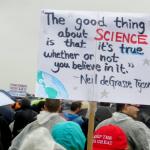
Tyson's Blunder: All Caps SCIENCE and Critical Thinking

Browse Our Archives
Select a Category Ableism Activism Addiction and Recovery Agnosticism Anti-intellectualism Arts Atheism Beauty Catholicism Charles Darwin Children China Christianity Church/State separation churchgoing communication compassionate humanism Creationism critical thinking Culture death disaster response doubt education Egypt Entertainment Environment ethics evolution Existence of God Exploration fear Foundation Beyond Belief Free speech God Health History Human rights humanism identity India Interfaith Islam labels Language LGBT Love Meaning Media Medicine Middle East misconceptions mixed belief marriage Moral argument Morality Myths Near-Death Experience Nonreligious parenting Parody Persecution complex Philosophy Poetry Politics prayer Psychology Rationality Religion religious atheists Religious privilege Republican Party Satire Schools science secular parenting Spirituality The Unpigeonholeables Uncategorized United Kingdom Wonder
Select a Month March 2021 August 2020 March 2020 January 2020 September 2019 July 2019 June 2019 April 2019 February 2019 January 2019 December 2018 November 2018 October 2018 September 2018 August 2018 July 2018 June 2018 May 2018 April 2018 March 2018 February 2018 January 2018 December 2017 November 2017 October 2017 September 2017 August 2017 July 2017 March 2017 February 2017 January 2017 December 2016 November 2016 October 2016 September 2016 August 2016 July 2016 June 2016 May 2016 April 2016 March 2016 February 2016 January 2016 December 2015 November 2015 October 2015 September 2015 June 2015 March 2015 February 2015 January 2015 December 2014 November 2014 October 2014 September 2014
Follow Us!
TAKE THE
Religious Wisdom Quiz
What’s the name of the garden where Adam and Eve lived?
Select your answer to see how you score.
Gethsemane Galilee Eden Nazareth
Related posts from The Secular Spectrum

Yasir Qadhi's Elitist Ruse to Conceal the Obscure...

Despite "Pro-Life" Claims, Stem Cell Therapy Has Very...

How Religion Can Impact Mental Health in Good...

On Cognitive Dissonance and the Thought Patterns Behind...
TRENDING AT PATHEOS Nonreligious

Dethroning Jesus and Enthroning Yourself
Jesus Never Asked to Be Worshipped. He Asked to Be Understood. Christianity...

Why Most Christians are Really Paulians and Jobians
I Don't Care, But It Matters Let's get this out of the...

Essential Tips to Successfully Navigate the Selling Process
Selling a house can feel overwhelming, but it doesn’t have to be....

To Make Remote Work Effective, Think About Others
The COVID-19 pandemic forced many companies to rapidly transition to remote work....

Flexibility Is Key to Solving Problems of Tomorrow
The world of work is undergoing a dramatic transformation. The COVID-19 pandemic...
view all Nonreligious blogs
Ad-Free & Subscriber Log-In Subscription Support
- About Us
- 2026 Calendar
- Videos
- Podcasts
- Library of World Religions
- Faith In Media Tracker
- Advertise With Us
- Write for Us
- Privacy Policy
- Terms of Service
- Do Not Sell My Data
- Contact Us
- Radiant Digital
- Manage Newsletter Subscriptions
- Unsubscribe From Notifications
- Sitemap
Copyright 2008-2026, Patheos. All rights reserved.
Subscription Support Ad-Free & Subscriber Log-In
Follow Patheos