
BuddhistCatholicContemplativeEvangelicalGeneral ChristianHinduJewishLatter-day SaintMuslimNew VisionsProgressive Christian
Beliefs
- Buddhist
- Catholic
- Contemplative
- Evangelical
- General Christian
- Hindu
- Jewish
- Latter-day Saint
- More Voices
- Muslim
- New Visions
- Pagan
- Progressive Christian
Topics
- Religion News
- Food and Religion
- Sports and Religion
- Religious Art
- Religious Music and Entertainment
- Religious Events
- History and Religion
- Style and Religion
- Politics and Religion
- Women in Religion
- Recreation Outdoors and Religion
- Business Finance and Religion
- Careers Workplace and Religion
- Education and Religion
- Family Parenting and Religion
- Health Fitness and Religion
- Home and Religion
- Relationships and Religion
- Technology and Religion
- Travel and Religion
Columnists
- Buddhist Columnists
- Business Finance and Religion Columnists
- Careers Workplace and Religion Columnists
- Catholic Columnists
- Contemplative Columnists
- Education and Religion Columnists
- Evangelists Columnists
- Family Parenting and Religion Columnists
- General Christian Columnists
- Health Fitness and Religion Columnists
- Hindu Columnists
- History and Religion Columnists
- Home and Religion Columnists
- Jewish Columnists
- More Voices Columnists
- Latter Day Columnists
- Muslim Columnists
- New Visions Columnists
- Nonreligious Columnists
- Pagan Columnists
- Politics and Religion Columnists
- Progressive Columnists
- Recreation Outdoors and Religion Columnists
- Relationships and Religion Columnists
- Religion News Columnists
- Religious Art Columnists
- Religious Events Columnists
- Religious Music and Entertainment Columnists
- Sports and Religion Columnists
- Style and Religion Columnists
- Technology and Religion Columnists
- Travel and Religion Columnists
- Women in Religion Columnists
Resource Library
- 2026 Calendar
- Library of World Religions
- The 100 Most Holy Places on Earth
- Patheos Answers
- Podcasts
- Videos
- Faith Leaders Database
- Anglican Episcopalian
- Bahai
- Baptist
- Buddhism
- Christianity
- Confucianism
- Eastern Orthodoxy
- Hinduism
- Holiness and Pentecostal
- ISKCON
- Islam
- Judaism
- Lutheran
- Methodist
- The Church of Jesus Christ of Latter-day Saints
- New Age
- Paganism
- Presbytarian and Reformed
- Protestantism
- Religion Behind the Scenes
- Roman Catholic
- Scientology
- Shia Islam
- Sikhism
- Sufism
- Sunni Islam
- Taoism
- Zen
- See all religions
Research Tools
 Ad-Free & Subscriber Log-In Subscription Support
Ad-Free & Subscriber Log-In Subscription Support
Follow Patheos 

- Trending:
- Forgiveness
- |
- Marriage
- |
- Consciousness
- |
- Death Penalty
- |
- Election
- |
- Halloween
 The Secular Spectrum
- Home
- Nonreligious
- Who Will Make America Safer?
Who Will Make America Safer?
Last updated on: October 16, 2016 at 3:08 pm by Gleb Tsipursky
Who Will Make America Safer? 2016-10-16T15:08:56-05:00 Gleb Tsipursky
Patheos Explore the world's faith through different perspectives on religion and spirituality! Patheos has the views of the prevalent religions and spiritualities of the world.
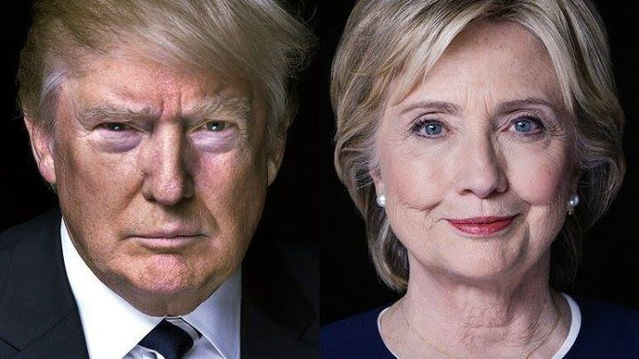
Caption: Photo of Trump and Clinton (Static, Flickr)
Co-written by Dr. Gleb Tsipursky, Intentional Insights Co-Founder and President, and Blake Page, Ohio Field Director for VoteVets
The second presidential debate featured both Hillary Clinton and Donald Trump claiming to be the best choice to make America safe. So which candidate is actually the best choice for safety?
In past elections, the Republican candidate usually succeeded in convincing those who care about safety and security to vote for him. Yet this is no ordinary election, as shown by over a hundred Republican national security leaders signing a letter saying that Trump “would use the authority of his office to act in ways that make America less safe, and which would diminish our standing in the world.”
Exchanges during the second debate show further evidence that those who care about safety should consider Trump the more risky and dangerous choice. Clinton noted that “you can look at the propaganda on a lot of the terrorists sites, and what Donald Trump says about Muslims is used to recruit fighters, because they want to create a war between us.” Indeed, an al Qaeda affiliate used statements by Donald Trump critical of Muslims in January 2016 to make the case that the United States is an Islamophobic society and that American Muslims should support al Qaeda. In March 2016, ISIS released a tape using Trump’s words as a recruitment tool.
Trump doubled down during this debate. Given the opportunity by a question from an audience member to share how he will help address the rising Islamophobia, Trump pivoted to criticizing Muslims, saying that “Muslims have to report the problems when they see them.” His implication is false, as according to the FBI’s director, James Comey, “some of our most productive relationships are with people who see things and tell us things who happen to be Muslim.”
To be fair to Trump, we need to ask whether there is any rational reason to fear Muslims. In 2015 there were seven terrorist acts in the United States, with nine terrorists altogether. Six of the nine were motivated, in some part, by Muslim beliefs.
A 2011 survey estimated that the United States had 1.8 million Muslim adults. Dividing the number of Muslim adults by the six who committed terrorist acts gives you a one-in-300,000 chance that any Muslim you see would commit a terrorist act in one year. That’s like picking out a terrorist randomly from the number of people in several football stadiums.
Applying this sort of probabilistic thinking is a research-based way to deal with any potential false beliefs and consequent bad decisions. We can see that being Muslim is a very poor statistical indicator of whether someone is a terrorist, making fears of Muslims irrational.
A savvy business leader, Trump can do such simple probabilistic calculations easily. He also must know that his words belittling Muslims will be used to recruit terrorists to attack the US. Why would he make such statements, especially ones that are clearly false?
Well, he knows that most Americans have little faith in media fact-checkers. He is thus willing to make false statements, even if they make America less safe, to appeal to fear and anger around terrorism among US citizens. From the start of the campaign, Trump has successfully used his emotional intelligence and charisma to stoke fear and anger, which are the two most powerful emotions that shape our decision-making.
By repeating his criticism of Muslims, despite the consequent increase in risk of terrorism, Trump is playing to problematic thinking and feeling patterns in our brains. Useful in the ancestral environment, such patterns serve us poorly in the modern world where those who are highly emotionally intelligent can take advantage of this faulty wiring in our brain to convince us to make bad decisions. One is known by psychologists as the mere-exposure effect, the notion that if you repeat something often enough, people start believing it is true – regardless of whether it is true or false.
Another is in-group–out-group bias, a phenomenon by which we instinctively dislike those who we perceive to not belong to our “tribe.” Throughout the campaign, Trump made sure to represent Muslims as as dangerous, different, undeserving of consideration, as not “our tribe.” No wonder that anti-Muslim hate crimes spiked by over 75 percent in 2015, when Trump began campaigning, compared to 2014. This growth, which many scholars attribute mostly to Trump’s rhetoric, also contributes to anti-American sentiment among Muslims.
By instigating such sentiments, Trump deserves blame for a significant portion of subsequent terrorist acts. Trump’s determination to get his way, regardless of how much it hurts America, makes him the more risky and less safe candidate for the presidency.
____________________________________________________________________
Bio: Dr. Gleb Tsipursky is an author, speaker, consultant, coach, scholar, and social entrepreneur specializing in science-based strategies for effective decision-making, goal achievement, emotional and social intelligence, meaning and purpose, and altruism – for more information or to hire him, see his personal website, GlebTsipursky.com. He runs a nonprofit that helps you reach your goals using science to build an altruistic and flourishing world, Intentional Insights; authored Find Your Purpose Using Science among other books; regular contributes to prominent venues; and is a tenure-track professor at Ohio State. Consider signing up to the Intentional Insights newsletter; volunteering; donating; or buying merchandise. You can support him personally on Patreon. Get in touch with him at [email protected].
Previous Post

October 7, 2016
The Gender Gap in the Presidential Race
Next Post

October 19, 2016 Patheos Atheists Tweet the Third Debate
Browse Our Archives
Select a Category Ableism Activism Addiction and Recovery Agnosticism Anti-intellectualism Arts Atheism Beauty Catholicism Charles Darwin Children China Christianity Church/State separation churchgoing communication compassionate humanism Creationism critical thinking Culture death disaster response doubt education Egypt Entertainment Environment ethics evolution Existence of God Exploration fear Foundation Beyond Belief Free speech God Health History Human rights humanism identity India Interfaith Islam labels Language LGBT Love Meaning Media Medicine Middle East misconceptions mixed belief marriage Moral argument Morality Myths Near-Death Experience Nonreligious parenting Parody Persecution complex Philosophy Poetry Politics prayer Psychology Rationality Religion religious atheists Religious privilege Republican Party Satire Schools science secular parenting Spirituality The Unpigeonholeables Uncategorized United Kingdom Wonder
Select a Month March 2021 August 2020 March 2020 January 2020 September 2019 July 2019 June 2019 April 2019 February 2019 January 2019 December 2018 November 2018 October 2018 September 2018 August 2018 July 2018 June 2018 May 2018 April 2018 March 2018 February 2018 January 2018 December 2017 November 2017 October 2017 September 2017 August 2017 July 2017 March 2017 February 2017 January 2017 December 2016 November 2016 October 2016 September 2016 August 2016 July 2016 June 2016 May 2016 April 2016 March 2016 February 2016 January 2016 December 2015 November 2015 October 2015 September 2015 June 2015 March 2015 February 2015 January 2015 December 2014 November 2014 October 2014 September 2014
Follow Us!
TAKE THE
Religious Wisdom Quiz
Which book of the Bible contains the Ten Plagues of Egypt?
Select your answer to see how you score.
Exodus Genesis Deuteronomy Leviticus
Related posts from The Secular Spectrum

Yasir Qadhi's Elitist Ruse to Conceal the Obscure...

Despite "Pro-Life" Claims, Stem Cell Therapy Has Very...

How Religion Can Impact Mental Health in Good...

On Cognitive Dissonance and the Thought Patterns Behind...
TRENDING AT PATHEOS Nonreligious

Dethroning Jesus and Enthroning Yourself
Jesus Never Asked to Be Worshipped. He Asked to Be Understood. Christianity...

Why Most Christians are Really Paulians and Jobians
I Don't Care, But It Matters Let's get this out of the...

Essential Tips to Successfully Navigate the Selling Process
Selling a house can feel overwhelming, but it doesn’t have to be....

To Make Remote Work Effective, Think About Others
The COVID-19 pandemic forced many companies to rapidly transition to remote work....

Flexibility Is Key to Solving Problems of Tomorrow
The world of work is undergoing a dramatic transformation. The COVID-19 pandemic...
view all Nonreligious blogs
Ad-Free & Subscriber Log-In Subscription Support
- About Us
- 2026 Calendar
- Videos
- Podcasts
- Library of World Religions
- Faith In Media Tracker
- Advertise With Us
- Write for Us
- Privacy Policy
- Terms of Service
- Do Not Sell My Data
- Contact Us
- Radiant Digital
- Manage Newsletter Subscriptions
- Unsubscribe From Notifications
- Sitemap
Copyright 2008-2026, Patheos. All rights reserved.
Subscription Support Ad-Free & Subscriber Log-In
Follow Patheos