
BuddhistCatholicContemplativeEvangelicalGeneral ChristianHinduJewishLatter-day SaintMuslimNew VisionsProgressive Christian
Beliefs
- Buddhist
- Catholic
- Contemplative
- Evangelical
- General Christian
- Hindu
- Jewish
- Latter-day Saint
- More Voices
- Muslim
- New Visions
- Pagan
- Progressive Christian
Topics
- Religion News
- Food and Religion
- Sports and Religion
- Religious Art
- Religious Music and Entertainment
- Religious Events
- History and Religion
- Style and Religion
- Politics and Religion
- Women in Religion
- Recreation Outdoors and Religion
- Business Finance and Religion
- Careers Workplace and Religion
- Education and Religion
- Family Parenting and Religion
- Health Fitness and Religion
- Home and Religion
- Relationships and Religion
- Technology and Religion
- Travel and Religion
Columnists
- Buddhist Columnists
- Business Finance and Religion Columnists
- Careers Workplace and Religion Columnists
- Catholic Columnists
- Contemplative Columnists
- Education and Religion Columnists
- Evangelists Columnists
- Family Parenting and Religion Columnists
- General Christian Columnists
- Health Fitness and Religion Columnists
- Hindu Columnists
- History and Religion Columnists
- Home and Religion Columnists
- Jewish Columnists
- More Voices Columnists
- Latter Day Columnists
- Muslim Columnists
- New Visions Columnists
- Nonreligious Columnists
- Pagan Columnists
- Politics and Religion Columnists
- Progressive Columnists
- Recreation Outdoors and Religion Columnists
- Relationships and Religion Columnists
- Religion News Columnists
- Religious Art Columnists
- Religious Events Columnists
- Religious Music and Entertainment Columnists
- Sports and Religion Columnists
- Style and Religion Columnists
- Technology and Religion Columnists
- Travel and Religion Columnists
- Women in Religion Columnists
Resource Library
- 2026 Calendar
- Library of World Religions
- The 100 Most Holy Places on Earth
- Patheos Answers
- Podcasts
- Videos
- Faith Leaders Database
- Anglican Episcopalian
- Bahai
- Baptist
- Buddhism
- Christianity
- Confucianism
- Eastern Orthodoxy
- Hinduism
- Holiness and Pentecostal
- ISKCON
- Islam
- Judaism
- Lutheran
- Methodist
- The Church of Jesus Christ of Latter-day Saints
- New Age
- Paganism
- Presbytarian and Reformed
- Protestantism
- Religion Behind the Scenes
- Roman Catholic
- Scientology
- Shia Islam
- Sikhism
- Sufism
- Sunni Islam
- Taoism
- Zen
- See all religions
Research Tools
 Ad-Free & Subscriber Log-In Subscription Support
Ad-Free & Subscriber Log-In Subscription Support
Follow Patheos 

- Trending:
- Forgiveness
- |
- Marriage
- |
- Consciousness
- |
- Death Penalty
- |
- Election
- |
- Halloween
 The Secular Spectrum
- Home
- Nonreligious
- Humanism and “The Other”
Humanism and “The Other”
Last updated on: August 10, 2016 at 4:10 pm by Dale McGowan
Humanism and “The Other” 2016-08-10T16:10:00-05:00 Dale McGowan
Patheos Explore the world's faith through different perspectives on religion and spirituality! Patheos has the views of the prevalent religions and spiritualities of the world.
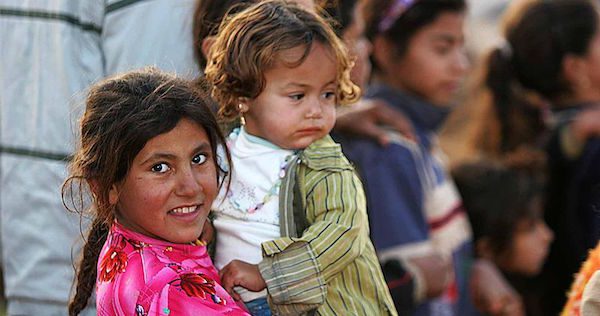
Iraqi refugee children in Damascus, Syria
Editors’ Note: This article is part of the Patheos Public Square on Immigration and Refugees. Read other perspectives here.
By Dale McGowan
Founding executive director, Foundation Beyond Belief
In the summer of 2013, I spent a lot of time imagining that I had lost everything—and it didn’t take much imagination.
It started with the F-5 tornado in Moore, Oklahoma. A young woman holding her toddler in front of the ruins of her home made me feel, viscerally, what it would be like to endure both the disaster itself and the disastrous aftermath.
Three weeks after the tornado, I was speaking in Oklahoma City and met that young woman. Her name was Rebecca Vitsmun. Like me, Rebecca was an atheist and a humanist, a fact she had to reveal unexpectedly on national television when Wolf Blitzer asked, with strange presumption, if she thanked the Lord for her survival.
That we shared a worldview had nothing to do with my empathy, though our shared identity as parents may well have. The moment I saw her holding that boy in front of the flatten house they had both been in, I felt it in my gut.
Fortunately, a humanist charitable foundation I led at the time called Foundation Beyond Belief gave the nonreligious community an effective outlet for our compassion. We mounted a drive that quickly raised over $50,000 to provide food aid and material relief for the tornado survivors.
Three months later, our staff became aware of the extent of the unfolding tragedy in and around Syria as two million refugees fled the Syrian civil war. International aid was falling desperately short of the need. Commentators drew unflattering comparisons between the crisis and other disasters that had drawn a more effective global response.
The problem was emotional and psychological: Donors respond most strongly to disasters that are sudden and visual and events in which they can directly relate to the victims. Terrorist attacks, earthquakes, and tsunamis all reach us visually and viscerally. A refugee crisis is more diffuse, slower moving – and more foreign to our imaginations. It is easy to understand the pain of displacement, but harder to really feel it.
In my mind, it was a perfect opportunity to rally the secular humanist community. Two values that animate humanists above all others are the value of rational responses over emotional ones, and the rejection of every form of tribalism. For many nonreligious people, both of these values represent a decisive step away from the most problematic aspects of religious community. They are especially keenly felt by those who were once religious, especially in conservative or dogmatic denominations.
The potential for human suffering in the refugee crisis was far greater in extent than any natural disaster in recent memory. That this potential had not yet manifested fully was an opportunity to get ahead of the curve. The fact that a “tribe” far from our own was doing the suffering was an opportunity to demonstrate our intention to be “citizens of the world.” And the fact that the world at large was failing to come through represented a chance to demonstrate our particular strengths as a movement.
So Foundation Beyond Belief mounted another fund drive to support the Syrian refugees. We selected International Rescue Committee (the IRC) as our beneficiary and provided our community with the facts and figures they needed to make a rational decision as donors.
And donations…trickled in.
It’s not that our donors lacked compassion. Far from it. The fairly small community of atheists and humanists had just poured their hearts into a large, successful drive just weeks earlier after the Oklahoma tornado. As a result, donor fatigue was a real factor. But I suspected that something else might be in play as well, something entirely understandable and very human—something to which atheists and humanists often think themselves immune.
Every community that articulates binding values is at risk of confusing the statement of those values with their achievement. Most atheists can rattle off a litany of those self-delusions for any given religious community. But we’re not as adept at seeing how we’ve mythologized ourselves.
Among our own delusions is the conviction that, by exiting religion under our own power, we had achieved pure rationality and freedom from tribalism. But seceding from our own human inheritance by fiat is easier said than done. My own daily life provides enough evidence to remind me that I’m neither fully rational nor fully free of chauvinistic loyalties.
To more effectively reach our donors, we added personal stories to the numbers, using the videos and written storytelling of the IRC to share the lives and experiences of individual refugee families. The data was still there – 2 million people externally displaced, 4.5 million internally displaced, an inadequate international response, 3,500 unaccompanied children crossing national borders, 35% of Syrian hospitals non-functional – but by adding this storytelling, we added opportunities for direct empathy. We provided a human face of this more distant and diffuse tragedy so donors could feel what they felt when they saw Rebecca standing in the ruins of her American home.
After we provided that human face, donations surged.
The following year, we launched a similar drive in the atheist and humanist community in support of unaccompanied minors who were arriving as refugees at the southern U.S. border. This time we struck a more effective balance from the start, bringing both reason and emotion to the effort.
But what about tribalism? Neither of these drives approached the level of support for the victims in Oklahoma—and I’m not convinced it was all fatigue. If the order of the drives had switched, I suspect Oklahoma would still have drawn a stronger response than Syria, not because our donors are humanists, but because they are humans. No matter how much we yearn to break free of our parochialism, our compassion is naturally strongest for sufferings we can relate to, and for people whose lives and situations are most like ours. It’s the same reason a massacre in France brings out a greater outpouring of grief and emotion from the West than even a much larger massacre in Baghdad or Nigeria.
Like many of our human inheritances, this is not a good thing, but it is a natural one—a product of evolution that leads us to protect and defend those who are closest to us and to over-emphasize that which divides us from “the other.”
Progressive religious communities are at their best when they urge their adherents to see themselves in the other, to recognize and transcend the concentric circles of diminishing empathy that emanate outward from us. And one of the reasons I’m proud to be a humanist is that humanism continues to articulate that urgent need, even as we struggle no less than the religious to achieve it.
Postscript: In a nice poetic circle, Rebecca Vitsmun, the atheist and humanist in Oklahoma who inspired so much compassion from our community, is now Development Coordinator for the Humanist Disaster Recovery Teams program of Foundation Beyond Belief.
This article is part of the August feature on Immigration, Refugees, Welcoming (or Rejecting) the “Other” for Patheos Public Square.
 Dale McGowan is the author and editor of 10 books about the nonreligious life. He was founding executive director of Foundation Beyond Belief, the world’s largest humanist charity, from 2009 to 2015. He is currently Director of Engagement and Managing Editor of the Atheist Channel at Patheos. He lives in Atlanta.
Top image by James Gordon – Iraqi refugee children, Damascus, Syria, CC BY 2.0
Previous Post

July 28, 2016
A Reason-Oriented Perspective on Meanings and Values
Next Post

August 11, 2016 Dissecting the GOP Platform with a Secular Scalpel
Browse Our Archives
Select a Category Ableism Activism Addiction and Recovery Agnosticism Anti-intellectualism Arts Atheism Beauty Catholicism Charles Darwin Children China Christianity Church/State separation churchgoing communication compassionate humanism Creationism critical thinking Culture death disaster response doubt education Egypt Entertainment Environment ethics evolution Existence of God Exploration fear Foundation Beyond Belief Free speech God Health History Human rights humanism identity India Interfaith Islam labels Language LGBT Love Meaning Media Medicine Middle East misconceptions mixed belief marriage Moral argument Morality Myths Near-Death Experience Nonreligious parenting Parody Persecution complex Philosophy Poetry Politics prayer Psychology Rationality Religion religious atheists Religious privilege Republican Party Satire Schools science secular parenting Spirituality The Unpigeonholeables Uncategorized United Kingdom Wonder
Select a Month March 2021 August 2020 March 2020 January 2020 September 2019 July 2019 June 2019 April 2019 February 2019 January 2019 December 2018 November 2018 October 2018 September 2018 August 2018 July 2018 June 2018 May 2018 April 2018 March 2018 February 2018 January 2018 December 2017 November 2017 October 2017 September 2017 August 2017 July 2017 March 2017 February 2017 January 2017 December 2016 November 2016 October 2016 September 2016 August 2016 July 2016 June 2016 May 2016 April 2016 March 2016 February 2016 January 2016 December 2015 November 2015 October 2015 September 2015 June 2015 March 2015 February 2015 January 2015 December 2014 November 2014 October 2014 September 2014
Follow Us!
TAKE THE
Religious Wisdom Quiz
Which Psalm prophesies the coming of the Messiah being rejected?
Select your answer to see how you score.
Psalm 51 Psalm 118 Psalm 137 Psalm 1
Related posts from The Secular Spectrum

Yasir Qadhi's Elitist Ruse to Conceal the Obscure...

How Religion Can Impact Mental Health in Good...

On Cognitive Dissonance and the Thought Patterns Behind...

Why Do We Question Vegetarianism When It's a...
TRENDING AT PATHEOS Nonreligious

Dethroning Jesus and Enthroning Yourself
Jesus Never Asked to Be Worshipped. He Asked to Be Understood. Christianity...

Why Most Christians are Really Paulians and Jobians
I Don't Care, But It Matters Let's get this out of the...

Essential Tips to Successfully Navigate the Selling Process
Selling a house can feel overwhelming, but it doesn’t have to be....

To Make Remote Work Effective, Think About Others
The COVID-19 pandemic forced many companies to rapidly transition to remote work....

Flexibility Is Key to Solving Problems of Tomorrow
The world of work is undergoing a dramatic transformation. The COVID-19 pandemic...
view all Nonreligious blogs
Ad-Free & Subscriber Log-In Subscription Support
- About Us
- 2026 Calendar
- Videos
- Podcasts
- Library of World Religions
- Faith In Media Tracker
- Advertise With Us
- Write for Us
- Privacy Policy
- Terms of Service
- Do Not Sell My Data
- Contact Us
- Radiant Digital
- Manage Newsletter Subscriptions
- Unsubscribe From Notifications
- Sitemap
Copyright 2008-2026, Patheos. All rights reserved.
Subscription Support Ad-Free & Subscriber Log-In
Follow Patheos