
BuddhistCatholicContemplativeEvangelicalGeneral ChristianHinduJewishLatter-day SaintMuslimNew VisionsProgressive Christian
Beliefs
- Buddhist
- Catholic
- Contemplative
- Evangelical
- General Christian
- Hindu
- Jewish
- Latter-day Saint
- More Voices
- Muslim
- New Visions
- Pagan
- Progressive Christian
Topics
- Religion News
- Food and Religion
- Sports and Religion
- Religious Art
- Religious Music and Entertainment
- Religious Events
- History and Religion
- Style and Religion
- Politics and Religion
- Women in Religion
- Recreation Outdoors and Religion
- Business Finance and Religion
- Careers Workplace and Religion
- Education and Religion
- Family Parenting and Religion
- Health Fitness and Religion
- Home and Religion
- Relationships and Religion
- Technology and Religion
- Travel and Religion
Columnists
- Buddhist Columnists
- Business Finance and Religion Columnists
- Careers Workplace and Religion Columnists
- Catholic Columnists
- Contemplative Columnists
- Education and Religion Columnists
- Evangelists Columnists
- Family Parenting and Religion Columnists
- General Christian Columnists
- Health Fitness and Religion Columnists
- Hindu Columnists
- History and Religion Columnists
- Home and Religion Columnists
- Jewish Columnists
- More Voices Columnists
- Latter Day Columnists
- Muslim Columnists
- New Visions Columnists
- Nonreligious Columnists
- Pagan Columnists
- Politics and Religion Columnists
- Progressive Columnists
- Recreation Outdoors and Religion Columnists
- Relationships and Religion Columnists
- Religion News Columnists
- Religious Art Columnists
- Religious Events Columnists
- Religious Music and Entertainment Columnists
- Sports and Religion Columnists
- Style and Religion Columnists
- Technology and Religion Columnists
- Travel and Religion Columnists
- Women in Religion Columnists
Resource Library
- 2026 Calendar
- Library of World Religions
- The 100 Most Holy Places on Earth
- Patheos Answers
- Podcasts
- Videos
- Faith Leaders Database
- Anglican Episcopalian
- Bahai
- Baptist
- Buddhism
- Christianity
- Confucianism
- Eastern Orthodoxy
- Hinduism
- Holiness and Pentecostal
- ISKCON
- Islam
- Judaism
- Lutheran
- Methodist
- The Church of Jesus Christ of Latter-day Saints
- New Age
- Paganism
- Presbytarian and Reformed
- Protestantism
- Religion Behind the Scenes
- Roman Catholic
- Scientology
- Shia Islam
- Sikhism
- Sufism
- Sunni Islam
- Taoism
- Zen
- See all religions
Research Tools
 Ad-Free & Subscriber Log-In Subscription Support
Ad-Free & Subscriber Log-In Subscription Support
Follow Patheos 

- Trending:
- Forgiveness
- |
- Marriage
- |
- Consciousness
- |
- Death Penalty
- |
- Election
- |
- Halloween
 The Secular Spectrum
- Home
- Nonreligious
- Why We’re Not Rational in Evaluating Others (And What The Science Suggests We Can Do About It)
Why We’re Not Rational in Evaluating Others (And What The Science Suggests We Can Do About It)
Last updated on: June 9, 2016 at 11:59 am by Gleb Tsipursky
Why We’re Not Rational in Evaluating Others (And What The Science Suggests We Can Do About It) 2016-06-09T11:59:13-05:00 Gleb Tsipursky
Patheos Explore the world's faith through different perspectives on religion and spirituality! Patheos has the views of the prevalent religions and spiritualities of the world.
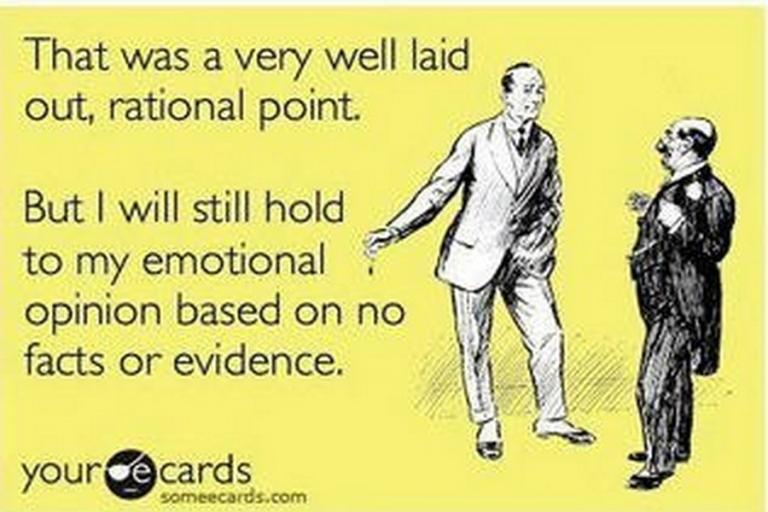
So imagine you are driving on autopilot, as we all do much of the time. Suddenly the car in front of you cuts you off quite unexpectedly. You slam your brakes and feel scared and indignant. Maybe you flash your lights or honk your horn at the other car. What’s your gut feeling about the other driver? I know my first reaction is that the driver is rude and obnoxious.
Now imagine a different situation. You’re driving on autopilot, minding your own business, and you suddenly realize you need to turn right at the next intersection. You quickly switch lanes and suddenly hear someone behind you honking their horn. You now realize that there was someone in your blind spot and you forgot to check it in the rush to switch lanes. So you cut them off pretty badly. Do you feel that you are a rude driver? The vast majority of us do not. After all, we did not deliberately cut that car off, we just failed to see the driver. Or let’s imagine another situation: say your friend hurt herself and you are rushing her to the emergency room. You are driving aggressively, cutting in front of others. Are you a rude driver? Not generally. You’re merely doing the right thing for the situation.
So why do we give ourselves a pass, while attributing an obnoxious status to others? Why does our gut always make us out to be the good guys, and other people bad guys? Clearly, there is a disconnect between our gut reaction and reality here. It turns out that this pattern is not a coincidence. Basically, our immediate gut reaction attributes the behavior of others to their personality and not to the situation in which the behavior occurs. The scientific name for this type of error in thinking and feeling is called the fundamental attribution error, also called the correspondence bias. So if we see someone behaving rudely, we immediately and intuitively feel that this person IS rude. We don’t automatically stop to consider whether an unusual situation may cause someone to act this way. With the driver example, maybe the person who cut you off did not see you. Or maybe they were driving their friend to the emergency room. But that’s not what our automatic reaction tells us. On the other hand, we attribute our own behavior to the situation, and not our personality. Much of the time, we feel like we have valid explanations for our actions.
Learning about the fundamental attribution error helped me quite a bit. I became less judgmental about others, including religious people. I realized that the people around me were not nearly as bad as my gut feelings immediately and intuitively assumed. This decreased my stress levels, and I gained more peace and calm. Moreover, I realized that my intuitive self-evaluation is excessively positive and that in reality I am not quite the good guy as my gut reaction tells me. Additionally, I realized that those around me who are unaware of this thinking and feeling error, are more judgmental of me than my intuition suggested. So I am striving to be more mindful and thoughtful about the impression I make on others.
The fundamental attribution error is one of many problems in our natural thinking and feeling patterns. It is certainly very helpful to learn about all of these errors, but it’s hard to focus on avoiding all of them in our daily life. A more effective strategy for evaluating reality more intentionally to have more clarity and thus gain greater agency is known as “map and territory.” This strategy involves recognizing the difference between the mental map of the world that we have in our heads and the reality of the actual world as it exists – the territory.
For myself, internalizing this concept has not been easy. It’s been painful to realize that my understanding of the world is by definition never perfect, as my map will never match the territory. At the same time, this realization was strangely freeing. It made me recognize that no one is perfect, and that I do not have to strive for perfection in my view of the world. Instead, what would most benefit me is to try to refine my map to make it more accurate. This more intentional approach made me more willing to admit to myself that though I intuitively and emotionally feel something is right, I may be mistaken. At the same time, the concept of map and territory makes me really optimistic, because it provides a constant opportunity to learn and improve my assessment of the situation. Others to whom I taught this concept in videotaped workshops for Intentional Insights also benefitted from learning about both the fundamental attribution error and the idea of map and territory. One workshop participant wrote in an anonymous feedback form: “with relation to the fundamental attribution error, it can give me a chance to keep a more open mind, which will help me to relate to others more, and view a different view of the “map” in my head.”
So what do you think of the concept of map and territory? How do you think they can help you in your life?
Previous Post

May 31, 2016
The Fight to Ban Clergy from Bathrooms
Next Post

June 13, 2016 Reason Rally for Us All
Browse Our Archives
Select a Category Ableism Activism Addiction and Recovery Agnosticism Anti-intellectualism Arts Atheism Beauty Catholicism Charles Darwin Children China Christianity Church/State separation churchgoing communication compassionate humanism Creationism critical thinking Culture death disaster response doubt education Egypt Entertainment Environment ethics evolution Existence of God Exploration fear Foundation Beyond Belief Free speech God Health History Human rights humanism identity India Interfaith Islam labels Language LGBT Love Meaning Media Medicine Middle East misconceptions mixed belief marriage Moral argument Morality Myths Near-Death Experience Nonreligious parenting Parody Persecution complex Philosophy Poetry Politics prayer Psychology Rationality Religion religious atheists Religious privilege Republican Party Satire Schools science secular parenting Spirituality The Unpigeonholeables Uncategorized United Kingdom Wonder
Select a Month March 2021 August 2020 March 2020 January 2020 September 2019 July 2019 June 2019 April 2019 February 2019 January 2019 December 2018 November 2018 October 2018 September 2018 August 2018 July 2018 June 2018 May 2018 April 2018 March 2018 February 2018 January 2018 December 2017 November 2017 October 2017 September 2017 August 2017 July 2017 March 2017 February 2017 January 2017 December 2016 November 2016 October 2016 September 2016 August 2016 July 2016 June 2016 May 2016 April 2016 March 2016 February 2016 January 2016 December 2015 November 2015 October 2015 September 2015 June 2015 March 2015 February 2015 January 2015 December 2014 November 2014 October 2014 September 2014
Follow Us!
TAKE THE
Religious Wisdom Quiz
How many days did God take to create the world?
Select your answer to see how you score.
Two Seven Six Ten
Related posts from The Secular Spectrum

Yasir Qadhi's Elitist Ruse to Conceal the Obscure...

Despite "Pro-Life" Claims, Stem Cell Therapy Has Very...

How Religion Can Impact Mental Health in Good...

On Cognitive Dissonance and the Thought Patterns Behind...
TRENDING AT PATHEOS Nonreligious

Dethroning Jesus and Enthroning Yourself
Jesus Never Asked to Be Worshipped. He Asked to Be Understood. Christianity...

Why Most Christians are Really Paulians and Jobians
I Don't Care, But It Matters Let's get this out of the...

Essential Tips to Successfully Navigate the Selling Process
Selling a house can feel overwhelming, but it doesn’t have to be....

To Make Remote Work Effective, Think About Others
The COVID-19 pandemic forced many companies to rapidly transition to remote work....

Flexibility Is Key to Solving Problems of Tomorrow
The world of work is undergoing a dramatic transformation. The COVID-19 pandemic...
view all Nonreligious blogs
Ad-Free & Subscriber Log-In Subscription Support
- About Us
- 2026 Calendar
- Videos
- Podcasts
- Library of World Religions
- Faith In Media Tracker
- Advertise With Us
- Write for Us
- Privacy Policy
- Terms of Service
- Do Not Sell My Data
- Contact Us
- Radiant Digital
- Manage Newsletter Subscriptions
- Unsubscribe From Notifications
- Sitemap
Copyright 2008-2026, Patheos. All rights reserved.
Subscription Support Ad-Free & Subscriber Log-In
Follow Patheos