
BuddhistCatholicContemplativeEvangelicalGeneral ChristianHinduJewishLatter-day SaintMuslimNew VisionsProgressive Christian
Beliefs
- Buddhist
- Catholic
- Contemplative
- Evangelical
- General Christian
- Hindu
- Jewish
- Latter-day Saint
- More Voices
- Muslim
- New Visions
- Pagan
- Progressive Christian
Topics
- Religion News
- Food and Religion
- Sports and Religion
- Religious Art
- Religious Music and Entertainment
- Religious Events
- History and Religion
- Style and Religion
- Politics and Religion
- Women in Religion
- Recreation Outdoors and Religion
- Business Finance and Religion
- Careers Workplace and Religion
- Education and Religion
- Family Parenting and Religion
- Health Fitness and Religion
- Home and Religion
- Relationships and Religion
- Technology and Religion
- Travel and Religion
Columnists
- Buddhist Columnists
- Business Finance and Religion Columnists
- Careers Workplace and Religion Columnists
- Catholic Columnists
- Contemplative Columnists
- Education and Religion Columnists
- Evangelists Columnists
- Family Parenting and Religion Columnists
- General Christian Columnists
- Health Fitness and Religion Columnists
- Hindu Columnists
- History and Religion Columnists
- Home and Religion Columnists
- Jewish Columnists
- More Voices Columnists
- Latter Day Columnists
- Muslim Columnists
- New Visions Columnists
- Nonreligious Columnists
- Pagan Columnists
- Politics and Religion Columnists
- Progressive Columnists
- Recreation Outdoors and Religion Columnists
- Relationships and Religion Columnists
- Religion News Columnists
- Religious Art Columnists
- Religious Events Columnists
- Religious Music and Entertainment Columnists
- Sports and Religion Columnists
- Style and Religion Columnists
- Technology and Religion Columnists
- Travel and Religion Columnists
- Women in Religion Columnists
Resource Library
- 2026 Calendar
- Library of World Religions
- The 100 Most Holy Places on Earth
- Patheos Answers
- Podcasts
- Videos
- Faith Leaders Database
- Anglican Episcopalian
- Bahai
- Baptist
- Buddhism
- Christianity
- Confucianism
- Eastern Orthodoxy
- Hinduism
- Holiness and Pentecostal
- ISKCON
- Islam
- Judaism
- Lutheran
- Methodist
- The Church of Jesus Christ of Latter-day Saints
- New Age
- Paganism
- Presbytarian and Reformed
- Protestantism
- Religion Behind the Scenes
- Roman Catholic
- Scientology
- Shia Islam
- Sikhism
- Sufism
- Sunni Islam
- Taoism
- Zen
- See all religions
Research Tools
 Ad-Free & Subscriber Log-In Subscription Support
Ad-Free & Subscriber Log-In Subscription Support
Follow Patheos 

- Trending:
- Forgiveness
- |
- Marriage
- |
- Consciousness
- |
- Death Penalty
- |
- Election
- |
- Halloween
 The Secular Spectrum
- Home
- Nonreligious
- Unnatural Selection
Unnatural Selection
Last updated on: May 3, 2016 at 5:58 pm by Stephanie Savage
Unnatural Selection 2016-05-03T17:58:43-05:00 Stephanie Savage
Patheos Explore the world's faith through different perspectives on religion and spirituality! Patheos has the views of the prevalent religions and spiritualities of the world.
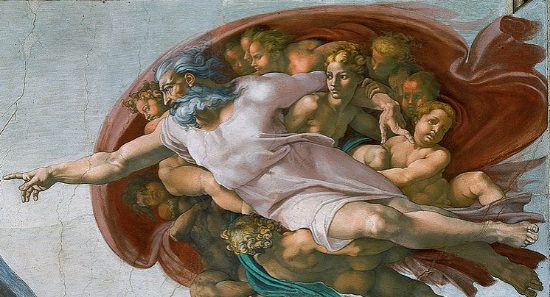
No, God isn’t saying pull my finger.
After the publication of On the Origin of Species, religious naturalists found themselves in a pickle. The tide of scientific thought had turned heavily toward evolution, with its wealth of compelling evidence. Yet natural selection was anathema to the devout. Random variation? Survival of the fittest? Where did God fit in when it was every species for itself, with no benevolent Creator as a guiding force?
Thus was born theistic evolution, a school of thought that seemingly died at the end of the 19th century, only to be revived in the modern era by such scientists as Francis Collins. We are still living with the legacy of what was intended by well-meaning believers as a means to reconcile evolution with their deeply held religious beliefs.
Creationists and IDers, too, have picked up many anti-Darwinian arguments from 19th century theistic evolutionists in order to falsify the very existence of evolution. The complexity of the eye is frequently cited. How could part of an eye see? Well, it works pretty well for sea anemones, thank you very much.
Yet theistic evolutionists were attempting to do the exact opposite. It wasn’t about disproving evolution, but clearing a space for God’s involvement in the evolutionary process. (You’re eyes are probably doing a pirouette right now, but bear with me here.)
Deism played a crucial role in freeing science from filing every unknown blank with…and then there was a miracle, as I’ve written about in part one and part two of this series on religion’s role in the evolution of evolutionary thought. For deists, God set the laws of nature in motion, then went off on a package tour of the universe. Even non-deists adopted deistic views of nature’s laws. It became uncool to plug the supernatural into scientific theories. Still, for many, natural selection was uncomfortably close to admitting that there was no need for God at all.
No duh.
By the end of the century, theories that were once condemned as atheistic became a fallback position for those fighting to maintain a role for God in the guiding of evolution. The supposed perfection of design was no longer a defensible argument for the hand of God (though it’s still popular with the intelligent design crowd). Instead, theistic evolutionary theories looked to regular patterns of evolution. Surely it wasn’t a coincidence that the eye of cephalopods so resembled that of humans.
Convergent evolution, anyone? But it’s unfair for me to judge 19th century thinkers with the snark of hindsight just because they didn’t understand what we know now.
Theistic evolutionists attempted to carve out an evolutionary compromise they could feel comfortable with. Yes, according to a modern mindset, this wasn’t good science. Indeed, even among their contemporaries, that became the prevailing attitude, sounding the death knell for their movement. But you have to spare a little sympathy for people honestly grasping at ways to preserve their personal beliefs while still maintaining their scientific integrity.
Their path was paved by Lamarckism. Surely use-inheritance would allow God to build a mechanism for progressive evolution into species without direct intervention. And didn’t the fossil record seem to suggest a linear progression like you would expect with Lamarckism? It certainly seemed to for most paleontologists of the time.
Another competing theory of evolution, orthogenesis, was also favored by those who sought a roll for God in the evolutionary process. Orthogenesis postulated an internal drive or vital force that drew organisms inexorably toward a particular goal, much like the siren call of a bakery window when you’re on a diet.

Darwin’s finches.
As I mentioned in The Abuse of Use and Disuse, On the Origin of Species became increasingly Lamarckian in its later editions. But that had more to do with Darwin searching for a mechanism of heredity, in those pre-Mendelian days.
Darwin fervently believed in the natural part of natural selection. But for others, Lamarckism was a grasp for a God-friendly, yet still essentially mechanistic, theory of evolution. Though Lamarckism was less directed than orthogenesis, both theories permitted God to be ultimately in the driver seat. For many naturalists, selectionism was far too materialistic for them to embrace.
The fact of the matter is that creationists are right about one thing—shh, don’t tell them—evolution does indeed lead to atheism. Without Darwinism, there would be no atheist movement today. Indeed, it led Darwin himself to nonbelief. If life could evolve from a single-celled organism into a human being, what do you need a creator-god for?
Yet for the Francis Collins’s of the world, who can’t let go of their faith, they have to compartmentalize their beliefs from the scientific evidence they know to be true. You would think their brains would go kablooey like the computers in Star Trek when fed contradictory information. Does not compute! Does not compute!
But I prefer this kind of psychological legerdemain to the ignorance, misinformation, and outright lies doled out by creationists and its ID offshoot. I’ve read the assertion that all the human fossils found could fit on the top of a piano. The famous Australopithecus afarensis, Lucy, could do that on her own. 19th century theistic evolutionists were earnestly trying to come up with evolutionary mechanisms compatible with their faith. Present day creationists distort scientific evidence to disprove the very existence of evolution.
Francis Collins has been drawing up a 21st century version of theistic evolution called BioLogos. While his quest is surely quixotic, his neo-theistic evolutionism is a sign of how far we’ve come. I look at this as another step in a long process that began when natural philosophers began postulating theories without recourse to divine providence, often thanks to our friends the deists. We’re not there yet, but remember that it has only been a century and a half plus since On the Origin of Species was published.
According to a 1998 study by Edward J. Larson and Larry Witham:
Disbelief in God and immortality among NAS [National Academy of Sciences]biological scientists was 65.2% and 69.0%, respectively, and among NAS physical scientists it was 79.0% and 76.3%. Most of the rest were agnostics on both issues, with few believers.
They were replicating a famous 1933 study by atheist James H. Leuba, who expected that the already high proportion of disbelief or doubt among top scientists his study revealed—70%—would further grow as time went on. That’s exactly what they found.
You might fairly accuse me of cherry picking (there are a number of issues regarding these surveys I plan to delve into in a future post). But Larson and Witham’s results were far more in line with my expectations than the 2007 Rice University study I cited in my last post. In that study, 41% of biologists proclaimed a belief in God.
A 1991 Gallup poll of scientists aligned closely with the Rice University findings, but it didn’t break down scientists by field. Is it a coincidence that the handful of creationist scientists all come from fields that don’t touch on biology or deep time? A chemist and a biologist are not equivalent when it comes to attitudes about a creator-god; the Larson and Witham survey drew from scientists in the natural science fields (as well as mathematics).
Atheists can’t do anything about the latent longing for God in some scientists. But just as organisms evolve, so do cultures. And God has been fighting a rearguard action in science since 1859.
Previous Post

April 14, 2016
What is the Meaning of Life for You?
Next Post

April 18, 2016 Is God Needed For Finding Meaning and Purpose? Science Says No!
Browse Our Archives
Select a Category Ableism Activism Addiction and Recovery Agnosticism Anti-intellectualism Arts Atheism Beauty Catholicism Charles Darwin Children China Christianity Church/State separation churchgoing communication compassionate humanism Creationism critical thinking Culture death disaster response doubt education Egypt Entertainment Environment ethics evolution Existence of God Exploration fear Foundation Beyond Belief Free speech God Health History Human rights humanism identity India Interfaith Islam labels Language LGBT Love Meaning Media Medicine Middle East misconceptions mixed belief marriage Moral argument Morality Myths Near-Death Experience Nonreligious parenting Parody Persecution complex Philosophy Poetry Politics prayer Psychology Rationality Religion religious atheists Religious privilege Republican Party Satire Schools science secular parenting Spirituality The Unpigeonholeables Uncategorized United Kingdom Wonder
Select a Month March 2021 August 2020 March 2020 January 2020 September 2019 July 2019 June 2019 April 2019 February 2019 January 2019 December 2018 November 2018 October 2018 September 2018 August 2018 July 2018 June 2018 May 2018 April 2018 March 2018 February 2018 January 2018 December 2017 November 2017 October 2017 September 2017 August 2017 July 2017 March 2017 February 2017 January 2017 December 2016 November 2016 October 2016 September 2016 August 2016 July 2016 June 2016 May 2016 April 2016 March 2016 February 2016 January 2016 December 2015 November 2015 October 2015 September 2015 June 2015 March 2015 February 2015 January 2015 December 2014 November 2014 October 2014 September 2014
Follow Us!
TAKE THE
Religious Wisdom Quiz
I became queen through a beauty contest, hiding my Jewish identity at my cousin's advice. Who am I?
Select your answer to see how you score.
Vashti Esther Sarah Ruth
Related posts from The Secular Spectrum

Yasir Qadhi's Elitist Ruse to Conceal the Obscure...

Despite "Pro-Life" Claims, Stem Cell Therapy Has Very...

On Cognitive Dissonance and the Thought Patterns Behind...

Reaching 'Faith Healers' Is an Urgent Public Health...
TRENDING AT PATHEOS Nonreligious

Dethroning Jesus and Enthroning Yourself
Jesus Never Asked to Be Worshipped. He Asked to Be Understood. Christianity...

Why Most Christians are Really Paulians and Jobians
I Don't Care, But It Matters Let's get this out of the...

Essential Tips to Successfully Navigate the Selling Process
Selling a house can feel overwhelming, but it doesn’t have to be....

To Make Remote Work Effective, Think About Others
The COVID-19 pandemic forced many companies to rapidly transition to remote work....

Flexibility Is Key to Solving Problems of Tomorrow
The world of work is undergoing a dramatic transformation. The COVID-19 pandemic...
view all Nonreligious blogs
Ad-Free & Subscriber Log-In Subscription Support
- About Us
- 2026 Calendar
- Videos
- Podcasts
- Library of World Religions
- Faith In Media Tracker
- Advertise With Us
- Write for Us
- Privacy Policy
- Terms of Service
- Do Not Sell My Data
- Contact Us
- Radiant Digital
- Manage Newsletter Subscriptions
- Unsubscribe From Notifications
- Sitemap
Copyright 2008-2026, Patheos. All rights reserved.
Subscription Support Ad-Free & Subscriber Log-In
Follow Patheos