
BuddhistCatholicContemplativeEvangelicalGeneral ChristianHinduJewishLatter-day SaintMuslimNew VisionsProgressive Christian
Beliefs
- Buddhist
- Catholic
- Contemplative
- Evangelical
- General Christian
- Hindu
- Jewish
- Latter-day Saint
- More Voices
- Muslim
- New Visions
- Pagan
- Progressive Christian
Topics
- Religion News
- Food and Religion
- Sports and Religion
- Religious Art
- Religious Music and Entertainment
- Religious Events
- History and Religion
- Style and Religion
- Politics and Religion
- Women in Religion
- Recreation Outdoors and Religion
- Business Finance and Religion
- Careers Workplace and Religion
- Education and Religion
- Family Parenting and Religion
- Health Fitness and Religion
- Home and Religion
- Relationships and Religion
- Technology and Religion
- Travel and Religion
Columnists
- Buddhist Columnists
- Business Finance and Religion Columnists
- Careers Workplace and Religion Columnists
- Catholic Columnists
- Contemplative Columnists
- Education and Religion Columnists
- Evangelists Columnists
- Family Parenting and Religion Columnists
- General Christian Columnists
- Health Fitness and Religion Columnists
- Hindu Columnists
- History and Religion Columnists
- Home and Religion Columnists
- Jewish Columnists
- More Voices Columnists
- Latter Day Columnists
- Muslim Columnists
- New Visions Columnists
- Nonreligious Columnists
- Pagan Columnists
- Politics and Religion Columnists
- Progressive Columnists
- Recreation Outdoors and Religion Columnists
- Relationships and Religion Columnists
- Religion News Columnists
- Religious Art Columnists
- Religious Events Columnists
- Religious Music and Entertainment Columnists
- Sports and Religion Columnists
- Style and Religion Columnists
- Technology and Religion Columnists
- Travel and Religion Columnists
- Women in Religion Columnists
Resource Library
- 2026 Calendar
- Library of World Religions
- The 100 Most Holy Places on Earth
- Patheos Answers
- Podcasts
- Videos
- Faith Leaders Database
- Anglican Episcopalian
- Bahai
- Baptist
- Buddhism
- Christianity
- Confucianism
- Eastern Orthodoxy
- Hinduism
- Holiness and Pentecostal
- ISKCON
- Islam
- Judaism
- Lutheran
- Methodist
- The Church of Jesus Christ of Latter-day Saints
- New Age
- Paganism
- Presbytarian and Reformed
- Protestantism
- Religion Behind the Scenes
- Roman Catholic
- Scientology
- Shia Islam
- Sikhism
- Sufism
- Sunni Islam
- Taoism
- Zen
- See all religions
Research Tools
 Ad-Free & Subscriber Log-In Subscription Support
Ad-Free & Subscriber Log-In Subscription Support
Follow Patheos 

- Trending:
- Forgiveness
- |
- Marriage
- |
- Consciousness
- |
- Death Penalty
- |
- Election
- |
- Halloween
 The Secular Spectrum
- Home
- Nonreligious
- Secular Civic Engagement and Your Life Purpose
Secular Civic Engagement and Your Life Purpose
Last updated on: March 6, 2016 at 9:57 pm by Gleb Tsipursky
Secular Civic Engagement and Your Life Purpose 2016-03-06T21:57:10-05:00 Gleb Tsipursky
Patheos Explore the world's faith through different perspectives on religion and spirituality! Patheos has the views of the prevalent religions and spiritualities of the world.
I remember how in November 2013 my wife (and fellow Intentional Insights co-founder) and I, together with a great bunch of people, organized a spaghetti dinner fundraiser at our Unitarian Universalist church in Columbus, OH. The event was a big success, with more than 120 attendees, a music program, a raffle and silent auction. We raised over $2000 for the Mid-Ohio Food Bank. It might surprise you that the dinner organizers and volunteers came from Columbus secular humanist, atheist, and skeptic groups, including the UU secular group, as this religious denomination embraces believers and non-believers alike. The dinner honored the Flying Spaghetti Monster, a light satire meant to promote reason-based scientific education in biology classes. No belief in a deity was required to participate in community-oriented civic engagement at this dinner – in fact, the event was explicitly oriented toward secular-minded folks.
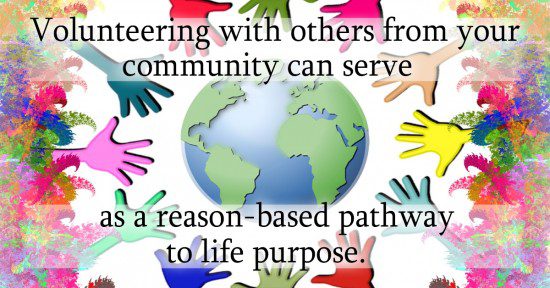
Studies indicate that opportunities to serve others, whether in civic, private, or professional settings, as well as charitable giving, result in a stronger sense of purpose and meaning in life, leading to better mental and physical well-being. This does not mean that serving others is necessary for a strong sense of meaning and purpose, but such civic engagement generally helps contribute to gaining this sense. Volunteering together with others in your community enables the creation of strong social bonds, which adds further to a sense of meaningfulness. In the United States, religion offers the main venue for community belonging, and also for working with others to pursue civic engagement. Civic engagement ranges from donating one’s time to bring about a better world such as through the spaghetti dinner fundraiser described above, to pursuing social justice through advocacy and lobbying, as exemplified by BREAD, the main interfaith social justice organization in Central Ohio. No wonder that the majority of the research indicates that church-going believers in the US generally have a stronger sense of life meaning. However, as my research illustrates, other societies create many alternative venues besides religious ones that provided similar opportunities and the benefits that can result (check out this brief video based on my research to learn more).
So is there something similar happening in North America? Here’s the thing: there are more and more secular communities around, and they are actively participating in social justice activities. Just here in Columbus, besides the FSM dinner, the Humanist Community of Central Ohio does regular blood donations, which were featured in the main newspaper in Central Ohio, participates in LGBTQ activism, and promotes other forms of social and economic civic engagement. The local chapter of the United Coalition of Reason hosted a walk-a-thon to benefit the Leukemia and Lymphoma Society, part of a broader national effort by the Foundation Beyond Belief. And COUNT, a Columbus secular group, is explicitly dedicated to volunteering. My wife and I have also led a year-long effort to get BREAD to open up its doors to secular folks, and then successfully mobilized a large contingent of non-believers to attend this event. National secular organizations, such as the Secular Student Alliance and the Secular Coalition for America, increasingly promote civic engagement. More and more opportunities are emerging for nonbelievers who want to volunteer together with others who share their value system, whether for more secular-themed causes such as Camp Quest, reason-based summer camps for children and youth, or social justice in general.
A particularly promising new trend in civic engagement is Effective Altruism. This movement is devoted to using well-reasoned, evidence-based approaches to find the most effective ways to improve the world, especially through charitable giving. Prominent secular notables are turning to Effective Altruism as the most reason-based, rational strategy of giving. Effective Altruism is endorsed by prominent secular philosophers such as Peter Singer. It includes organizations such as Giving What We Can, GiveWell, and 80,000 Hours. Your dollars will do the most good for the world through Effective Altruism!
What are the practical takeaways here? Whether you are a believer or secular, to gain a greater sense of purpose and meaning in life it helps to participate in civic engagement with others from your community. It might be more challenging if you are a non-believer, but there are plenty of local secular groups around the United States that offer opportunities to contribute to social justice on a local level. Take the initiative to push your local communities to do service for the social good. You will likely help yourself and others find a more powerful perception of life meaning, increase mental and physical well-being for yourself and others, and you can gain greater agency through achieving your personal and social goals. Here, altruism and self-orientation combine for the win!
- Have you done any volunteering with others in your social circle?
- If so, what benefits do you think you gained?
- If not, what are practical steps you can take to help yourself and others in your social circle engage in social service activities?
Previous Post

March 3, 2016
Born Free (of God)
Next Post
March 9, 2016 Caught in the Web of @theist Dating
Browse Our Archives
Select a Category Ableism Activism Addiction and Recovery Agnosticism Anti-intellectualism Arts Atheism Beauty Catholicism Charles Darwin Children China Christianity Church/State separation churchgoing communication compassionate humanism Creationism critical thinking Culture death disaster response doubt education Egypt Entertainment Environment ethics evolution Existence of God Exploration fear Foundation Beyond Belief Free speech God Health History Human rights humanism identity India Interfaith Islam labels Language LGBT Love Meaning Media Medicine Middle East misconceptions mixed belief marriage Moral argument Morality Myths Near-Death Experience Nonreligious parenting Parody Persecution complex Philosophy Poetry Politics prayer Psychology Rationality Religion religious atheists Religious privilege Republican Party Satire Schools science secular parenting Spirituality The Unpigeonholeables Uncategorized United Kingdom Wonder
Select a Month March 2021 August 2020 March 2020 January 2020 September 2019 July 2019 June 2019 April 2019 February 2019 January 2019 December 2018 November 2018 October 2018 September 2018 August 2018 July 2018 June 2018 May 2018 April 2018 March 2018 February 2018 January 2018 December 2017 November 2017 October 2017 September 2017 August 2017 July 2017 March 2017 February 2017 January 2017 December 2016 November 2016 October 2016 September 2016 August 2016 July 2016 June 2016 May 2016 April 2016 March 2016 February 2016 January 2016 December 2015 November 2015 October 2015 September 2015 June 2015 March 2015 February 2015 January 2015 December 2014 November 2014 October 2014 September 2014
Follow Us!
TAKE THE
Religious Wisdom Quiz
Where was Jesus' first miracle performed?
Select your answer to see how you score.
Jerusalem Capernaum Nazareth Cana
Related posts from The Secular Spectrum

Yasir Qadhi's Elitist Ruse to Conceal the Obscure...

How Religion Can Impact Mental Health in Good...

On Cognitive Dissonance and the Thought Patterns Behind...

Why Do We Question Vegetarianism When It's a...
TRENDING AT PATHEOS Nonreligious

Dethroning Jesus and Enthroning Yourself
Jesus Never Asked to Be Worshipped. He Asked to Be Understood. Christianity...

Why Most Christians are Really Paulians and Jobians
I Don't Care, But It Matters Let's get this out of the...

Essential Tips to Successfully Navigate the Selling Process
Selling a house can feel overwhelming, but it doesn’t have to be....

To Make Remote Work Effective, Think About Others
The COVID-19 pandemic forced many companies to rapidly transition to remote work....

Flexibility Is Key to Solving Problems of Tomorrow
The world of work is undergoing a dramatic transformation. The COVID-19 pandemic...
view all Nonreligious blogs
Ad-Free & Subscriber Log-In Subscription Support
- About Us
- 2026 Calendar
- Videos
- Podcasts
- Library of World Religions
- Faith In Media Tracker
- Advertise With Us
- Write for Us
- Privacy Policy
- Terms of Service
- Do Not Sell My Data
- Contact Us
- Radiant Digital
- Manage Newsletter Subscriptions
- Unsubscribe From Notifications
- Sitemap
Copyright 2008-2026, Patheos. All rights reserved.
Subscription Support Ad-Free & Subscriber Log-In
Follow Patheos