
BuddhistCatholicContemplativeEvangelicalGeneral ChristianHinduJewishLatter-day SaintMuslimNew VisionsProgressive Christian
Beliefs
- Buddhist
- Catholic
- Contemplative
- Evangelical
- General Christian
- Hindu
- Jewish
- Latter-day Saint
- More Voices
- Muslim
- New Visions
- Pagan
- Progressive Christian
Topics
- Religion News
- Food and Religion
- Sports and Religion
- Religious Art
- Religious Music and Entertainment
- Religious Events
- History and Religion
- Style and Religion
- Politics and Religion
- Women in Religion
- Recreation Outdoors and Religion
- Business Finance and Religion
- Careers Workplace and Religion
- Education and Religion
- Family Parenting and Religion
- Health Fitness and Religion
- Home and Religion
- Relationships and Religion
- Technology and Religion
- Travel and Religion
Columnists
- Buddhist Columnists
- Business Finance and Religion Columnists
- Careers Workplace and Religion Columnists
- Catholic Columnists
- Contemplative Columnists
- Education and Religion Columnists
- Evangelists Columnists
- Family Parenting and Religion Columnists
- General Christian Columnists
- Health Fitness and Religion Columnists
- Hindu Columnists
- History and Religion Columnists
- Home and Religion Columnists
- Jewish Columnists
- More Voices Columnists
- Latter Day Columnists
- Muslim Columnists
- New Visions Columnists
- Nonreligious Columnists
- Pagan Columnists
- Politics and Religion Columnists
- Progressive Columnists
- Recreation Outdoors and Religion Columnists
- Relationships and Religion Columnists
- Religion News Columnists
- Religious Art Columnists
- Religious Events Columnists
- Religious Music and Entertainment Columnists
- Sports and Religion Columnists
- Style and Religion Columnists
- Technology and Religion Columnists
- Travel and Religion Columnists
- Women in Religion Columnists
Resource Library
- 2026 Calendar
- Library of World Religions
- The 100 Most Holy Places on Earth
- Patheos Answers
- Podcasts
- Videos
- Faith Leaders Database
- Anglican Episcopalian
- Bahai
- Baptist
- Buddhism
- Christianity
- Confucianism
- Eastern Orthodoxy
- Hinduism
- Holiness and Pentecostal
- ISKCON
- Islam
- Judaism
- Lutheran
- Methodist
- The Church of Jesus Christ of Latter-day Saints
- New Age
- Paganism
- Presbytarian and Reformed
- Protestantism
- Religion Behind the Scenes
- Roman Catholic
- Scientology
- Shia Islam
- Sikhism
- Sufism
- Sunni Islam
- Taoism
- Zen
- See all religions
Research Tools
 Ad-Free & Subscriber Log-In Subscription Support
Ad-Free & Subscriber Log-In Subscription Support
Follow Patheos 

- Trending:
- Forgiveness
- |
- Marriage
- |
- Consciousness
- |
- Death Penalty
- |
- Election
- |
- Halloween
 The Secular Spectrum
- Home
- Nonreligious
- A Secular Purpose-Driven Life
A Secular Purpose-Driven Life
Last updated on: February 23, 2016 at 3:44 pm by Guest Contributor
A Secular Purpose-Driven Life 2016-02-23T15:44:03-05:00 Guest Contributor
Patheos Explore the world's faith through different perspectives on religion and spirituality! Patheos has the views of the prevalent religions and spiritualities of the world.
By Gleb Tsipursky
How can you find purpose and meaning from a secular perspective?
Mike meets regularly with friends and acquaintances from his neighborhood in a large building. There, he enjoys listening to presentations about big life questions: on the meaning of life, on the nature of morality, on ethical behavior, etc. He participates in study circles that engage with these questions in more depth. Mike sings, dances, and enjoys musical performances there. Together with others, he volunteers to help clean up the streets and build housing for poor people in the neighborhood.
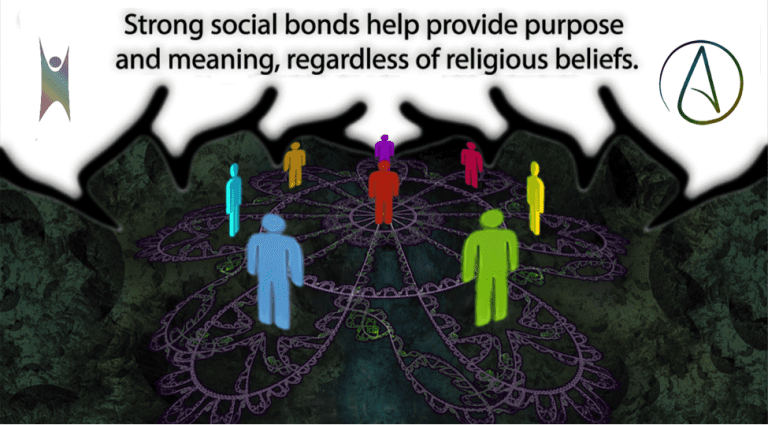
Research generally shows that those who believe in God and go to church have an overall more powerful sense of purpose and meaning in life, although some recent studies nuance these conclusions. As research shows, a strong perception of meaning in life leads to significantly higher mental well-being and physical health. But is it the belief in God the cause that creates this stronger sense of life meaning and purpose, or is something else going on? Other research indicates that religion satisfies people’s desire to belong. Studies show that people have a higher sense of life meaning and purpose when they are part of a community and have strong social bonds. Likewise, people have a stronger sense of life meaning when they have an opportunity to reflect on this question, by themselves and especially together with others. Religion provides the primary opportunity for community ties and the main venue for discussing life meaning and purpose, at least in the United States. In other societies different institutions offer many of the same benefits as churches do in the US.
Well, what about Mike? After all, through his activities, he gains social bonds and community connections, chances for serving others, and places to reflect on big life questions – all the components that make up gaining a sense of meaning and purpose. Mike’s full name is not Michael, but Mikhail, and his experience describes the prototypical experience of Soviet citizens in state-sponsored community activities. For example, the future Soviet leader Mikhail Gorbachev described in his memoirs how much he and other Soviet citizens enjoyed such events: according to him, “everybody was keen to participate” (pg. 6). The Soviet Union is typically perceived as a militaristic and grey society, with a government that oriented all of its efforts to taking over the world. Well, that’s simply not true, as the Soviet authorities put a lot of resources into providing its citizens with opportunities to find meaning and purpose in life, as well as fun and pleasure – although they also certainly wanted to spread communism throughout the world, and put a lot of efforts into this goal as well. To understand how the USSR’s government helped its citizens gain a greater sense of meaning and purpose, I spent over a decade investigating government reports in archives across the Soviet Union, exploring national and local newspapers, read memoirs and diaries, and interviewed over fifty former Soviet citizens. The answer: to a large extent, through government-sponsored community and cultural centers called kluby (clubs). These venues, and other ones such as discos, replaced in many ways the social function provided by churches, offering Soviet citizens social and community connections, chances for serving others, and places to reflect on meaning and purpose in life, in a setting that combined state sponsorship with grassroots engagement.

Scene in the Soviet opera Arkhimed at a Soviet club. Image from the private archive of M. A. Lebedeva. (For more on Arkhimed, see Tsipursky, “Having Fun in the Thaw”).

Banquet after a performance of Arkhimed. Image from private archive of M. A. Lebedeva.
Present-day societies with a more secular orientation than the United States have similar stories to tell, as illustrated by research on contemporary Denmark and Sweden. Most Danes and Swedes do not worship any god. At the same time these countries score at the very top of the “happiness index,” have very low crime and corruption rates, great educational systems, strong economies, well-supported arts, free health care, egalitarian social policies. They have a wide variety of strong social institutions that provide community connections, opportunities for serving others, and other benefits that religion provides in the United States.
So believing in God and going to church is not the only way to attain a strong sense of life purpose and meaning. You can gain it in venues that are secular and provide an opportunity for community ties and a chance to reflect on life purpose and meaning just as religious communities have traditionally offered. Research indicates that those who engage with such deep questions in a setting that does not expect conformity to a specific dogma overall gain a deeper perception of meaning and purpose.
In the United States, such venues are few and far between, but their numbers are growing. Right here in Columbus, OH, you can join the Humanist Community of Central Ohio, an affiliate of the American Humanist Association. Other groups that provide local affiliates the:
- Freedom From Religion Foundation
- Center for Inquiry
- Foundation Beyond Belief
- Sunday Assembly
- Secular Coalition for America
- Black Free Thinkers
- Recovering from Religion
- American Ethical Union
- United Coalition of Reason
- American Atheists
- People of Color Beyond Faith
- Americans United for the Separation of Church and State
- African Americans for Humanism
- Skeptics Society
- Hispanic Secular Humanists
- Military Association of Atheists and Freethinkers
Those in college and high school can go to Secular Student Alliance affiliates, while children and teenagers enjoy lively discussions and fun at Camp Quest. Interfaith venues also exist such as United Universalist congregations, including the UU church in Columbus, OH, that I attend with my wife, Agnes Vishnevkin.
So if you want to gain a rich sense of life meaning and purpose, without an externally imposed and God-oriented framework, check out local affiliates of these national organizations. You will find a place to reflect on deep life questions from reason-based perspectives, and gain an opportunity to enter communities where you can form strong social bonds and great friendships. Also, check out workshops and videos by Intentional Insights on finding purpose and meaning from an evidence-based perspective, and discuss your thoughts on this topic in a virtual forum on this blog.
What is your experience reflecting on life meaning and purpose in a community setting? If you are part of a community, do you find that such social ties help reinforce your sense of life meaning and purpose? If not, what steps might you take to gain this benefit and thus increase your mental and physical well-being?
 Dr. Gleb Tsipursky is an activist for reason and science popularizer, and runs a nonprofit that helps people reach their goals using science, Intentional Insights. He authored Find Your Purpose Using Science, the forthcoming Reach Your Goals Using Science, and other books. He regularly published in prominent venues such as The Huffington Post, Lifehack, Salon, The Plain Dealer, and elsewhere; reason-oriented venues such as Skeptical Inquirer, American Atheist Magazine, Essays in the Philosophy of Humanism, The Human Prospect, Religious Humanism, Secular World, etc.; as well as peer-reviewed academic venues. He is available as a speaker through the SSA and AHA Speaker Bureau. He serves as a tenure-track professor at Ohio State. Email Gleb here.
Previous Post

February 22, 2016
Hiding Darwin's Disbelief
Next Post

February 25, 2016 The Trumping of America
Browse Our Archives
Select a Category Ableism Activism Addiction and Recovery Agnosticism Anti-intellectualism Arts Atheism Beauty Catholicism Charles Darwin Children China Christianity Church/State separation churchgoing communication compassionate humanism Creationism critical thinking Culture death disaster response doubt education Egypt Entertainment Environment ethics evolution Existence of God Exploration fear Foundation Beyond Belief Free speech God Health History Human rights humanism identity India Interfaith Islam labels Language LGBT Love Meaning Media Medicine Middle East misconceptions mixed belief marriage Moral argument Morality Myths Near-Death Experience Nonreligious parenting Parody Persecution complex Philosophy Poetry Politics prayer Psychology Rationality Religion religious atheists Religious privilege Republican Party Satire Schools science secular parenting Spirituality The Unpigeonholeables Uncategorized United Kingdom Wonder
Select a Month March 2021 August 2020 March 2020 January 2020 September 2019 July 2019 June 2019 April 2019 February 2019 January 2019 December 2018 November 2018 October 2018 September 2018 August 2018 July 2018 June 2018 May 2018 April 2018 March 2018 February 2018 January 2018 December 2017 November 2017 October 2017 September 2017 August 2017 July 2017 March 2017 February 2017 January 2017 December 2016 November 2016 October 2016 September 2016 August 2016 July 2016 June 2016 May 2016 April 2016 March 2016 February 2016 January 2016 December 2015 November 2015 October 2015 September 2015 June 2015 March 2015 February 2015 January 2015 December 2014 November 2014 October 2014 September 2014
Follow Us!
TAKE THE
Religious Wisdom Quiz
What does "Pentateuch" mean?
Select your answer to see how you score.
Five Scrolls Holy Writings God's Law Sacred Teachings
Related posts from The Secular Spectrum

Yasir Qadhi's Elitist Ruse to Conceal the Obscure...

Despite "Pro-Life" Claims, Stem Cell Therapy Has Very...

How Religion Can Impact Mental Health in Good...

Trump Admin's Prioritization of Religion Over Health Care...
TRENDING AT PATHEOS Nonreligious

Dethroning Jesus and Enthroning Yourself
Jesus Never Asked to Be Worshipped. He Asked to Be Understood. Christianity...

Why Most Christians are Really Paulians and Jobians
I Don't Care, But It Matters Let's get this out of the...

Essential Tips to Successfully Navigate the Selling Process
Selling a house can feel overwhelming, but it doesn’t have to be....

To Make Remote Work Effective, Think About Others
The COVID-19 pandemic forced many companies to rapidly transition to remote work....

Flexibility Is Key to Solving Problems of Tomorrow
The world of work is undergoing a dramatic transformation. The COVID-19 pandemic...
view all Nonreligious blogs
Ad-Free & Subscriber Log-In Subscription Support
- About Us
- 2026 Calendar
- Videos
- Podcasts
- Library of World Religions
- Faith In Media Tracker
- Advertise With Us
- Write for Us
- Privacy Policy
- Terms of Service
- Do Not Sell My Data
- Contact Us
- Radiant Digital
- Manage Newsletter Subscriptions
- Unsubscribe From Notifications
- Sitemap
Copyright 2008-2026, Patheos. All rights reserved.
Subscription Support Ad-Free & Subscriber Log-In
Follow Patheos