
BuddhistCatholicContemplativeEvangelicalGeneral ChristianHinduJewishLatter-day SaintMuslimNew VisionsProgressive Christian
Beliefs
- Buddhist
- Catholic
- Contemplative
- Evangelical
- General Christian
- Hindu
- Jewish
- Latter-day Saint
- More Voices
- Muslim
- New Visions
- Pagan
- Progressive Christian
Topics
- Religion News
- Food and Religion
- Sports and Religion
- Religious Art
- Religious Music and Entertainment
- Religious Events
- History and Religion
- Style and Religion
- Politics and Religion
- Women in Religion
- Recreation Outdoors and Religion
- Business Finance and Religion
- Careers Workplace and Religion
- Education and Religion
- Family Parenting and Religion
- Health Fitness and Religion
- Home and Religion
- Relationships and Religion
- Technology and Religion
- Travel and Religion
Columnists
- Buddhist Columnists
- Business Finance and Religion Columnists
- Careers Workplace and Religion Columnists
- Catholic Columnists
- Contemplative Columnists
- Education and Religion Columnists
- Evangelists Columnists
- Family Parenting and Religion Columnists
- General Christian Columnists
- Health Fitness and Religion Columnists
- Hindu Columnists
- History and Religion Columnists
- Home and Religion Columnists
- Jewish Columnists
- More Voices Columnists
- Latter Day Columnists
- Muslim Columnists
- New Visions Columnists
- Nonreligious Columnists
- Pagan Columnists
- Politics and Religion Columnists
- Progressive Columnists
- Recreation Outdoors and Religion Columnists
- Relationships and Religion Columnists
- Religion News Columnists
- Religious Art Columnists
- Religious Events Columnists
- Religious Music and Entertainment Columnists
- Sports and Religion Columnists
- Style and Religion Columnists
- Technology and Religion Columnists
- Travel and Religion Columnists
- Women in Religion Columnists
Resource Library
- 2026 Calendar
- Library of World Religions
- The 100 Most Holy Places on Earth
- Patheos Answers
- Podcasts
- Videos
- Faith Leaders Database
- Anglican Episcopalian
- Bahai
- Baptist
- Buddhism
- Christianity
- Confucianism
- Eastern Orthodoxy
- Hinduism
- Holiness and Pentecostal
- ISKCON
- Islam
- Judaism
- Lutheran
- Methodist
- The Church of Jesus Christ of Latter-day Saints
- New Age
- Paganism
- Presbytarian and Reformed
- Protestantism
- Religion Behind the Scenes
- Roman Catholic
- Scientology
- Shia Islam
- Sikhism
- Sufism
- Sunni Islam
- Taoism
- Zen
- See all religions
Research Tools
 Ad-Free & Subscriber Log-In Subscription Support
Ad-Free & Subscriber Log-In Subscription Support
Follow Patheos 

- Trending:
- Forgiveness
- |
- Marriage
- |
- Consciousness
- |
- Death Penalty
- |
- Election
- |
- Halloween
 The Secular Spectrum
- Home
- Nonreligious
- Born This Way?
Born This Way?
Last updated on: January 30, 2016 at 5:56 am by Dale McGowan
Born This Way? 2016-01-30T05:56:51-05:00 Dale McGowan
Patheos Explore the world's faith through different perspectives on religion and spirituality! Patheos has the views of the prevalent religions and spiritualities of the world.
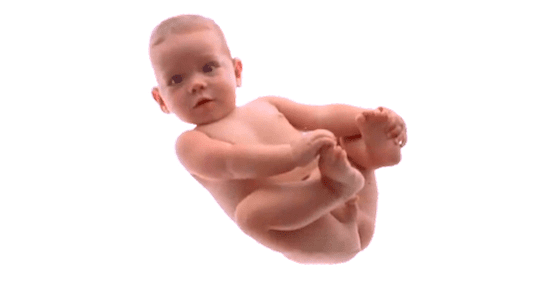
It is an interesting and demonstrable fact that all children are Atheists, and were religion not inculcated into their minds they would remain so…[T]here is no religion in human nature, nor human nature in religion. It is purely artificial, the result of education, while Atheism is natural, and, were the human mind not perverted and bewildered by the mysteries and follies of superstition, would be universal.
ERNESTINE ROSE, “A Defence of Atheism” (1861)
Boy do we seculars love a quote like that. It says our atheism is just a return to our natural condition, a rejection of something artificial blown into our heads by human culture. But that’s a little misleading.
It’s obviously true that we are born without religious belief. But this equates to what is called weak or negative atheism, the simple absence of belief in a god or gods. What about the other major assertion there — that without inculcation, the absence of belief would remain?
This gets at the very basic question of what religion is. The Rose quote implies that it’s a cultural construction, pure and simple. But if Ernestine Rose was right and atheism is so damn natural, why is religion so globally dominant? And why is the inculcation of religion received so eagerly and pried loose with such difficulty?
I’ve spent years chasing this question through the work of EO Wilson, Pinker, Boyer, Dennett, Diamond and more. The result has made me less angry and frustrated and more empathetic toward the religious impulse, even as I continue to find most religious ideas both incorrect and problematic. It has deeply informed my secular parenting in a very good way.
Thinking about religion anthropologically has made me a better proponent of my own worldview, a more effective challenger of toxic religious ideas, and a much better secular parent.
Why we are the way we are
If you want to understand why we are the way we are, there’s no better place to look than the Paleolithic Era (2.4 million years ago – 11,000 years ago). Over 99.5 percent of the history of the genus Homo — 120,000 generations — took place during the Paleolithic. For the last 10,000 of those generations, we were anatomically modern. Same body, same brain.
The brain in your head was evolved in response to conditions in that era, not this one. The mere 500 generations that have passed since the Paleolithic ended represent a virtual goose egg in evolutionary time.
To put it simply: we are born in the Stone Age. Childhood is a period during which we are brought — by parenting, experience, and education — into the modern world. Or not.
So if we were evolved for the Paleolithic, what was it like then? In short, it sucked to be us.
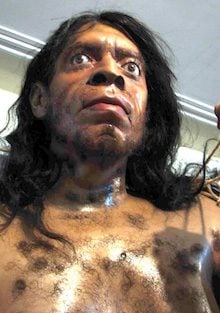 The hominid population in the Lower Paleolithic (starting around 2.4 million years ago) is estimated to have been around 26,000. Earth’s climate was affected by frequent glacial periods that would lock up global water, leading to severe arid conditions in the temperate zones and scarce plant and animal life, making food hard to come by.
The average hominid life span was about 20 years, due mostly to high child mortality. We lived in small bands competing for negligible resources. For two million years, our genus was balancing on the edge of extinction.
Then it got worse.
In the Middle Paleolithic, a supervolcano erupted in what is now Lake Toba in Indonesia. On the Volcanic Explosivity Index — with categories apparently named by a seven-year-old boy — this eruption was a “mega-colossal,” the most catastrophic kind. Earth was plunged into a volcanic winter lasting at least a decade. The human population dropped to an estimated 5,000-10,000 individuals, each living what had to be a terrifying, marginal existence.
These humans had the same thirsty and capable brain you and I enjoy, but few reliable methods for filling it up. The most common cause of death was infectious disease. If somebody was gored by a mammoth, you could figure out how to avoid that in the future. But most people died for no apparent reason. Just broke out in bloody boils, then keeled over dead.
Imagine how terrifying such a world would be to a mind fully capable of comprehending the situation but utterly lacking in answers, and worse yet, lacking the ability to control it. It’s not hard to picture the human mind simply rebelling against that reality and creating an alternative in its place, neatly packaged for the grateful relief of subsequent generations.
The first evidence of supernatural religion appears in the Middle Paleolithic.
Religion solves our central problem: that (to quote Jennifer Michael Hecht) we are human and the universe is not. It’s not really about explanation. It’s about seizing the controls, or at least imagining that we have. To be fully conscious of our frailty and mortality in a hostile and indifferent universe and powerless to do anything about it would have been simply unacceptable to the human mind. So we created powerful beings whom we could ultimately control through prayer, sacrifice, behavior changes, ritual, spinning around three times, what have you.
Conservative, traditional religion is a natural response to being human in the Paleolithic. Whether it was a good response or not is beside the point — it was the only one we had.
But we’re not in the Paleolithic anymore, you say. You certainly have the calendar on your side. We began to climb out of our situation about 500 generations ago when agriculture made it possible to stand still and live a little longer. Eventually we had the time and security to develop better responses to the problem, better ways of interrogating and controlling the world around us. But the Scientific Revolution, our biggest step forward in that journey, was just 20 generations ago. Think of that. It just happened. Our species is still suffering from the post-traumatic stress of 120,000 generations in hell. And like the battle veteran who hits the dirt when he hears a backfiring car, it takes very little to push the Paleolithic button in our heads.
Yes, your kids are born without religious belief. But they are also born with the problem of being human, which includes a strong tendency to hit the dirt when the universe backfires. One of the best things a secular parent can do is know that the Paleolithic button is there so we can help our kids resist the deeply natural urge to push it.
Baby screenshot via YouTube; early hominid reconstruction via Wikimedia
DALE McGOWAN is the author of Atheism for Dummies and Raising Freethinkers. He lives in Atlanta.
Previous Post

January 28, 2016
A Teacher in the South
Next Post

February 3, 2016 A Little Birdie Told Me to Do It
Browse Our Archives
Select a Category Ableism Activism Addiction and Recovery Agnosticism Anti-intellectualism Arts Atheism Beauty Catholicism Charles Darwin Children China Christianity Church/State separation churchgoing communication compassionate humanism Creationism critical thinking Culture death disaster response doubt education Egypt Entertainment Environment ethics evolution Existence of God Exploration fear Foundation Beyond Belief Free speech God Health History Human rights humanism identity India Interfaith Islam labels Language LGBT Love Meaning Media Medicine Middle East misconceptions mixed belief marriage Moral argument Morality Myths Near-Death Experience Nonreligious parenting Parody Persecution complex Philosophy Poetry Politics prayer Psychology Rationality Religion religious atheists Religious privilege Republican Party Satire Schools science secular parenting Spirituality The Unpigeonholeables Uncategorized United Kingdom Wonder
Select a Month March 2021 August 2020 March 2020 January 2020 September 2019 July 2019 June 2019 April 2019 February 2019 January 2019 December 2018 November 2018 October 2018 September 2018 August 2018 July 2018 June 2018 May 2018 April 2018 March 2018 February 2018 January 2018 December 2017 November 2017 October 2017 September 2017 August 2017 July 2017 March 2017 February 2017 January 2017 December 2016 November 2016 October 2016 September 2016 August 2016 July 2016 June 2016 May 2016 April 2016 March 2016 February 2016 January 2016 December 2015 November 2015 October 2015 September 2015 June 2015 March 2015 February 2015 January 2015 December 2014 November 2014 October 2014 September 2014
Follow Us!
TAKE THE
Religious Wisdom Quiz
Which book records the walls of Jerusalem being rebuilt?
Select your answer to see how you score.
Malachi Haggai Nehemiah Ezra
Related posts from The Secular Spectrum

Yasir Qadhi's Elitist Ruse to Conceal the Obscure...

Despite "Pro-Life" Claims, Stem Cell Therapy Has Very...

On Cognitive Dissonance and the Thought Patterns Behind...

The Problem with “Thoughts and Prayers”
TRENDING AT PATHEOS Nonreligious

Dethroning Jesus and Enthroning Yourself
Jesus Never Asked to Be Worshipped. He Asked to Be Understood. Christianity...

Why Most Christians are Really Paulians and Jobians
I Don't Care, But It Matters Let's get this out of the...

Essential Tips to Successfully Navigate the Selling Process
Selling a house can feel overwhelming, but it doesn’t have to be....

To Make Remote Work Effective, Think About Others
The COVID-19 pandemic forced many companies to rapidly transition to remote work....

Flexibility Is Key to Solving Problems of Tomorrow
The world of work is undergoing a dramatic transformation. The COVID-19 pandemic...
view all Nonreligious blogs
Ad-Free & Subscriber Log-In Subscription Support
- About Us
- 2026 Calendar
- Videos
- Podcasts
- Library of World Religions
- Faith In Media Tracker
- Advertise With Us
- Write for Us
- Privacy Policy
- Terms of Service
- Do Not Sell My Data
- Contact Us
- Radiant Digital
- Manage Newsletter Subscriptions
- Unsubscribe From Notifications
- Sitemap
Copyright 2008-2026, Patheos. All rights reserved.
Subscription Support Ad-Free & Subscriber Log-In
Follow Patheos