
BuddhistCatholicContemplativeEvangelicalGeneral ChristianHinduJewishLatter-day SaintMuslimNew VisionsProgressive Christian
Beliefs
- Buddhist
- Catholic
- Contemplative
- Evangelical
- General Christian
- Hindu
- Jewish
- Latter-day Saint
- More Voices
- Muslim
- New Visions
- Pagan
- Progressive Christian
Topics
- Religion News
- Food and Religion
- Sports and Religion
- Religious Art
- Religious Music and Entertainment
- Religious Events
- History and Religion
- Style and Religion
- Politics and Religion
- Women in Religion
- Recreation Outdoors and Religion
- Business Finance and Religion
- Careers Workplace and Religion
- Education and Religion
- Family Parenting and Religion
- Health Fitness and Religion
- Home and Religion
- Relationships and Religion
- Technology and Religion
- Travel and Religion
Columnists
- Buddhist Columnists
- Business Finance and Religion Columnists
- Careers Workplace and Religion Columnists
- Catholic Columnists
- Contemplative Columnists
- Education and Religion Columnists
- Evangelists Columnists
- Family Parenting and Religion Columnists
- General Christian Columnists
- Health Fitness and Religion Columnists
- Hindu Columnists
- History and Religion Columnists
- Home and Religion Columnists
- Jewish Columnists
- More Voices Columnists
- Latter Day Columnists
- Muslim Columnists
- New Visions Columnists
- Nonreligious Columnists
- Pagan Columnists
- Politics and Religion Columnists
- Progressive Columnists
- Recreation Outdoors and Religion Columnists
- Relationships and Religion Columnists
- Religion News Columnists
- Religious Art Columnists
- Religious Events Columnists
- Religious Music and Entertainment Columnists
- Sports and Religion Columnists
- Style and Religion Columnists
- Technology and Religion Columnists
- Travel and Religion Columnists
- Women in Religion Columnists
Resource Library
- 2026 Calendar
- Library of World Religions
- The 100 Most Holy Places on Earth
- Patheos Answers
- Podcasts
- Videos
- Faith Leaders Database
- Anglican Episcopalian
- Bahai
- Baptist
- Buddhism
- Christianity
- Confucianism
- Eastern Orthodoxy
- Hinduism
- Holiness and Pentecostal
- ISKCON
- Islam
- Judaism
- Lutheran
- Methodist
- The Church of Jesus Christ of Latter-day Saints
- New Age
- Paganism
- Presbytarian and Reformed
- Protestantism
- Religion Behind the Scenes
- Roman Catholic
- Scientology
- Shia Islam
- Sikhism
- Sufism
- Sunni Islam
- Taoism
- Zen
- See all religions
Research Tools
 Ad-Free & Subscriber Log-In Subscription Support
Ad-Free & Subscriber Log-In Subscription Support
Follow Patheos 

- Trending:
- Forgiveness
- |
- Marriage
- |
- Consciousness
- |
- Death Penalty
- |
- Election
- |
- Halloween
 The Secular Spectrum
- Home
- Nonreligious
- When One Partner Leaves the Faith: The Story of Hope and David
When One Partner Leaves the Faith: The Story of Hope and David
Last updated on: November 11, 2015 at 5:32 pm by Dale McGowan
When One Partner Leaves the Faith: The Story of Hope and David 2015-11-11T17:32:46-05:00 Dale McGowan
Patheos Explore the world's faith through different perspectives on religion and spirituality! Patheos has the views of the prevalent religions and spiritualities of the world.

In the secular/religious marriage, the highest tension and conflict result when the couple first shared a worldview, then one changed. This is the story of Hope and David, one of eight couples profiled in In Faith and In Doubt.
Growing up, Hope belonged to a fundamentalist Reformed Baptist church in small-town Georgia. Her parents taught Sunday school, and her father was a deacon.
David grew up in a Baptist family one county over. His parents divorced when he was three, and his mother struggled to raise her three children as she coped with severe clinical depression. “We wouldn’t always know where our next meal was coming from,” David says, “but the church ladies would bring the leftovers from the Wednesday church dinner to my family.”
Eventually his mother’s depression overwhelmed her, and David and his brother and sister became wards of the state. It was during this time, at age eight, under the influence of a loving couple who supervised his group home, that David said the Sinner’s Prayer and was baptized.
By his late teens, David and his siblings were back with their mother. They attended a Reformed Baptist church, and by age 19, David had become a respected leader.
It was there that he met a Sunday school teacher named Hope.
“He was the first person to ask me really deep questions about what I believed so he could get to know me better as a person,” Hope remembers. “He was the most serious, intense person I’d ever met, but loving and gentle and easy to talk to.”
She was drawn to the intensity of his faith and his certainty about his own path. He was going to be a pastor. “I believed in him with every fiber of my being. Our shared faith was the entirety of my attraction to him. I knew he was going to be part of something significant in the church.”
David saw something special in Hope. “I knew she would be the perfect wife for me—smart and beautiful, serious-minded, and very kind. Since my own home life was such a mess, I needed to marry someone who came from a functional home if my future kids were to have a fighting chance at life. And our shared faith was always a huge part of our relationship.”
In late 2007, after the birth of four children and years of trying to find a pastoral job, David heard a debate between [theologian] Alister McGrath and [atheist biologist] Richard Dawkins. He felt McGrath had done poorly. “I tried to get outside of the evangelistic assumptions and suddenly saw how devastating the unbeliever’s questions were to an honest person,” he says. “For the first time, I saw how everything hinged on those assumptions—whether Jesus was who he said he was and whether the Bible was what I believed it to be.”
For the next few weeks, David explored his doubts intensely. “I spent every available minute listening to debates and reading, trying to find satisfactory answers to my questions. I was seeing more and more how the Gospel didn’t measure up to rigorous questioning, and the answers from the Christian community were only believable if you presupposed the inspiration of the Bible and its inerrancy. I remember giving myself permission to go through an entire day as an atheist—no prayers and trying to find natural explanations for those things I would normally have thanked God for. Surely, I thought, God would forgive an honest quest for truth.
“At the end of the day, I realized that the day wasn’t much different,” he says. “I wasn’t struck by lightning. It surprised me how much more sense it made of the world and the wonder that it provoked in me. The very next day, I said to myself, ‘I think I’m an atheist.’ I knew that this could cost me my family so I didn’t say anything to my wife at first.”
He didn’t need to. Hope began to put the pieces together herself. One night she said, “I need to ask you something. I will be okay no matter what you say, but I need to know what you are thinking regarding Christianity.”
“I had to tell her that I was now an atheist,” David says. “She was shocked and asked me why. I told her about my concerns.”
“It was huge to hear him say he didn’t believe in any of it anymore,” Hope recalls. “Our shared faith was totally central to everything we were as a family.”
Soon afterwards, David announced his change of beliefs in an email to family and friends. Some of the responses were supportive. Many were not.
“It felt like all of our friends and most of our family immediately turned their backs on him,” Hope says. “There were a lot of long Facebook debates. One of our best friends sent a long handwritten letter pleading with him to return to his faith and warning him that if he didn’t he’d go to hell. It wasn’t exactly loving.”
Hope was dealing with her own emotions as well. “I was devastated. I cried and cried. I woke up and cried as I fixed breakfast for my kids. I cried as I rocked my baby and tried to wrap my mind around what had happened. The first time we tried to have sex after he deconverted, I ran out of the room sobbing. I remember thinking that it would have been easier to deal with his death than his deconversion. I had never even had a close non-Christian friend and had never known an atheist—and now I was married to one.”
David’s emotions were a complicated mix of anger at what he had been taught all those years and elation at his newfound freedom. Hope felt her own faith shaken.
“Suddenly I was questioning everything I believed and wondering why I believe what I do,” she says. “Was it just because I was raised in a Christian home? It didn’t feel that way. My faith was the center of my life. My relationship with God felt too real to me to even really consider turning my back on it. I felt betrayed. I felt angry. We argued about religion a lot for the first couple of years. It was hard for me to separate myself from my religion, so if David attacked what he saw to be as something illogical or inconsistent in my beliefs, I felt personally attacked and would often respond emotionally, or I’d feel like David was trying to convert me or pressure me.”
Shortly after David’s deconversion, Hope’s younger brother took his own life. Hope became depressed as she tried to work through her feelings. Had it happened six months earlier, David would have responded in traditional Christian fashion, with assurances that her brother was in heaven with God, and that God was using the situation to bring more people to faith. But that was no longer an option. “I tried to be there for her, but I couldn’t give her the lies that everyone else was giving her for her comfort. To me it was just tragic, and I hated how the preachers were using this terrible time with threats of hell and lies packaged as answers to people who wanted to know why this had happened.”
It was all too much for Hope. “Truthfully, we were not entirely happy before my husband deconverted. His change exacerbated every pre-existing weakness in our marriage.”
She decided at last that she would take the children and leave. “There was so much tension and lack of intimacy after he deconverted, I just wanted to separate. We could not agree on how to discipline our children, how to teach them or even whether they should attend church with me.”
David learned of her plans by reading an entry in her journal. He was stunned. “She hadn’t mentioned it to me at all. I took the next day off work and we were able to talk things through, but for a while I was fearful every day when I left for work that I would come home and they all would be gone.”
“We tried counseling, but it was a disaster,” Hope says. “It freaked me out to feel like we were not making any progress and like David didn’t even understand what was wrong with our marriage or accept responsibility for his part of our problems. I felt like there was no cooperation and not enough mutual respect. I constantly felt like I was too angry to love. I was terrified and I felt totally alone. None of my friends at church had a clue what I was going through or how to support me. They moved on with their lives, but I had all of these shattered dreams. I just wanted to run.”
In the end, after much time and discussion, they decided to stick it out.
“I wish I could say it was easy to make up my mind to love David and then move forward with that decision, but it was not. I realized that we weren’t likely to end our marriage in a peaceful or friendly way, in part because of David’s traumatic childhood, so I decided to stay. Five years later, I’m really glad I did.”
David is glad she didn’t leave, though he continues to feel deeply frustrated. “I can’t say we’ve really worked through things. It’s more like we’ve roped off territory and have agreed not to enter each others’ space. We don’t talk about religion. We don’t really talk about much at all of substance. I was actually hoping at first that we could make this change together. For me, I feel like the woman I married for her rigorous intellect and independent mind has valued her beliefs over me. Rather than giving it an honest investigation, she has decided that she doesn’t want to look any further. I feel hurt and disrespected by her lack of interest in the substance of our differences and reasons for them. She seems completely unwilling to accept that she might be wrong or that there might be intelligent reasons for or against her position. She is religious because that’s what makes her feel good and seems unaffected by not knowing if its true.”
He does acknowledge the difficulty she would face. “I can’t imagine how hard it must be for her to reconsider the teachings that she has been told since birth. I just would have hoped that our relationship was worth at least an honest attempt at understanding.”
Hope wishes David would reconvert just as much as David wishes Hope would deconvert. “I hope that he returns to God some day. I want him to experience the same joy in God and love and peace I experience. But if I could look ahead to the future and know with 100 percent certainty that David will never turn back to God, I wouldn’t change a thing. It took me a long time to get to this place, a very long time, but I love my husband, and we have a happy life together.”
She agrees with David that challenges remain. “Five years later, we still have a lot to work out. We still struggle at times. But we’re learning how to make compromises that are respectful to each other. We’re loyal, devoted partners now, and I don’t think we will ever divorce. But if we ever did…” She pauses. “If we did, our religious difference would probably be the reason.”
When I ask Hope what has helped her most during this time, she doesn’t pause. “Trusting God, surrendering to His will for my life, allowing His spirit to heal every hurt, to help me love when I feel empty or bitter. Unconditional love is the biggest, most important thing I’ve learned in this journey. Real love doesn’t act lovingly because of what I hope to get from the other person. Real love chooses to stay open.”
“I love my wife so much,” David says. “I feel the loss of our shared faith keenly, and I despise the distance that’s between us now because of our religious difference. I know the kind of relationship we’re capable of because we’ve been there, and I mourn the loss of that relationship every single day. To avoid conflict, we don’t share our deepest thoughts with each other anymore.”
“When we started this journey,” Hope says, “the biggest question I had was if it was possible to have a happy mixed-religion marriage. Six years into this I would say yes, it is possible. It is hard, but marriage is hard. Our struggles are different from some other people, but not a lot more difficult than most other couples.”
She also acknowledges that her own views have changed somewhat. “You don’t realize it, but in the type of narrow-minded church I grew up in, you are told what to think about God and what to believe about the Bible. You are handed your opinion about secular culture and other religions. Since David left that world, he’s become much more liberal in his views on…well, just about everything. I have too, though not as much. A lot of my friends act like I’m crazy, especially about abortion issues and gay rights. But I think more or less it’s a shift for good.
“At the end of the day,” she says, “having my nice little Christian bubble popped has been a good thing. I wish more Christians could see the way they look to outsiders like I have with my non-Christian husband.”
Image by MFer Photography via Flickr | CC 2.0
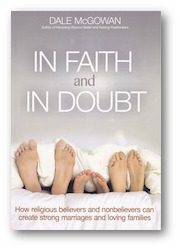
Adapted from In Faith and in Doubt: How Religious Believers and Nonbelievers Can Create Strong Marriages and Loving Families by Dale McGowan (2014).
DALE McGOWAN is the author of several books related to the nonreligious perspective. He was Harvard Humanist of the Year in 2008 and founded the humanist charity Foundation Beyond Belief in 2010. He is Content Development Editor and Atheist Channel Managing Editor at Patheos. He lives with his family in Atlanta.
Previous Post

November 10, 2015
The Big Reveal: Telling your religious partner you're an atheist
Next Post
November 12, 2015 Winning the Everlasting Gobstopper of Life
Browse Our Archives
Select a Category Ableism Activism Addiction and Recovery Agnosticism Anti-intellectualism Arts Atheism Beauty Catholicism Charles Darwin Children China Christianity Church/State separation churchgoing communication compassionate humanism Creationism critical thinking Culture death disaster response doubt education Egypt Entertainment Environment ethics evolution Existence of God Exploration fear Foundation Beyond Belief Free speech God Health History Human rights humanism identity India Interfaith Islam labels Language LGBT Love Meaning Media Medicine Middle East misconceptions mixed belief marriage Moral argument Morality Myths Near-Death Experience Nonreligious parenting Parody Persecution complex Philosophy Poetry Politics prayer Psychology Rationality Religion religious atheists Religious privilege Republican Party Satire Schools science secular parenting Spirituality The Unpigeonholeables Uncategorized United Kingdom Wonder
Select a Month March 2021 August 2020 March 2020 January 2020 September 2019 July 2019 June 2019 April 2019 February 2019 January 2019 December 2018 November 2018 October 2018 September 2018 August 2018 July 2018 June 2018 May 2018 April 2018 March 2018 February 2018 January 2018 December 2017 November 2017 October 2017 September 2017 August 2017 July 2017 March 2017 February 2017 January 2017 December 2016 November 2016 October 2016 September 2016 August 2016 July 2016 June 2016 May 2016 April 2016 March 2016 February 2016 January 2016 December 2015 November 2015 October 2015 September 2015 June 2015 March 2015 February 2015 January 2015 December 2014 November 2014 October 2014 September 2014
Follow Us!
TAKE THE
Religious Wisdom Quiz
What is the "WCC," an international Christian organization founded in 1948?
Select your answer to see how you score.
World Christian Crusade World College of Catholics World Council of Churches World Clergy Conference
Related posts from The Secular Spectrum

Yasir Qadhi's Elitist Ruse to Conceal the Obscure...
The Problem with “Thoughts and Prayers”
Reaching 'Faith Healers' Is an Urgent Public Health...
American Pluralism: Its Promises and Struggles
TRENDING AT PATHEOS Nonreligious

Dethroning Jesus and Enthroning Yourself
Jesus Never Asked to Be Worshipped. He Asked to Be Understood. Christianity...

Why Most Christians are Really Paulians and Jobians
I Don't Care, But It Matters Let's get this out of the...

Essential Tips to Successfully Navigate the Selling Process
Selling a house can feel overwhelming, but it doesn’t have to be....

To Make Remote Work Effective, Think About Others
The COVID-19 pandemic forced many companies to rapidly transition to remote work....

Flexibility Is Key to Solving Problems of Tomorrow
The world of work is undergoing a dramatic transformation. The COVID-19 pandemic...
view all Nonreligious blogs
Ad-Free & Subscriber Log-In Subscription Support
- About Us
- 2026 Calendar
- Videos
- Podcasts
- Library of World Religions
- Faith In Media Tracker
- Advertise With Us
- Write for Us
- Privacy Policy
- Terms of Service
- Do Not Sell My Data
- Contact Us
- Radiant Digital
- Manage Newsletter Subscriptions
- Unsubscribe From Notifications
- Sitemap
Copyright 2008-2026, Patheos. All rights reserved.
Subscription Support Ad-Free & Subscriber Log-In
Follow Patheos