
BuddhistCatholicContemplativeEvangelicalGeneral ChristianHinduJewishLatter-day SaintMuslimNew VisionsProgressive Christian
Beliefs
- Buddhist
- Catholic
- Contemplative
- Evangelical
- General Christian
- Hindu
- Jewish
- Latter-day Saint
- More Voices
- Muslim
- New Visions
- Pagan
- Progressive Christian
Topics
- Religion News
- Food and Religion
- Sports and Religion
- Religious Art
- Religious Music and Entertainment
- Religious Events
- History and Religion
- Style and Religion
- Politics and Religion
- Women in Religion
- Recreation Outdoors and Religion
- Business Finance and Religion
- Careers Workplace and Religion
- Education and Religion
- Family Parenting and Religion
- Health Fitness and Religion
- Home and Religion
- Relationships and Religion
- Technology and Religion
- Travel and Religion
Columnists
- Buddhist Columnists
- Business Finance and Religion Columnists
- Careers Workplace and Religion Columnists
- Catholic Columnists
- Contemplative Columnists
- Education and Religion Columnists
- Evangelists Columnists
- Family Parenting and Religion Columnists
- General Christian Columnists
- Health Fitness and Religion Columnists
- Hindu Columnists
- History and Religion Columnists
- Home and Religion Columnists
- Jewish Columnists
- More Voices Columnists
- Latter Day Columnists
- Muslim Columnists
- New Visions Columnists
- Nonreligious Columnists
- Pagan Columnists
- Politics and Religion Columnists
- Progressive Columnists
- Recreation Outdoors and Religion Columnists
- Relationships and Religion Columnists
- Religion News Columnists
- Religious Art Columnists
- Religious Events Columnists
- Religious Music and Entertainment Columnists
- Sports and Religion Columnists
- Style and Religion Columnists
- Technology and Religion Columnists
- Travel and Religion Columnists
- Women in Religion Columnists
Resource Library
- 2026 Calendar
- Library of World Religions
- The 100 Most Holy Places on Earth
- Patheos Answers
- Podcasts
- Videos
- Faith Leaders Database
- Anglican Episcopalian
- Bahai
- Baptist
- Buddhism
- Christianity
- Confucianism
- Eastern Orthodoxy
- Hinduism
- Holiness and Pentecostal
- ISKCON
- Islam
- Judaism
- Lutheran
- Methodist
- The Church of Jesus Christ of Latter-day Saints
- New Age
- Paganism
- Presbytarian and Reformed
- Protestantism
- Religion Behind the Scenes
- Roman Catholic
- Scientology
- Shia Islam
- Sikhism
- Sufism
- Sunni Islam
- Taoism
- Zen
- See all religions
Research Tools
 Ad-Free & Subscriber Log-In Subscription Support
Ad-Free & Subscriber Log-In Subscription Support
Follow Patheos 

- Trending:
- Forgiveness
- |
- Marriage
- |
- Consciousness
- |
- Death Penalty
- |
- Election
- |
- Halloween
 The Secular Spectrum
- Home
- Nonreligious
- OBEY: The Heart of Conservative Christian Parenting
OBEY: The Heart of Conservative Christian Parenting
Last updated on: November 24, 2015 at 11:02 am by Dale McGowan
OBEY: The Heart of Conservative Christian Parenting 2015-11-24T11:02:53-05:00 Dale McGowan
Patheos Explore the world's faith through different perspectives on religion and spirituality! Patheos has the views of the prevalent religions and spiritualities of the world.

A few years ago, the book descriptions on Amazon.com included a geeky little feature called a concordance — a list of the 100 most frequently-used words in a given book. It vanished after a couple of years, which is too bad — you can learn a lot about the content, approach, and tone of a book by seeing what words are used over and over again.
I managed to grab the concordance links for a few parenting books before they disappeared. Comparing the most common words is pretty revealing of the values and priorities in each book.
I’ll start with a conservative Christian parenting book by mega-author and evangelist John MacArthur.
What the Bible Says About Parenting: Biblical Principles for Raising Godly Children by John MacArthur
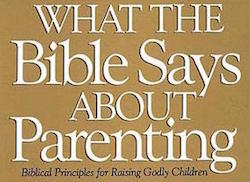
children—parents—god—child—love—own—husband—family—lord—word—wife—teach—heart—sin—christ—father—need—life—things—even—kids—should—man—must—son—proverbs—parenting—mother—does—scripture—kind—wisdom—evil—first—church—shall—may—home—fear—authority—marriage—obey—christian—ephesians—law—work—right—come—principle—means—take—truth—wives—woman—time—true—good—himself—solomon—give—live—men—let—paul—role—society—duty—honor—commandment—obedience—responsibility—teaching—against—gospel—know—therefore—verse—discipline—people—submit—something—themselves—jesus—want—women—wrong—world—day—think—instruction—faith—apostle—always—attitude—command—ing—certainly—spiritual—genesis—now
Now compare to the top 100 in my book for nonreligious parents.
Parenting Beyond Belief: On Raising Ethical, Caring Kids Without Religion ed. Dale McGowan
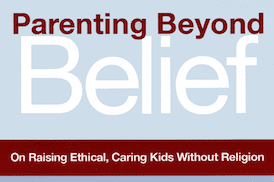 children—god—parents—religious—time—people—child—good—things—life—family—religion—world—think—believe—secular—know—even—beliefs—may—years—questions—own—right—kids—human—death—reason—first—school—idea—need—day—should—ing—moral—see—live—want—new—book—help—now—find—say—take—work—answer—others—something—church—come—wonder—bob—values—age—friends—get—go—little—does—without—long—often—true—thinking—feel—stories—must—love—exist—part—give—important—really—animals—two—great—kind—might—humanist—best—look—seems—still—atheist—few—thought—mean—mind—kobir—different—though—meaning—experience—problem—always—fact—adults—ceremony
Ignoring funny anomalies like the suffix ing and personal names, let’s compare.
It’s interesting that they have the same top three words, and even more interesting that the secular parenting book mentions God more often. Interesting, but not surprising: The top four words in Quitting Smoking for Dummies are SMOKING, SMOKE, TOBACCO, and CIGARETTES.
Now look at the relative importance of obedience. What the Bible Says About Parenting uses the word OBEY 66 times and OBEDIENCE 49 times, while the same words appear only 6 and 4 times (respectively) in Parenting Beyond Belief — even though PBB is almost twice as long. Adjusted for text length, obedience-related words appear 22 times more often in the conservative religious book.
What about mainstream parenting books that are neither explicitly religious or nonreligious? I looked at several competing titles such as Parenting From the Inside Out. None included OBEY or OBEDIENCE in the top 100.
Obedience is just the tip of the iceberg. The words SIN, DUTY, EVIL, FEAR, AUTHORITY, DISCIPLINE, COMMAND, COMMANDMENT, SUBMIT, and LAW are also prominent in What the Bible and entirely missing from Parenting Beyond Belief’s top 100.
THINK is #14 for the secular parenting book and #89 for the religious one. Also high in the secular list are QUESTIONS (#22) and IDEA (#31) — neither of which appears in the other list.
The presence of HUSBAND, WIFE, SON, MOTHER, and FATHER high in the What the Bible list show the importance of role divisions. None of these appear in the secular parenting list.
It makes sense for EPHESIANS to be mentioned in What the Bible, since the end of Ephesians lists several familial duties — ‘Wives, submit to your husbands as to the Lord,’ (5:22) ‘Husbands, love your wives’ (5:25). But 64 times?! That baffled me — until I remembered one of the most chilling verses in the NT:
Children, obey your parents in the Lord, for this is right. Honor your father and mother — which is the first commandment with a promise — that it may go well with you and that you may enjoy long life on the earth (Ephesians 6:1-3).
The conditional phrase “that you may enjoy long life” is no metaphor: It’s an allusion to Deuteronomy 21:18-21, the command to stone disobedient children to death.
MacArthur isn’t alone. James Dobson is one of the voices on the religious right who stresses obedience obsessively, along with his favorite enforcement mechanism, corporal punishment.
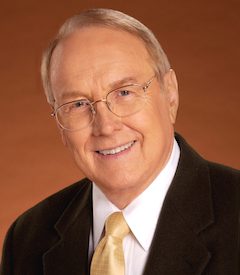
James Dobson
Dobson’s The New Dare to Discipline doesn’t have a concordance, but a sampling of the text can give you the idea.
“Spanking should be of sufficient magnitude to cause genuine tears,” he says, and recommends painful squeezing of the trapezius muscle on the neck to obtain “instant obedience,” and hitting children as young as 18 months old with a paddle. He advises hitting a toddler whenever he “hits his friends.” And if a child cries more than a few minutes after being spanked, Dobson says, hit him again. “When a youngster tries this kind of stiff-necked rebellion, you had better take it out of him,” he warns, “and pain is a marvelous purifier.”
His advice frequently lapses into sneering contempt for the child. “You have drawn a line in the dirt, and the child has deliberately flopped his bony little toe across it. Who is going to win? Who has the most courage? Who is in charge here? If you do not conclusively answer these questions for your strong-willed children, they will precipitate other battles designed to ask them again and again.”
Dobson’s work builds on such classics in Christian parenting as Rev. Jack Hyles‘s How to Rear Children (1972):
Obedience is the foundation for all character. It is the foundation for the home. It is the foundation for a society. It is absolutely necessary for law and order to prevail….Obedience should always be immediate, instant, without question or argument….The parents allow no exceptions to the rule. [T]he child should not deem it necessary to have an explanation for the orders he has received from his parents.
Many unconverted psychologists say that the parents should always take time to explain to the child why he should do certain things and that parents should never command a child to do something without the child knowing the reason. Nothing could be further from the truth!
Yeah, about that.
This obedience-centered approach is called authoritarian parenting. The approach he is disparaging, the one that developmental research continually supports, is authoritative parenting.
Authoritarian parents
- have high expectations of conformity;
- emphasize the power gradient between parent and child;
- believe that rules and actions do not require explanation;
- are less responsive to child input;
- are more likely to use physical force or punishment.
Authoritative parents
- have high expectations of maturity;
- de-emphasize the power gradient between parent and child;
- explain the reasons for rules and actions;
- are responsive to child input;
- are less likely to use physical force or punishment.
Authoritarian parenting is advocated mostly by religious and social conservatives. Authoritative parenting is advocated by…actual research.
Developmental psychologist Joan Grusec finds that “parents who tend to be harshly authoritarian are less likely to be successful [as moral educators] than those who place substantial emphasis on reasoning.” Marvin Berkowitz, professor of character education at the University of Missouri, notes that “the most useful form of character education encourages children to think for themselves.” And explaining the reasons for rules and decisions is central because it helps kids develop their own ability to think clearly and ethically instead of merely following rules.
As it turns outs, the key dividing line isn’t between religious and nonreligious — it’s between conservative and progressive. In parenting, as in many other areas, religious progressives have much more in common with nonreligious progressives than they do with religious conservatives.
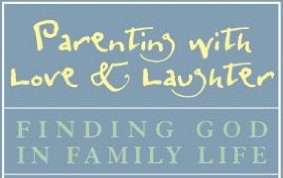 Parenting With Love and Laughter: Finding God in Family Life by Jeffrey Jones is a liberal Christian parenting book with none of the chilling earmarks of MacArthur, Dobson, and the rest.
Of the 12 authority-laden words (OBEDIENCE, OBEY, SIN, DUTY, EVIL, FEAR, AUTHORITY, DISCIPLINE, COMMAND, COMMANDMENT, SUBMIT, LAW) in What the Bible, not a single one appears in the top 100 of this Christian parenting book. On the contrary, the Jones book favors humane, loving language and ideas and an authoritative approach that’s much closer to Parenting Beyond Belief.
In fact, Parenting with Love and Laughter has much more in common with Parenting Beyond Belief than either does with the conservatives. Of the top 50 words in the Jones book, fully half are also in the top 50 of Parenting Beyond Belief.
Top image via Shutterstock. Dobson photo via Wikimedia.
DALE McGOWAN is editor and co-author of Parenting Beyond Belief and Raising Freethinkers. He lives in Atlanta.
Previous Post

November 19, 2015
The Compassion of Secular and Religious Voices
Next Post
November 25, 2015 I Was a Jewish Hitler in the 5th Grade
Browse Our Archives
Select a Category Ableism Activism Addiction and Recovery Agnosticism Anti-intellectualism Arts Atheism Beauty Catholicism Charles Darwin Children China Christianity Church/State separation churchgoing communication compassionate humanism Creationism critical thinking Culture death disaster response doubt education Egypt Entertainment Environment ethics evolution Existence of God Exploration fear Foundation Beyond Belief Free speech God Health History Human rights humanism identity India Interfaith Islam labels Language LGBT Love Meaning Media Medicine Middle East misconceptions mixed belief marriage Moral argument Morality Myths Near-Death Experience Nonreligious parenting Parody Persecution complex Philosophy Poetry Politics prayer Psychology Rationality Religion religious atheists Religious privilege Republican Party Satire Schools science secular parenting Spirituality The Unpigeonholeables Uncategorized United Kingdom Wonder
Select a Month March 2021 August 2020 March 2020 January 2020 September 2019 July 2019 June 2019 April 2019 February 2019 January 2019 December 2018 November 2018 October 2018 September 2018 August 2018 July 2018 June 2018 May 2018 April 2018 March 2018 February 2018 January 2018 December 2017 November 2017 October 2017 September 2017 August 2017 July 2017 March 2017 February 2017 January 2017 December 2016 November 2016 October 2016 September 2016 August 2016 July 2016 June 2016 May 2016 April 2016 March 2016 February 2016 January 2016 December 2015 November 2015 October 2015 September 2015 June 2015 March 2015 February 2015 January 2015 December 2014 November 2014 October 2014 September 2014
Follow Us!
TAKE THE
Religious Wisdom Quiz
What was Ezra's profession?
Select your answer to see how you score.
Scribe Soldier Priest Farmer
Related posts from The Secular Spectrum

Yasir Qadhi's Elitist Ruse to Conceal the Obscure...
The Intertwined Pull of the Secular and Religious...

Storytelling while Secular: Writing about Loss in an...

What We Talk About When We Talk About...
TRENDING AT PATHEOS Nonreligious

Dethroning Jesus and Enthroning Yourself
Jesus Never Asked to Be Worshipped. He Asked to Be Understood. Christianity...

Why Most Christians are Really Paulians and Jobians
I Don't Care, But It Matters Let's get this out of the...

Essential Tips to Successfully Navigate the Selling Process
Selling a house can feel overwhelming, but it doesn’t have to be....

To Make Remote Work Effective, Think About Others
The COVID-19 pandemic forced many companies to rapidly transition to remote work....

Flexibility Is Key to Solving Problems of Tomorrow
The world of work is undergoing a dramatic transformation. The COVID-19 pandemic...
view all Nonreligious blogs
Ad-Free & Subscriber Log-In Subscription Support
- About Us
- 2026 Calendar
- Videos
- Podcasts
- Library of World Religions
- Faith In Media Tracker
- Advertise With Us
- Write for Us
- Privacy Policy
- Terms of Service
- Do Not Sell My Data
- Contact Us
- Radiant Digital
- Manage Newsletter Subscriptions
- Unsubscribe From Notifications
- Sitemap
Copyright 2008-2026, Patheos. All rights reserved.
Subscription Support Ad-Free & Subscriber Log-In
Follow Patheos