
BuddhistCatholicContemplativeEvangelicalGeneral ChristianHinduJewishLatter-day SaintMuslimNew VisionsProgressive Christian
Beliefs
- Buddhist
- Catholic
- Contemplative
- Evangelical
- General Christian
- Hindu
- Jewish
- Latter-day Saint
- More Voices
- Muslim
- New Visions
- Pagan
- Progressive Christian
Topics
- Religion News
- Food and Religion
- Sports and Religion
- Religious Art
- Religious Music and Entertainment
- Religious Events
- History and Religion
- Style and Religion
- Politics and Religion
- Women in Religion
- Recreation Outdoors and Religion
- Business Finance and Religion
- Careers Workplace and Religion
- Education and Religion
- Family Parenting and Religion
- Health Fitness and Religion
- Home and Religion
- Relationships and Religion
- Technology and Religion
- Travel and Religion
Columnists
- Buddhist Columnists
- Business Finance and Religion Columnists
- Careers Workplace and Religion Columnists
- Catholic Columnists
- Contemplative Columnists
- Education and Religion Columnists
- Evangelists Columnists
- Family Parenting and Religion Columnists
- General Christian Columnists
- Health Fitness and Religion Columnists
- Hindu Columnists
- History and Religion Columnists
- Home and Religion Columnists
- Jewish Columnists
- More Voices Columnists
- Latter Day Columnists
- Muslim Columnists
- New Visions Columnists
- Nonreligious Columnists
- Pagan Columnists
- Politics and Religion Columnists
- Progressive Columnists
- Recreation Outdoors and Religion Columnists
- Relationships and Religion Columnists
- Religion News Columnists
- Religious Art Columnists
- Religious Events Columnists
- Religious Music and Entertainment Columnists
- Sports and Religion Columnists
- Style and Religion Columnists
- Technology and Religion Columnists
- Travel and Religion Columnists
- Women in Religion Columnists
Resource Library
- 2026 Calendar
- Library of World Religions
- The 100 Most Holy Places on Earth
- Patheos Answers
- Podcasts
- Videos
- Faith Leaders Database
- Anglican Episcopalian
- Bahai
- Baptist
- Buddhism
- Christianity
- Confucianism
- Eastern Orthodoxy
- Hinduism
- Holiness and Pentecostal
- ISKCON
- Islam
- Judaism
- Lutheran
- Methodist
- The Church of Jesus Christ of Latter-day Saints
- New Age
- Paganism
- Presbytarian and Reformed
- Protestantism
- Religion Behind the Scenes
- Roman Catholic
- Scientology
- Shia Islam
- Sikhism
- Sufism
- Sunni Islam
- Taoism
- Zen
- See all religions
Research Tools
 Ad-Free & Subscriber Log-In Subscription Support
Ad-Free & Subscriber Log-In Subscription Support
Follow Patheos 

- Trending:
- Forgiveness
- |
- Marriage
- |
- Consciousness
- |
- Death Penalty
- |
- Election
- |
- Halloween
 The Secular Spectrum
- Home
- Nonreligious
- No, Virginia…and the World is Still Wonderful
No, Virginia…and the World is Still Wonderful
Last updated on: December 4, 2017 at 2:40 pm by Dale McGowan
No, Virginia…and the World is Still Wonderful 2017-12-04T14:40:01-05:00 Dale McGowan
Patheos Explore the world's faith through different perspectives on religion and spirituality! Patheos has the views of the prevalent religions and spiritualities of the world.
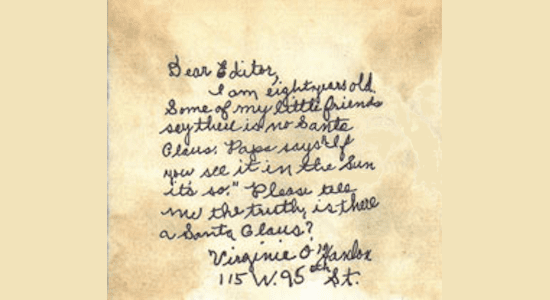
The original letter
One thing that never fails to pee on my Yule log this time of year is the reappearance of the “Yes, Virginia” editorial. In 1897, an actual little girl wrote the following to the editors of the New York Sun:
DEAR EDITOR,
I am 8 years old. Some of my little friends say there is no Santa Claus. Papa says, ‘If you see it in THE SUN it’s so.’ Please tell me the truth; is there a Santa Claus?
VIRGINIA O’HANLON. 115 W 95th St.
The editor replied:
VIRGINIA,
Your little friends are wrong. They have been affected by the skepticism of a skeptical age. They do not believe except they see. They think that nothing can be which is not comprehensible by their little minds. All minds, Virginia, whether they be men’s or children’s, are little. In this great universe of ours man is a mere insect, an ant, in his intellect, as compared with the boundless world about him, as measured by the intelligence capable of grasping the whole of truth and knowledge.
Yes, VIRGINIA, there is a Santa Claus. He exists as certainly as love and generosity and devotion exist, and you know that they abound and give to your life its highest beauty and joy. Alas! how dreary would be the world if there were no Santa Claus. It would be as dreary as if there were no Virginias! There would be no childlike faith then, no poetry, no romance to make tolerable this existence. We should have no enjoyment, except in sense and sight. The eternal light with which childhood fills the world would be extinguished.
Not believe in Santa Claus! You might as well not believe in fairies! You might get your papa to hire men to watch in all the chimneys on Christmas Eve to catch Santa Claus, but even if they did not see Santa Claus coming down, what would that prove? Nobody sees Santa Claus, but that is no sign that there is no Santa Claus. The most real things in the world are those that neither children nor men can see. Did you ever see fairies dancing on the lawn? Of course not, but that’s no proof that they are not there. Nobody can conceive or imagine all the wonders there are unseen and unseeable in the world.
And so on.
Let’s peel back the spun sugar coating to see the festering heart of that reply. A little girl expresses her trust in the Sun’s veracity, then says, “Please tell me the truth.” In response, the editor not only lies, but tells the girl that the world would be intolerable if this thing he knows to be false were false. And the world coos with delight.
The Santa myth itself isn’t the problem here. Engaging in the myth is not only harmless and fun but an unmissable opportunity for critical thinking. When kids begin spotting holes in the story, they start by poking around the edges, intentionally avoiding the obvious direct question because their desire to know has not yet overtaken their desire to believe.

But there’s a crucial turning point in the Santa game. Virginia had reached it — and the editor betrayed her. When the desire to know pulls ahead of the desire to believe, and they ask if Santa is real, you must tell the truth, or the whole exercise becomes a farce. When kids finally say that they are ready for the answer, be there with the answer they are ready for. Help them see that Christmas still happens, and the world is just as wonderful when you know where all the good things actually come from.
I’m convinced that the roughly six percent of kids who feel “betrayed” when they find out Santa isn’t real had their belief perpetuated beyond its normal course, usually by well-meaning parents.
“Yes, Virginia” is an unbeatable example of Daniel Dennett’s hypothesis that any given magical belief is less about a given god or text or myth than simply “belief in belief” — the untethered but deep compulsion that belief itself (in gods, faeries, Santa, karma, good luck charms, The Secret) is a good to be treasured and its loss a thing to be grieved. This remains one of the greatest insights into the religious impulse I have ever heard.
Just as I was recovering from my first annual dose of “Yes, Virginia,” a related piece of spam plopped wetly into my inbox from EZSantaLetters.com:
How to Convince Your Child That Santa is Real
One of the major drawbacks of life in today’s world is the fact that children grow up too fast. Belief in Santa Claus is one of the aspects of childhood that is usually first to go. Promoting the belief in Santa is one of many things parents do for their children. Several methods exist to accomplish this, but two of the best are a Santa call and Santa letters.
A call from Santa Claus will go a long way in promulgating the belief in him in most children. Children do not normally receive many phone calls as a rule. Since they are usually a special event to begin with, calls from Santa Claus will be especially well accepted.
As parents, we all want our children to be able to hold onto their childhood as long as possible. One aspect of childhood that we encourage is the belief in Santa Claus and all he stands for. Arranging for a child to receive a phone call from Santa and planting evidence of his visit are two ways to help keep children believing as long as possible. These will add to the child’s enjoyment of Christmas as well.
I have no words.
This Santa spam and its “Yes Virginia” ancestor are like drops of amber with a bit of human nature inside — that urgent human yearning toward belief, and revulsion to disbelief, that keeps religion alive well beyond the point we’re ready to know the truth.
Dale McGowan is the author of books including Atheism for Dummies, Parenting Beyond Belief, and Raising Freethinkers. He lives in Atlanta.
Previous Post

November 27, 2015
Santa Claus - The Ultimate Dry Run
Next Post

December 1, 2015 Secular Culture: Humanist, atheist and scientific poetry needed!
Browse Our Archives
Select a Category Ableism Activism Addiction and Recovery Agnosticism Anti-intellectualism Arts Atheism Beauty Catholicism Charles Darwin Children China Christianity Church/State separation churchgoing communication compassionate humanism Creationism critical thinking Culture death disaster response doubt education Egypt Entertainment Environment ethics evolution Existence of God Exploration fear Foundation Beyond Belief Free speech God Health History Human rights humanism identity India Interfaith Islam labels Language LGBT Love Meaning Media Medicine Middle East misconceptions mixed belief marriage Moral argument Morality Myths Near-Death Experience Nonreligious parenting Parody Persecution complex Philosophy Poetry Politics prayer Psychology Rationality Religion religious atheists Religious privilege Republican Party Satire Schools science secular parenting Spirituality The Unpigeonholeables Uncategorized United Kingdom Wonder
Select a Month March 2021 August 2020 March 2020 January 2020 September 2019 July 2019 June 2019 April 2019 February 2019 January 2019 December 2018 November 2018 October 2018 September 2018 August 2018 July 2018 June 2018 May 2018 April 2018 March 2018 February 2018 January 2018 December 2017 November 2017 October 2017 September 2017 August 2017 July 2017 March 2017 February 2017 January 2017 December 2016 November 2016 October 2016 September 2016 August 2016 July 2016 June 2016 May 2016 April 2016 March 2016 February 2016 January 2016 December 2015 November 2015 October 2015 September 2015 June 2015 March 2015 February 2015 January 2015 December 2014 November 2014 October 2014 September 2014
Follow Us!
TAKE THE
Religious Wisdom Quiz
Who dreamed of a ladder reaching to heaven?
Select your answer to see how you score.
Isaac Joseph Abraham Jacob
Related posts from The Secular Spectrum

Yasir Qadhi's Elitist Ruse to Conceal the Obscure...

How Religion Can Impact Mental Health in Good...

On Cognitive Dissonance and the Thought Patterns Behind...

Why Do We Question Vegetarianism When It's a...
TRENDING AT PATHEOS Nonreligious

Dethroning Jesus and Enthroning Yourself
Jesus Never Asked to Be Worshipped. He Asked to Be Understood. Christianity...

Why Most Christians are Really Paulians and Jobians
I Don't Care, But It Matters Let's get this out of the...

Essential Tips to Successfully Navigate the Selling Process
Selling a house can feel overwhelming, but it doesn’t have to be....

To Make Remote Work Effective, Think About Others
The COVID-19 pandemic forced many companies to rapidly transition to remote work....

Flexibility Is Key to Solving Problems of Tomorrow
The world of work is undergoing a dramatic transformation. The COVID-19 pandemic...
view all Nonreligious blogs
Ad-Free & Subscriber Log-In Subscription Support
- About Us
- 2026 Calendar
- Videos
- Podcasts
- Library of World Religions
- Faith In Media Tracker
- Advertise With Us
- Write for Us
- Privacy Policy
- Terms of Service
- Do Not Sell My Data
- Contact Us
- Radiant Digital
- Manage Newsletter Subscriptions
- Unsubscribe From Notifications
- Sitemap
Copyright 2008-2026, Patheos. All rights reserved.
Subscription Support Ad-Free & Subscriber Log-In
Follow Patheos