
BuddhistCatholicContemplativeEvangelicalGeneral ChristianHinduJewishLatter-day SaintMuslimNew VisionsProgressive Christian
Beliefs
- Buddhist
- Catholic
- Contemplative
- Evangelical
- General Christian
- Hindu
- Jewish
- Latter-day Saint
- More Voices
- Muslim
- New Visions
- Pagan
- Progressive Christian
Topics
- Religion News
- Food and Religion
- Sports and Religion
- Religious Art
- Religious Music and Entertainment
- Religious Events
- History and Religion
- Style and Religion
- Politics and Religion
- Women in Religion
- Recreation Outdoors and Religion
- Business Finance and Religion
- Careers Workplace and Religion
- Education and Religion
- Family Parenting and Religion
- Health Fitness and Religion
- Home and Religion
- Relationships and Religion
- Technology and Religion
- Travel and Religion
Columnists
- Buddhist Columnists
- Business Finance and Religion Columnists
- Careers Workplace and Religion Columnists
- Catholic Columnists
- Contemplative Columnists
- Education and Religion Columnists
- Evangelists Columnists
- Family Parenting and Religion Columnists
- General Christian Columnists
- Health Fitness and Religion Columnists
- Hindu Columnists
- History and Religion Columnists
- Home and Religion Columnists
- Jewish Columnists
- More Voices Columnists
- Latter Day Columnists
- Muslim Columnists
- New Visions Columnists
- Nonreligious Columnists
- Pagan Columnists
- Politics and Religion Columnists
- Progressive Columnists
- Recreation Outdoors and Religion Columnists
- Relationships and Religion Columnists
- Religion News Columnists
- Religious Art Columnists
- Religious Events Columnists
- Religious Music and Entertainment Columnists
- Sports and Religion Columnists
- Style and Religion Columnists
- Technology and Religion Columnists
- Travel and Religion Columnists
- Women in Religion Columnists
Resource Library
- 2026 Calendar
- Library of World Religions
- The 100 Most Holy Places on Earth
- Patheos Answers
- Podcasts
- Videos
- Faith Leaders Database
- Anglican Episcopalian
- Bahai
- Baptist
- Buddhism
- Christianity
- Confucianism
- Eastern Orthodoxy
- Hinduism
- Holiness and Pentecostal
- ISKCON
- Islam
- Judaism
- Lutheran
- Methodist
- The Church of Jesus Christ of Latter-day Saints
- New Age
- Paganism
- Presbytarian and Reformed
- Protestantism
- Religion Behind the Scenes
- Roman Catholic
- Scientology
- Shia Islam
- Sikhism
- Sufism
- Sunni Islam
- Taoism
- Zen
- See all religions
Research Tools
 Ad-Free & Subscriber Log-In Subscription Support
Ad-Free & Subscriber Log-In Subscription Support
Follow Patheos 

- Trending:
- Forgiveness
- |
- Marriage
- |
- Consciousness
- |
- Death Penalty
- |
- Election
- |
- Halloween
 The Secular Spectrum
- Home
- Nonreligious
- 8 Red Flags in the Secular/Religious Marriage
8 Red Flags in the Secular/Religious Marriage
Last updated on: November 4, 2015 at 2:26 pm by Dale McGowan
8 Red Flags in the Secular/Religious Marriage 2015-11-04T14:26:41-05:00 Dale McGowan
Patheos Explore the world's faith through different perspectives on religion and spirituality! Patheos has the views of the prevalent religions and spiritualities of the world.
By Dale McGowan
Author, In Faith and in Doubt
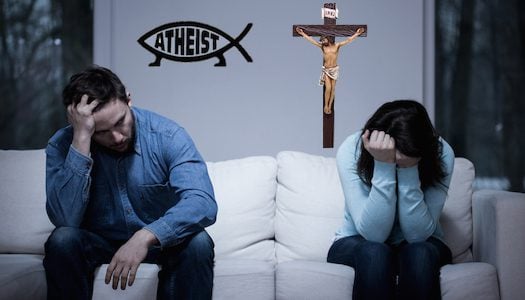
When I talk about red flags in the secular/religious marriage, somebody will reliably say, “Red Flag #1: You are in a secular/religious marriage.” It’d be a lot more clever if it were true. The supposed negative effect of mixed beliefs on a marriage has been grossly oversold for years, even as research continues to find that “the belief dissimilarity of spouses has little effect on the likelihood of dissolution” of a marriage.
This applies as well to the increasingly common union of religious believers and nonbelievers. As I wrote in the previous post, many couples in this mix experience very little conflict. In fact, the average length of marriage for participants in my survey of these couples was ten years so far — already well beyond the average length of 8 years for U.S. marriages. Many were beyond 25 years, and one couple had just celebrated 42 years.
But other such marriages are painful and difficult, and some even end as a direct result of the belief gap. To figure out why some succeed and others fail, you have to dig below the surface of the religious difference, as I did during the research for In Faith and in Doubt: How Religious Believers and Nonbelievers Can Create Strong Marriages and Loving Families.
Here are 8 things that can make a secular/religious relationship more difficult. They aren’t always terminal by any means, but couples with one or more of these situations will need to draw on other strengths to offset the challenges.
8 Red Flags to Watch for in the Secular/Religious Marriage
1. A couple shared a worldview when they married, then one partner changed.
Though never enough by itself, this was among the most consistent risk markers. The partner whose worldview is unchanged often feels that an agreement has been violated, unspoken or otherwise, one on which the very choice to marry was often predicated. The correlation between this factor and the tension markers in the survey conducted for this book was very high.
2. Both partners identify intensely or dogmatically with their respective worldviews.
If both partners are fairly moderate in the intensity of their worldview expression, tension and conflict tend to be low. Even if one is intensely engaged, the opportunity for compromise is still available. But when one partner is intensely religious and the other is intensely nonreligious, the issues multiply, and the opportunity for compromise diminishes. If the intensity is accompanied by dogmatism or a strong desire to convert, the strain on the relationship can be intense.
Dogmatism is not the same as intensity. It has nothing to do with how loud or confident you are, nor with the presence of written dogmas. It describes a person’s unwillingness to allow that he or she could conceivably be wrong. Written dogmas reflect this stance, but they don’t necessarily generate it. So yes, an atheist can indeed be dogmatic.
A person can be highly committed to a worldview, whether religious or nonreligious, and still retain some flexibility of thinking and a willingness to admit that he or she might be wrong. One dogmatic thinker in a marriage can be challenging. Two partners who are dogmatic on opposite ends is deadly.
3. One or both partners have a strong desire to convert the other.
It’s never a good idea to enter a relationship with the assumption or expectation that the other person will change. Because religious identity is less likely to change than most habits, and because it’s tied so tightly to personal identity, a persistent expressed desire to convert one’s partner causes resentment and alienation to build over time. In the survey, a strong desire by one or both partners to convert the other correlated strongly with tension and conflict in the relationship.
4. The secular partner identifies as an anti-theist.
Whether anti-theism is a justified position is a separate question. But the survey results were clear: those who self-identified as anti-theists were also more likely to report a higher level of tension and conflict with a religious partner.
5. The religious partner identifies with a conservative, dogmatic, or fundamentalist denomination.
A few denominations show an especially high correlation with tension and conflict in the secular/religious marriage. Mormonism, Jehovah’s Witnesses, Pentecostalism, and conservative Evangelical Protestants are among those with the highest levels of conflict and divorce in secular/religious matches, much of which takes the form of pressure or shunning by extended family.
6. The marriage already includes other high-risk factors.
If a relationship already includes one or more of the classic risk factors, religious differences can exacerbate the effect. General risks with a correlation to conflict and divorce include:
- Significant age difference between partners
- Young age at marriage (under 25, especially under 21)
- Parents’ history of divorce
- Alcoholism or other addiction by one partner or both
- Mismatched desire to have children, or more children
- Low overall life satisfaction/marital satisfaction
- Communication in general that is often disrespectful or contemptuous
7. The couple experiences significant disapproval from extended family and/or the community.
A Harvard study in 2012 found that strong outside disapproval puts serious stress on a relationship and even on the health of the individuals. “The more people felt like their family and friends and society didn’t approve of and support their relationship, the worse their health was,” said Justin Lehmiller, lead researcher on the study. And if the source of the tension is the religious difference between the partners, such disapproval can greatly increase existing tensions between them.
8. There is disagreement over religious identity, boundaries, and practices for children.
Many issues that lie dormant for a secular/religious couple prior to having kids come roaring to the surface once that Rubicon is crossed. It’s fine to say each partner can hold the beliefs he or she chooses, but what about the kids? Do they have a religious identity? Are they free to select their own in the long run? Do they go to Sunday school or religious services? Will they be baptized, confirmed, bar mitzvahed? Are any questions or opinions off limits? Secular/religious couples who do not come to agreement on these questions as early as possible—preferably before the kids are born—are in for some very strong shock waves, especially if one or both partners have a strong worldview identity.
Images via Shutterstock and EvolveFish
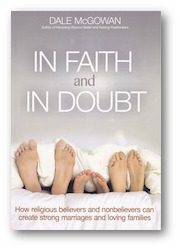
Adapted from In Faith and in Doubt: How Religious Believers and Nonbelievers Can Create Strong Marriages and Loving Families by Dale McGowan (2014)
DALE McGOWAN is the author of several books from the nonreligious perspective. He was Harvard Humanist of the Year in 2008 and founded the humanist charity Foundation Beyond Belief in 2010.
He is currently Content Development Editor and Atheist Channel Managing Editor at Patheos. He lives with his wife and children in Atlanta.
Previous Post

October 29, 2015
Spreading Fear: The Goal of SecularProLife
Next Post
November 5, 2015 Armin Navabi: Ex-Muslim Turned Global Atheist Activist
Browse Our Archives
Select a Category Ableism Activism Addiction and Recovery Agnosticism Anti-intellectualism Arts Atheism Beauty Catholicism Charles Darwin Children China Christianity Church/State separation churchgoing communication compassionate humanism Creationism critical thinking Culture death disaster response doubt education Egypt Entertainment Environment ethics evolution Existence of God Exploration fear Foundation Beyond Belief Free speech God Health History Human rights humanism identity India Interfaith Islam labels Language LGBT Love Meaning Media Medicine Middle East misconceptions mixed belief marriage Moral argument Morality Myths Near-Death Experience Nonreligious parenting Parody Persecution complex Philosophy Poetry Politics prayer Psychology Rationality Religion religious atheists Religious privilege Republican Party Satire Schools science secular parenting Spirituality The Unpigeonholeables Uncategorized United Kingdom Wonder
Select a Month March 2021 August 2020 March 2020 January 2020 September 2019 July 2019 June 2019 April 2019 February 2019 January 2019 December 2018 November 2018 October 2018 September 2018 August 2018 July 2018 June 2018 May 2018 April 2018 March 2018 February 2018 January 2018 December 2017 November 2017 October 2017 September 2017 August 2017 July 2017 March 2017 February 2017 January 2017 December 2016 November 2016 October 2016 September 2016 August 2016 July 2016 June 2016 May 2016 April 2016 March 2016 February 2016 January 2016 December 2015 November 2015 October 2015 September 2015 June 2015 March 2015 February 2015 January 2015 December 2014 November 2014 October 2014 September 2014
Follow Us!
TAKE THE
Religious Wisdom Quiz
Which Psalm begins, "The Lord is my light and my salvation; whom shall I fear?"
Select your answer to see how you score.
Psalm 14 Psalm 91 Psalm 27 Psalm 139
Related posts from The Secular Spectrum

Why Do We Question Vegetarianism When It's a...
American Pluralism: Its Promises and Struggles


TRENDING AT PATHEOS Nonreligious

Dethroning Jesus and Enthroning Yourself
Jesus Never Asked to Be Worshipped. He Asked to Be Understood. Christianity...

Why Most Christians are Really Paulians and Jobians
I Don't Care, But It Matters Let's get this out of the...

Essential Tips to Successfully Navigate the Selling Process
Selling a house can feel overwhelming, but it doesn’t have to be....

To Make Remote Work Effective, Think About Others
The COVID-19 pandemic forced many companies to rapidly transition to remote work....

Flexibility Is Key to Solving Problems of Tomorrow
The world of work is undergoing a dramatic transformation. The COVID-19 pandemic...
view all Nonreligious blogs
Ad-Free & Subscriber Log-In Subscription Support
- About Us
- 2026 Calendar
- Videos
- Podcasts
- Library of World Religions
- Faith In Media Tracker
- Advertise With Us
- Write for Us
- Privacy Policy
- Terms of Service
- Do Not Sell My Data
- Contact Us
- Radiant Digital
- Manage Newsletter Subscriptions
- Unsubscribe From Notifications
- Sitemap
Copyright 2008-2026, Patheos. All rights reserved.
Subscription Support Ad-Free & Subscriber Log-In
Follow Patheos