
BuddhistCatholicContemplativeEvangelicalGeneral ChristianHinduJewishLatter-day SaintMuslimNew VisionsProgressive Christian
Beliefs
- Buddhist
- Catholic
- Contemplative
- Evangelical
- General Christian
- Hindu
- Jewish
- Latter-day Saint
- More Voices
- Muslim
- New Visions
- Pagan
- Progressive Christian
Topics
- Religion News
- Food and Religion
- Sports and Religion
- Religious Art
- Religious Music and Entertainment
- Religious Events
- History and Religion
- Style and Religion
- Politics and Religion
- Women in Religion
- Recreation Outdoors and Religion
- Business Finance and Religion
- Careers Workplace and Religion
- Education and Religion
- Family Parenting and Religion
- Health Fitness and Religion
- Home and Religion
- Relationships and Religion
- Technology and Religion
- Travel and Religion
Columnists
- Buddhist Columnists
- Business Finance and Religion Columnists
- Careers Workplace and Religion Columnists
- Catholic Columnists
- Contemplative Columnists
- Education and Religion Columnists
- Evangelists Columnists
- Family Parenting and Religion Columnists
- General Christian Columnists
- Health Fitness and Religion Columnists
- Hindu Columnists
- History and Religion Columnists
- Home and Religion Columnists
- Jewish Columnists
- More Voices Columnists
- Latter Day Columnists
- Muslim Columnists
- New Visions Columnists
- Nonreligious Columnists
- Pagan Columnists
- Politics and Religion Columnists
- Progressive Columnists
- Recreation Outdoors and Religion Columnists
- Relationships and Religion Columnists
- Religion News Columnists
- Religious Art Columnists
- Religious Events Columnists
- Religious Music and Entertainment Columnists
- Sports and Religion Columnists
- Style and Religion Columnists
- Technology and Religion Columnists
- Travel and Religion Columnists
- Women in Religion Columnists
Resource Library
- 2026 Calendar
- Library of World Religions
- The 100 Most Holy Places on Earth
- Patheos Answers
- Podcasts
- Videos
- Faith Leaders Database
- Anglican Episcopalian
- Bahai
- Baptist
- Buddhism
- Christianity
- Confucianism
- Eastern Orthodoxy
- Hinduism
- Holiness and Pentecostal
- ISKCON
- Islam
- Judaism
- Lutheran
- Methodist
- The Church of Jesus Christ of Latter-day Saints
- New Age
- Paganism
- Presbytarian and Reformed
- Protestantism
- Religion Behind the Scenes
- Roman Catholic
- Scientology
- Shia Islam
- Sikhism
- Sufism
- Sunni Islam
- Taoism
- Zen
- See all religions
Research Tools
 Ad-Free & Subscriber Log-In Subscription Support
Ad-Free & Subscriber Log-In Subscription Support
Follow Patheos 

- Trending:
- Forgiveness
- |
- Marriage
- |
- Consciousness
- |
- Death Penalty
- |
- Election
- |
- Halloween
 The Secular Spectrum
- Home
- Nonreligious
- Useful Monsters and the Problem of Fear
Useful Monsters and the Problem of Fear
Last updated on: October 29, 2015 at 4:03 pm by Dale McGowan
Useful Monsters and the Problem of Fear 2015-10-29T16:03:05-05:00 Dale McGowan
Patheos Explore the world's faith through different perspectives on religion and spirituality! Patheos has the views of the prevalent religions and spiritualities of the world.
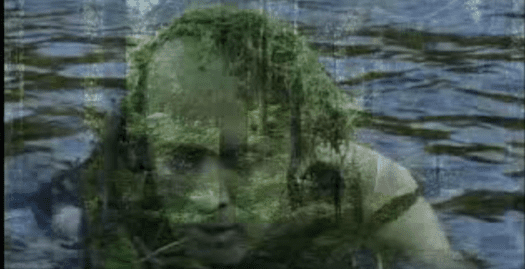
Näkki, a Finnish lake spirit known for pulling curious children under the water (YouTube)
By Dale McGowan –
Beneath the amber waters of the River Tees in Northern England lives a creature named Peg Powler. Peg is a mermaid — but don’t picture the perky Disney redhead. Peg is a river hag, with green hair and skin and a row of jagged teeth. Unlike Ariel, Peg lives not to make children glad, but to kill and eat them.
Peg Powler lives in the foamy yellow rapids of the river. Wander too close to the river’s edge, goes the mother’s warning, especially near that foam, and Peg will have you by the ankle. She’ll yank you below the water and eat you up, flesh, bones, and all, ending with a belch of yellow foam.
Nice touch.
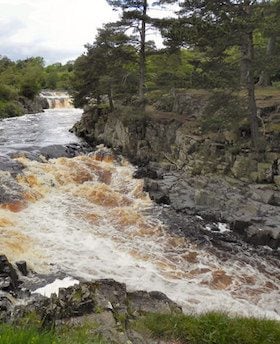
The peat-stained Low Force Waterfalls.
Image © David Dixon, CC 2.0
The Tees is no meandering stream. Dropping from its rugged source on Cross Fell, it roars through narrow, rocky vales to produce coursing rapids and three of the most impressive waterfalls in Britain—Low Force, High Force, and the unbeatably-named Cauldron Snout.
In addition to its rapid speed, the water of the Tees is extremely cold. It’s this feature that causes someone falling into the water to inhale in a sudden gasp, one of the most common causes of drowning. Add the fact that the Tees runs as much as fifteen feet deep with intense undercurrents, and drownings are a logical but tragic drumbeat throughout the river’s course and history.
It makes sense that the legend of Peg Powler was born on the banks of the Tees rather than the sluggish Thames. The creature was imagined into existence for one purpose only—to scare children safe. She is naturally said to live in the foam, which both marks the most dangerously turbulent spots in the river and obscures the view of the water below. The occasional drowning reinforces and perpetuates the legend. Peg will have her meal.
These monster legends find fertile soil wherever there are parents and water. Inuit Islanders warn their children of Tizheruk, an enormous sea snake said to snatch children from shore with its tail. For Serbs, it’s Bukavac, a six-legged lake-dweller that jumps from the water to strangle passersby—and again, a culinary preference is expressed for the young. Even as water-starved a region as aboriginal Australia has a water-dwelling child-eater called the Muldjewangk living in the Murray, one of the few major rivers on the continent.

But of all the water-warning legends on Earth, it’s hard to beat the kappa of Japan for creative details.
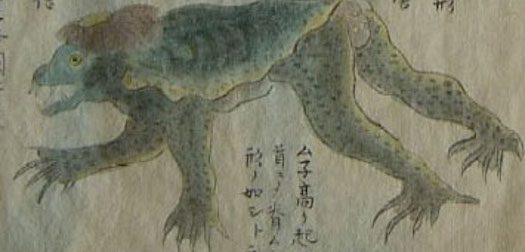
Kappa illustration from 1836, via Wikimedia.
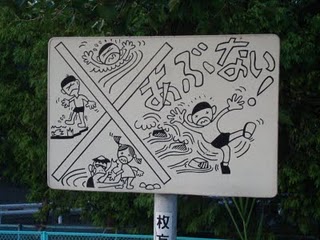
Primarily a harmless trickster-spirit who loudly passes gas and looks up women’s kimonos, the kappa is said to occasionally snatch a child from a riverbank, drag him or her below the water, and—as if all this weren’t dissuasive enough—to suck out the child’s organs through the anus. To this day, many Japanese towns and villages post illustrated (but thankfully not overly detailed) signs along the banks of rivers and lakes warning children to beware the kappa*.*
There are childhood dangers other than water, of course. Slavic mothers have traditionally warned their little ones not to wander off in public places for fear of Baba Yaga, a witch who preys specifically on lost children. Dropping from the sky in a flying mortar and pestle, Baba sweeps the lost ones off their feet and takes them to her hut on chicken legs, which is surrounded by a fence built from the bones of her tiny victims.
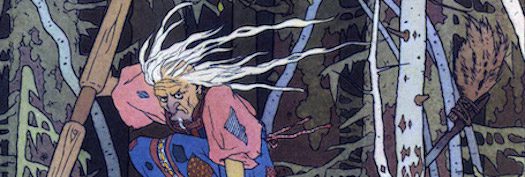
Bilibin’s Baba Yaga (1902), via Wikimedia
In Upper Egypt, parents warn of the monstrous silowa, which is said to pass through villages from its home in the hills at dusk to get a drink at the Nile, snacking on children along the way. This by itself would be no more extreme than any of the monsters invoked above, but the landscape of fear for rural Egyptian children extends far beyond specific physical protections into a network of superstitious horrors. Children are warned not to look at their own shadows lest they go insane and are instructed to chant passages from the Qur’an whenever passing “haunted places”—which according to some observers seem to occur every ten steps in most villages. Kenyan toddlers who will not nurse are set outside in the dark while the mother calls loudly from the hut for the manani (wild beasts) to come and eat the child.
Eucalyptus trees in Australia— called “widowmakers” for their tendency to suddenly lose enormous branches—are said to shelter vicious man-eating koalas known as “drop bears” for their practice of dropping and dining on those who camp beneath the tree.
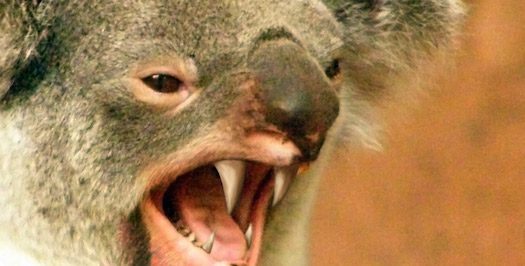
“Dropbear” by Yamavu – Own work. Licensed under CC BY-SA 3.0 via Commons.

The child-munching hiisi of Finland live in and around crevasses, large boulders, and the edges of cliffs; and the Polish ghoul Południca causes children trespassing in cornfields to become forever lost among the stalks.
And so it goes, in every culture and time. We populate an already frightening world with useful monsters, hoping to bring ill-defined risks into focus, keeping the most vulnerable among us safe—terrified, yes, maybe prone to social conservativism, but alive.
Warning legends like these tend to involve a kind of cost-benefit analysis: The cost to the child in fear and mental anguish is weighed against the potential for harm, and the benefit of protection—from dangers real or parentally imagined—almost always wins. This is not a conscious process, but a subconscious cultural calculus by which a monster’s terrors are equated to a danger in the parents’ eyes.
But protective monsters have one serious failing: they are often specific, even when the danger they represent is general. A child who learns to fear Peg Powler will not necessarily generalize the danger to other rivers, much less to other risks. On a visit to the River Spey in Scotland—no less dangerous but free of the peat-stained yellow foam—a child raised to watch for Peg might happily tempt the waters, since the fearful hag is so very far away. By misrepresenting the danger, it could be argued that specific supernatural protection myths make children less safe than a reasoned description of real dangers.
A fear-based approach to parenting or education is among the least effective options at our disposal. It works in limited, short-term ways and fails as a solution to the more general long-term problems for which parents must prepare their children. But generation after generation, we too often reach for the easy fix of instilling fear. The result is a vigilance paradox: Continuous anxiety, and the naming or personification of evil, makes us feel vigilant and therefore safe, while in fact distracting us from real risks, making us less safe.
Useful monsters serve the admirable purpose of protecting children from potentially lethal harm. While an argument can be made for allowing kids to make mistakes and learn from them, there’s little point in advocating the occasional slip into a fast-moving river as a lesson in avoiding danger. There’s a very real chance that no further opportunities to use that wisdom will present themselves.
So the problem isn’t the useful monster per se — it’s the next step. Having found fear a useful tool for protecting children from harm, adults often find it difficult to resist using fear as a tool of control — for children, and for each other.
Adapted from Everyday Humanism, Anthony Pinn and Dale McGowan, eds., Equinox (2014)
DALE McGOWAN is the author of several books from the nonreligious perspective. He was Harvard Humanist of the Year in 2008 and founded the humanist charity Foundation Beyond Belief in 2010. He is currently Content Development Editor and Atheist Channel Managing Editor for Patheos. He lives in Atlanta.
Previous Post
October 27, 2015
10 Ways Believers and Nonbelievers Make Great Marriages
Next Post

October 29, 2015 Origin Story
Browse Our Archives
Select a Category Ableism Activism Addiction and Recovery Agnosticism Anti-intellectualism Arts Atheism Beauty Catholicism Charles Darwin Children China Christianity Church/State separation churchgoing communication compassionate humanism Creationism critical thinking Culture death disaster response doubt education Egypt Entertainment Environment ethics evolution Existence of God Exploration fear Foundation Beyond Belief Free speech God Health History Human rights humanism identity India Interfaith Islam labels Language LGBT Love Meaning Media Medicine Middle East misconceptions mixed belief marriage Moral argument Morality Myths Near-Death Experience Nonreligious parenting Parody Persecution complex Philosophy Poetry Politics prayer Psychology Rationality Religion religious atheists Religious privilege Republican Party Satire Schools science secular parenting Spirituality The Unpigeonholeables Uncategorized United Kingdom Wonder
Select a Month March 2021 August 2020 March 2020 January 2020 September 2019 July 2019 June 2019 April 2019 February 2019 January 2019 December 2018 November 2018 October 2018 September 2018 August 2018 July 2018 June 2018 May 2018 April 2018 March 2018 February 2018 January 2018 December 2017 November 2017 October 2017 September 2017 August 2017 July 2017 March 2017 February 2017 January 2017 December 2016 November 2016 October 2016 September 2016 August 2016 July 2016 June 2016 May 2016 April 2016 March 2016 February 2016 January 2016 December 2015 November 2015 October 2015 September 2015 June 2015 March 2015 February 2015 January 2015 December 2014 November 2014 October 2014 September 2014
Follow Us!
TAKE THE
Religious Wisdom Quiz
Which book is written almost completely as poetry?
Select your answer to see how you score.
Jeremiah Ezra Isaiah Lamentations
Related posts from The Secular Spectrum
The Problem with “Thoughts and Prayers”

Reaching 'Faith Healers' Is an Urgent Public Health...
Storytelling while Secular: Writing about Loss in an...
What We Talk About When We Talk About...
TRENDING AT PATHEOS Nonreligious

Dethroning Jesus and Enthroning Yourself
Jesus Never Asked to Be Worshipped. He Asked to Be Understood. Christianity...

Why Most Christians are Really Paulians and Jobians
I Don't Care, But It Matters Let's get this out of the...

Essential Tips to Successfully Navigate the Selling Process
Selling a house can feel overwhelming, but it doesn’t have to be....

To Make Remote Work Effective, Think About Others
The COVID-19 pandemic forced many companies to rapidly transition to remote work....

Flexibility Is Key to Solving Problems of Tomorrow
The world of work is undergoing a dramatic transformation. The COVID-19 pandemic...
view all Nonreligious blogs
Ad-Free & Subscriber Log-In Subscription Support
- About Us
- 2026 Calendar
- Videos
- Podcasts
- Library of World Religions
- Faith In Media Tracker
- Advertise With Us
- Write for Us
- Privacy Policy
- Terms of Service
- Do Not Sell My Data
- Contact Us
- Radiant Digital
- Manage Newsletter Subscriptions
- Unsubscribe From Notifications
- Sitemap
Copyright 2008-2026, Patheos. All rights reserved.
Subscription Support Ad-Free & Subscriber Log-In
Follow Patheos