
BuddhistCatholicContemplativeEvangelicalGeneral ChristianHinduJewishLatter-day SaintMuslimNew VisionsProgressive Christian
Beliefs
- Buddhist
- Catholic
- Contemplative
- Evangelical
- General Christian
- Hindu
- Jewish
- Latter-day Saint
- More Voices
- Muslim
- New Visions
- Pagan
- Progressive Christian
Topics
- Religion News
- Food and Religion
- Sports and Religion
- Religious Art
- Religious Music and Entertainment
- Religious Events
- History and Religion
- Style and Religion
- Politics and Religion
- Women in Religion
- Recreation Outdoors and Religion
- Business Finance and Religion
- Careers Workplace and Religion
- Education and Religion
- Family Parenting and Religion
- Health Fitness and Religion
- Home and Religion
- Relationships and Religion
- Technology and Religion
- Travel and Religion
Columnists
- Buddhist Columnists
- Business Finance and Religion Columnists
- Careers Workplace and Religion Columnists
- Catholic Columnists
- Contemplative Columnists
- Education and Religion Columnists
- Evangelists Columnists
- Family Parenting and Religion Columnists
- General Christian Columnists
- Health Fitness and Religion Columnists
- Hindu Columnists
- History and Religion Columnists
- Home and Religion Columnists
- Jewish Columnists
- More Voices Columnists
- Latter Day Columnists
- Muslim Columnists
- New Visions Columnists
- Nonreligious Columnists
- Pagan Columnists
- Politics and Religion Columnists
- Progressive Columnists
- Recreation Outdoors and Religion Columnists
- Relationships and Religion Columnists
- Religion News Columnists
- Religious Art Columnists
- Religious Events Columnists
- Religious Music and Entertainment Columnists
- Sports and Religion Columnists
- Style and Religion Columnists
- Technology and Religion Columnists
- Travel and Religion Columnists
- Women in Religion Columnists
Resource Library
- 2026 Calendar
- Library of World Religions
- The 100 Most Holy Places on Earth
- Patheos Answers
- Podcasts
- Videos
- Faith Leaders Database
- Anglican Episcopalian
- Bahai
- Baptist
- Buddhism
- Christianity
- Confucianism
- Eastern Orthodoxy
- Hinduism
- Holiness and Pentecostal
- ISKCON
- Islam
- Judaism
- Lutheran
- Methodist
- The Church of Jesus Christ of Latter-day Saints
- New Age
- Paganism
- Presbytarian and Reformed
- Protestantism
- Religion Behind the Scenes
- Roman Catholic
- Scientology
- Shia Islam
- Sikhism
- Sufism
- Sunni Islam
- Taoism
- Zen
- See all religions
Research Tools
 Ad-Free & Subscriber Log-In Subscription Support
Ad-Free & Subscriber Log-In Subscription Support
Follow Patheos 

- Trending:
- Forgiveness
- |
- Marriage
- |
- Consciousness
- |
- Death Penalty
- |
- Election
- |
- Halloween
 The Secular Spectrum
- Home
- Nonreligious
- The Southern Baptist Cafeteria
The Southern Baptist Cafeteria
Last updated on: October 8, 2015 at 11:06 am by Dale McGowan
The Southern Baptist Cafeteria 2015-10-08T11:06:20-05:00 Dale McGowan
Patheos Explore the world's faith through different perspectives on religion and spirituality! Patheos has the views of the prevalent religions and spiritualities of the world.

Pixabay
| By Dale McGowan |
There’s a Southern Baptist church in Fort Worth, Texas that holds the Letter of Baptism for my wife Becca. After mostly growing up in the denomination, she was willingly baptized as an adult in 1990, the year before our wedding. I was by her side.
She was not a Mainline Protestant when we married — by affiliation, she was a Protestant Evangelical. If she ascribed to every piece of the denomination’s creed, the Baptist Faith and Message, we could still easily have been friends, but I doubt we would have dated, much less married. She agreed with several items in the list, but the Baptist Faith and Message includes a few important doctrines that I was pretty sure Becca wouldn’t ever have endorsed, any more than I’d endorse every Dawkins tweet.
I once printed out the BF&M and asked Becca which of its positions she remembered holding true when we were first married and which she would have rejected.
She believed there is only one God and that he is perfect, all-powerful, and all-knowing. But she never believed that man brought sin into the human race by disobedience, nor that “as soon as [people] are capable of moral action, they become transgressors and are under condemnation.”
She believed that Christ was the son of God, but not that he was born of a virgin, nor that salvation is available only through him.
She did not agree that “all Scripture is totally true and trustworthy.”
She did believe that baptism is “the believer’s death to sin, the burial of the old life, and the resurrection to walk in newness of life in Christ Jesus,” as well as a testimony to “faith in the final resurrection of the dead.”
But she didn’t believe it is “the duty and privilege of every follower of Christ” to evangelize others to the faith.
She agreed that “Christians should oppose racism, every form of greed, selfishness, and vice,” “work to provide for the orphaned, the needy, the abused, the aged, the helpless, and the sick,” and “do all in their power to put an end to war.” But she did not agree that homosexuality is a form of “sexual immorality,” that Christians should “speak on behalf of the unborn,” nor that the strict definition of marriage should be “the uniting of one man and one woman.”
One of the statements of the Baptist Faith and Message that surprises outsiders (and insiders, come to that) is clear support for church-state separation. “Church and state should be separate,” it says, and “the state has no right to impose penalties for religious opinions of any kind.” She agreed.
As for marriage and parenting, she had a somewhat more conservative approach than I did, but she never believed that it was her place to “submit herself graciously to the servant leadership of her husband even as the church willingly submits to the headship of Christ,” nor that she had “the God-given responsibility to respect her husband and to serve as his helper in managing the household and nurturing the next generation.”
You might think that this indicates her religious identity wasn’t important to her, but that’s not true. Before we were married, she made sure I would not ask her to stop attending church, and she went every week. She prayed and read a daily devotional. Her religious identity was a big part of who she was. But the contents of her cafeteria tray identified her as a representative of the Evangelical Left, who affirm the theological basics (atonement, incarnation, resurrection) but reject the conservative social platform of the evangelical churches.
So aside from the God-and-Jesus theological frame, my own tray of humanist values and beliefs wasn’t all that different from Becca’s.
Sure, you might say, but the remaining differences include some pretty big stuff, like God and Jesus, and what happens when we die. Doesn’t get much bigger than that.
And there’s the question at the heart of the religious/nonreligious marriage: Even if there is some common ground, aren’t the remaining differences just too big for the relationship to work? How could any question be bigger than God’s existence, how the universe will end, or what happens when we die?
Yes, those are big questions. But “big” and “important” aren’t always the same. This isn’t about the way I see the world — it’s about whether I can be in a loving, enduring relationship with someone who sees it differently. And when the question is framed in that way, the “big” theological questions are actually smaller and less important than the social values questions. On those, this atheist and his evangelical wife had a solid match for 13 years. And when she decided to clear the theological beliefs off her tray ten years ago, most of her values stayed put.
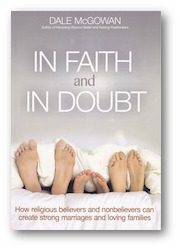 Excerpt from In Faith and in Doubt: How Religious Believers and Nonbelievers Can Create Strong Marriages and Loving Families by Dale McGowan (AMACOM, 2014)
DALE McGOWAN has written and edited 11 books, mostly focused on the nonreligious life. He was Harvard Humanist of the Year in 2008 and founded the humanist charity Foundation Beyond Belief in 2010. Dale is now content development editor and Atheist Channel manager for Patheos. He lives in Atlanta.
Previous Post

October 6, 2015
Catching the rainbow
Next Post
October 9, 2015 Deists: Believers in a different kind of creator
Browse Our Archives
Select a Category Ableism Activism Addiction and Recovery Agnosticism Anti-intellectualism Arts Atheism Beauty Catholicism Charles Darwin Children China Christianity Church/State separation churchgoing communication compassionate humanism Creationism critical thinking Culture death disaster response doubt education Egypt Entertainment Environment ethics evolution Existence of God Exploration fear Foundation Beyond Belief Free speech God Health History Human rights humanism identity India Interfaith Islam labels Language LGBT Love Meaning Media Medicine Middle East misconceptions mixed belief marriage Moral argument Morality Myths Near-Death Experience Nonreligious parenting Parody Persecution complex Philosophy Poetry Politics prayer Psychology Rationality Religion religious atheists Religious privilege Republican Party Satire Schools science secular parenting Spirituality The Unpigeonholeables Uncategorized United Kingdom Wonder
Select a Month March 2021 August 2020 March 2020 January 2020 September 2019 July 2019 June 2019 April 2019 February 2019 January 2019 December 2018 November 2018 October 2018 September 2018 August 2018 July 2018 June 2018 May 2018 April 2018 March 2018 February 2018 January 2018 December 2017 November 2017 October 2017 September 2017 August 2017 July 2017 March 2017 February 2017 January 2017 December 2016 November 2016 October 2016 September 2016 August 2016 July 2016 June 2016 May 2016 April 2016 March 2016 February 2016 January 2016 December 2015 November 2015 October 2015 September 2015 June 2015 March 2015 February 2015 January 2015 December 2014 November 2014 October 2014 September 2014
Follow Us!
TAKE THE
Religious Wisdom Quiz
According to Philippians, whose name is above every name?
Select your answer to see how you score.
Christ Jesus The Lord God
Related posts from The Secular Spectrum
American Pluralism: Its Promises and Struggles

Christians Are Divided on the Legalization of Cannabis....


Atheism in Colombia: Not as Different as You...
TRENDING AT PATHEOS Nonreligious

Dethroning Jesus and Enthroning Yourself
Jesus Never Asked to Be Worshipped. He Asked to Be Understood. Christianity...

Why Most Christians are Really Paulians and Jobians
I Don't Care, But It Matters Let's get this out of the...

Essential Tips to Successfully Navigate the Selling Process
Selling a house can feel overwhelming, but it doesn’t have to be....

To Make Remote Work Effective, Think About Others
The COVID-19 pandemic forced many companies to rapidly transition to remote work....

Flexibility Is Key to Solving Problems of Tomorrow
The world of work is undergoing a dramatic transformation. The COVID-19 pandemic...
view all Nonreligious blogs
Ad-Free & Subscriber Log-In Subscription Support
- About Us
- 2026 Calendar
- Videos
- Podcasts
- Library of World Religions
- Faith In Media Tracker
- Advertise With Us
- Write for Us
- Privacy Policy
- Terms of Service
- Do Not Sell My Data
- Contact Us
- Radiant Digital
- Manage Newsletter Subscriptions
- Unsubscribe From Notifications
- Sitemap
Copyright 2008-2026, Patheos. All rights reserved.
Subscription Support Ad-Free & Subscriber Log-In
Follow Patheos