
BuddhistCatholicContemplativeEvangelicalGeneral ChristianHinduJewishLatter-day SaintMuslimNew VisionsProgressive Christian
Beliefs
- Buddhist
- Catholic
- Contemplative
- Evangelical
- General Christian
- Hindu
- Jewish
- Latter-day Saint
- More Voices
- Muslim
- New Visions
- Pagan
- Progressive Christian
Topics
- Religion News
- Food and Religion
- Sports and Religion
- Religious Art
- Religious Music and Entertainment
- Religious Events
- History and Religion
- Style and Religion
- Politics and Religion
- Women in Religion
- Recreation Outdoors and Religion
- Business Finance and Religion
- Careers Workplace and Religion
- Education and Religion
- Family Parenting and Religion
- Health Fitness and Religion
- Home and Religion
- Relationships and Religion
- Technology and Religion
- Travel and Religion
Columnists
- Buddhist Columnists
- Business Finance and Religion Columnists
- Careers Workplace and Religion Columnists
- Catholic Columnists
- Contemplative Columnists
- Education and Religion Columnists
- Evangelists Columnists
- Family Parenting and Religion Columnists
- General Christian Columnists
- Health Fitness and Religion Columnists
- Hindu Columnists
- History and Religion Columnists
- Home and Religion Columnists
- Jewish Columnists
- More Voices Columnists
- Latter Day Columnists
- Muslim Columnists
- New Visions Columnists
- Nonreligious Columnists
- Pagan Columnists
- Politics and Religion Columnists
- Progressive Columnists
- Recreation Outdoors and Religion Columnists
- Relationships and Religion Columnists
- Religion News Columnists
- Religious Art Columnists
- Religious Events Columnists
- Religious Music and Entertainment Columnists
- Sports and Religion Columnists
- Style and Religion Columnists
- Technology and Religion Columnists
- Travel and Religion Columnists
- Women in Religion Columnists
Resource Library
- 2026 Calendar
- Library of World Religions
- The 100 Most Holy Places on Earth
- Patheos Answers
- Podcasts
- Videos
- Faith Leaders Database
- Anglican Episcopalian
- Bahai
- Baptist
- Buddhism
- Christianity
- Confucianism
- Eastern Orthodoxy
- Hinduism
- Holiness and Pentecostal
- ISKCON
- Islam
- Judaism
- Lutheran
- Methodist
- The Church of Jesus Christ of Latter-day Saints
- New Age
- Paganism
- Presbytarian and Reformed
- Protestantism
- Religion Behind the Scenes
- Roman Catholic
- Scientology
- Shia Islam
- Sikhism
- Sufism
- Sunni Islam
- Taoism
- Zen
- See all religions
Research Tools
 Ad-Free & Subscriber Log-In Subscription Support
Ad-Free & Subscriber Log-In Subscription Support
Follow Patheos 

- Trending:
- Forgiveness
- |
- Marriage
- |
- Consciousness
- |
- Death Penalty
- |
- Election
- |
- Halloween
 The Secular Spectrum
- Home
- Nonreligious
- Getting My Own Story Straight
Getting My Own Story Straight
Last updated on: October 22, 2015 at 8:19 pm by Dale McGowan
Getting My Own Story Straight 2015-10-22T20:19:44-05:00 Dale McGowan
Patheos Explore the world's faith through different perspectives on religion and spirituality! Patheos has the views of the prevalent religions and spiritualities of the world.
by Dale McGowan
It’s easy to get your own story wrong. Selective memory takes a messy life and creates a narrative — a winding path, but one that in retrospect was always bringing Odysseus to Ithaca. And you’d swear it’s a documentary.
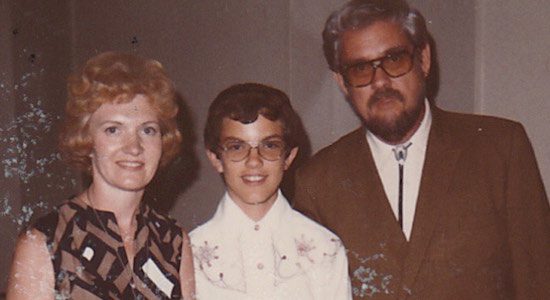
With my parents in 1975, the year before Dad died
For years, the movie in my head of my own road to religious disbelief started with a clear establishing shot — me at 13, staring into the open casket of my father. I always said his death was the event that hit me between the eyes with the God question. Not because I was “mad at God” for taking him away: I loved my father, but it would have been perverse to blame God for killing a three-pack-a-day smoker. I was overwhelmed with grief, but also with a consuming curiosity, one I’d never felt before with such heat. “My Dad” was clearly not in that casket. So where was he?
As the lid was slowly lowered, I swore through my tears to learn the truth. That was the precise moment my intellectual journey began, the one that led me away from the myth of God and toward reality.
Or not.
As it happens, that isn’t the only scene I recall from that week — and another one vetoes the casket epiphany.
I’d spent the previous day avoiding hugs from the murmuring relatives who filled our home. At one point I ducked into my bedroom, a gambit that couldn’t possibly work. I knew someone would notice the missing son and head off on a seek-and-console mission.
Sure enough, as I was reading on my bed, a voice from the doorway made me jump.
“Oh Dale.” It was Aunt Dar, my dad’s older sister, her face contoured with sadness. When she saw the book in my lap, her eyes lit up. “Oh, that’s wonderful! I’m so glad to see you reading that. There is no better place to turn in times of trouble.”
It was the Bible.
What she didn’t know is that I had not turned to the Bible for comfort. I was reading it skeptically, working my way from cover to cover. One way I know this is the wave of guilt I clearly remember crashing over me when she praised me for reading it.
I don’t know quite when I started, but what happened next tells me it wasn’t set in motion by my dad’s death, much less the funeral.
Dar walked to my bedside, glanced at the page I was reading, and gasped. “Oh no dear, not the Book of Kings. Not now. Not that.” She was right, of course. You won’t find much from First and Second Kings embroidered on little pillows. Every five minutes, children are slaughtered by bears, or beheaded, or cooked and eaten by their mothers.
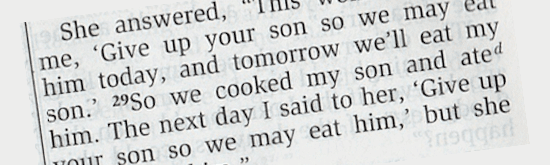
“Oh no dear, not the Book of Kings. Not now. Not that.”
She took the book gently, flipped to Psalms, patted my shoulder, and left the room, click click click, knitting her own happy narrative.
See the problem? Nobody starts reading in Kings. Like most people, I had started with Genesis. I was hundreds of pages into my first full read-through of the Bible by the time Dad died. And even if his death had been the impetus for my questioning, there’s no way I’d have already found enough time alone to get to Kings.
Poking further back, I find more credible catalysts for my early questions. I loved Greek and Roman myths when I was a kid, which led me to wonder what was so different about the more current versions. I read the story of Perseus — in which a god impregnates a virgin, who gives birth to a son who narrowly escapes death, then grows to be a great hero and savior of his people — around the same time I first heard the story of Jesus. I read twice about an infant boy who was hidden in the wilds, then found and brought to a palace to be raised by a king and queen — first Oedipus, then Moses.
I had also developed a crucial attitude: I’d fallen in love with the world. By reading Carl Sagan and others, I’d come to the conclusion that the universe was wonderful, period, and that I was incredibly fortunate to get a chance to be a conscious thing in the midst of it. The wonder of it came with no conditions, no “ifs.” I had become unconditionally smitten with reality long before Dad died, and at some point started working on whether God exists.
If I had any predisposition, it was the usual human one: a desire that it all be true. How could I have stood at that casket and wished for anything but the existence of God, since that might continue the existence of my father? But I knew my preferences were irrelevant. I’d be fine if there was a God; I’d be fine if there wasn’t. I just wanted to know.
In short, I took the question seriously.
Adapted excerpt from “The Unconditional Love of Reality” by Dale McGowan, in 50 Voices of Disbelief, ed. Blackford and Schuklenk (Wiley-Blackwell). Images © 2015 Dale McGowan.

DALE McGOWAN is the author of several books from the nonreligious perspective. He was Harvard Humanist of the Year in 2008 and founded the humanist charity Foundation Beyond Belief in 2010.
Dale is now Content Development Editor and Atheist Channel manager for Patheos. He lives in Atlanta.
Previous Post

October 21, 2015
Miracle Girl?
Next Post

October 23, 2015 "Please Put a Blanket on Me" -- I Was Aware in My Coma
Browse Our Archives
Select a Category Ableism Activism Addiction and Recovery Agnosticism Anti-intellectualism Arts Atheism Beauty Catholicism Charles Darwin Children China Christianity Church/State separation churchgoing communication compassionate humanism Creationism critical thinking Culture death disaster response doubt education Egypt Entertainment Environment ethics evolution Existence of God Exploration fear Foundation Beyond Belief Free speech God Health History Human rights humanism identity India Interfaith Islam labels Language LGBT Love Meaning Media Medicine Middle East misconceptions mixed belief marriage Moral argument Morality Myths Near-Death Experience Nonreligious parenting Parody Persecution complex Philosophy Poetry Politics prayer Psychology Rationality Religion religious atheists Religious privilege Republican Party Satire Schools science secular parenting Spirituality The Unpigeonholeables Uncategorized United Kingdom Wonder
Select a Month March 2021 August 2020 March 2020 January 2020 September 2019 July 2019 June 2019 April 2019 February 2019 January 2019 December 2018 November 2018 October 2018 September 2018 August 2018 July 2018 June 2018 May 2018 April 2018 March 2018 February 2018 January 2018 December 2017 November 2017 October 2017 September 2017 August 2017 July 2017 March 2017 February 2017 January 2017 December 2016 November 2016 October 2016 September 2016 August 2016 July 2016 June 2016 May 2016 April 2016 March 2016 February 2016 January 2016 December 2015 November 2015 October 2015 September 2015 June 2015 March 2015 February 2015 January 2015 December 2014 November 2014 October 2014 September 2014
Follow Us!
TAKE THE
Religious Wisdom Quiz
Which Christian festival begins with Ash Wednesday and ends at Easter?
Select your answer to see how you score.
Advent Lent Epiphany Pentecost
Related posts from The Secular Spectrum
The Problem with “Thoughts and Prayers”

Reaching 'Faith Healers' Is an Urgent Public Health...
American Pluralism: Its Promises and Struggles

Christians Are Divided on the Legalization of Cannabis....
TRENDING AT PATHEOS Nonreligious

Dethroning Jesus and Enthroning Yourself
Jesus Never Asked to Be Worshipped. He Asked to Be Understood. Christianity...

Why Most Christians are Really Paulians and Jobians
I Don't Care, But It Matters Let's get this out of the...

Essential Tips to Successfully Navigate the Selling Process
Selling a house can feel overwhelming, but it doesn’t have to be....

To Make Remote Work Effective, Think About Others
The COVID-19 pandemic forced many companies to rapidly transition to remote work....

Flexibility Is Key to Solving Problems of Tomorrow
The world of work is undergoing a dramatic transformation. The COVID-19 pandemic...
view all Nonreligious blogs
Ad-Free & Subscriber Log-In Subscription Support
- About Us
- 2026 Calendar
- Videos
- Podcasts
- Library of World Religions
- Faith In Media Tracker
- Advertise With Us
- Write for Us
- Privacy Policy
- Terms of Service
- Do Not Sell My Data
- Contact Us
- Radiant Digital
- Manage Newsletter Subscriptions
- Unsubscribe From Notifications
- Sitemap
Copyright 2008-2026, Patheos. All rights reserved.
Subscription Support Ad-Free & Subscriber Log-In
Follow Patheos