
BuddhistCatholicContemplativeEvangelicalGeneral ChristianHinduJewishLatter-day SaintMuslimNew VisionsProgressive Christian
Beliefs
- Buddhist
- Catholic
- Contemplative
- Evangelical
- General Christian
- Hindu
- Jewish
- Latter-day Saint
- More Voices
- Muslim
- New Visions
- Pagan
- Progressive Christian
Topics
- Religion News
- Food and Religion
- Sports and Religion
- Religious Art
- Religious Music and Entertainment
- Religious Events
- History and Religion
- Style and Religion
- Politics and Religion
- Women in Religion
- Recreation Outdoors and Religion
- Business Finance and Religion
- Careers Workplace and Religion
- Education and Religion
- Family Parenting and Religion
- Health Fitness and Religion
- Home and Religion
- Relationships and Religion
- Technology and Religion
- Travel and Religion
Columnists
- Buddhist Columnists
- Business Finance and Religion Columnists
- Careers Workplace and Religion Columnists
- Catholic Columnists
- Contemplative Columnists
- Education and Religion Columnists
- Evangelists Columnists
- Family Parenting and Religion Columnists
- General Christian Columnists
- Health Fitness and Religion Columnists
- Hindu Columnists
- History and Religion Columnists
- Home and Religion Columnists
- Jewish Columnists
- More Voices Columnists
- Latter Day Columnists
- Muslim Columnists
- New Visions Columnists
- Nonreligious Columnists
- Pagan Columnists
- Politics and Religion Columnists
- Progressive Columnists
- Recreation Outdoors and Religion Columnists
- Relationships and Religion Columnists
- Religion News Columnists
- Religious Art Columnists
- Religious Events Columnists
- Religious Music and Entertainment Columnists
- Sports and Religion Columnists
- Style and Religion Columnists
- Technology and Religion Columnists
- Travel and Religion Columnists
- Women in Religion Columnists
Resource Library
- 2026 Calendar
- Library of World Religions
- The 100 Most Holy Places on Earth
- Patheos Answers
- Podcasts
- Videos
- Faith Leaders Database
- Anglican Episcopalian
- Bahai
- Baptist
- Buddhism
- Christianity
- Confucianism
- Eastern Orthodoxy
- Hinduism
- Holiness and Pentecostal
- ISKCON
- Islam
- Judaism
- Lutheran
- Methodist
- The Church of Jesus Christ of Latter-day Saints
- New Age
- Paganism
- Presbytarian and Reformed
- Protestantism
- Religion Behind the Scenes
- Roman Catholic
- Scientology
- Shia Islam
- Sikhism
- Sufism
- Sunni Islam
- Taoism
- Zen
- See all religions
Research Tools
 Ad-Free & Subscriber Log-In Subscription Support
Ad-Free & Subscriber Log-In Subscription Support
Follow Patheos 

- Trending:
- Forgiveness
- |
- Marriage
- |
- Consciousness
- |
- Death Penalty
- |
- Election
- |
- Halloween
 The Secular Spectrum
- Home
- Nonreligious
- 10 Ways Believers and Nonbelievers Make Great Marriages
10 Ways Believers and Nonbelievers Make Great Marriages
Last updated on: October 28, 2015 at 6:24 am by Dale McGowan
10 Ways Believers and Nonbelievers Make Great Marriages 2015-10-28T06:24:04-05:00 Dale McGowan
Patheos Explore the world's faith through different perspectives on religion and spirituality! Patheos has the views of the prevalent religions and spiritualities of the world.

By Dale McGowan
Not long ago, marriages in the U.S. tended to be religiously uniform. Catholics married Catholics, Lutherans married Lutherans — and the nonreligious were a vanishingly small part of the cultural landscape.
The picture is more interesting today. Mixed-belief marriages in the U.S. have more than doubled from 19% in 1960 to 39% today — and the nonreligious are a large and growing part of that mix. Forty-four percent of the religiously unaffiliated who are married have partners with a specific religious identity.
Marriages between religious believers and nonbelievers are sometimes a nightmare of tension and conflict. Some end in divorce as a direct result of the religious difference. But many others are strong and lasting, with very little tension and conflict. So why do some fail miserably and others succeed brilliantly?
While writing my book In Faith and in Doubt: How Religious Believers and Nonbelievers Can Create Strong Marriages and Loving Families, I surveyed nearly 1,000 people in secular/religious relationships and interviewed couples of many different configurations and outcomes. Over time, some solid patterns emerged — elements typical of low-tension, enduring relationships between religious and nonreligious partners, and elements typical of relationships marked by high tension and conflict, including many that had already ended as a result.
If you’re currently in a secular/religious relationship or are considering one, here are 10 ways to put the odds in your favor.
1. Never try to convert or de-convert your partner. In matters of belief, support and encourage your partner’s autonomy.
If your partner wants to question or challenge his or her own opinions and wants a sounding board, he/she knows where to find you. No problem discussing and challenging each other’s ideas. But if you want a mixed-belief relationship to work, let your partner know that in the end you respect his or her right to self-determination.
2. Talk about your differences of belief as early as possible in the relationship.
Relationships should be entered into with all cards on the table. Sharing a difference in belief with a partner or potential partner as early as you can demonstrates honesty and respect. You don’t have to reveal your whole personal history on the first date, but when things start getting serious—and certainly before engagement, marriage, kids—it’s best to discuss the difference openly.
3. Define your negotiables and non-negotiables.
Each partner might have a long list of preferences related to religious or nonreligious practice — churchgoing, parenting, family religious identity, and so on. Which are negotiable for each of you, and which are not? Decide what you can live with and without, and what you cannot, then compare lists for potential conflicts.
4. Focus on shared values more than different beliefs.
We tend to focus tightly on differences in belief, many of which are theological abstractions. But values (opinions about what is good and important) impact daily life more intensely than most beliefs. Moderate and liberal believers and nonbelievers share more values with each other than either shares with the more extreme representatives of their respective worldviews.
5. Make personal respect non-negotiable, even if you question and challenge each other’s ideas.
Ideas and opinions must earn respect, but respect for each other as people is a non-negotiable requirement of any relationship. If separating the two is not possible, a mixed-belief relationship might not be for you.
6. Engage in and learn about each other’s worldviews.
Make an effort to learn more about your partner’s worldview, not only on paper but by talking to your partner and having shared experiences in both traditions to whatever extent you are comfortable. It’s a huge gesture of personal respect and a way to deepen your mutual understanding.
7. Remember that the opinions of believers are not always the same as the doctrines of their churches, and the opinions of nonbelievers are not always the same as those of prominent atheists.
The marriage of a believer and nonbeliever is not a marriage of the Bible and The God Delusion. Most religious people aren’t Old Testament literalists, and most nonreligious people don’t think religion poisons everything. Take the time to find out whether and how your partner’s beliefs differ from the stereotype.
8. Raise children with the freedom to choose their own religious or nonreligious identity. Expose them to many traditions, beliefs, and practices.
If parents have two different worldviews, there is one clear best practice for the kids: keep them unlabeled, then preserve space around them so they can come to their own conclusions in the long run. Provide knowledge and experience to fuel that process, and let them know you will never withhold your love and support, no matter how they decide these questions. Progressive believers and nonbelievers alike embrace this idea to a greater extent than either tends to assume of the other.
9. Support and protect each other from mistreatment or disrespect, especially by those who share your worldview, including extended family.
If your partner is being maligned, pressured, or ostracized by family or community members because of his or her beliefs, a mixed-belief partner is in a unique position to come to his or her defense. Never miss an opportunity to do so.
10. Spread the word.
If you are married to someone across the gap between religious belief and nonbelief, you’re in a unique position to dispel negative stereotypes about your partner’s worldview. The religious partner can be a moderating voice when the church ladies start suggesting that all atheists are immoral, and the nonreligious partner can do the same when those in the local atheist group suggest that all religious people are unintelligent. You know better, so find the courage to speak up.
There are no guarantees, but these practices correlate highly with couples in functional, satisfying, lasting relationships across the biggest belief gap of all.
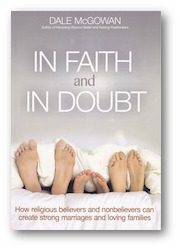 Excerpt from In Faith and in Doubt: How Religious Believers and Nonbelievers Can Create Strong Marriages and Loving Families by Dale McGowan (AMACOM, 2014)
DALE McGOWAN is the author of several books from the nonreligious perspective. He was Harvard Humanist of the Year in 2008 and founded the humanist charity Foundation Beyond Belief in 2010. He is currently Content Development Editor and Atheist Channel Managing Editor for Patheos. He lives in Atlanta.
Previous Post

October 23, 2015
"Please Put a Blanket on Me" -- I Was Aware in My Coma
Next Post

October 28, 2015 Useful Monsters and the Problem of Fear
Browse Our Archives
Select a Category Ableism Activism Addiction and Recovery Agnosticism Anti-intellectualism Arts Atheism Beauty Catholicism Charles Darwin Children China Christianity Church/State separation churchgoing communication compassionate humanism Creationism critical thinking Culture death disaster response doubt education Egypt Entertainment Environment ethics evolution Existence of God Exploration fear Foundation Beyond Belief Free speech God Health History Human rights humanism identity India Interfaith Islam labels Language LGBT Love Meaning Media Medicine Middle East misconceptions mixed belief marriage Moral argument Morality Myths Near-Death Experience Nonreligious parenting Parody Persecution complex Philosophy Poetry Politics prayer Psychology Rationality Religion religious atheists Religious privilege Republican Party Satire Schools science secular parenting Spirituality The Unpigeonholeables Uncategorized United Kingdom Wonder
Select a Month March 2021 August 2020 March 2020 January 2020 September 2019 July 2019 June 2019 April 2019 February 2019 January 2019 December 2018 November 2018 October 2018 September 2018 August 2018 July 2018 June 2018 May 2018 April 2018 March 2018 February 2018 January 2018 December 2017 November 2017 October 2017 September 2017 August 2017 July 2017 March 2017 February 2017 January 2017 December 2016 November 2016 October 2016 September 2016 August 2016 July 2016 June 2016 May 2016 April 2016 March 2016 February 2016 January 2016 December 2015 November 2015 October 2015 September 2015 June 2015 March 2015 February 2015 January 2015 December 2014 November 2014 October 2014 September 2014
Follow Us!
TAKE THE
Religious Wisdom Quiz
In Roman armor, what purpose did the belt serve?
Select your answer to see how you score.
Holding the rest of the armor together Protecting the waist A weapon storage A decorative piece
Related posts from The Secular Spectrum

Why Do We Question Vegetarianism When It's a...

The Joker and the Supermen: Secular Story-Telling in...

Atheism in Colombia: Not as Different as You...

Beyond the Brand: Finding the Communal Self Behind...
TRENDING AT PATHEOS Nonreligious

Dethroning Jesus and Enthroning Yourself
Jesus Never Asked to Be Worshipped. He Asked to Be Understood. Christianity...

Why Most Christians are Really Paulians and Jobians
I Don't Care, But It Matters Let's get this out of the...

Essential Tips to Successfully Navigate the Selling Process
Selling a house can feel overwhelming, but it doesn’t have to be....

To Make Remote Work Effective, Think About Others
The COVID-19 pandemic forced many companies to rapidly transition to remote work....

Flexibility Is Key to Solving Problems of Tomorrow
The world of work is undergoing a dramatic transformation. The COVID-19 pandemic...
view all Nonreligious blogs
Ad-Free & Subscriber Log-In Subscription Support
- About Us
- 2026 Calendar
- Videos
- Podcasts
- Library of World Religions
- Faith In Media Tracker
- Advertise With Us
- Write for Us
- Privacy Policy
- Terms of Service
- Do Not Sell My Data
- Contact Us
- Radiant Digital
- Manage Newsletter Subscriptions
- Unsubscribe From Notifications
- Sitemap
Copyright 2008-2026, Patheos. All rights reserved.
Subscription Support Ad-Free & Subscriber Log-In
Follow Patheos