
BuddhistCatholicContemplativeEvangelicalGeneral ChristianHinduJewishLatter-day SaintMuslimNew VisionsProgressive Christian
Beliefs
- Buddhist
- Catholic
- Contemplative
- Evangelical
- General Christian
- Hindu
- Jewish
- Latter-day Saint
- More Voices
- Muslim
- New Visions
- Pagan
- Progressive Christian
Topics
- Religion News
- Food and Religion
- Sports and Religion
- Religious Art
- Religious Music and Entertainment
- Religious Events
- History and Religion
- Style and Religion
- Politics and Religion
- Women in Religion
- Recreation Outdoors and Religion
- Business Finance and Religion
- Careers Workplace and Religion
- Education and Religion
- Family Parenting and Religion
- Health Fitness and Religion
- Home and Religion
- Relationships and Religion
- Technology and Religion
- Travel and Religion
Columnists
- Buddhist Columnists
- Business Finance and Religion Columnists
- Careers Workplace and Religion Columnists
- Catholic Columnists
- Contemplative Columnists
- Education and Religion Columnists
- Evangelists Columnists
- Family Parenting and Religion Columnists
- General Christian Columnists
- Health Fitness and Religion Columnists
- Hindu Columnists
- History and Religion Columnists
- Home and Religion Columnists
- Jewish Columnists
- More Voices Columnists
- Latter Day Columnists
- Muslim Columnists
- New Visions Columnists
- Nonreligious Columnists
- Pagan Columnists
- Politics and Religion Columnists
- Progressive Columnists
- Recreation Outdoors and Religion Columnists
- Relationships and Religion Columnists
- Religion News Columnists
- Religious Art Columnists
- Religious Events Columnists
- Religious Music and Entertainment Columnists
- Sports and Religion Columnists
- Style and Religion Columnists
- Technology and Religion Columnists
- Travel and Religion Columnists
- Women in Religion Columnists
Resource Library
- 2026 Calendar
- Library of World Religions
- The 100 Most Holy Places on Earth
- Patheos Answers
- Podcasts
- Videos
- Faith Leaders Database
- Anglican Episcopalian
- Bahai
- Baptist
- Buddhism
- Christianity
- Confucianism
- Eastern Orthodoxy
- Hinduism
- Holiness and Pentecostal
- ISKCON
- Islam
- Judaism
- Lutheran
- Methodist
- The Church of Jesus Christ of Latter-day Saints
- New Age
- Paganism
- Presbytarian and Reformed
- Protestantism
- Religion Behind the Scenes
- Roman Catholic
- Scientology
- Shia Islam
- Sikhism
- Sufism
- Sunni Islam
- Taoism
- Zen
- See all religions
Research Tools
 Ad-Free & Subscriber Log-In Subscription Support
Ad-Free & Subscriber Log-In Subscription Support
Follow Patheos 

- Trending:
- Forgiveness
- |
- Marriage
- |
- Consciousness
- |
- Death Penalty
- |
- Election
- |
- Halloween
 The Secular Spectrum
- Home
- Nonreligious
- Raising (Actual) Freethinkers
Raising (Actual) Freethinkers
Last updated on: October 30, 2014 at 5:45 am by Dale McGowan
Raising (Actual) Freethinkers 2014-10-30T05:45:50-05:00 Dale McGowan
Patheos Explore the world's faith through different perspectives on religion and spirituality! Patheos has the views of the prevalent religions and spiritualities of the world.
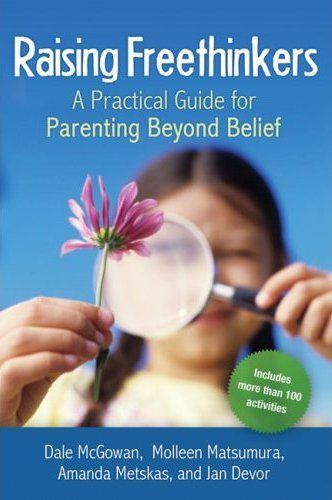
After 20 years as a parent, I’ve learned that the phrase “I’m not a parent myself, but…” is a clear signal that I should not just take the next few words with a grain of salt, but bludgeon them with Lot’s wife.
Many atheist non-parents over the years have said to me, with great confidence, “I’m not a parent myself, but atheists should definitely raise their children as atheists. Just tell them that God is pretend and be done with it!” The alternative, I’m told, is to privilege religion “as true,” or to be “neutral” on the question. (Sometimes atheist parents say the same, but much less often in my experience.)
I don’t call religion “true,” and I don’t pretend to be neutral on the question — and I haven’t raised my kids as atheists. Fortunately, there’s yet another way, and it’s awesome: Teach your kids to think critically and to love reality, then turn them loose on every hypothesis about the world they live in. Every one.
When a fellow Patheos blogger asked rhetorically, “should I ‘let my children decide’ whether JFK was not actually killed by Oswald or whether the moon landing was faked or whether 9/11 was an inside job?”, I thought, Why wouldn’t you? The alternative to “letting them decide” is not letting them decide. The alternative is handing them packages of truth that we have tied up for them, saying, “No need to do all that thinking. I’ve done it for you.”
No, I’m not saying, “Gee, who am I to say what’s really true?” These aren’t hard to figure out. In fact, my confidence in the answers is so formidable that I can trust anyone who has both the critical tools and a love of reality to find those conclusions themselves — and in the process, to know WHY they are true, which sends their confidence in those conclusions through the roof. If someone else figured out the “why” for them, their confidence would be based only on their relationship to that person as a source.
Of course for all their historical importance, Kennedy’s death and the moon landing and what made the Twin Towers fall are less crucial to know than a lot of other things. That vaccinations are good, for example. That human action created global warming. That race and gender are irrelevant in judging a person’s character, intelligence, or ability. These are things that really, really matter…so I have to hand these to the kids as tied-up packages, right?
Sure. If I want their confidence in those vital conclusions to rest on my authority, then sure.
If instead you’re serious about putting a firm foundation under their conclusions about important things, then give them the tools and set them free — because these things are important.
This doesn’t mean I have to pretend to be without an opinion on these things. I’m just one source among many. I share my opinions openly, and I give my reasons for them. But then I specifically urge them to decide for themselves, not because I’m under-confident, and not because I think it’s unimportant, but because I’m hugely confident and it’s hugely important.
My kids don’t think racism is bullshit because I said it is — they think it’s bullshit because they actively sought out the (weak) pro-racism arguments through the years and discovered that oh hey, it’s bullshit. They don’t just know it is, they know why. And they know why vaccinations are good and why global warming is human-made because they cared enough to do the heavy lifting themselves. The result is opinions with staying power.
Which brings us to religion.
I had the lucky circumstance of parents who encouraged me to think for myself and to find the world wonderful enough to know on its own terms. So I dug into the big questions, including God and religion. No one handled me settled answers either way, so I had to dig in and find out for myself. Lo and behold, I found out it’s all nonsense, because that’s what you find out when you actually try.
Because I did it all myself, I’m standing on a foundation of incredible strength. I know every brick in that foundation because I put it there myself. When someone challenges my opinions, I can be relaxed and confident because I know exactly why I hold them. It’s an incredibly satisfying feeling to have done that myself. Why would I deny my kids that feeling?
If someone had merely informed me that God and religion were nonsense, handed me a tied-up package, I could have mumbled, “Okay, thanks” — and my foundation would be Swiss cheese. Why would I put my kids in that position?
I’m an atheist, but atheism is not at the heart of my parenting — freethought is. My kids know my religious views, and I know my opinion will carry more weight than others. So I’ve always gone to great lengths to counter that undue influence, not because I think I’m wrong, but to preserve their autonomy so they can make up their minds independently in the long run and own that process.
When Erin (then 9, now 16) came to me and asked, “Did Jesus really come alive after he was dead?”, I said, “I don’t think so, no. I think that’s just a story that was made up so we feel better about death.” And I told her why I thought that. “But talk to Grandma Barbara. I know she thinks it really happened. And then you can ask why she thinks that, then make up your own mind and even change your mind back and forth a thousand times if you want.” Even more helpful was the fact that my wife was religious for most of their childhood, and smart, and devoted to the same free process. We had the defense and prosecution for every religious idea under the same roof so the kids could be the judges.

My kids took this freedom and ran with it — especially Delaney, who was constantly trying on the glasses of various worldviews as she grew up. She was a fairly conventional New Testament Christian for a while, then became something of a Manichaean dualist, believing the world was divided into good and evil, darkness and light. She eventually went through a sort of Einsteinian-pantheist phase before adopting a benevolent, utilitarian humanism.
And then she turned six.
I always encouraged my kids to try on as many beliefs as they wanted and to switch back and forth whenever they felt drawn toward a different hat, confident that in the long run they would be better informed not only of the identity they choose but of those they declined.
As of now, all three are secular. Two have decided they are atheists, and the other prefers agnostic. And because they built their worldviews themselves, their opinions are relaxed and confident, with great nuance and empathy — all things they might have lacked if I simply told them what to believe.
Other Patheos Atheists on this topic:
Why I Will Teach My Children that Religion is Nonsense at On the Margin of Error
Why I Won’t Teach My Children that Religion is Nonsense at Love, Joy, Feminism
Is It Possible to be Neutral When Talking About Religion? at Natural Wonderers
Should Atheist Parents Set Out to Raise Atheists? at Camels With Hammers
Previous Post

October 9, 2014
The receiverless prayer
Next Post
November 5, 2014 The invisible secular humanists
Recent Comments
Browse Our Archives
Select a Category Ableism Activism Addiction and Recovery Agnosticism Anti-intellectualism Arts Atheism Beauty Catholicism Charles Darwin Children China Christianity Church/State separation churchgoing communication compassionate humanism Creationism critical thinking Culture death disaster response doubt education Egypt Entertainment Environment ethics evolution Existence of God Exploration fear Foundation Beyond Belief Free speech God Health History Human rights humanism identity India Interfaith Islam labels Language LGBT Love Meaning Media Medicine Middle East misconceptions mixed belief marriage Moral argument Morality Myths Near-Death Experience Nonreligious parenting Parody Persecution complex Philosophy Poetry Politics prayer Psychology Rationality Religion religious atheists Religious privilege Republican Party Satire Schools science secular parenting Spirituality The Unpigeonholeables Uncategorized United Kingdom Wonder
Select a Month March 2021 August 2020 March 2020 January 2020 September 2019 July 2019 June 2019 April 2019 February 2019 January 2019 December 2018 November 2018 October 2018 September 2018 August 2018 July 2018 June 2018 May 2018 April 2018 March 2018 February 2018 January 2018 December 2017 November 2017 October 2017 September 2017 August 2017 July 2017 March 2017 February 2017 January 2017 December 2016 November 2016 October 2016 September 2016 August 2016 July 2016 June 2016 May 2016 April 2016 March 2016 February 2016 January 2016 December 2015 November 2015 October 2015 September 2015 June 2015 March 2015 February 2015 January 2015 December 2014 November 2014 October 2014 September 2014
Follow Us!
TAKE THE
Religious Wisdom Quiz
What does Paul tell Timothy to guard in 1 Timothy?
Select your answer to see how you score.
The church The gospel What has been entrusted to his care His heart
Related posts from The Secular Spectrum

Beyond the Brand: Finding the Communal Self Behind...

Trump Rescinds Trans Youth Rights: Helped by Christians...

TRENDING AT PATHEOS Nonreligious

Dethroning Jesus and Enthroning Yourself
Jesus Never Asked to Be Worshipped. He Asked to Be Understood. Christianity...

Why Most Christians are Really Paulians and Jobians
I Don't Care, But It Matters Let's get this out of the...

Essential Tips to Successfully Navigate the Selling Process
Selling a house can feel overwhelming, but it doesn’t have to be....

To Make Remote Work Effective, Think About Others
The COVID-19 pandemic forced many companies to rapidly transition to remote work....

Flexibility Is Key to Solving Problems of Tomorrow
The world of work is undergoing a dramatic transformation. The COVID-19 pandemic...
view all Nonreligious blogs
Ad-Free & Subscriber Log-In Subscription Support
- About Us
- 2026 Calendar
- Videos
- Podcasts
- Library of World Religions
- Faith In Media Tracker
- Advertise With Us
- Write for Us
- Privacy Policy
- Terms of Service
- Do Not Sell My Data
- Contact Us
- Radiant Digital
- Manage Newsletter Subscriptions
- Unsubscribe From Notifications
- Sitemap
Copyright 2008-2026, Patheos. All rights reserved.
Subscription Support Ad-Free & Subscriber Log-In
Follow Patheos