
BuddhistCatholicContemplativeEvangelicalGeneral ChristianHinduJewishLatter-day SaintMuslimNew VisionsProgressive Christian
Beliefs
- Buddhist
- Catholic
- Contemplative
- Evangelical
- General Christian
- Hindu
- Jewish
- Latter-day Saint
- More Voices
- Muslim
- New Visions
- Pagan
- Progressive Christian
Topics
- Religion News
- Food and Religion
- Sports and Religion
- Religious Art
- Religious Music and Entertainment
- Religious Events
- History and Religion
- Style and Religion
- Politics and Religion
- Women in Religion
- Recreation Outdoors and Religion
- Business Finance and Religion
- Careers Workplace and Religion
- Education and Religion
- Family Parenting and Religion
- Health Fitness and Religion
- Home and Religion
- Relationships and Religion
- Technology and Religion
- Travel and Religion
Columnists
- Buddhist Columnists
- Business Finance and Religion Columnists
- Careers Workplace and Religion Columnists
- Catholic Columnists
- Contemplative Columnists
- Education and Religion Columnists
- Evangelists Columnists
- Family Parenting and Religion Columnists
- General Christian Columnists
- Health Fitness and Religion Columnists
- Hindu Columnists
- History and Religion Columnists
- Home and Religion Columnists
- Jewish Columnists
- More Voices Columnists
- Latter Day Columnists
- Muslim Columnists
- New Visions Columnists
- Nonreligious Columnists
- Pagan Columnists
- Politics and Religion Columnists
- Progressive Columnists
- Recreation Outdoors and Religion Columnists
- Relationships and Religion Columnists
- Religion News Columnists
- Religious Art Columnists
- Religious Events Columnists
- Religious Music and Entertainment Columnists
- Sports and Religion Columnists
- Style and Religion Columnists
- Technology and Religion Columnists
- Travel and Religion Columnists
- Women in Religion Columnists
Resource Library
- 2026 Calendar
- Library of World Religions
- The 100 Most Holy Places on Earth
- Patheos Answers
- Podcasts
- Videos
- Faith Leaders Database
- Anglican Episcopalian
- Bahai
- Baptist
- Buddhism
- Christianity
- Confucianism
- Eastern Orthodoxy
- Hinduism
- Holiness and Pentecostal
- ISKCON
- Islam
- Judaism
- Lutheran
- Methodist
- The Church of Jesus Christ of Latter-day Saints
- New Age
- Paganism
- Presbytarian and Reformed
- Protestantism
- Religion Behind the Scenes
- Roman Catholic
- Scientology
- Shia Islam
- Sikhism
- Sufism
- Sunni Islam
- Taoism
- Zen
- See all religions
Research Tools
 Ad-Free & Subscriber Log-In Subscription Support
Ad-Free & Subscriber Log-In Subscription Support
Follow Patheos 

- Trending:
- Forgiveness
- |
- Marriage
- |
- Consciousness
- |
- Death Penalty
- |
- Election
- |
- Halloween
 Seasons of the Church
- Home
- General Christian
- Become Incarnate
Become Incarnate
Last updated on: December 11, 2014 at 4:00 am by Ragan Sutterfield
Become Incarnate 2014-12-08T14:29:14-07:00 Ragan Sutterfield
Patheos Explore the world's faith through different perspectives on religion and spirituality! Patheos has the views of the prevalent religions and spiritualities of the world.
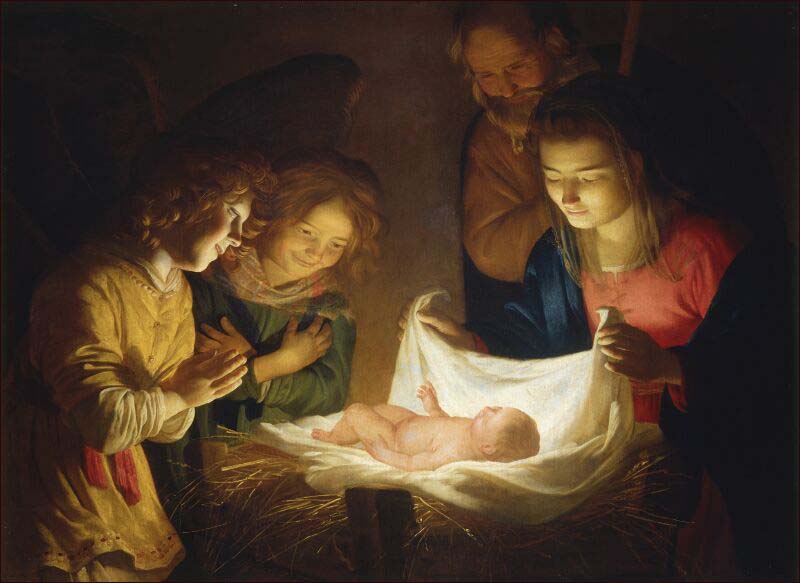
Gerard (Gerrit) van Honthorst (1590-1656), Adoration of the Children (1620)
This is incarnation season. This is the time we remember that God lived in a womb, floating in amniotic fluid, fed through an umbilical cord. Christ would have been kicking about now; a look at Mary’s swollen stomach would have revealed the flutter of the Messiah inside. He could see at this point, the glow world of light through skin, punctuated by subcutaneous blood vessels. The voices were familiar, his mother singing her subversive songs, his father caring for this illegitimate Messiah to come. Joseph’s shop close at hand, the utero Jesus would have known the sound of iron nails driven in hard wood.
This is incarnation season and we have a problem with it. We don’t want our God so near as this. We are worried that if God became human we will have to become human too. We are worried that if God became incarnate we will have to be incarnate, taking on skin and flesh, living in our bodies. We want a divine, spiritual God who will usher us from our bodily life into some ethereal reality. Try other doors for that than Christianity. Christianity is a faith that centers on a God who became embodied and remains in the flesh, a God who died and returned with skin that bares scars.
But we have a problem with such a God because we have a problem with our own bodies. We don’t want to live lives bound by skin, limited by blood and the exchange of oxygen. We long for cyberspace, unbound desire that never comes crashing into hunger or hurt or exhaustion. Some of our religious teachers comfort us with promises of a spiritual heaven, a far away hope away from this earth of dirt and these bodies that live from and toward the soil. On the other side the message from the grocery store magazine rack offers another kind of denial of our flesh. The covers would have us think that we will never be happy in our skin unless we achieve some airbrushed six-pack, the impossible proportions of our pornographic imaginings. This too is a denial of the flesh because flesh is more messy and glorious than all that. The magazine model is as much a spiritualized figment of imagination as some harp-strumming angel.
So lets take this season of Advent, this season in which we await God made human, as a time to become incarnate, to take on flesh and be embodied. Let this be a season to run hard and feel the burn in our lungs of the winter wind. Let this be a season to embrace bodies and hold hands in prayer. Let this be a time to taste with tongues in the electric pulse of nerves, see with eyes the physical stuff of photons that are the light of the world, listen through the vibrations of air and ear to voice and sound. Let this be a time when we fill stomachs that burn with hunger; a time when we comfort bodies that live in exhaustion and pain.
This is incarnation season. Let us become incarnate so that we too made be made human once again.
Ragan Sutterfield is a writer and Episcopal seminarian sojourning from his native Arkansas in Alexandria, Virginia. He is the author of Cultivating Reality: How the Soil Might Save Us, Farming as a Spiritual Discipline and a contributor to the book Sacred Acts: How churches are working to protect the Earth’s climate. He blogs at Word + Flesh here.
Previous Post

December 10, 2014
Pray an Advent Breath Prayer
Next Post
December 12, 2014 Prepare Ye the Way of the Lord
Browse Our Archives
Select a Category Advent Uncategorized
Select a Month December 2014 November 2014
TAKE THE
Religious Wisdom Quiz
Where did the Pentecostal movement begin in the early 1900s?
Select your answer to see how you score.
Azusa Street, Los Angeles London Berlin Rome
Related posts from Seasons of the Church
Alison Krauss and Yo-Yo Ma: The Wexford Carol
We Are All Meant to Be Mothers of...

TRENDING AT PATHEOS General Christian

Catholic Integralists believe that religious values – specifically Christian ones – should...

Electing A Virtuous President Would Make Immunity Irrelevant
Presidential immunity can bring with it many risks. So how can we...

Why The Olympic Games Are A ‘Civil Religious’...
Sporting events form a vital space where Americans display their 'civil religious...

After more than a decade of news, research updates, and insights on...

Q: Why do Southern Baptists and like-minded Protestants...
THE RELIGION GUY’S ANSWER: Why? Simple. Because they believe that’s what the...

THE QUESTION: Is gambling evil? THE RELIGION GUY’S ANSWER: Analysts anticipate a...
view all General Christian blogs
Ad-Free & Subscriber Log-In Subscription Support
- About Us
- 2026 Calendar
- Videos
- Podcasts
- Library of World Religions
- Faith In Media Tracker
- Advertise With Us
- Write for Us
- Privacy Policy
- Terms of Service
- Do Not Sell My Data
- Contact Us
- Radiant Digital
- Manage Newsletter Subscriptions
- Unsubscribe From Notifications
- Sitemap
Copyright 2008-2026, Patheos. All rights reserved.
Subscription Support Ad-Free & Subscriber Log-In
Follow Patheos