
BuddhistCatholicContemplativeEvangelicalGeneral ChristianHinduJewishLatter-day SaintMuslimNew VisionsProgressive Christian
Beliefs
- Buddhist
- Catholic
- Contemplative
- Evangelical
- General Christian
- Hindu
- Jewish
- Latter-day Saint
- More Voices
- Muslim
- New Visions
- Pagan
- Progressive Christian
Topics
- Religion News
- Food and Religion
- Sports and Religion
- Religious Art
- Religious Music and Entertainment
- Religious Events
- History and Religion
- Style and Religion
- Politics and Religion
- Women in Religion
- Recreation Outdoors and Religion
- Business Finance and Religion
- Careers Workplace and Religion
- Education and Religion
- Family Parenting and Religion
- Health Fitness and Religion
- Home and Religion
- Relationships and Religion
- Technology and Religion
- Travel and Religion
Columnists
- Buddhist Columnists
- Business Finance and Religion Columnists
- Careers Workplace and Religion Columnists
- Catholic Columnists
- Contemplative Columnists
- Education and Religion Columnists
- Evangelists Columnists
- Family Parenting and Religion Columnists
- General Christian Columnists
- Health Fitness and Religion Columnists
- Hindu Columnists
- History and Religion Columnists
- Home and Religion Columnists
- Jewish Columnists
- More Voices Columnists
- Latter Day Columnists
- Muslim Columnists
- New Visions Columnists
- Nonreligious Columnists
- Pagan Columnists
- Politics and Religion Columnists
- Progressive Columnists
- Recreation Outdoors and Religion Columnists
- Relationships and Religion Columnists
- Religion News Columnists
- Religious Art Columnists
- Religious Events Columnists
- Religious Music and Entertainment Columnists
- Sports and Religion Columnists
- Style and Religion Columnists
- Technology and Religion Columnists
- Travel and Religion Columnists
- Women in Religion Columnists
Resource Library
- 2026 Calendar
- Library of World Religions
- The 100 Most Holy Places on Earth
- Patheos Answers
- Podcasts
- Videos
- Faith Leaders Database
- Anglican Episcopalian
- Bahai
- Baptist
- Buddhism
- Christianity
- Confucianism
- Eastern Orthodoxy
- Hinduism
- Holiness and Pentecostal
- ISKCON
- Islam
- Judaism
- Lutheran
- Methodist
- The Church of Jesus Christ of Latter-day Saints
- New Age
- Paganism
- Presbytarian and Reformed
- Protestantism
- Religion Behind the Scenes
- Roman Catholic
- Scientology
- Shia Islam
- Sikhism
- Sufism
- Sunni Islam
- Taoism
- Zen
- See all religions
Research Tools
 Ad-Free & Subscriber Log-In Subscription Support
Ad-Free & Subscriber Log-In Subscription Support
Follow Patheos 

- Trending:
- Forgiveness
- |
- Marriage
- |
- Consciousness
- |
- Death Penalty
- |
- Election
- |
- Halloween
 To Give a Defense
- Home
- Catholic
- Writing Negative Reviews: A Defense
Writing Negative Reviews: A Defense
Last updated on: March 9, 2017 at 2:06 am by Scott Eric Alt
Writing Negative Reviews: A Defense 2017-03-09T02:06:59-04:00 Scott Eric Alt
Patheos Explore the world's faith through different perspectives on religion and spirituality! Patheos has the views of the prevalent religions and spiritualities of the world.
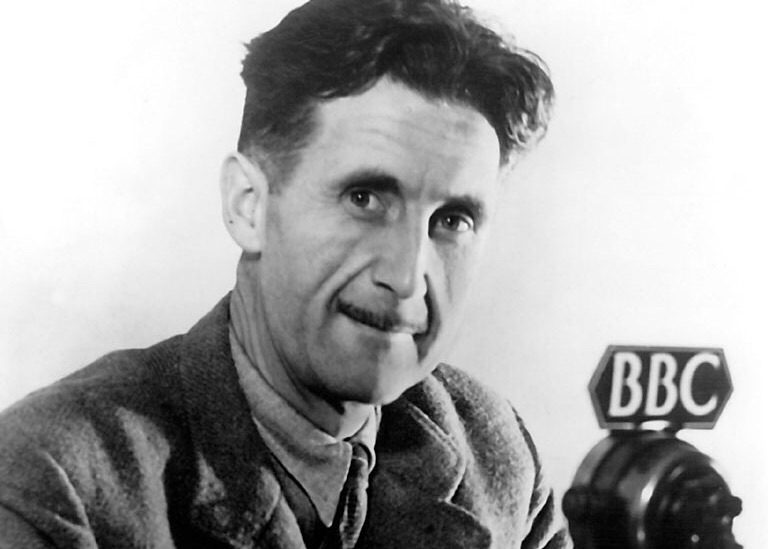
George Orwell: scourge of the cliche (public domain)
Flannery O’Connor, in a classic baring of the knife, said: “Everywhere I go I’m asked if I think the university stifles writers. My opinion is that they don’t stifle enough of them.” O’Connor spoke with some authority: She did not have to go around trying to pretend she could write. Once, when asked why she wrote, she did not come up with wind like “to make the world a better place,” or “to inspire people,” or “to change lives.” She said: “Because I’m good at it.” Exactly.
I wrote my first negative book review last month. It was not published, and that’s fine. Originally I had suggested to Mr. P that I not write the review for his site at all, because I could not think of any positive value the book had, other than to termites. But Mr. P asked me to write it anyway; then, after I sent it to him, he decided just to e-mail a rejection letter to the author, with the (mildly edited) review attached. (I did not say anything about termites in the actual review.)
I put the book and its author out of my mind, and I would not be writing anything about it now, were it not that C. wrote about the review on her blog. The title of the post was a metaphor comparing me to an assassin. So I feel somewhat at liberty to say a few words, though I think it improper to mention the name of the author, or the book, or the Web site for which I had written the review.
In truth, I had not said anything all that negative in the review. I said that the novel was stuffed shapeless with clichés (like the dictator who rules “with an iron fist”). I said that it was bloated with vague and labored description (like the angel whose face is “hooded with golden eyebrows”). That is the kind of writing you will find on every page, if you get through every page before gouging your eyes with a claw. I said that C. would be helped greatly by reading “Politics and the English Language” and Martin Amis’s more recent book The War Against Cliche
Well, Mr. Amis’s title is meant to be ironic. It’s a cliché itself, if you have not noticed. They are hard to notice, we are so used to them and the lethargic blank into which they tire the brain. But if once you notice the first one, and soon find they lurk on every page, there’s a problem, and it’s called bad writing and bad thinking. The problem with clichés is that the person who uses them is not writing at all. There is nothing original or striking in the language: It is not the author who speaks, but everyone else before him. The evil of clichés is that they are a form of groupthink; and Orwell did more than anyone else to point out how easy it is to control those who mouth clichés by rote, like the mantras of the hypnotized. One seldom stops to consider what the image means or suggests in the first place (quick: what is a “rift”? Orwell asks); a cliché is a knife used by reflex because it is the closest one to you, but it has never once been resharpened and may not be the best knife for what you are trying to cut anyway.
But C. in her blog post described my attack on her writing as though it were an attack on her person. She cried in bed for two days and did not want to be wife or mother or writer. I’m just a ruthless ass, driving C. to clinical depression! But C. finally decided, as an act of defiance, to bravely continue writing, “clichés and all”! But I gather, from one particular paragraph in C’s post, that in the upcoming sequel to her novel (save us, there’s more?), I will make an appearance as a wicked book critic, against whose fiery darts (or bullets, in this case) the writer-heroine must bravely fight. Well, so it goes. I sigh. I doubt C. understands why clichés are so bad, why they are a betrayal of good writing, or why she desperately needs to read Orwell and Amis and take them to heart if she wants to be any good. Clichés are now her badge of honor. (Did you see it?)
Now, there are some circumstances under which I would never write a negative review. I write book reviews for Our Sunday Visitor, and their purpose in contacting me was to provide publicity for the books they publish. If I could not give a book a positive review, I would send it back to them. I get that.
Likewise, I used to write book reviews for Create Space, which is a company that helps authors to self-publish their books. 99% of self-published books are awful. The companies try to lure authors in by reciting all the famous writers who once self-published (while neglecting to mention, for example, that Stephen King was a fifteen-year-old at the time and wasn’t self-publishing The Shining). But when you write a book review in such a context, the author pays you for publicity; you are not at liberty to write a bad review. If you don’t think the book has any merit, you either lie or you turn down the money and let it be given to someone who has no intellect or no conscience.
But readers are deceived when a book reviewer lies, and mainly it is the author and the publisher who profit.
Do not misunderstand: Almost all book reviewers are happy to be a middleman and get the word out about a book that has real merit and is worth reading. They are book reviewers because they love to read, after all, and they want others to share pleasure. The problem is when an author looks at a reviewer as no more than someone who can bring him sales, or attention, or self-validation. In an interview back in 1985 with Don Swaim, John Irving said that negative reviews don’t really matter to authors who have a large audience anyway, but that they are malicious and harmful to unknown authors. Of course, Mr. Irving views book critics as his “inferior” (that’s his word) since he can actually write, and no book critic can. (If the critic could write, the argument goes, he would write worthy things like novels rather than book reviews, which are nothing more than ads.) As for Mr. Irving, he hasn’t written one decent novel in the last 25 years.
BuzzFeed has generated a lot of discussion in the last few months (see here and here and here and here) after its decision to ban negative book reviews. All who responded defended the negative review, but it is not the first time this discussion has been had. Most notably, in 2012, many were upset and pinpricked to cursing after the novelist and book critic William Giraldi panned Alix Ohlin in the New York Times (for clichés, of course); and Mr. Giraldi wrote a long article in the Daily Beast to defend his style of criticism. I suspect the argument will continue, because there are those who flush and sweat at the thought of being called mean; for no one must be offended or have their pretty feelings hurt.
If all the critic were was a middleman to bring a “real” book by a “real” writer to the public’s attention, then I would agree that he should write only positive reviews and leave the bad books alone. But the critic has other obligations, and one is to keep an audience from (in his view) wasting its time and money.
Another, and more important, role is to teach us how to analyze and weigh and differentiate the junk from the gold. If merit in art is a real thing, if some books are objectively better than others, then it is the job of the critic to tell us what makes good writing good and bad writing bad. And some of the best critics are no slouches at writing themselves: I’m thinking of master stylists like William Hazlitt and Virginia Woolf, Harold Bloom and Sven Birkerts, G. K. Chesterton and George Orwell, who are not only good essayists and critics but a joy to read.
Criticism would be poorer without this gem from Dorothy Parker: “This is not a book to be tossed aside lightly. It should be hurled with great force.” Or this one from Mark Twain: “Every time I read Pride and Prejudice I want to dig her up and hit her over the skull with her own shin bone.” One admires the passion in those sentences, the evidence of a reader who loves good books so much that bad books are an intolerable offense. If I hate a book, Francine Prose says, “life is too short not to say so.”
A critic who is willing to write a negative review is a critic readers will trust when he writes a positive one. The critic is not just out for his fee or his commission. A critic who is offended by trash, and has the spine to call trash by its name, is a critic whose positive judgment is worth something. He does not just indiscriminately praise, but only what merits praise. He has standards; he weighs and values. A critic who writes only positive reviews is to be viewed with suspicion.
Negative reviews are important because, while truth might sting, truth matters. Lies belittle us all.
The teachers who had nothing but praise for my writing, when I was in school, made me feel good. They were Adderall to my ego. But they never helped my writing. The teachers who helped my writing were the ones who told me what was bad about it. There are some teachers whose critical eye I long to be able to have recourse to again.
Anyway, writers who put their work out there for public consumption should be adults with tough exteriors. They are not, in Zoe Heller’s words, “kindergartners making potato prints for their parents.” If someone on a blog uses a metaphor to compare me to an assassin, that’s fairly personal (more so than just saying that someone used a lot of clichés), but I’m not going to lay supine in bed over it or acquire a complex. I’m a grown-up; I’ve got a blog; I can use words too; I keep writing, and I hopefully keep getting better at it.
I can benefit from criticism, but no matter how good I am, not everyone is going to like me or what I have to say. So what? They can say so, and I’d rather they do so than lie; and I can keep writing.
Book critics have the right and the obligation to treat authors who have published their writing as though they are adults.
***
If you like the content on this blog, your generous gift to the author helps to keep it active. I remember all my supporters in my Mass intentions each week.


Next Post

February 28, 2014 The Order of These Forty Days: 7QT XVI Seriatim
Browse Our Archives
Select a Category Abortion About Me Answers for Calvinists Answers to Media Fictions Answers to Objections Anti-Catholicism Apologetics Apostolic Succession Atonement Authority of the Church Baptism Benedictines Biblical Exegesis Blogging Book Reviews Books & Writing &c. Calvin's Institutes Capital Punishment Catholic Church Chastity Christology Church Fathers Church Social Doctrine Confession Contraception Conversion Stories Crusades Debates Depression & Suicide Deuterocanon Development of Doctrine Ecumenism English Language Eucharistic Adoration Exorcism Extra Ecclesiam Fisks & Rebuttals Freedom of Religion Freedom of Speech Fundamentalism Gender Politics Gender Theory Good Works Homosexuality Humor Idolatry Immaculate Conception In the News Inquisition ISIS Islam Just for Fun Just War Justification LCWR Limbo Liturgical Abuse Liturgical Year Magisterium Marriage and Family Mary Mortal Sin New Evangelization NFP Papacy Papal Documents Papal Infallibility Personal Narrative Politics Pope Francis Pope Francis Derangement Syndrome Population Control Praying to the "Dead" Priesthood Primacy of Peter Protestant Denominations Purgatory Radical Islam Radical Traditionalists Real Presence Right to Conscience RIght to Life Saints Same-Sex "Marriage" Seven Quick Takes Social Justice Social Media Sola Scriptura Spirit of Vatican II SSPX The Eucharist The Mass The Resurrection Traditionalism Vatican II Year of Mercy
Select a Month August 2019 July 2019 June 2019 May 2019 November 2018 October 2018 August 2018 July 2018 June 2018 April 2018 November 2017 October 2017 September 2017 May 2017 April 2017 March 2017 February 2017 November 2016 October 2016 September 2016 August 2016 July 2016 June 2016 May 2016 April 2016 March 2016 February 2016 January 2016 December 2015 November 2015 October 2015 September 2015 July 2015 June 2015 May 2015 April 2015 March 2015 February 2015 January 2015 December 2014 September 2014 August 2014 July 2014 June 2014 May 2014 April 2014 March 2014 February 2014 January 2014 December 2013 November 2013 October 2013 May 2013 April 2013 February 2013 January 2013
Follow Us!
TAKE THE
Religious Wisdom Quiz
I stood on a wooden platform and read the Law from daybreak till noon, and the people wept. Who am I?
Select your answer to see how you score.
Ezra Joshua Moses Nehemiah
Related posts from To Give a Defense

Through the Year With Pope Francis

The Catholic Men's Bible: Devotional, Call to Holiness,...

The Last Confession of the Vampire Judas Iscariot....
Three Books By Priests from OSV
TRENDING AT PATHEOS Catholic

Rejecting Doom: Christian Hope And Human Action
Christianity is a religion of hope. We are to have hope and...

It’s What Comes From Within Which Matters
One of the most difficult things for us to understand is why...

Why I Choose the Eucharist Over the Sermon
Choose the Eucharist, Not the Sermon What are we supposed to get...

5 Design Elements Found in Spiritually Rooted Homes
Putting Spirituality Into Home Decor Our homes are more than our living...

Credo: A Story of God Told with the...
About 10 years ago, I began to imagine a personal "Credo" that...

The Anatomy of Divine Revelation in Catholic Thought
The claim that God has made Himself known to human beings is...
view all Catholic blogs
Ad-Free & Subscriber Log-In Subscription Support
- About Us
- 2026 Calendar
- Videos
- Podcasts
- Library of World Religions
- Faith In Media Tracker
- Advertise With Us
- Write for Us
- Privacy Policy
- Terms of Service
- Do Not Sell My Data
- Contact Us
- Radiant Digital
- Manage Newsletter Subscriptions
- Unsubscribe From Notifications
- Sitemap
Copyright 2008-2026, Patheos. All rights reserved.
Subscription Support Ad-Free & Subscriber Log-In
Follow Patheos