
BuddhistCatholicContemplativeEvangelicalGeneral ChristianHinduJewishLatter-day SaintMuslimNew VisionsProgressive Christian
Beliefs
- Buddhist
- Catholic
- Contemplative
- Evangelical
- General Christian
- Hindu
- Jewish
- Latter-day Saint
- More Voices
- Muslim
- New Visions
- Pagan
- Progressive Christian
Topics
- Religion News
- Food and Religion
- Sports and Religion
- Religious Art
- Religious Music and Entertainment
- Religious Events
- History and Religion
- Style and Religion
- Politics and Religion
- Women in Religion
- Recreation Outdoors and Religion
- Business Finance and Religion
- Careers Workplace and Religion
- Education and Religion
- Family Parenting and Religion
- Health Fitness and Religion
- Home and Religion
- Relationships and Religion
- Technology and Religion
- Travel and Religion
Columnists
- Buddhist Columnists
- Business Finance and Religion Columnists
- Careers Workplace and Religion Columnists
- Catholic Columnists
- Contemplative Columnists
- Education and Religion Columnists
- Evangelists Columnists
- Family Parenting and Religion Columnists
- General Christian Columnists
- Health Fitness and Religion Columnists
- Hindu Columnists
- History and Religion Columnists
- Home and Religion Columnists
- Jewish Columnists
- More Voices Columnists
- Latter Day Columnists
- Muslim Columnists
- New Visions Columnists
- Nonreligious Columnists
- Pagan Columnists
- Politics and Religion Columnists
- Progressive Columnists
- Recreation Outdoors and Religion Columnists
- Relationships and Religion Columnists
- Religion News Columnists
- Religious Art Columnists
- Religious Events Columnists
- Religious Music and Entertainment Columnists
- Sports and Religion Columnists
- Style and Religion Columnists
- Technology and Religion Columnists
- Travel and Religion Columnists
- Women in Religion Columnists
Resource Library
- 2026 Calendar
- Library of World Religions
- The 100 Most Holy Places on Earth
- Patheos Answers
- Podcasts
- Videos
- Faith Leaders Database
- Anglican Episcopalian
- Bahai
- Baptist
- Buddhism
- Christianity
- Confucianism
- Eastern Orthodoxy
- Hinduism
- Holiness and Pentecostal
- ISKCON
- Islam
- Judaism
- Lutheran
- Methodist
- The Church of Jesus Christ of Latter-day Saints
- New Age
- Paganism
- Presbytarian and Reformed
- Protestantism
- Religion Behind the Scenes
- Roman Catholic
- Scientology
- Shia Islam
- Sikhism
- Sufism
- Sunni Islam
- Taoism
- Zen
- See all religions
Research Tools
 Ad-Free & Subscriber Log-In Subscription Support
Ad-Free & Subscriber Log-In Subscription Support
Follow Patheos 

- Trending:
- Forgiveness
- |
- Marriage
- |
- Consciousness
- |
- Death Penalty
- |
- Election
- |
- Halloween
 To Give a Defense
- Home
- Catholic
- But What If A Pope Did Teach Heresy Ex Cathedra?
But What If A Pope Did Teach Heresy Ex Cathedra?
Last updated on: March 10, 2018 at 5:53 pm by Scott Eric Alt
But What If A Pope Did Teach Heresy Ex Cathedra? 2018-03-10T17:53:42-04:00 Scott Eric Alt
Patheos Explore the world's faith through different perspectives on religion and spirituality! Patheos has the views of the prevalent religions and spiritualities of the world.
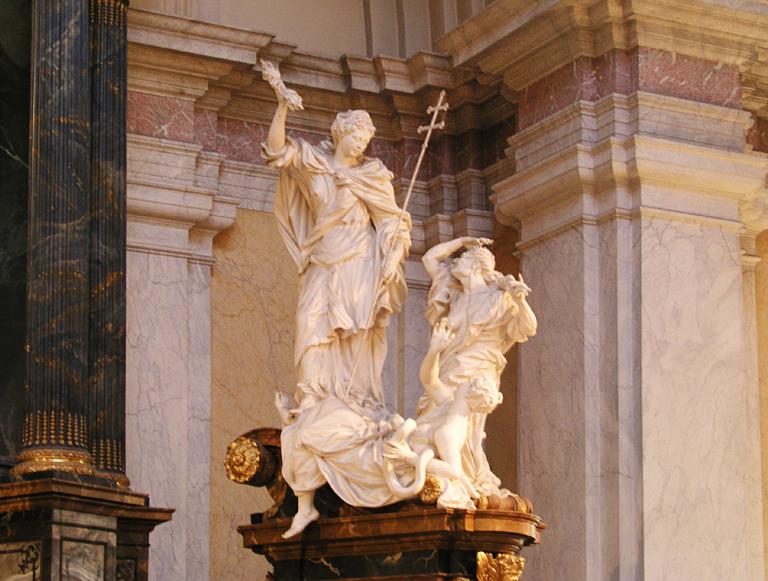
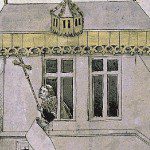
Gustaf Vasakyrkan, “The Gospel Triumphs Over Heresy.” Photo by Hakan Svensson (Creative Commons).
Dustin Lattimore, a Protestant, asked the question on Facebook. Earlier today, Dave Armstrong also also blogged about it. Mr. Armstrong, in denying the possibility of ex cathedra heresy, tried to be thorough but still hedged.
To get really philosophically heavy [Dear God.], at this point I would deny (in faith) that it could happen, but I don’t think it is an “impossible counterfactual” or “logically impossible” in all possible or conceivable worlds. [No, not all of them.] It’s the difference between philosophy and faith. In faith, I don’t believe it ever would or could happen in fact.
But it could in other worlds? Really?
Now, as I see it, this is like asking, “But what if God had made a round square?” There are no round squares. Round squares are logically impossible. And there is no other world in which the logically impossible exists. I don’t like to get into quantum apologetics. God can not make a round square any more than he can make a feline dog. God can’t make dark light; God can’t make a straight angle. Nor can he make a rock too big for himself to lift.
God does not give us a Church, if he gives us a Church at all (cf. Matt. 16:18), that can teach error. End stop. Let us consult Sacred Scripture on this point.
John 16:13. When the Spirit of truth comes, he will guide you into all the truth; for he will not speak on his own authority, but whatever he hears he will speak, and he will declare to you the things that are to come.
1 Tim. 3:15. If I am delayed, you may know how one ought to behave in the household of God, which is the church of the living God, the pillar and bulwark of the truth.
God does not make a round square; he does not make a bulwark of truth that teaches falsehood. Christ builds the Church on Peter; he does not give us a Church that could err.
The Church too tells us that a pope can not—no, not ever—teach error ex cathedra. Here is Vatican I.
We teach and define as a divinely revealed dogma that when the Roman Pontiff speaks ex cathedra, that is, when, in the exercise of his office as shepherd and teacher of all Christians, in virtue of his supreme apostolic authority, he defines a doctrine concerning faith or morals to be held by the whole Church, he possesses, by the divine assistance promised to him in blessed Peter, that infallibility which the divine Redeemer willed his Church to enjoy in defining doctrine concerning faith or morals.
God does not make a round square; God does not make a fallibly infallible pope.
But let us look further, to the wery Catechism of the Church.
In order to preserve the Church in the purity of the faith handed on by the apostles, Christ who is the Truth willed to confer on her a share in his own infallibility. By a “supernatural sense of faith” the People of God, under the guidance of the Church’s living Magisterium, “unfailingly adheres to this faith.”
The mission of the Magisterium is linked to the definitive nature of the covenant established by God with his people in Christ. It is this Magisterium’s task to preserve God’s people from deviations and defections and to guarantee them the objective possibility of professing the true faith without error. [God does not make a round square; God does not give an uncertain guarantee.]. Thus, the pastoral duty of the Magisterium is aimed at seeing to it that the People of God abides in the truth that liberates. To fulfill this service, Christ endowed the Church’s shepherds with the charism of infallibility in matters of faith and morals. [A pope can not teach error because he is protected from it by God.] The exercise of this charism takes several forms:
“The Roman Pontiff, head of the college of bishops, enjoys this infallibility in virtue of his office, when, as supreme pastor and teacher of all the faithful—who confirms his brethren in the faith he proclaims by a definitive act a doctrine pertaining to faith or morals. … The infallibility promised to the Church is also present in the body of bishops when, together with Peter’s successor, they exercise the supreme Magisterium,” above all in an Ecumenical Council. When the Church through its supreme Magisterium proposes a doctrine “for belief as being divinely revealed,” and as the teaching of Christ, the definitions “must be adhered to with the obedience of faith.” This infallibility extends as far as the deposit of divine Revelation itself.
Divine assistance is also given to the successors of the apostles, teaching in communion with the successor of Peter, and, in a particular way, to the bishop of Rome, pastor of the whole Church, when, without arriving at an infallible definition and without pronouncing in a “definitive manner,” they propose in the exercise of the ordinary Magisterium a teaching that leads to better understanding of Revelation in matters of faith and morals. To this ordinary teaching the faithful “are to adhere to it with religious assent” which, though distinct from the assent of faith, is nonetheless an extension of it.
God gives us an infallible teaching Church. That is a guarantee. There is no “but what if?” And not only does the pope have infallibility ex cathedra: Church councils have it; the bishops who teach in union with the Church have it.
It is just not possible for a pope to teach error. It has not happened; it can’t. End stop. It would mean that the Holy Spirit does not guide the Church into all truth; and that would make Jesus a liar when he speaks to the apostles in John 16:13.
If someone does think a pope might teach error ex cathedra, then it is pointless to start speculating about hypothetical other worlds in which God can make a round square or a bulwark of truth that errs. Direct me to a pope who has taught error ex cathedra. We’ve had 266 of them; there’s 2000 years of data. Search. Take all the time you need. Get back to us when you find one.
***
Previous Post
November 30, 2016
Sorry, But I've Changed My Mind About Pope Francis


Browse Our Archives
Select a Category Abortion About Me Answers for Calvinists Answers to Media Fictions Answers to Objections Anti-Catholicism Apologetics Apostolic Succession Atonement Authority of the Church Baptism Benedictines Biblical Exegesis Blogging Book Reviews Books & Writing &c. Calvin's Institutes Capital Punishment Catholic Church Chastity Christology Church Fathers Church Social Doctrine Confession Contraception Conversion Stories Crusades Debates Depression & Suicide Deuterocanon Development of Doctrine Ecumenism English Language Eucharistic Adoration Exorcism Extra Ecclesiam Fisks & Rebuttals Freedom of Religion Freedom of Speech Fundamentalism Gender Politics Gender Theory Good Works Homosexuality Humor Idolatry Immaculate Conception In the News Inquisition ISIS Islam Just for Fun Just War Justification LCWR Limbo Liturgical Abuse Liturgical Year Magisterium Marriage and Family Mary Mortal Sin New Evangelization NFP Papacy Papal Documents Papal Infallibility Personal Narrative Politics Pope Francis Pope Francis Derangement Syndrome Population Control Praying to the "Dead" Priesthood Primacy of Peter Protestant Denominations Purgatory Radical Islam Radical Traditionalists Real Presence Right to Conscience RIght to Life Saints Same-Sex "Marriage" Seven Quick Takes Social Justice Social Media Sola Scriptura Spirit of Vatican II SSPX The Eucharist The Mass The Resurrection Traditionalism Vatican II Year of Mercy
Select a Month August 2019 July 2019 June 2019 May 2019 November 2018 October 2018 August 2018 July 2018 June 2018 April 2018 November 2017 October 2017 September 2017 May 2017 April 2017 March 2017 February 2017 November 2016 October 2016 September 2016 August 2016 July 2016 June 2016 May 2016 April 2016 March 2016 February 2016 January 2016 December 2015 November 2015 October 2015 September 2015 July 2015 June 2015 May 2015 April 2015 March 2015 February 2015 January 2015 December 2014 September 2014 August 2014 July 2014 June 2014 May 2014 April 2014 March 2014 February 2014 January 2014 December 2013 November 2013 October 2013 May 2013 April 2013 February 2013 January 2013
Follow Us!
TAKE THE
Religious Wisdom Quiz
Who was the prophet who pronounced doom on Jezebel and Ahab?
Select your answer to see how you score.
Hosea Isaiah Elijah Elisha
Related posts from To Give a Defense

Infallibility is true, but (almost) useless. With some...
God Willed Pope Francis Derangement Syndrome Vol. XXII
Does Canon 194 Provide an Opening to Depose...
TRENDING AT PATHEOS Catholic

Rejecting Doom: Christian Hope And Human Action
Christianity is a religion of hope. We are to have hope and...

It’s What Comes From Within Which Matters
One of the most difficult things for us to understand is why...

Why I Choose the Eucharist Over the Sermon
Choose the Eucharist, Not the Sermon What are we supposed to get...

5 Design Elements Found in Spiritually Rooted Homes
Putting Spirituality Into Home Decor Our homes are more than our living...

Credo: A Story of God Told with the...
About 10 years ago, I began to imagine a personal "Credo" that...

The Anatomy of Divine Revelation in Catholic Thought
The claim that God has made Himself known to human beings is...
view all Catholic blogs
Ad-Free & Subscriber Log-In Subscription Support
- About Us
- 2026 Calendar
- Videos
- Podcasts
- Library of World Religions
- Faith In Media Tracker
- Advertise With Us
- Write for Us
- Privacy Policy
- Terms of Service
- Do Not Sell My Data
- Contact Us
- Radiant Digital
- Manage Newsletter Subscriptions
- Unsubscribe From Notifications
- Sitemap
Copyright 2008-2026, Patheos. All rights reserved.
Subscription Support Ad-Free & Subscriber Log-In
Follow Patheos