
BuddhistCatholicContemplativeEvangelicalGeneral ChristianHinduJewishLatter-day SaintMuslimNew VisionsProgressive Christian
Beliefs
- Buddhist
- Catholic
- Contemplative
- Evangelical
- General Christian
- Hindu
- Jewish
- Latter-day Saint
- More Voices
- Muslim
- New Visions
- Pagan
- Progressive Christian
Topics
- Religion News
- Food and Religion
- Sports and Religion
- Religious Art
- Religious Music and Entertainment
- Religious Events
- History and Religion
- Style and Religion
- Politics and Religion
- Women in Religion
- Recreation Outdoors and Religion
- Business Finance and Religion
- Careers Workplace and Religion
- Education and Religion
- Family Parenting and Religion
- Health Fitness and Religion
- Home and Religion
- Relationships and Religion
- Technology and Religion
- Travel and Religion
Columnists
- Buddhist Columnists
- Business Finance and Religion Columnists
- Careers Workplace and Religion Columnists
- Catholic Columnists
- Contemplative Columnists
- Education and Religion Columnists
- Evangelists Columnists
- Family Parenting and Religion Columnists
- General Christian Columnists
- Health Fitness and Religion Columnists
- Hindu Columnists
- History and Religion Columnists
- Home and Religion Columnists
- Jewish Columnists
- More Voices Columnists
- Latter Day Columnists
- Muslim Columnists
- New Visions Columnists
- Nonreligious Columnists
- Pagan Columnists
- Politics and Religion Columnists
- Progressive Columnists
- Recreation Outdoors and Religion Columnists
- Relationships and Religion Columnists
- Religion News Columnists
- Religious Art Columnists
- Religious Events Columnists
- Religious Music and Entertainment Columnists
- Sports and Religion Columnists
- Style and Religion Columnists
- Technology and Religion Columnists
- Travel and Religion Columnists
- Women in Religion Columnists
Resource Library
- 2026 Calendar
- Library of World Religions
- The 100 Most Holy Places on Earth
- Patheos Answers
- Podcasts
- Videos
- Faith Leaders Database
- Anglican Episcopalian
- Bahai
- Baptist
- Buddhism
- Christianity
- Confucianism
- Eastern Orthodoxy
- Hinduism
- Holiness and Pentecostal
- ISKCON
- Islam
- Judaism
- Lutheran
- Methodist
- The Church of Jesus Christ of Latter-day Saints
- New Age
- Paganism
- Presbytarian and Reformed
- Protestantism
- Religion Behind the Scenes
- Roman Catholic
- Scientology
- Shia Islam
- Sikhism
- Sufism
- Sunni Islam
- Taoism
- Zen
- See all religions
Research Tools
 Ad-Free & Subscriber Log-In Subscription Support
Ad-Free & Subscriber Log-In Subscription Support
Follow Patheos 

- Trending:
- Forgiveness
- |
- Marriage
- |
- Consciousness
- |
- Death Penalty
- |
- Election
- |
- Halloween
 To Give a Defense
- Home
- Catholic
- We Await in Joyful Hope
We Await in Joyful Hope
Last updated on: March 13, 2017 at 5:31 pm by Scott Eric Alt
We Await in Joyful Hope 2017-03-13T17:31:22-04:00 Scott Eric Alt
Patheos Explore the world's faith through different perspectives on religion and spirituality! Patheos has the views of the prevalent religions and spiritualities of the world.
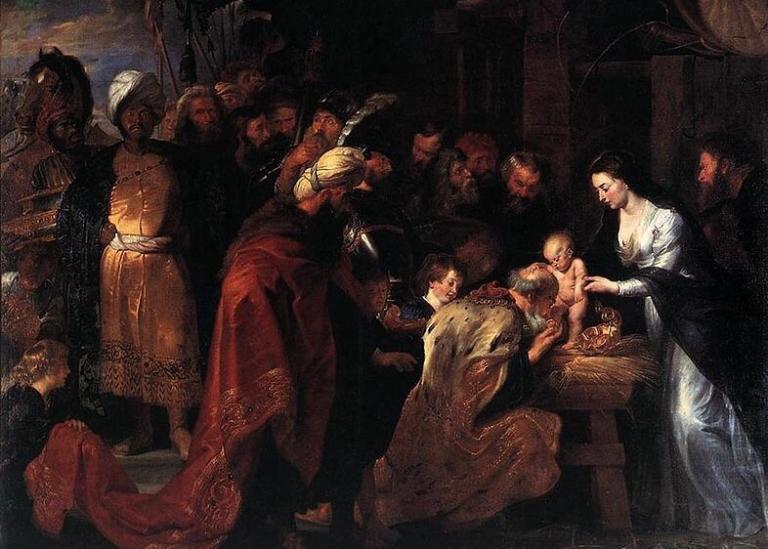
Peter Paul Rubens, “Adoration of the Magi”
Today is Twelfth Night. I love vigils of any kind the Church gives us, but this one may be my favorite apart from the Easter Vigil. In an important way each is like the other: At the Easter Vigil we wait for Resurrection—Christ come back to us from the tomb; on Twelfth Night we wait for Incarnation—Christ come to us in the manger and adored by wise men. Christmas begins in Nativity and culminates in Epiphany. We wait for Christ, and we wait, and follow, and at last we behold Him, born or risen. We await in joyful hope.
TWELFTH NIGHT: BLINDNESS AND CARNIVAL
Each year on January 5 I keep an old habit of rereading Twelfth Night
You will search a long time if you try to find anything in the play that has to do with Twelfth Night, other than the title. Some scholars believe that Shakespeare wrote it to be performed on January 5, but the first performance we have on record took place on the Feast of Candlemas—February 2, 1602. In Shakespeare’s day, Twelfth Night was an occasion of carnival, during which servants dressed up as their masters and men dressed up as women. It was a single night of topsy-turvy inversion, the last of Christmas, before life (and liturgy) turned ordinary again on January 6.
The plot involves twins—a brother and sister—who are shipwrecked off the coast of Illyria and make their way to land; each of them believes the other has died. Viola, the sister—an unknown and solitary female in a patriarchal society—decides to dress up as a man and present herself as a servant to the duke, Orsino. It’s her way to assure some protection for herself. She tells him her name is “Cesario” (it’s a loose anagram of “Orsino”). The duke, when she meets him, is preoccupied by his infatuation with the countess Olivia, even though Olivia has refused to requite him since long before the plot begins. Very quickly the duke develops a strong bond of affection with “Cesario,” and decides to send “him” to Olivia on his behalf, armed with epistles of love. Upon delivering them, Viola tells her she is “the cruel’st she alive” if she does not return Orsino’s affection; but Olivia is unmoved. “I cannot love him,” she says. “He might have took his answer long ago.” But, under the impression that Viola is a man, she promptly falls in love with “him.” As for Viola, she has fallen in love with Orsino—although, dressed up as “Cesario,” she is not able to declare it to him.
Meanwhile Viola’s twin brother, Sebastian, shows up. Neither he, nor Viola, nor anyone else, know of their mutual presence in Illyria, and Shakespeare will contrive to keep it a mystery until the last scene of the play. In the logic of comedy, the first group of people Sebastian comes into contact with are the very servants of Olivia who had just met Viola when she was there on the duke’s business. Thus they believe that Sebastian is “Cesario.” A comic subplot of mistaken identity ensues.
In another subplot, Sir Toby Belch (Olivia’s uncle), Maria (her waiting-gentlewoman), Sir Andrew Aguecheek (a foolish sycophant), and Feste (the court jester) have been enjoying some drunken revelry loud enough to wake Olivia’s surly, Puritanical, and self-regarding steward, Malvolio. After he chides them late one night, they decide to play a practical joke on him. Maria leaves a letter for him to find—he is meant to believe it is from Olivia, since their handwriting looks the same. The letter tells him that she would very much like him to dress in cross-gartered yellow stockings and upbraid Toby and the servants in her presence. In return for such insane behavior (Olivia in fact detests cross-gartered yellow stockings), she will marry him so that he can lord it unchallenged over the rest of the servants all his days. And so Malvolio, who “thanks his stars” at this fictional promise of an increase in station over the rabble (for so he views them), takes off his exact and customary Puritan garb, dresses up in stockings, and preens and titters in front of Olivia. But Olivia, who is unaware of the joke, thinks that he has gone mad and locks him in the stocks. While he is there, Feste comes to him in the guise of “Sir Topas,” an exorcist who will cast the devil from his soul. Feste has his own fun with the poor man. “Fie, thou dishonest Satan!” he cries when Malvolio insists he has all his wits about him. “Thou art more puzzled than the Egyptians in their fog.”
The theme of carnival and disguise on the final night of Christmas holiday is a large part of Shakespeare’s play, and I would not want to minimize it. But in my view, the more important theme is madness and how poorly all the characters see. That is why Shakespeare has included so much mistaken identity in the play, as well as so much misplaced love and self-delusion. His characters, though they have eyes, are blind. All of them, not just Malvolio, are “puzzled.” This is Shakespeare’s dramatic irony at work: What the players think they see plainly is not at all what the audience knows to be the truth. Olivia, who thinks that Sebastian is “Cesario,” offers him marriage; they have just met for the first time, but she thinks she knows him well, while the real object of her “love” is another woman. Staggeringly, Sebastian agrees to marry her, even though he knows that she thinks he is someone else and, for aught he does know, might be insane. Orsino, though he has been rebuffed by Olivia countless times, still insists on courting her in the deluded hope that surely her heart can be changed. These plot elements are not in the play just for the sake of the comedy. Behind all that, Shakespeare is showing us how far into madness people can go when what they think they see is false. We lie to ourselves and are blind; we engage in self-puzzlement. Malvolio is sent to the stocks as a joke on him, but Shakespeare’s joke on us is that Malvolio really is mad. He is mad because he thinks that to be virtuous means to be sour. He has to be tricked into being merry, but to be merry he must believe a lie. Malvolio can only be merry in dreams of future self-grandeur; he can only be a pompous and insufferable and ridiculous merry.
Though the play does not mention the vigil, it is fitting that Shakespeare should name it Twelfth Night. On Epiphany the Magi, who have followed a star a long way, behold the Christ, and all illusions and lies end. They behold the creator and sustainer of all things in the form of a helpless baby in a feeding trough. Everything depends on giving up our illusions and naming Him correctly. Who do you say He is? At the end of Twelfth Night, the masks come off and the truth is known. (You’ll have to read it to find out how.) And whatever their illusions had been, which they thought would make them happy, Shakespeare’s characters are better when they know the truth. They have an epiphany about who they really are, and who everyone else is.
At the end of the play, Viola’s mask comes off and Orsino marries her. If “Cesario” is an anagram of “Orsino,” “Viola” is an anagram of of “Olivia.” Viola’s identity, and Orsino’s love, have at last been put in right order. Viola and Sebastian are reunited, which is a good thing too because the comedy of the play makes it easy to forget that these are an incredibly close brother and sister who have spent the whole play thinking that the other is dead and trying to cope with their loss in a strange land where everyone has gone mad. In Shakespeare, comic resolution always comes just before, and precludes, the irrevocable descent into chaos and madness. (In Measure for Measure it nearly fails.) Only Malvolio, who can’t stand to have had a joke played on him, who can’t stand to have been tricked to behave in a way inconsistent with his proper Puritan dignity, refuses to participate in the happy ending and the casting off of disguises; he storms off the stage, vowing revenge on all. He reminds us that some people do choose to run away from truth. He prefers his own lies and cannot laugh at them; he prefers his own humorless self-regard.
(I should also point out that most people will be familiar with the plot device—a woman dresses up as a man and falls in love with a man who doesn’t know she’s a woman—because it also shows up in “Shakespeare In Love.”
A GOOD MAN IS HARD TO FIND: FROM BLINDNESS TO EPIPHANY

If human beings can muster startling flashes of selflessness and generosity, why do we revert so quickly to our flawed, limited selves? And does the fact that we do relapse into old patterns diminish what we are in our best moments?
O’Connor would answer by saying that, no, our relapses do not diminish who we are in our best moments. In a brief talk she gave prior to reading “A Good Man is Hard to Find,” she explained why the story has to be so violent.
It is the extreme situation that best reveals what we are essentially. … Violence is a force which can be used for good or evil, and among other things taken by it is the kingdom of heaven. But regardless of what can be taken by it, the man in the violent situation reveals those qualities least dispensible in his personality, those qualities which are all he will have to take into eternity with him; and since the characters in this story are all on the verge of eternity, it is appropriate to think of what they take with them.
The Grandmother, just before she is shot, reveals what is “least dispensible” in herself. She reveals who she “is essentially.” It is her best moment. She is tested and shows herself to be more than just a “hypocritical old soul.” Far from our best moments being diminished by our relapses, our best moments reveal who we are. They reveal the heart that God knoweth.
So that is what I shall consider and bring to Mass tomorrow when I celebrate a rare Epiphany Sunday that falls on January 6. What do I bring with me when I go to meet Christ? Who am I when I behold the truth in front of my eyes? Who am I when I see the Blessed Sacrament held aloft? Who am I when I receive it on my tongue at the altar? That is who I am. If my best moment is not then, when I am face to face with Christ, then I need to spend some serious time in prayer and fasting and self-examination.
I know that there will be times when I, like the characters in Twelfth Night, succumb to illusions and lies. I know that after Epiphany there will be times when my vision of Christ will grow dim. And I know, also, that there will be other times when I will be struck with awe and joy and the best that I am. Of such times we can not know the hour. But on Epiphany we can see Christ, and we can ask ourselves what we bring with us. How clearly do we see him?
Christina Rossetti, my favorite poet, reminds us what we should think of in our worship tomorrow. We should ponder that Christ, whom we now behold, fulfills all that we have waited to see for all our lives. He is the truth we have awaited in joyful hope. It is Christ—not our lies, not our sins—who we really want. And now, at last, we see him.
Bow down and worship, righteous man:
This Infant of a span
Is He man sought for since the world began!
Happy feast of the Epiphany.
***
If you like the content on this blog, your generous gift to the author helps to keep it active. I remember all my supporters in my Mass intentions each week.

Next Post
January 7, 2013 I See Men as Trees Walking Part II: A Capacity for Wonder
Browse Our Archives
Select a Category Abortion About Me Answers for Calvinists Answers to Media Fictions Answers to Objections Anti-Catholicism Apologetics Apostolic Succession Atonement Authority of the Church Baptism Benedictines Biblical Exegesis Blogging Book Reviews Books & Writing &c. Calvin's Institutes Capital Punishment Catholic Church Chastity Christology Church Fathers Church Social Doctrine Confession Contraception Conversion Stories Crusades Debates Depression & Suicide Deuterocanon Development of Doctrine Ecumenism English Language Eucharistic Adoration Exorcism Extra Ecclesiam Fisks & Rebuttals Freedom of Religion Freedom of Speech Fundamentalism Gender Politics Gender Theory Good Works Homosexuality Humor Idolatry Immaculate Conception In the News Inquisition ISIS Islam Just for Fun Just War Justification LCWR Limbo Liturgical Abuse Liturgical Year Magisterium Marriage and Family Mary Mortal Sin New Evangelization NFP Papacy Papal Documents Papal Infallibility Personal Narrative Politics Pope Francis Pope Francis Derangement Syndrome Population Control Praying to the "Dead" Priesthood Primacy of Peter Protestant Denominations Purgatory Radical Islam Radical Traditionalists Real Presence Right to Conscience RIght to Life Saints Same-Sex "Marriage" Seven Quick Takes Social Justice Social Media Sola Scriptura Spirit of Vatican II SSPX The Eucharist The Mass The Resurrection Traditionalism Vatican II Year of Mercy
Select a Month August 2019 July 2019 June 2019 May 2019 November 2018 October 2018 August 2018 July 2018 June 2018 April 2018 November 2017 October 2017 September 2017 May 2017 April 2017 March 2017 February 2017 November 2016 October 2016 September 2016 August 2016 July 2016 June 2016 May 2016 April 2016 March 2016 February 2016 January 2016 December 2015 November 2015 October 2015 September 2015 July 2015 June 2015 May 2015 April 2015 March 2015 February 2015 January 2015 December 2014 September 2014 August 2014 July 2014 June 2014 May 2014 April 2014 March 2014 February 2014 January 2014 December 2013 November 2013 October 2013 May 2013 April 2013 February 2013 January 2013
Follow Us!
TAKE THE
Religious Wisdom Quiz
The beginning of knowledge starts with this.
Select your answer to see how you score.
Instruction Understanding Fear of the Lord Wisdom
Related posts from To Give a Defense


Is the Novel Protestant? A Reply to Joseph...
Pentecost: To Woo Back a World's Desire
TRENDING AT PATHEOS Catholic

Rejecting Doom: Christian Hope And Human Action
Christianity is a religion of hope. We are to have hope and...

It’s What Comes From Within Which Matters
One of the most difficult things for us to understand is why...

Why I Choose the Eucharist Over the Sermon
Choose the Eucharist, Not the Sermon What are we supposed to get...

5 Design Elements Found in Spiritually Rooted Homes
Putting Spirituality Into Home Decor Our homes are more than our living...

Credo: A Story of God Told with the...
About 10 years ago, I began to imagine a personal "Credo" that...

The Anatomy of Divine Revelation in Catholic Thought
The claim that God has made Himself known to human beings is...
view all Catholic blogs
Ad-Free & Subscriber Log-In Subscription Support
- About Us
- 2026 Calendar
- Videos
- Podcasts
- Library of World Religions
- Faith In Media Tracker
- Advertise With Us
- Write for Us
- Privacy Policy
- Terms of Service
- Do Not Sell My Data
- Contact Us
- Radiant Digital
- Manage Newsletter Subscriptions
- Unsubscribe From Notifications
- Sitemap
Copyright 2008-2026, Patheos. All rights reserved.
Subscription Support Ad-Free & Subscriber Log-In
Follow Patheos