
BuddhistCatholicContemplativeEvangelicalGeneral ChristianHinduJewishLatter-day SaintMuslimNew VisionsProgressive Christian
Beliefs
- Buddhist
- Catholic
- Contemplative
- Evangelical
- General Christian
- Hindu
- Jewish
- Latter-day Saint
- More Voices
- Muslim
- New Visions
- Pagan
- Progressive Christian
Topics
- Religion News
- Food and Religion
- Sports and Religion
- Religious Art
- Religious Music and Entertainment
- Religious Events
- History and Religion
- Style and Religion
- Politics and Religion
- Women in Religion
- Recreation Outdoors and Religion
- Business Finance and Religion
- Careers Workplace and Religion
- Education and Religion
- Family Parenting and Religion
- Health Fitness and Religion
- Home and Religion
- Relationships and Religion
- Technology and Religion
- Travel and Religion
Columnists
- Buddhist Columnists
- Business Finance and Religion Columnists
- Careers Workplace and Religion Columnists
- Catholic Columnists
- Contemplative Columnists
- Education and Religion Columnists
- Evangelists Columnists
- Family Parenting and Religion Columnists
- General Christian Columnists
- Health Fitness and Religion Columnists
- Hindu Columnists
- History and Religion Columnists
- Home and Religion Columnists
- Jewish Columnists
- More Voices Columnists
- Latter Day Columnists
- Muslim Columnists
- New Visions Columnists
- Nonreligious Columnists
- Pagan Columnists
- Politics and Religion Columnists
- Progressive Columnists
- Recreation Outdoors and Religion Columnists
- Relationships and Religion Columnists
- Religion News Columnists
- Religious Art Columnists
- Religious Events Columnists
- Religious Music and Entertainment Columnists
- Sports and Religion Columnists
- Style and Religion Columnists
- Technology and Religion Columnists
- Travel and Religion Columnists
- Women in Religion Columnists
Resource Library
- 2026 Calendar
- Library of World Religions
- The 100 Most Holy Places on Earth
- Patheos Answers
- Podcasts
- Videos
- Faith Leaders Database
- Anglican Episcopalian
- Bahai
- Baptist
- Buddhism
- Christianity
- Confucianism
- Eastern Orthodoxy
- Hinduism
- Holiness and Pentecostal
- ISKCON
- Islam
- Judaism
- Lutheran
- Methodist
- The Church of Jesus Christ of Latter-day Saints
- New Age
- Paganism
- Presbytarian and Reformed
- Protestantism
- Religion Behind the Scenes
- Roman Catholic
- Scientology
- Shia Islam
- Sikhism
- Sufism
- Sunni Islam
- Taoism
- Zen
- See all religions
Research Tools
 Ad-Free & Subscriber Log-In Subscription Support
Ad-Free & Subscriber Log-In Subscription Support
Follow Patheos 

- Trending:
- Forgiveness
- |
- Marriage
- |
- Consciousness
- |
- Death Penalty
- |
- Election
- |
- Halloween
 To Give a Defense
- Home
- Catholic
- Three Reasons to Take John 6 Literally
Three Reasons to Take John 6 Literally
Last updated on: April 7, 2018 at 12:12 am by Scott Eric Alt
Three Reasons to Take John 6 Literally 2018-04-07T00:12:24-04:00 Scott Eric Alt
Patheos Explore the world's faith through different perspectives on religion and spirituality! Patheos has the views of the prevalent religions and spiritualities of the world.
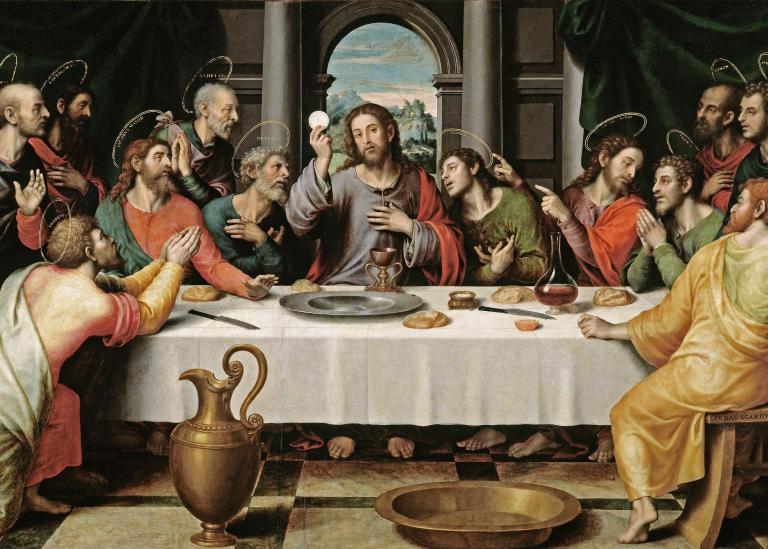
Juan de Juanes, “The Last Supper,” ca. 1562
In my last post (here) I responded to a few arguments, made recently by TurretinFan, on the subject of the Real Presence of Christ in the Eucharist. You may find his posts here and here.
(TF, due to his anonymity and his bold persistence in strange arguments, is known on this blog as the Amazing and Undaunted Mr. X of Calvinism.)
Mr. X’s argument, in his two posts, relies on two non sequiturs:
I. If we can establish that Christ is using the word “cup” in a metaphorical sense (in Matt. 26:28, Mark 14:24, and Luke 22:20), it must follow that he is using the word “blood” in a metaphorical sense too.
Strictly speaking, Christ’s use of the word “cup” is not metaphor but metonymy—but that’s a literary distinction fine enough to both escape the subtle brain of Mr. X, and to be tangential to the real point. Just because one word in a sentence is metaphorical does not imply that others are. Mr. X attempts to argue that the word “blood” is used metaphorically—not because it is, but because cup is. That just won’t do: It’s a shell game with metaphor.
II. If we can show that the word “blood” is used metaphorically elsewhere in Scripture, it must be used metaphorically in John 6 (and related passages) as well.
This too is a non sequitur. It simultaneously proves too little and too much. Are we then to assume that the word “blood” is metaphorical every time it is used in Scripture? That makes a mockery of the crucifixion—though I am sure that that is not Mr. X’s intention; he is just unaware (I speak as a charitable man) of the implications of his hasty and ill-considered argument. I do not suggest that he is John Shelby Spong, or a covert member of the Jesus Seminar. I do not suspect that his true identity is Bart Ehrman, and that Dr. Ehrman makes weird and untenable arguments under a pseudonym the better to discredit Calvinism. I suggest none of those things.
The true question is not whether there’s a figure of speech elsewhere in the Bible, or even whether there is one in the same sentence. To point out such things is tantamount to arguing: “Metaphors exist, therefore this is a metaphor.” You can make a metaphor of anything you like that way. Perhaps the real reason no one knows who Mr. X is is because he doesn’t exist; he’s just a metaphor for the secretive, oddball Calvinist. But no one seriously suggests any such thing. Instead, the only question is: What are the reasons to take this passage literally. And in my view, there are three.
THE JEWS UNDERSTOOD JESUS LITERALLY, AND HE DID NOT CORRECT THEM
Here is the full passage from John 6. (Because it is a long text, for convenience I will intralink the verse numbers in my discussion.)
30 They said therefore unto him, What sign shewest thou then, that we may see, and believe thee? what dost thou work?
31 Our fathers did eat manna in the desert; as it is written, He gave them bread from heaven to eat.
32 Then Jesus said unto them, Verily, verily, I say unto you, Moses gave you not that bread from heaven; but my Father giveth you the true bread from heaven.
33 For the bread of God is he which cometh down from heaven, and giveth life unto the world.
34 Then said they unto him, Lord, evermore give us this bread.
35 And Jesus said unto them, I am the bread of life: he that cometh to me shall never hunger; and he that believeth on me shall never thirst.
36 But I said unto you, That ye also have seen me, and believe not.
37 All that the Father giveth me shall come to me; and him that cometh to me I will in no wise cast out.
38 For I came down from heaven, not to do mine own will, but the will of him that sent me.
39 And this is the Father’s will which hath sent me, that of all which he hath given me I should lose nothing, but should raise it up again at the last day.
40 And this is the will of him that sent me, that every one which seeth the Son, and believeth on him, may have everlasting life: and I will raise him up at the last day.
41 The Jews then murmured at him, because he said, I am the bread which came down from heaven.
42 And they said, Is not this Jesus, the son of Joseph, whose father and mother we know? how is it then that he saith, I came down from heaven?
43 Jesus therefore answered and said unto them, Murmur not among yourselves.
44 No man can come to me, except the Father which hath sent me draw him: and I will raise him up at the last day.
45 It is written in the prophets, And they shall be all taught of God. Every man therefore that hath heard, and hath learned of the Father, cometh unto me.
46 Not that any man hath seen the Father, save he which is of God, he hath seen the Father.
47 Verily, verily, I say unto you, He that believeth on me hath everlasting life.
48 I am that bread of life.
49 Your fathers did eat manna in the wilderness, and are dead.
50 This is the bread which cometh down from heaven, that a man may eat thereof, and not die.
51 I am the living bread which came down from heaven: if any man eat of this bread, he shall live for ever: and the bread that I will give is my flesh, which I will give for the life of the world.
52 The Jews therefore strove among themselves, saying, How can this man give us his flesh to eat?
53 Then Jesus said unto them, Verily, verily, I say unto you, Except ye eat the flesh of the Son of man, and drink his blood, ye have no life in you.
54 Whoso eateth my flesh, and drinketh my blood, hath eternal life; and I will raise him up at the last day.
55 For my flesh is meat indeed, and my blood is drink indeed.
56 He that eateth my flesh, and drinketh my blood, dwelleth in me, and I in him.
57 As the living Father hath sent me, and I live by the Father: so he that eateth me, even he shall live by me.
58 This is that bread which came down from heaven: not as your fathers did eat manna, and are dead: he that eateth of this bread shall live for ever.
59 These things said he in the synagogue, as he taught in Capernaum.
60 Many therefore of his disciples, when they had heard this, said, This is an hard saying; who can hear it?
61 When Jesus knew in himself that his disciples murmured at it, he said unto them, Doth this offend you?
62 What and if ye shall see the Son of man ascend up where he was before?
63 It is the spirit that quickeneth; the flesh profiteth nothing: the words that I speak unto you, they are spirit, and they are life.
64 But there are some of you that believe not. For Jesus knew from the beginning who they were that believed not, and who should betray him.
65 And he said, Therefore said I unto you, that no man can come unto me, except it were given unto him of my Father.
66 From that time many of his disciples went back, and walked no more with him.
67 Then said Jesus unto the twelve, Will ye also go away?
68 Then Simon Peter answered him, Lord, to whom shall we go? thou hast the words of eternal life.
69 And we believe and are sure that thou art that Christ, the Son of the living God.
70 Jesus answered them, Have not I chosen you twelve, and one of you is a devil?
71 He spake of Judas Iscariot the son of Simon: for he it was that should betray him, being one of the twelve.
The text begins with His disciples asking Christ for a “sign” (v. 30) that they might believe in Him. They recall the manna, sent by God in the wilderness, as the very kind of “sign” they are thinking of (v. 31). (Of course, the Jews did not believe God even then, so why something like manna should matter now is anybody’s guess.)
Now, no one argues, except he be liberal-minded, that the manna in the desert was merely symbolic of something. And even most liberals will agree that it was true bread, though they may not want to attribute a supernatural origin to it. But at this point—note—Christ says that He is truer bread than even the manna was (v. 32). He is “the bread of life” (v. 35).
Now, this could have a merely spiritual meaning. The manna in the desert was physical bread, and the Jews ate it, and they died. Christ, however—figuratively; by way of analogy—is the “bread” through which one has eternal life. That’s how Mr. X understands Him.
But it is not how those who first heard Christ understood Him, when He said that he is “living bread” (v. 51)
“How can this man give us his flesh to eat?” they said (v. 52). And indeed, one can understand their distress: To eat human flesh, and drink blood, was an abomination (Lev. 17:10).
So if Christ’s meaning was merely figurative, this was the right moment to reassure His audience on that point. But He doesn’t. Indeed, He repeats Himself; if anything, more strongly: “Verily, verily, I say unto you, Except ye eat the flesh of the Son of man, and drink his blood, ye have no life in you. Whoso eateth my flesh, and drinketh my blood, hath eternal life; and I will raise him up at the last day” (vv. 53-54).
And then—this is crucial; pay attention here, Mr. X—Christ specifically says that he is not speaking metaphorically. In verse 55 He says, “My flesh is true food, and my blood is true drink.”
Lest anyone try to reassure himself, “Oh, Yeshua is just using a figure here,” Yeshua says: No, sir. Get that idea out of your head. Yeshua does not “clarify”; He doubles down. Thus in verse 57 He says: “He that eateth me, even so shall he live by me.”
All this goes far beyond Christ’s presumably using the word “blood” metaphorically at the Last Supper. Here, if we are to believe Mr. X, Christ is using the word “eat,” and even the word “true,” metaphorically as well. If we are to believe Mr. X, at the very moment the Jews took a metaphor literally, Christ repeated the metaphor in even more extreme terms. Hey, brothers, if you think that metaphor was confusing, try this one on for size!
“This is a hard saying,” his disciples say (v. 60). “Who can hear it?” So they still understand Christ literally: Far from being reassured, they’re all the more troubled.
And note that Christ, again, is firm in standing behind what he had just said. “Doth this offend you?” he says (vv. 61-62). Perhaps it offends; they understand me literally; and well they should, too. “What an if you shall see the Son of Man ascend up to where He was before?”
You think this is difficult, wait until you see the Ascension. Then you’ll have something to wrestle with, that let me tell you.
Verse 63 is the one that Protestants such as Mr. X often cite in an attempt to show that Christ was speaking metaphorically. “It is the spirit that quickeneth; the flesh profiteth nothing,” Christ says. “The words I speak unto you, they are spirit.”
Now, the problem with that interpretation is not merely that it relies on looking at the word “spirit” and interpreting it to mean “metaphorical.” (Are our spirits only metaphors, or are they real things?) The problem is also that it utterly disregards what Christ is responding to. He is responding not to His disciples’ difficulty with understanding what He has said, but rather their difficulty with accepting it. And what He is saying is that they must accept it on the basis, not of human reason, but of spiritual faith. By your own reason, you will not get it; by faith, you will: That is Christ’s meaning. His meaning is not: Calm down, brothers, I’m just using a figure of speech here.
At this point (vv. 66-68), many of Christ’s disciples abandon Him. Evidently, they still understand Him literally (even after the “flesh profiteth nothing” passage). Does Christ turn to the twelve and say, “Do you also misunderstand”? No. Does He say, “To them it is given to misunderstand, lest they repent and be saved; but to you, I will explain myself plainly”? No. He says, “Will ye also go away?” He gives no indication at all of having been misunderstood literally when He meant His words figuratively. And Peter says, “Lord, to whom shall we go?” Those are words of abandonment to Christ—not of human reason reassured, but of faith despite the limitations of human reason.
But it is Judas who does begin to abandon Christ at this moment (vv. 70-71). That is interesting: It is over the doctrine of the Real Presence that Judas first begins to abandon Christ.
ST. PAUL’S STRONG LANGUAGE ABOUT THE EUCHARIST
I can remember, two years before I became Catholic, being tremendously struck by the severity of St. Paul’s words about the Eucharist in 1 Corinthians 11:26-29:
For as often as ye eat this bread, and drink this cup, ye do shew the Lord’s death till he come. Wherefore whosoever shall eat this bread, and drink this cup of the Lord, unworthily, shall be guilty of the body and blood of the Lord. But let a man examine himself, and so let him eat of that bread, and drink of that cup. For he that eateth and drinketh unworthily, eateth and drinketh damnation to himself, not discerning the Lord’s body.
Of course, I was struck by the last clause of the last verse, in which St. Paul indicates that one should “discern the Lord’s body” in the Eucharist. But more than that, I was struck by how uncompromising and direct his language was. Whoever partakes of the Eucharist “unworthily”—that is to say, in a state of mortal sin—is guilty of the crucifixion itself. Whoever partakes of the Eucharist in a state of mortal sin “drinketh damnation.” That’s hard.
It’s hard, that is, if we’re merely talking about a symbol.
But it makes perfectly reasonable sense if the Eucharist actually is, literally, the body and blood, soul and divinity, of Christ. Then it makes sense to be guilty of the crucifixion in the circumstances St. Paul describes. The crucifixion did not involve a symbolic body or symbolic blood; neither does the Eucharist. To link the two—crucifixion and Eucharist—as Paul does implies that they are linked.
THE UNANIMOUS WITNESS OF THE EARLY CHURCH
And I mean unanimous.
Justin Martyr: “For not as common bread nor common drink do we receive these; but since Jesus Christ our Savior was made incarnate by the word of God and had both flesh and blood for our salvation, so too, as we have been taught, the food which has been made into the Eucharist by the Eucharistic prayer set down by him, and by the change of which our blood and flesh is nurtured, is both the flesh and the blood of that incarnated Jesus” (First Apology 66, here).
Ignatius of Antioch: “Take note of those who hold heterodox opinions on the grace of Jesus Christ which has come to us, and see how contrary their opinions are to the mind of God. . . . They abstain from the Eucharist and from prayer because they do not confess that the Eucharist is the flesh of our Savior Jesus Christ, flesh which suffered for our sins and which that Father, in his goodness, raised up again. They who deny the gift of God are perishing in their disputes” (Letter to the Smyrnaeans 6-7, here).
St. Cyril of Alexandria: “The offerings, by the hidden power of God Almighty, are changed into Christ’s Body and Blood” (Commentary on Matthew 26-27, quoted here).
Cyril of Jerusalem: “After the invocation the Bread becomes the Body of Christ, and the Wine the Blood of Christ” (Catechetical Lectures 19:7, here).
Cyril of Jerusalem: Since then He Himself declared and said of the Bread, This is My Body, who shall dare to doubt any longer? And since He has Himself affirmed and said, This is My Blood, who shall ever hesitate, saying, that it is not His blood?” (Catechetical Lectures 22:1, here).
Who shall dare to doubt, Mr. X? Who shall hesitate? It is not enough to simply show that metaphor exists elsewhere in the Bible, or even elsewhere in the same passage, if you can not show that this is metaphorical. Y is metaphorical because x is is no argument; neither is x was metaphorical when it was used there, therefore it is metaphorical when it used here. That is sophomoric reasoning—a cop-out, an attempt to avoid the real hard work of honest exegesis and historical inquiry.
Well, but then, exegesis and historical inquiry do run counter to the notion that the body and blood of Christ are merely symbolic in the Eucharist. That interpretation does not bear up under close examination of the relevant biblical passages, and it does not square with the understanding of Christ’s disciples and the early Church.
I end by quoting the following, very amusing, footnote from Mr. X:
I should add that the Roman Catholic position is particularly absurd in that it takes “this is my body” as implying that the bread ceases to be bread and becomes the body, blood, soul and divinity of Jesus. Likewise, it is claimed that “this is … my blood” implies exactly the same thing about the contents of the cup. That’s quite far from taking the words literally, in which the bread would just be the body, and the contents of the cup would just be the blood.
How now, Nestorius? Still attempting to separate the humanity and the divinity of Christ? Old heresies never die; they just fade away into newer ones.
You can read more about the Church Fathers on Transubstantiation here; and you can read a good article on John 6 by seminarian Joe Heschmeyer (of Shameless Popery) here.
***
If you like the content on this blog, your generous gift to the author helps to keep it active. I remember all my supporters in my Mass intentions each week.
Previous Post
July 29, 2014
Mr. X Struggles With Metaphor, Transubstantiation, & John 6
Next Post
August 1, 2014 The New Evangelization, Sans Puns: Scott Hahn's "Mission Manual"
Browse Our Archives
Select a Category Abortion About Me Answers for Calvinists Answers to Media Fictions Answers to Objections Anti-Catholicism Apologetics Apostolic Succession Atonement Authority of the Church Baptism Benedictines Biblical Exegesis Blogging Book Reviews Books & Writing &c. Calvin's Institutes Capital Punishment Catholic Church Chastity Christology Church Fathers Church Social Doctrine Confession Contraception Conversion Stories Crusades Debates Depression & Suicide Deuterocanon Development of Doctrine Ecumenism English Language Eucharistic Adoration Exorcism Extra Ecclesiam Fisks & Rebuttals Freedom of Religion Freedom of Speech Fundamentalism Gender Politics Gender Theory Good Works Homosexuality Humor Idolatry Immaculate Conception In the News Inquisition ISIS Islam Just for Fun Just War Justification LCWR Limbo Liturgical Abuse Liturgical Year Magisterium Marriage and Family Mary Mortal Sin New Evangelization NFP Papacy Papal Documents Papal Infallibility Personal Narrative Politics Pope Francis Pope Francis Derangement Syndrome Population Control Praying to the "Dead" Priesthood Primacy of Peter Protestant Denominations Purgatory Radical Islam Radical Traditionalists Real Presence Right to Conscience RIght to Life Saints Same-Sex "Marriage" Seven Quick Takes Social Justice Social Media Sola Scriptura Spirit of Vatican II SSPX The Eucharist The Mass The Resurrection Traditionalism Vatican II Year of Mercy
Select a Month August 2019 July 2019 June 2019 May 2019 November 2018 October 2018 August 2018 July 2018 June 2018 April 2018 November 2017 October 2017 September 2017 May 2017 April 2017 March 2017 February 2017 November 2016 October 2016 September 2016 August 2016 July 2016 June 2016 May 2016 April 2016 March 2016 February 2016 January 2016 December 2015 November 2015 October 2015 September 2015 July 2015 June 2015 May 2015 April 2015 March 2015 February 2015 January 2015 December 2014 September 2014 August 2014 July 2014 June 2014 May 2014 April 2014 March 2014 February 2014 January 2014 December 2013 November 2013 October 2013 May 2013 April 2013 February 2013 January 2013
Follow Us!
TAKE THE
Religious Wisdom Quiz
What king of Judah found the Book of the Law during Temple repairs?
Select your answer to see how you score.
Josiah Manasseh Hezekiah Jehoshaphat
Related posts from To Give a Defense
Does the Mass crucify Jesus another time? Part...
Does the Mass "banish the remembrance of Christ's...

How much does God hate lying? (Proverbs 6:16-19)
Don't Cite Leviticus 18 If You're Going to...
TRENDING AT PATHEOS Catholic

Rejecting Doom: Christian Hope And Human Action
Christianity is a religion of hope. We are to have hope and...

It’s What Comes From Within Which Matters
One of the most difficult things for us to understand is why...

Why I Choose the Eucharist Over the Sermon
Choose the Eucharist, Not the Sermon What are we supposed to get...

5 Design Elements Found in Spiritually Rooted Homes
Putting Spirituality Into Home Decor Our homes are more than our living...

Credo: A Story of God Told with the...
About 10 years ago, I began to imagine a personal "Credo" that...

The Anatomy of Divine Revelation in Catholic Thought
The claim that God has made Himself known to human beings is...
view all Catholic blogs
Ad-Free & Subscriber Log-In Subscription Support
- About Us
- 2026 Calendar
- Videos
- Podcasts
- Library of World Religions
- Faith In Media Tracker
- Advertise With Us
- Write for Us
- Privacy Policy
- Terms of Service
- Do Not Sell My Data
- Contact Us
- Radiant Digital
- Manage Newsletter Subscriptions
- Unsubscribe From Notifications
- Sitemap
Copyright 2008-2026, Patheos. All rights reserved.
Subscription Support Ad-Free & Subscriber Log-In
Follow Patheos