
BuddhistCatholicContemplativeEvangelicalGeneral ChristianHinduJewishLatter-day SaintMuslimNew VisionsProgressive Christian
Beliefs
- Buddhist
- Catholic
- Contemplative
- Evangelical
- General Christian
- Hindu
- Jewish
- Latter-day Saint
- More Voices
- Muslim
- New Visions
- Pagan
- Progressive Christian
Topics
- Religion News
- Food and Religion
- Sports and Religion
- Religious Art
- Religious Music and Entertainment
- Religious Events
- History and Religion
- Style and Religion
- Politics and Religion
- Women in Religion
- Recreation Outdoors and Religion
- Business Finance and Religion
- Careers Workplace and Religion
- Education and Religion
- Family Parenting and Religion
- Health Fitness and Religion
- Home and Religion
- Relationships and Religion
- Technology and Religion
- Travel and Religion
Columnists
- Buddhist Columnists
- Business Finance and Religion Columnists
- Careers Workplace and Religion Columnists
- Catholic Columnists
- Contemplative Columnists
- Education and Religion Columnists
- Evangelists Columnists
- Family Parenting and Religion Columnists
- General Christian Columnists
- Health Fitness and Religion Columnists
- Hindu Columnists
- History and Religion Columnists
- Home and Religion Columnists
- Jewish Columnists
- More Voices Columnists
- Latter Day Columnists
- Muslim Columnists
- New Visions Columnists
- Nonreligious Columnists
- Pagan Columnists
- Politics and Religion Columnists
- Progressive Columnists
- Recreation Outdoors and Religion Columnists
- Relationships and Religion Columnists
- Religion News Columnists
- Religious Art Columnists
- Religious Events Columnists
- Religious Music and Entertainment Columnists
- Sports and Religion Columnists
- Style and Religion Columnists
- Technology and Religion Columnists
- Travel and Religion Columnists
- Women in Religion Columnists
Resource Library
- 2026 Calendar
- Library of World Religions
- The 100 Most Holy Places on Earth
- Patheos Answers
- Podcasts
- Videos
- Faith Leaders Database
- Anglican Episcopalian
- Bahai
- Baptist
- Buddhism
- Christianity
- Confucianism
- Eastern Orthodoxy
- Hinduism
- Holiness and Pentecostal
- ISKCON
- Islam
- Judaism
- Lutheran
- Methodist
- The Church of Jesus Christ of Latter-day Saints
- New Age
- Paganism
- Presbytarian and Reformed
- Protestantism
- Religion Behind the Scenes
- Roman Catholic
- Scientology
- Shia Islam
- Sikhism
- Sufism
- Sunni Islam
- Taoism
- Zen
- See all religions
Research Tools
 Ad-Free & Subscriber Log-In Subscription Support
Ad-Free & Subscriber Log-In Subscription Support
Follow Patheos 

- Trending:
- Forgiveness
- |
- Marriage
- |
- Consciousness
- |
- Death Penalty
- |
- Election
- |
- Halloween
 To Give a Defense
- Home
- Catholic
- The Solemnity of Christ the King: The End of All Things is at Hand
The Solemnity of Christ the King: The End of All Things is at Hand
Last updated on: March 9, 2017 at 4:29 pm by Scott Eric Alt
The Solemnity of Christ the King: The End of All Things is at Hand 2017-03-09T16:29:37-04:00 Scott Eric Alt
Patheos Explore the world's faith through different perspectives on religion and spirituality! Patheos has the views of the prevalent religions and spiritualities of the world.
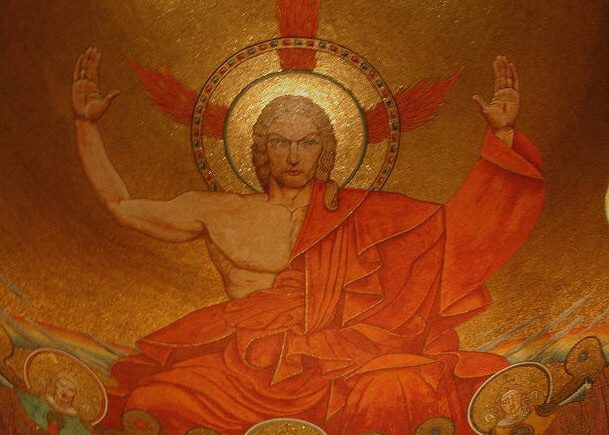
John de Rosen, “Christ in Majesty.” Basilica of the National Shrine of the Immaculate Conception. (Creative Commons.)
There is a right way to talk about the end of our lives, the end of time, the end of all things. It is not the way of Harold Camping; we may not predict hours or dates. It is not the way of the Left Behind series; we must not speculate about plot or politics. We are not to prognosticate every time there is war or rumors of war. We are not meant to have apocalypse anxiety. Rather, I suspect that what is proper is to be mindful that our years are short and that our real home is elsewhere.
THE END OF ALL THINGS IS AT HAND
Christina Rossetti, whose poems for the liturgical year will be familiar to regular readers of this blog, had urgent but reposeful words to say about the “Sunday Before Advent.”
The end of all things is at hand. We all
Stand in the balance trembling as we stand;
Or if not trembling, tottering to a fall.
The end of all things is at hand.
O hearts of men, covet the unending land!
O hearts of men, covet the musical,
Sweet, never-ending waters of that strand!
While Earth shows poor, a slippery rolling ball,
And Hell looms vast, a gulf unplumbed, unspanned,
And Heaven flings wide its gates to great and small,
The end of all things is at hand.
Although life and earth are good, eternal life is better, and we are not to covet or cling; the final stage of death is always acceptance and letting go, and we are to covet only “the unending land.” This is hard. Earth is tactile, and breath a sweet filling of the lungs, and I, as anyone, am attached. I hate terribly to have to say goodbye, and I hate terribly that some of the greatest people I’ve known are no longer with me. But then, that does remind me I am meant to go where they have gone. We yearn for permanence, which means we were made for permanence; and if we are eluded it is only because we are seeking it here when it is there.
That is why God is to be praised for giving us the continual rising and setting of the sun. It is why He is to be praised for giving us the cycle of the seasons. And it is why the Church in her wisdom has given us the liturgical year. These things keep us mindful of an approaching end. They keep us mindful, too, of reckoning. For if Rossetti understood the need to “covet the unending land,” she also understood that “we all stand in the balance trembling … or tottering to a fall.” “Hell looms vast,” she reminds us. And Christ, who is in majesty, is our advocate but also King and Judge. So all the more we must remember the coming end of all things.
TREMBLING AS WE STAND
He is called “Angry Jesus,” but I appreciate John de Rosen’s artwork at the Basilica of the National Shrine of the Immaculate Conception. I used to belong to the Church of the Warm and Fuzzy Jesus. I used to have an image of a Jesus who did nothing but walk around holding lambs and patting people on the head. But now I’m middle-aged and jaded and a Jesus who is ticked off all the time makes more sense to me. De Rosen’s Jesus is Howard Beale in glory. De Rosen’s Jesus is the one who said, “How can you escape the damnation of Hell?” De Rosen’s Jesus is the one who flogged the moneychangers with cords. I like that Jesus. I want the day to come when Satan and all evil-doers go permanently down.
COVET THE UNENDING LAND
Christ is King. The Christ who came to us came to us as an infant; he came to us as the image of a human being. That is not the Christ who will come again. That is not the Christ we will go to, if that is where we go. When Christ comes again, He comes in glory and victorious; He comes as King of kings and Lord of lords.
Should we not say that? Should we be bothered, or frightened, or offended, or uncomfortable at the sight of “Angry Jesus”? My guess is that the real discomfort that some have with this depiction of Jesus has a lot to do with latent sorrow and guilt. We worry that Christ’s expression is directed at us, perhaps because we know it deserves to be.
The mercy of God, and God in humility, are easy to understand, and comfortable. But the justice of God, and God in glory, challenge. If, at the beginning of the liturgical year, we prepare for the humility of God in the womb of Mary and in the manager in Bethlehem, who came for mercy and sacrifice, it is right that at the end of the year we contemplate the glory of God on the throne, whose triumph and justice are just as certain. They are the same God, and we cannot understand the one without understanding the other.
And so we celebrate the solemnity of Christ the King. The Church has celebrated it since 1925, when Pope Pius XI, in his encyclical Quas Primas (here), attempted to respond to the growing tide of secularism within modern culture:
When once men recognize, both in private and public life, that Christ is King, society will at last recognize the blessings of real liberty, well-ordered discipline, peace, and harmony. Our Lord’s regal office invests the human authority of princes and rulers with a religious significance; it ennobles the citizen’s duty of obedience. … If princes and magistrates duly elected are filled with the persuasion that they rule, not by their own right, but by the mandate and in the place of the Divine King, they will exercise their authority piously and wisely …
The error of secularism is the belief that there is no life beyond this life and no power beyond the power of this world. The solemnity of Christ the King is meant to remind us that we were made for another world and that all power is of that world, where Christ reigns in glory. Attachments are vain and earthly rule is vain. Wealth and good looks and good health and everything on earth we love will pass. If we remember Christ the King—if we remember “Angry Jesus”—then our passing will be sweet and we will rest in His glory.
Crown Him with many crowns.
***
If you like the content on this blog, your generous gift to the author helps to keep it active. I remember all my supporters in my Mass intentions each week.
Previous Post
November 22, 2013
Seven Epiphanies That Made Me Catholic: 7QT VII Seriatim
Next Post

November 27, 2013 Seven Things to Do for Thanksgiving and Black Friday: 7QT VIII Seriatim
Browse Our Archives
Select a Category Abortion About Me Answers for Calvinists Answers to Media Fictions Answers to Objections Anti-Catholicism Apologetics Apostolic Succession Atonement Authority of the Church Baptism Benedictines Biblical Exegesis Blogging Book Reviews Books & Writing &c. Calvin's Institutes Capital Punishment Catholic Church Chastity Christology Church Fathers Church Social Doctrine Confession Contraception Conversion Stories Crusades Debates Depression & Suicide Deuterocanon Development of Doctrine Ecumenism English Language Eucharistic Adoration Exorcism Extra Ecclesiam Fisks & Rebuttals Freedom of Religion Freedom of Speech Fundamentalism Gender Politics Gender Theory Good Works Homosexuality Humor Idolatry Immaculate Conception In the News Inquisition ISIS Islam Just for Fun Just War Justification LCWR Limbo Liturgical Abuse Liturgical Year Magisterium Marriage and Family Mary Mortal Sin New Evangelization NFP Papacy Papal Documents Papal Infallibility Personal Narrative Politics Pope Francis Pope Francis Derangement Syndrome Population Control Praying to the "Dead" Priesthood Primacy of Peter Protestant Denominations Purgatory Radical Islam Radical Traditionalists Real Presence Right to Conscience RIght to Life Saints Same-Sex "Marriage" Seven Quick Takes Social Justice Social Media Sola Scriptura Spirit of Vatican II SSPX The Eucharist The Mass The Resurrection Traditionalism Vatican II Year of Mercy
Select a Month August 2019 July 2019 June 2019 May 2019 November 2018 October 2018 August 2018 July 2018 June 2018 April 2018 November 2017 October 2017 September 2017 May 2017 April 2017 March 2017 February 2017 November 2016 October 2016 September 2016 August 2016 July 2016 June 2016 May 2016 April 2016 March 2016 February 2016 January 2016 December 2015 November 2015 October 2015 September 2015 July 2015 June 2015 May 2015 April 2015 March 2015 February 2015 January 2015 December 2014 September 2014 August 2014 July 2014 June 2014 May 2014 April 2014 March 2014 February 2014 January 2014 December 2013 November 2013 October 2013 May 2013 April 2013 February 2013 January 2013
Follow Us!
TAKE THE
Religious Wisdom Quiz
Who said, "Shall we accept good from God, and not trouble?"
Select your answer to see how you score.
Job Jeremiah Moses Solomon
Related posts from To Give a Defense
Pentecost: To Woo Back a World's Desire

TRENDING AT PATHEOS Catholic

Creation, Preservation, and Teleology in Catholic Theology
As I write this, it is very early Monday morning. Like millions...

The Parable Of The Sower And The Word...
One of Christ’s most famous parables is that of the sower who...

Rejecting Doom: Christian Hope And Human Action
Christianity is a religion of hope. We are to have hope and...

Why I Choose the Eucharist Over the Sermon
Choose the Eucharist, Not the Sermon What are we supposed to get...

5 Design Elements Found in Spiritually Rooted Homes
Putting Spirituality Into Home Decor Our homes are more than our living...

Credo: A Story of God Told with the...
About 10 years ago, I began to imagine a personal "Credo" that...
view all Catholic blogs
Ad-Free & Subscriber Log-In Subscription Support
- About Us
- 2026 Calendar
- Videos
- Podcasts
- Library of World Religions
- Faith In Media Tracker
- Advertise With Us
- Write for Us
- Privacy Policy
- Terms of Service
- Do Not Sell My Data
- Contact Us
- Radiant Digital
- Manage Newsletter Subscriptions
- Unsubscribe From Notifications
- Sitemap
Copyright 2008-2026, Patheos. All rights reserved.
Subscription Support Ad-Free & Subscriber Log-In
Follow Patheos