
BuddhistCatholicContemplativeEvangelicalGeneral ChristianHinduJewishLatter-day SaintMuslimNew VisionsProgressive Christian
Beliefs
- Buddhist
- Catholic
- Contemplative
- Evangelical
- General Christian
- Hindu
- Jewish
- Latter-day Saint
- More Voices
- Muslim
- New Visions
- Pagan
- Progressive Christian
Topics
- Religion News
- Food and Religion
- Sports and Religion
- Religious Art
- Religious Music and Entertainment
- Religious Events
- History and Religion
- Style and Religion
- Politics and Religion
- Women in Religion
- Recreation Outdoors and Religion
- Business Finance and Religion
- Careers Workplace and Religion
- Education and Religion
- Family Parenting and Religion
- Health Fitness and Religion
- Home and Religion
- Relationships and Religion
- Technology and Religion
- Travel and Religion
Columnists
- Buddhist Columnists
- Business Finance and Religion Columnists
- Careers Workplace and Religion Columnists
- Catholic Columnists
- Contemplative Columnists
- Education and Religion Columnists
- Evangelists Columnists
- Family Parenting and Religion Columnists
- General Christian Columnists
- Health Fitness and Religion Columnists
- Hindu Columnists
- History and Religion Columnists
- Home and Religion Columnists
- Jewish Columnists
- More Voices Columnists
- Latter Day Columnists
- Muslim Columnists
- New Visions Columnists
- Nonreligious Columnists
- Pagan Columnists
- Politics and Religion Columnists
- Progressive Columnists
- Recreation Outdoors and Religion Columnists
- Relationships and Religion Columnists
- Religion News Columnists
- Religious Art Columnists
- Religious Events Columnists
- Religious Music and Entertainment Columnists
- Sports and Religion Columnists
- Style and Religion Columnists
- Technology and Religion Columnists
- Travel and Religion Columnists
- Women in Religion Columnists
Resource Library
- 2026 Calendar
- Library of World Religions
- The 100 Most Holy Places on Earth
- Patheos Answers
- Podcasts
- Videos
- Faith Leaders Database
- Anglican Episcopalian
- Bahai
- Baptist
- Buddhism
- Christianity
- Confucianism
- Eastern Orthodoxy
- Hinduism
- Holiness and Pentecostal
- ISKCON
- Islam
- Judaism
- Lutheran
- Methodist
- The Church of Jesus Christ of Latter-day Saints
- New Age
- Paganism
- Presbytarian and Reformed
- Protestantism
- Religion Behind the Scenes
- Roman Catholic
- Scientology
- Shia Islam
- Sikhism
- Sufism
- Sunni Islam
- Taoism
- Zen
- See all religions
Research Tools
 Ad-Free & Subscriber Log-In Subscription Support
Ad-Free & Subscriber Log-In Subscription Support
Follow Patheos 

- Trending:
- Forgiveness
- |
- Marriage
- |
- Consciousness
- |
- Death Penalty
- |
- Election
- |
- Halloween
 To Give a Defense
- Home
- Catholic
- The Papacy, Necessity, and Unbroken Succession: A Reply to Mr. X
The Papacy, Necessity, and Unbroken Succession: A Reply to Mr. X
Last updated on: March 14, 2017 at 12:29 am by Scott Eric Alt
The Papacy, Necessity, and Unbroken Succession: A Reply to Mr. X 2017-03-14T00:29:50-04:00 Scott Eric Alt
Patheos Explore the world's faith through different perspectives on religion and spirituality! Patheos has the views of the prevalent religions and spiritualities of the world.
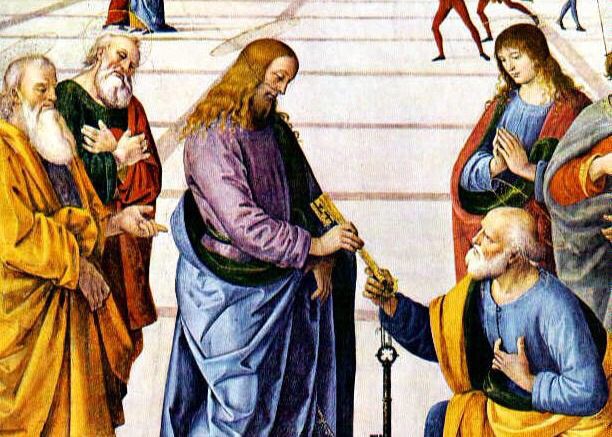
Pietro Perugino, “Christ Handing the Keys to St Peter”
Readers coming first to this post, which is about the papacy, should take note that it is the fifth in a back-and-forth between myself and TurretinFan—the amazing and undaunted Mr. X of Calvinism. The first and second posts in the series are by Mr. X; the third by myself, in reply to Post 2; and the fourth by Mr. X, in reply to Post 3. In this his latest reply, Mr. X tries bravely, though weakly, to clarify his argument on the topic of necessity and the papacy. To begin, he states the Catholic claim in the form of a syllogism.
- If the papacy is necessary, it must be true;
- The papacy is necessary;
- Therefore, the papacy must be true.
According to Mr. X, (2) is false; and to show that it is false, he wrote the second in the series of posts linked to above. To defeat the syllogism, there is no need—so Mr. X says—for him to prove that the papacy itself is false. (Mr. X is at great pains to make that disclaimer.) He need only show that the argument from necessity does not prove it to be true.
i. Will the real syllogism please stand up?
S
o far so good. I do not claim that Mr. X believes the papacy to be false because it’s unnecessary. (He does believe it to be false, but for other reasons.) My claim is a different one: namely, that any discussion about whether or not the papacy is “necessary” misses the point. It misses the point whether you’re Catholic or Reformed. If by “necessary” you mean “could not have been otherwise,” then strictly speaking nothing is necessary. One may as well say, “God could have chosen some different source of light and heat than a burning star; therefore, the sun is not necessary.”
But that is the argument I understood Mr. X to have been making when he said that the pope’s administrative functions might well be handled by someone else.
- If Church business can be tended to without a papacy, the papacy is not necessary;
- The pope is not needed for the appointment of cardinals and bishops;
- Therefore, the papacy is not necessary.
My reply was and remains simple: We should not, by false theory and syllogism, think that God would institute only those offices in the Church that are “necessary” in our own sight. Such an idea makes Christ powerless before Necessity the same way Zeus is powerless before Fate. I doubt Mr. X believes that Necessity is a higher order of divinity than Christ. But that is the logical consequence—is it not?—when you judge some office in the Church upon the standard of its “necessity,” rather than the only proper standard: namely, did Christ intend this?
If Christ meant for there to be a pope, then it is the role He intended the pope to play, not what we subjectively think we “need,” that we should be talking about. What Christ in fact did is all that matters.
Mr. X says that all this talk about necessity began on the Catholic side, and he was trying only to show that the claim is meaningless. Thus he points the reader to his original post, from 2010, in which he replies to words spoken by John Paul II, in a General Audience, on January 27, 1993. The only problem is, nowhere in the text provided by the Vatican does John Paul II claim that the papacy is “necessary.” If it was he who started this whole bother about “necessity,” as Mr. X wants us to believe (and he cites no other source), then where is that claim in the text? I’ve looked; it is not there. I’ve looked again. Maybe Mr. X has more hawk-like eyes than the rest of us. Or perhaps he is just preternaturally inventive.
Now, what John Paul II does say is that the “service of authority” is necessary to the papal office. In other words, for the pope to be the pope, rightly understood, he must have authority over the whole Church. But nowhere does he claim that the papacy of itself is necessary to the Church. And the part of the text quoted by Mr. X has nothing to say about “necessity” of any kind, but includes only John Paul II’s observations regarding an unbroken succession from Peter to himself.
I do not doubt, and I am sure no one does, that John Paul II believed in the necessity of his own office. But in the text cited by Mr. X, the pope nowhere makes that specific claim.
So what is Mr. X jabbering about necessity for? His real argument would seem to be a syllogism of this form:
- Rome attempts to justify the papacy by appealing to an unbroken succession;
- There is no unbroken succession;
- Therefore, better arguments for the papacy are needed.
The meaningless discussion about “necessity” need not come up. Truth be told, the only ones I’ve known to bring it up are Reformed apologists. Mr. X insists that it is just those Catholic apologists who claim the necessity of the papacy, and he’s but watching from the sidelines and rebutting them in gentle and beset innocence, with all the flaming darts of the wicked raining down upon his blog. But that does not pass the credibility test, at least from the sources he has cited. Perhaps he might direct me to a Catholic apologist who has made such a claim, since John Paul II doesn’t—at least, not in the text quoted by Mr. X.
ii. swinging at the papacy: mr. x goes 0 for 6
T
hus and so: In terms of the actual arguments Mr. X makes in his original post from 2010, I need only show that they are not adequate to disprove the papacy, or its unbroken succession, or its necessity, or its red shoes, or anything else Mr. X may think is vain and false about it. As a Catholic, I am happy to assume unbroken succession to be a given. The burden of proof is on the disputers to show where a break occurred. Call it “X-Man’s Burden.”
In an attempt to thus undo his burden, Mr. X gives six reasons why one may find the Catholic appeal to an unbroken succession to be “meaningless.” Let us check out how they fare.
1.
There is a sede vacante between every papacy. How long, the sly Mr. X wonders, would the Chair of St. Peter need to be vacant in order for there to be a break in succession? In answer to the question, I can only say that I am not aware of any Church law that requires the new pope to be elected and installed within a fixed span of time; a canon lawyer might know differently than I would. The longest sede vacante, as Mr. X surely knows, lasted for thirty-three months, during the conclave that elected Teobaldo Visconti (Gregory X) to succeed Clement IV; there was no pope from November 29, 1268, to September 1, 1271.
A better answer to Mr. X is to say that a “break” is not determined by some fixed length of time, and that the presence of a conclave to elect a specific successor to a specific pope must put a stop to any rude talk that there has been one. It is indeed sophomoric (perhaps it is worse), for Mr. X to say, with pipe-smoking conviction, “Aha! so! there was no pope for two weeks earlier this year, yes? hence we see that there was a break in the unbroken succession! And life went on! And birds still flew, yes? And fish still swam, no? And Calvinists still said crazy things! I don’t need a papacy to be a fool!”
Such a claim is cleverness in search of coherence. Mr. X seemingly means for us to believe that the standard for “unbroken succession” is that a new pope must be in place the very second the former pope is no longer pope, lest the sky fall and cars pitch headlong over the cliff. That is the kind of argument that will convince only the intellectually comatose.
So much for Mr. X’s first try. But he has more.
2.
Pope Benedict IX was deposed, and twice. He was pope on three separate occasions between 1032 and 1048! The chain of succession ran thus: Benedict IX, Sylvester III, Benedict IX, Gregory VI, Clement II, Benedict IX. That wild and crazy papacy! what are the Mr. Akins, the Mr. Madrids, the Mr. Alts, to say about this one?
To be honest, I don’t know why Benedict IX, who was pope in triplicate, should worry Mr. X, any more than it should worry him that Grover Cleveland was voted out of the presidency in 1888 only to be elected to it a second time in 1892. No one argues that the sequence Grover Cleveland, Benjamin Harrison, Grover Cleveland constitutes a break in presidential succession. No one argues, either, that there was a break when Richard Nixon was forced to resign under threat of impeachment and removal. Why there should be some different standard for popes than presidents, Mr. X does not explain.
So much for Mr. X’s second try. But he has more.
3.
There might be a break if the pope commits some “outrageous” sin. This claim seems to me to be yet one more case of cleverness in search of coherence. I’m not sure on what basis it can be said that, if a pope sins in some especially notorious or preposterous way, he’s no longer pope. Is Mr. X aware of some point of canon law that I am not? There are indeed those who believe that Pope John XXIII and his successors taught heresy by embracing modernism, and that therefore there has been a sede vacante ever since Pius XII died in 1958. I trust Mr. X is familiar with the name Gerry Matatics. I would not have thought that he would want to rely on the arguments of the sedevacantists.
But if one accepts Mr. X’s line of thinking here, the Chair of Peter was vacated for all time, not in 1958 but in 1492, when Alexander VI became pope by simony. Mr. X, not content with laying only that charge at the feet of Alexander, goes on to recount several other of the pope’s dark acts. And to be sure, there is not a Catholic apologist who labors under the sun who would claim that Alexander was a man of great virtue and noble deeds. But Mr. X doesn’t offer any theory as to what threshold of sin would need to be crossed for someone to forfeit the papacy. Which malfeasance of Alexander’s did it, and why that one and not some other? No Catholic law that I am aware of establishes a standard of any such kind. Even assuming that one did exist (if the pope murders someone he’s no longer pope), there would also be a canonical process to remove the pope and select a new one. In that way, the unbroken succession would be preserved. The papacy could not have endured as long as it has if were defenseless against the chance sinful deeds of men.
So much for Mr. X’s third try. But he has more.


4.
There might be a break if a pope teaches heresy. In his effort to convince us of this quintessentially sedevacantist argument, Mr. X cites the dubious, and by now cliché, example of (drum roll, Ringo) Pope Honorius I. Mr. X repeats the oft-circulated rumor that Honorius was a “monophosite” [sic]. (I think Mr. X is confusing his mono with his mono, and that he meant to say “monothelite.”) As evidence for this act of accusatory bravura, he links the reader to a long article by William Webster—a man of great learning who is known by all to be free of bias or cant.
The example is dubious, and always has been. Honorius was not a monophysite; nor was he a monothelite; nor was he a monoenergist; nor was he anything but a monotheist. Catholic apologists have proven as much beyond any room for doubt. But for reasons of their own (they’ll have to tell us what they are), anti-Catholics continue to bring up the name Honorius as though it had talismanic properties. As is frequently the case, it takes a few pages to sort out the myth from the truth, and so I would direct the interested reader to Patrick Madrid’s chapter on Honorius in his book Pope Fiction (see the link above).
The short of it is, Honorius was attempting, in a private letter, to affirm that Christ’s will is not opposed to the will of the Father: “Since Christ’s human will is faultless, there can be no talk of opposing wills.” That statement was later misconstrued by the Monothelites as an affirmation of their false doctrine that Christ had only one will. The orthodox teaching is that Christ has both a human and a divine will, which are in harmony with each other and with God. This teaching, Honorius accepted. So when the Third Council of Constantinople condemned him as a heretic, it was in error. Pope Leo II never confirmed the Council’s decree; thus it never had authority in the Church.
In truth, I must confess surprise that Mr. X would use this example in this context, since Honorius is typically cited by anti-Catholics to refute infallibility, not unbroken succession.
So much for Mr. X’s fourth try. But he has more.
5.
There may have been a break during the so-called “Avignon papacy.” After all, from 1309 to 1376 the pope reigned, not from Rome, but from Avignon, France. See, Wikipedia says so! Case closed!
This is one of the more odd arguments, in that no one explains—least of all Mr. X—why the papacy must always be seated in Rome. It is true that the pope is the bishop of Rome, but there are complex historical reasons why the pope reigned from France for this period. Long story short, they have to do with a conflict of politics between the pope and the French monarch. No one claims that the Avignon popes were not true popes. No one claims that they were bishop of Avignon instead of Rome. But these, again, are some of the unstated, and sophomoric, conclusions that we are meant to reach whenever an anti-Catholic apologist brings up the Avignon papacy as though he’s revealed the fourth ace in his hand.
To cite a different example, it may have come to pass that Pius XII would have been forced into exile (along with any potential successors) during World War II. According to this story in the UK Telegraph, Pius XII was prepared to resign, effective immediately, if Hitler followed through on a reputed plot to have him arrested. He directed that, in such an event, the cardinal electors should gather in Portugal and move Vatican affairs there until the political situation had become stable once more. If that had happened, would Catholic apologists have to counter claims from Mr. X of a Lisbon, or perhaps a Fatima, papacy?
My point is this: The papacy cannot be held hostage to the vagaries of politics and war. The fact that it was moved (temporarily) to Avignon in the 14th century, and might have been moved (temporarily) to Portugal, or Spain, in the 20th, is a point in favor of unbroken succession. Political powers have been unable to destroy it, and that is a strong sign of God’s providence and protection. It is a sign that He has kept his promise. The gates of Hell have not prevailed (Matt. 16:18).
So much for Mr. X’s fifth try. But he has more.
6.
In the fifteenth century the Council of Constance needed to be called to resolve a three-way dispute over who was the true pope. Once more, I accuse the truly undaunted Mr. X of cleverness in search of coherence. No one argues that there was no true pope during this period, merely that there were rival claimants. In this case, a council was needed to sort it out. It sorted it out. In the cloud-cuckoo world of sedevacantism, there are rival claimants today. The only difference is, no one suspects that these fools are good for anything but a laugh. Patrick Madrid addresses the Council in greater detail in Pope Fiction.
So much for Mr. X’s sixth try. He has no more.
Catholic apologists do not limit themselves (nor should they) to merely rebutting arguments against the papacy. Not every post has to provide arguments for it. But positive arguments have indeed been offered—both scriptural, such as the exegesis of Matthew 16:18 and the surrounding verses; and historical, such as Steve Ray’s detailed and thoroughly-documented study Upon This Rock.
But Reformed apologists should try to come up with better arguments; in this case specifically, better rebuttals.
***
If you like the content on this blog, your generous gift to the author helps to keep it active. I remember all my supporters in my Mass intentions each week.
Previous Post
April 11, 2013
St. Francis and Pope Francis: To Teach By Gesture
Next Post
April 14, 2013 On Kermit Gosnell and Facing Human Evil
Browse Our Archives
Select a Category Abortion About Me Answers for Calvinists Answers to Media Fictions Answers to Objections Anti-Catholicism Apologetics Apostolic Succession Atonement Authority of the Church Baptism Benedictines Biblical Exegesis Blogging Book Reviews Books & Writing &c. Calvin's Institutes Capital Punishment Catholic Church Chastity Christology Church Fathers Church Social Doctrine Confession Contraception Conversion Stories Crusades Debates Depression & Suicide Deuterocanon Development of Doctrine Ecumenism English Language Eucharistic Adoration Exorcism Extra Ecclesiam Fisks & Rebuttals Freedom of Religion Freedom of Speech Fundamentalism Gender Politics Gender Theory Good Works Homosexuality Humor Idolatry Immaculate Conception In the News Inquisition ISIS Islam Just for Fun Just War Justification LCWR Limbo Liturgical Abuse Liturgical Year Magisterium Marriage and Family Mary Mortal Sin New Evangelization NFP Papacy Papal Documents Papal Infallibility Personal Narrative Politics Pope Francis Pope Francis Derangement Syndrome Population Control Praying to the "Dead" Priesthood Primacy of Peter Protestant Denominations Purgatory Radical Islam Radical Traditionalists Real Presence Right to Conscience RIght to Life Saints Same-Sex "Marriage" Seven Quick Takes Social Justice Social Media Sola Scriptura Spirit of Vatican II SSPX The Eucharist The Mass The Resurrection Traditionalism Vatican II Year of Mercy
Select a Month August 2019 July 2019 June 2019 May 2019 November 2018 October 2018 August 2018 July 2018 June 2018 April 2018 November 2017 October 2017 September 2017 May 2017 April 2017 March 2017 February 2017 November 2016 October 2016 September 2016 August 2016 July 2016 June 2016 May 2016 April 2016 March 2016 February 2016 January 2016 December 2015 November 2015 October 2015 September 2015 July 2015 June 2015 May 2015 April 2015 March 2015 February 2015 January 2015 December 2014 September 2014 August 2014 July 2014 June 2014 May 2014 April 2014 March 2014 February 2014 January 2014 December 2013 November 2013 October 2013 May 2013 April 2013 February 2013 January 2013
Follow Us!
TAKE THE
Religious Wisdom Quiz
Who was Boaz's mother?
Select your answer to see how you score.
Sarah Rahab Naomi Ruth
Related posts from To Give a Defense

Documentation of Taylor Marshall's attacks on Pope Francis...
Does the Mass "banish the remembrance of Christ's...
Pope Says Don't Criticize Pope; FaithfulCatholics™ Weep and...
Does Canon 194 Provide an Opening to Depose...
TRENDING AT PATHEOS Catholic

Rejecting Doom: Christian Hope And Human Action
Christianity is a religion of hope. We are to have hope and...

It’s What Comes From Within Which Matters
One of the most difficult things for us to understand is why...

Why I Choose the Eucharist Over the Sermon
Choose the Eucharist, Not the Sermon What are we supposed to get...

5 Design Elements Found in Spiritually Rooted Homes
Putting Spirituality Into Home Decor Our homes are more than our living...

Credo: A Story of God Told with the...
About 10 years ago, I began to imagine a personal "Credo" that...

The Anatomy of Divine Revelation in Catholic Thought
The claim that God has made Himself known to human beings is...
view all Catholic blogs
Ad-Free & Subscriber Log-In Subscription Support
- About Us
- 2026 Calendar
- Videos
- Podcasts
- Library of World Religions
- Faith In Media Tracker
- Advertise With Us
- Write for Us
- Privacy Policy
- Terms of Service
- Do Not Sell My Data
- Contact Us
- Radiant Digital
- Manage Newsletter Subscriptions
- Unsubscribe From Notifications
- Sitemap
Copyright 2008-2026, Patheos. All rights reserved.
Subscription Support Ad-Free & Subscriber Log-In
Follow Patheos