
BuddhistCatholicContemplativeEvangelicalGeneral ChristianHinduJewishLatter-day SaintMuslimNew VisionsProgressive Christian
Beliefs
- Buddhist
- Catholic
- Contemplative
- Evangelical
- General Christian
- Hindu
- Jewish
- Latter-day Saint
- More Voices
- Muslim
- New Visions
- Pagan
- Progressive Christian
Topics
- Religion News
- Food and Religion
- Sports and Religion
- Religious Art
- Religious Music and Entertainment
- Religious Events
- History and Religion
- Style and Religion
- Politics and Religion
- Women in Religion
- Recreation Outdoors and Religion
- Business Finance and Religion
- Careers Workplace and Religion
- Education and Religion
- Family Parenting and Religion
- Health Fitness and Religion
- Home and Religion
- Relationships and Religion
- Technology and Religion
- Travel and Religion
Columnists
- Buddhist Columnists
- Business Finance and Religion Columnists
- Careers Workplace and Religion Columnists
- Catholic Columnists
- Contemplative Columnists
- Education and Religion Columnists
- Evangelists Columnists
- Family Parenting and Religion Columnists
- General Christian Columnists
- Health Fitness and Religion Columnists
- Hindu Columnists
- History and Religion Columnists
- Home and Religion Columnists
- Jewish Columnists
- More Voices Columnists
- Latter Day Columnists
- Muslim Columnists
- New Visions Columnists
- Nonreligious Columnists
- Pagan Columnists
- Politics and Religion Columnists
- Progressive Columnists
- Recreation Outdoors and Religion Columnists
- Relationships and Religion Columnists
- Religion News Columnists
- Religious Art Columnists
- Religious Events Columnists
- Religious Music and Entertainment Columnists
- Sports and Religion Columnists
- Style and Religion Columnists
- Technology and Religion Columnists
- Travel and Religion Columnists
- Women in Religion Columnists
Resource Library
- 2026 Calendar
- Library of World Religions
- The 100 Most Holy Places on Earth
- Patheos Answers
- Podcasts
- Videos
- Faith Leaders Database
- Anglican Episcopalian
- Bahai
- Baptist
- Buddhism
- Christianity
- Confucianism
- Eastern Orthodoxy
- Hinduism
- Holiness and Pentecostal
- ISKCON
- Islam
- Judaism
- Lutheran
- Methodist
- The Church of Jesus Christ of Latter-day Saints
- New Age
- Paganism
- Presbytarian and Reformed
- Protestantism
- Religion Behind the Scenes
- Roman Catholic
- Scientology
- Shia Islam
- Sikhism
- Sufism
- Sunni Islam
- Taoism
- Zen
- See all religions
Research Tools
 Ad-Free & Subscriber Log-In Subscription Support
Ad-Free & Subscriber Log-In Subscription Support
Follow Patheos 

- Trending:
- Forgiveness
- |
- Marriage
- |
- Consciousness
- |
- Death Penalty
- |
- Election
- |
- Halloween
 To Give a Defense
- Home
- Catholic
- The Necessity Argument Against the Papacy
The Necessity Argument Against the Papacy
Last updated on: March 14, 2017 at 12:24 am by Scott Eric Alt
The Necessity Argument Against the Papacy 2017-03-14T00:24:47-04:00 Scott Eric Alt
Patheos Explore the world's faith through different perspectives on religion and spirituality! Patheos has the views of the prevalent religions and spiritualities of the world.
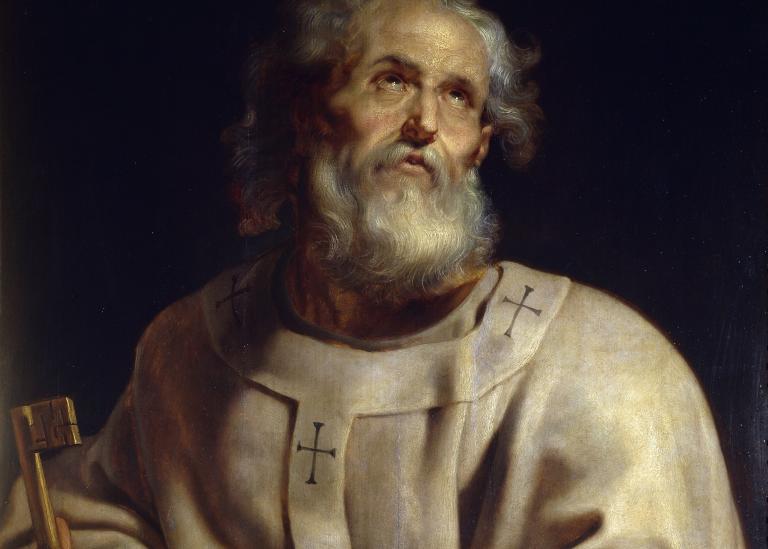
St. Peter, by Peter Paul Rubens, 1610-1612
Every now and then, an anti-Catholic apologist—he need not be Protestant; he could be an atheist, or a Hindu, or an agnostic endocrinologist—will try to discredit the papacy, or the priesthood, or tradition, or Mary gardens, or some other element of the Church, by waving his hand and saying, “We don’t need it.” Thus the false god of Necessity is invoked against what very God of very God wants us to have as a pure and unmerited gift. TurretinFan (known on this blog as Mr. X) is the latest to make this odd claim about the papacy. You can read his blog post here. It is short, so you won’t waste hours of your busy day wading through swamps of rhetoric. War is kind.
Now, Mr. X’s claim rests on two observations. The first of them is that “For a brief time earlier this year, there was no pope.”
Mr. X unleashes this shocker upon us as though it really were news. You would think this was the first time such a sad state of affairs had ever beset a wailing Church. Unless 1 Cor. 9:24 has no discernible meaning, the papacy is supposed to be a relay race with the fisherman’s ring. Sic transit gloria mundi, there was no pope for two long weeks! The gaping wound in the heart of the Church has been horrifically exposed by the Amazing Mr. X of Somewhere, Somewhere!
But let us read on.
During the interregnum, Mr. X pointlessly tells us—when there was no pope, and you could have heard an anxious pin drop, for nothing like it had ever been—camerlengo Tarcisio Bertone, who is also the secretary of state, was in charge of running the Vatican government.
Yes. This is how it works, right? Now, technically, during a sede vacante the camerlengo is the acting head of state of Vatican City; the governance of the Catholic Church, per the norms of Universi Dominici Gregis, is entrusted to the College of Cardinals—“solely for the dispatch of ordinary business and of matters which cannot be postponed, and for the preparation of everything necessary for the election of the new Pope” [UDG 2]. Someone must keep things going during a sede vacante and prepare for a successor. That’s the kind of thing Constitutions spell out. Where’s the shock in this? How is this different from, well, anything in matters of leadership and governance? Heads of organizations, of states, of churches, of businesses, of rotary clubs, of schools, of supermarkets, of wrestling teams, of fraternities and sororities and Friday night bowling leagues and barber shops frequented by Mr. X, come and go. Often there are vacancies at the top. Procedures exist for how to keep things running in the meantime. This is news? This is worth a blog post? This tells us something that will shake us to the core?
Mr. X’s second observation is that, despite this “break” in the “unbroken succession” (which he admits was only a break “of sorts”), “life went on.”
Well jeepers me, you would think the Catholic teaching was that, without a pope, even for one second, all men everywhere will die. A thirteen-day interregnum, during a papal conclave, constitutes a break in succession? The new pope must be in place the second the last pope dies, or resigns, or is suddenly whisked away in a chariot of fire? If not, it makes Catholics everywhere tremble for fear of the Rapture? (We don’t fare well in the Rapture, if you recall.) If not, the papacy has been snuffed like an altar candle after Mass? If not, the keys of the kingdom have been melted down to liquidate the national debt? Since there was a sede vacante for thirteen days, Francis didn’t really succeed Benedict after all; he’s the first pope in a reinvented papacy? Where does Mr. X get this idea? Does he make this stuff up as he goes along? The dust storm that clouds this desperate man’s thinking would make Tom Joad say, “God has blessed us sevenfold.”
And if you think all this is banal, dear reader, you have not read far enough into the post. For look.
Life would have gone on had the cardinals not picked a successor. The bishop of Rome is really not necessary for anyone. People who had questions about the meaning of Scripture found answers. … Any argument for the papacy … needs to come from some other quarter than from necessity.
Well, what does Mr. X think? That when Catholics have a question about the meaning of Scripture, they call the pope on the phone or send him an e-mail? That unless there’s a pope around ready to take the call, they can’t go to a Catholic commentary, or ask their priest? That is not what we think a pope is for. That is a caricature.
What lies beneath all this talk on Mr. X’s part is—bear with me while I explain—the bias of sola scriptura. For a Protestant, the whole point of life as a Christian, after you are saved, is the exegesis of Scripture. Once you are saved, not much else matters but what the Scripture says. So for a Protestant, an infallible pope—if such a thing exists—is pointless unless the pope can give us the definitive exegesis of every verse of Scripture. There would be no other point to a papacy but that. Mere administration can be done by anyone. But Christianity itself lives or dies by exegesis. So if, during a sede vacante, a Catholic can figure out the meaning of some difficult text in Hebrews, it must mean the papacy is unnecessary.
But the very same line of reasoning could be used as an argument against the presidency. There was a break, of sorts, in the “unbroken succession” of the presidency after President Kennedy died but before Vice President Johnson could be sworn in. And life went on. The race did not become extinct at 2:00 EST on November 22, 1963. Walter Cronkite lived. Life would have gone on if a special election needed to be called. (Assuming such was the method provided by the Constitution).
Strictly speaking, of course, the presidency isn’t “necessary,” if you understand the concept of necessity in the strictest, most limited possible sense (without this, we will all stop breathing). The Founders could have set up any form of government they wished. They could have chosen rule by a King, or a committee of Baptist elders, or eleven pipers piping. But the point isn’t what we think we “need,” for strictly speaking there isn’t any single form of government, Church or State, that we “need.” The point, rather, is what the Founders intended to give us.
And strictly speaking, Mr. X is right: The papacy isn’t “necessary”; but the point isn’t what is “necessary,” but what Christ intended for His Church. Whether some of us feel we need that or not is beside the point. Strictly speaking, the Incarnation, the Crucifixion, and the Resurrection weren’t necessary. God could have chosen to redeem us by different means; He could have chosen to redeem us with a simple wave of his hand, and no bloody sacrifice on Calvary. But that’s not what He did choose. The point is what He chooses, not what human beings feel they need.
But if Mr. X really believes that a temporary sede vacante during a papal conclave is an argument against the Catholic claim of an “unbroken succession,” then I submit to you that he is engaging in the kind of sophomoric “cleverness” that might be convincing to—well, sophomores—but which ought to be beneath him.
The pope is the teacher of the whole Church; that much is true. But that doesn’t mean that Catholics must ring him up for every question that pops into their head and would thus be lost during a sede vacante. Commentaries, catechisms, the homilies of priests: These all flow from what the Church has already taught for 2000 years. These are available to any Catholic at any time. Does Mr. X really mean for us to believe that when there’s a sede vacante the slate is wiped clean and the Church has to start over again as if it were 33 A.D.? Bible commentaries are all null and void until there’s a new pope to speak? The Church is lost on the meaning of Luke 22:19? No. It is a weird fallacy to think that, though the pope teaches the whole Church, one must consult with him personally every time he is confused about a text of Scripture. Popes are not meant to function that way.
So then Mr. X makes the opposite fallacy and suggests that, if the pope is not needed to answer Joe Catholic’s question about Psalm 105, the papacy is no more than a temporal, political office.
The Roman Catholic Church couldn’t exist as such without the pope in the long run, because of various administrative tasks that fall to the pope. … But those tasks are not tasks that are really necessary for the bishop of Rome to be doing.
Of course—again—one could say the same thing about any office within the Church. Strictly speaking, anyone can perform its administrative tasks. Why do we need a bishop of Rome? Why do we need an elder of the Phoenix Reformed Baptist Church? What Mr. X would say about elders in the Reformed Church, he overlooks about the pope: It is not merely a temporal office, with particular administrative tasks to be carried out, but a spiritual office that has as its end the care of souls.
The pope’s necessity transcends these two reductive fallacies: sole source for every question of biblical exegesis that comes up, or mere administrative functionary. Christ gives Peter the keys to the kingdom of Heaven. There are historical reasons why the pope also acquired the keys to Vatican City. And, of course, the handling of such things as appointments within the Church is necessary to its being able to function, in the same way that it falls to the president of the United States to appoint cabinet officers and Supreme Court justices. But none of these things are what the papacy is about, which is the care of souls. The pope’s role is to be the supreme teacher of the faith and the supreme shepherd of souls. No one else can fulfill that spiritual mission because the pope alone is who Christ appointed. Christ could have chosen to teach and care for the people of God another way. But he didn’t.
Really, those on the Reformed side need to come up with better arguments. Any argument against the papacy must be made on the basis of what Christ did or did not intend, not on any subjective, earth-bound idea about what’s “necessary.”
***
If you like the content on this blog, your generous gift to the author helps to keep it active. I remember all my supporters in my Mass intentions each week.
Previous Post
April 8, 2013
Is John Bugay's Rejection of Infallibility Infallible?
Next Post
April 11, 2013 St. Francis and Pope Francis: To Teach By Gesture
Browse Our Archives
Select a Category Abortion About Me Answers for Calvinists Answers to Media Fictions Answers to Objections Anti-Catholicism Apologetics Apostolic Succession Atonement Authority of the Church Baptism Benedictines Biblical Exegesis Blogging Book Reviews Books & Writing &c. Calvin's Institutes Capital Punishment Catholic Church Chastity Christology Church Fathers Church Social Doctrine Confession Contraception Conversion Stories Crusades Debates Depression & Suicide Deuterocanon Development of Doctrine Ecumenism English Language Eucharistic Adoration Exorcism Extra Ecclesiam Fisks & Rebuttals Freedom of Religion Freedom of Speech Fundamentalism Gender Politics Gender Theory Good Works Homosexuality Humor Idolatry Immaculate Conception In the News Inquisition ISIS Islam Just for Fun Just War Justification LCWR Limbo Liturgical Abuse Liturgical Year Magisterium Marriage and Family Mary Mortal Sin New Evangelization NFP Papacy Papal Documents Papal Infallibility Personal Narrative Politics Pope Francis Pope Francis Derangement Syndrome Population Control Praying to the "Dead" Priesthood Primacy of Peter Protestant Denominations Purgatory Radical Islam Radical Traditionalists Real Presence Right to Conscience RIght to Life Saints Same-Sex "Marriage" Seven Quick Takes Social Justice Social Media Sola Scriptura Spirit of Vatican II SSPX The Eucharist The Mass The Resurrection Traditionalism Vatican II Year of Mercy
Select a Month August 2019 July 2019 June 2019 May 2019 November 2018 October 2018 August 2018 July 2018 June 2018 April 2018 November 2017 October 2017 September 2017 May 2017 April 2017 March 2017 February 2017 November 2016 October 2016 September 2016 August 2016 July 2016 June 2016 May 2016 April 2016 March 2016 February 2016 January 2016 December 2015 November 2015 October 2015 September 2015 July 2015 June 2015 May 2015 April 2015 March 2015 February 2015 January 2015 December 2014 September 2014 August 2014 July 2014 June 2014 May 2014 April 2014 March 2014 February 2014 January 2014 December 2013 November 2013 October 2013 May 2013 April 2013 February 2013 January 2013
Follow Us!
TAKE THE
Religious Wisdom Quiz
Who prophesied destruction for Jerusalem but also promised a New Covenant?
Select your answer to see how you score.
Joel Ezekiel Jeremiah Isaiah
Related posts from To Give a Defense

Documentation of Taylor Marshall's attacks on Pope Francis...
Does the Mass "banish the remembrance of Christ's...
Pope Says Don't Criticize Pope; FaithfulCatholics™ Weep and...
Does Canon 194 Provide an Opening to Depose...
TRENDING AT PATHEOS Catholic

Rejecting Doom: Christian Hope And Human Action
Christianity is a religion of hope. We are to have hope and...

It’s What Comes From Within Which Matters
One of the most difficult things for us to understand is why...

Why I Choose the Eucharist Over the Sermon
Choose the Eucharist, Not the Sermon What are we supposed to get...

5 Design Elements Found in Spiritually Rooted Homes
Putting Spirituality Into Home Decor Our homes are more than our living...

Credo: A Story of God Told with the...
About 10 years ago, I began to imagine a personal "Credo" that...

The Anatomy of Divine Revelation in Catholic Thought
The claim that God has made Himself known to human beings is...
view all Catholic blogs
Ad-Free & Subscriber Log-In Subscription Support
- About Us
- 2026 Calendar
- Videos
- Podcasts
- Library of World Religions
- Faith In Media Tracker
- Advertise With Us
- Write for Us
- Privacy Policy
- Terms of Service
- Do Not Sell My Data
- Contact Us
- Radiant Digital
- Manage Newsletter Subscriptions
- Unsubscribe From Notifications
- Sitemap
Copyright 2008-2026, Patheos. All rights reserved.
Subscription Support Ad-Free & Subscriber Log-In
Follow Patheos