
BuddhistCatholicContemplativeEvangelicalGeneral ChristianHinduJewishLatter-day SaintMuslimNew VisionsProgressive Christian
Beliefs
- Buddhist
- Catholic
- Contemplative
- Evangelical
- General Christian
- Hindu
- Jewish
- Latter-day Saint
- More Voices
- Muslim
- New Visions
- Pagan
- Progressive Christian
Topics
- Religion News
- Food and Religion
- Sports and Religion
- Religious Art
- Religious Music and Entertainment
- Religious Events
- History and Religion
- Style and Religion
- Politics and Religion
- Women in Religion
- Recreation Outdoors and Religion
- Business Finance and Religion
- Careers Workplace and Religion
- Education and Religion
- Family Parenting and Religion
- Health Fitness and Religion
- Home and Religion
- Relationships and Religion
- Technology and Religion
- Travel and Religion
Columnists
- Buddhist Columnists
- Business Finance and Religion Columnists
- Careers Workplace and Religion Columnists
- Catholic Columnists
- Contemplative Columnists
- Education and Religion Columnists
- Evangelists Columnists
- Family Parenting and Religion Columnists
- General Christian Columnists
- Health Fitness and Religion Columnists
- Hindu Columnists
- History and Religion Columnists
- Home and Religion Columnists
- Jewish Columnists
- More Voices Columnists
- Latter Day Columnists
- Muslim Columnists
- New Visions Columnists
- Nonreligious Columnists
- Pagan Columnists
- Politics and Religion Columnists
- Progressive Columnists
- Recreation Outdoors and Religion Columnists
- Relationships and Religion Columnists
- Religion News Columnists
- Religious Art Columnists
- Religious Events Columnists
- Religious Music and Entertainment Columnists
- Sports and Religion Columnists
- Style and Religion Columnists
- Technology and Religion Columnists
- Travel and Religion Columnists
- Women in Religion Columnists
Resource Library
- 2026 Calendar
- Library of World Religions
- The 100 Most Holy Places on Earth
- Patheos Answers
- Podcasts
- Videos
- Faith Leaders Database
- Anglican Episcopalian
- Bahai
- Baptist
- Buddhism
- Christianity
- Confucianism
- Eastern Orthodoxy
- Hinduism
- Holiness and Pentecostal
- ISKCON
- Islam
- Judaism
- Lutheran
- Methodist
- The Church of Jesus Christ of Latter-day Saints
- New Age
- Paganism
- Presbytarian and Reformed
- Protestantism
- Religion Behind the Scenes
- Roman Catholic
- Scientology
- Shia Islam
- Sikhism
- Sufism
- Sunni Islam
- Taoism
- Zen
- See all religions
Research Tools
 Ad-Free & Subscriber Log-In Subscription Support
Ad-Free & Subscriber Log-In Subscription Support
Follow Patheos 

- Trending:
- Forgiveness
- |
- Marriage
- |
- Consciousness
- |
- Death Penalty
- |
- Election
- |
- Halloween
 To Give a Defense
- Home
- Catholic
- The Fight Between Mardi Gras and Lent
The Fight Between Mardi Gras and Lent
Last updated on: March 10, 2017 at 12:06 am by Scott Eric Alt
The Fight Between Mardi Gras and Lent 2017-03-10T00:06:56-04:00 Scott Eric Alt
Patheos Explore the world's faith through different perspectives on religion and spirituality! Patheos has the views of the prevalent religions and spiritualities of the world.
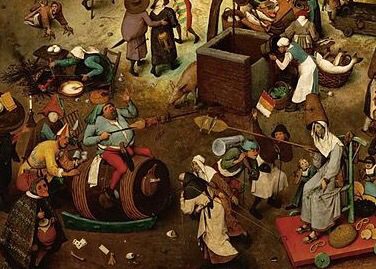
Pieter Bruegel the Elder, “The Fight Between Carnival and Lent,” 1559
If I could be granted one vast and naïve wish, it would be that the pagan world would stop taking our holidays and perverting their meaning.
They do it with Christmas and Easter; they do it with Halloween; God knows they do it with Mardi Gras.
I say: Let them invent their own days, and eat their own cakes, and drink their own ale.
FEASTS ARE BOUGHT WITH FASTS
The word “holiday” is a kind of contraction; it comes from the Old English hæligdæg, or “holy day.” Is this a holiday or a holy day? we ask of some day perverted out of its true meaning; as though they were two, as though we could turn secular a day that is meant to be a reprieve from the secular. Joy and celebration and feasting, rightly understood, are holy: They give us a foretaste of heaven and remind us of our true longing. They tell us of a world to come where every day will be holiday. But we treat holiness as though it were a dour thing, and then call holiday something different.
Thus the division of souls from God begins with the division of words from meaning. Perchance it would help to start pronouncing “holiday” the way we pronounce “holiness.”
Now, what Mardi Gras reminds us is that feasts must be bought with fast; we are still here, and not yet there. Rightly understood, Mardi Gras is the day when families use up all eggs, fats, and butter in the home in preparation for Lent. The idea is, one does not want those materials to spoil and go to waste. That’s not really gluttony; that’s thrift. You get fat, or gras, not for the sake of fatness but to get rid of all that tempts discipline of will.
Mardi Gras does not mean, go, and get all the sin out of your system; which, in the practical reality of pagan culture, gets transformed into, go, and use this day as an excuse for the debauchery you engage in anyway. The day does not mean, do your sin in public today, for tomorrow you will do it in private.
It is right, at the end of seasons of joy and feast (Christmas and Epiphany) to indulge in some last harmless, sinless joy. In Heaven is perpetual joy, not perpetual sin. (They are opposites.) There is no Mardi Gras in Heaven only because there is no Ash Wednesday and no Lent, not because there is no fun. There is joy in heaven because there is no sin.
We have Mardi Gras here because there is sin, and we need Lent; and so it is also the day, in addition to the last feast for forty, when—if you had not yet made a recent confession—you did so. The joy and celebration and feasting on Mardi Gras are always tempered by a spirit of penance. If you may call it such, you may call it a somber feast, and eat your meat with a bitter belly. Tomorrow is Ash Wednesday.
GRAS OR SHRIVEN?
It would be better if we had not relied on the depraved French to name this holiday for us, but instead on the practical English.
The English name for Mardi Gras is Shrovetide. (Not “Fat Tuesday” but “Shrove Tuesday.”) To “shrive” means, either, “to confess,” or, “to absolve.” It is one of those old words which ought to come back into use. (But not so much that it gets corrupted too.)
“Mardi Gras,” as it hath been corrupted by wicked men, signifieth getting oneself gras, not on cakes and ale, but on sin. But “Shrovetide” remindeth the soul of man of the need to be shriven. To shrive and be shriven is to have joy. Later. First one must contemplate the depth of sin, and its cost to God. That should take at least forty days, once a year.
But speaking of words and their meanings, did you know that the word “carnival” comes from the Latin carnis, meaning meat? Carnival is no more than the time when we eat meat as an outward sign of our joy of spirit.
How words get wrenched and twisted and strangled is a source of endless perplexity to me.
A BRUEGEL
But none of this is new under the sun. Here is a painting from 450 years ago, showing the exact same tension between Shrovetide and Lent.
On the left of the painting is an inn; on the right, a church. Near the church are well-behaved children; near the inn, men drunk on beer. Prominent in the front, and just slightly toward the left, a fat man (Carnival) rides a beer barrel with a pork chop attached to the front. On his head he wears a meat pie. Immediately in front of him (and to our right) Christ (Lent) wears a purple robe and a bucket in place of a crown of thorns. In his right hand, Christ extends two pieces of fish.
Which side are you on: the side of the fat man besotted with beer and full with meat; or the side of the wounded Christ about to be crucified and eating a spare meal?
A SATIRE ON PROTESTANTS
In early modern Europe, as part of Shrovetide celebrations, a battle was enacted between two figures, the one representing Carnival, the other Lent: a battle between the flesh (carnis) and the spirit. In part, Brueggel is depicting one such battle.
But some critics also view the painting as a satire on the religious controversies of the day between Protestants and Catholics. Calvinists and Lutherans had abolished the observance of Lent, believing it to contribute to a theology of works (since almsgiving is a traditional part of one’s Lenten discipline). The “Carnival” figures in the painting are Protestants; the “Lent” are Catholics.
Brueggel, in other words, satirizes Protestants for acting as though they can have perpetual Carnival, and no Lent: grace without works, feasting without fasting. Once that theological error creeps in, the sled goes downhill and crashes into the wreck of pagan indulgence.
BETWEEN CARNIVAL AND CONFESSIONAL
In truth it is a false dichotomy, the fight between Mardi Gras and Lent; only in Heaven is there Mardi Gras without Lent, only in Hell Lent without Easter. Here, caught between the two worlds, we must buy feast at the price of fast, and temper joy with sorrow. Between Mardi Gras and Lent, carnival and confessional, neither must have the upper hand.
For myself, as I do this day every year (or I try), I indulge with some steak and baked potato, and finish the last of the beer. And then I pray and prepare for ash and a season of shriving.
***
If you like the content on this blog, your generous gift to the author helps to keep it active. I remember all my supporters in my Mass intentions each week.
Previous Post
February 28, 2014
The Order of These Forty Days: 7QT XVI Seriatim
Next Post
March 6, 2014 Why Latin Mass Onlyists are Destroying the Latin Mass
Browse Our Archives
Select a Category Abortion About Me Answers for Calvinists Answers to Media Fictions Answers to Objections Anti-Catholicism Apologetics Apostolic Succession Atonement Authority of the Church Baptism Benedictines Biblical Exegesis Blogging Book Reviews Books & Writing &c. Calvin's Institutes Capital Punishment Catholic Church Chastity Christology Church Fathers Church Social Doctrine Confession Contraception Conversion Stories Crusades Debates Depression & Suicide Deuterocanon Development of Doctrine Ecumenism English Language Eucharistic Adoration Exorcism Extra Ecclesiam Fisks & Rebuttals Freedom of Religion Freedom of Speech Fundamentalism Gender Politics Gender Theory Good Works Homosexuality Humor Idolatry Immaculate Conception In the News Inquisition ISIS Islam Just for Fun Just War Justification LCWR Limbo Liturgical Abuse Liturgical Year Magisterium Marriage and Family Mary Mortal Sin New Evangelization NFP Papacy Papal Documents Papal Infallibility Personal Narrative Politics Pope Francis Pope Francis Derangement Syndrome Population Control Praying to the "Dead" Priesthood Primacy of Peter Protestant Denominations Purgatory Radical Islam Radical Traditionalists Real Presence Right to Conscience RIght to Life Saints Same-Sex "Marriage" Seven Quick Takes Social Justice Social Media Sola Scriptura Spirit of Vatican II SSPX The Eucharist The Mass The Resurrection Traditionalism Vatican II Year of Mercy
Select a Month August 2019 July 2019 June 2019 May 2019 November 2018 October 2018 August 2018 July 2018 June 2018 April 2018 November 2017 October 2017 September 2017 May 2017 April 2017 March 2017 February 2017 November 2016 October 2016 September 2016 August 2016 July 2016 June 2016 May 2016 April 2016 March 2016 February 2016 January 2016 December 2015 November 2015 October 2015 September 2015 July 2015 June 2015 May 2015 April 2015 March 2015 February 2015 January 2015 December 2014 September 2014 August 2014 July 2014 June 2014 May 2014 April 2014 March 2014 February 2014 January 2014 December 2013 November 2013 October 2013 May 2013 April 2013 February 2013 January 2013
Follow Us!
TAKE THE
Religious Wisdom Quiz
Who said: "If we confess our sins, he is faithful and just and will forgive us our sins"?
Select your answer to see how you score.
Jesus Peter John Paul
Related posts from To Give a Defense
Pentecost: To Woo Back a World's Desire

TRENDING AT PATHEOS Catholic

Rejecting Doom: Christian Hope And Human Action
Christianity is a religion of hope. We are to have hope and...

It’s What Comes From Within Which Matters
One of the most difficult things for us to understand is why...

Why I Choose the Eucharist Over the Sermon
Choose the Eucharist, Not the Sermon What are we supposed to get...

5 Design Elements Found in Spiritually Rooted Homes
Putting Spirituality Into Home Decor Our homes are more than our living...

Credo: A Story of God Told with the...
About 10 years ago, I began to imagine a personal "Credo" that...

The Anatomy of Divine Revelation in Catholic Thought
The claim that God has made Himself known to human beings is...
view all Catholic blogs
Ad-Free & Subscriber Log-In Subscription Support
- About Us
- 2026 Calendar
- Videos
- Podcasts
- Library of World Religions
- Faith In Media Tracker
- Advertise With Us
- Write for Us
- Privacy Policy
- Terms of Service
- Do Not Sell My Data
- Contact Us
- Radiant Digital
- Manage Newsletter Subscriptions
- Unsubscribe From Notifications
- Sitemap
Copyright 2008-2026, Patheos. All rights reserved.
Subscription Support Ad-Free & Subscriber Log-In
Follow Patheos