
BuddhistCatholicContemplativeEvangelicalGeneral ChristianHinduJewishLatter-day SaintMuslimNew VisionsProgressive Christian
Beliefs
- Buddhist
- Catholic
- Contemplative
- Evangelical
- General Christian
- Hindu
- Jewish
- Latter-day Saint
- More Voices
- Muslim
- New Visions
- Pagan
- Progressive Christian
Topics
- Religion News
- Food and Religion
- Sports and Religion
- Religious Art
- Religious Music and Entertainment
- Religious Events
- History and Religion
- Style and Religion
- Politics and Religion
- Women in Religion
- Recreation Outdoors and Religion
- Business Finance and Religion
- Careers Workplace and Religion
- Education and Religion
- Family Parenting and Religion
- Health Fitness and Religion
- Home and Religion
- Relationships and Religion
- Technology and Religion
- Travel and Religion
Columnists
- Buddhist Columnists
- Business Finance and Religion Columnists
- Careers Workplace and Religion Columnists
- Catholic Columnists
- Contemplative Columnists
- Education and Religion Columnists
- Evangelists Columnists
- Family Parenting and Religion Columnists
- General Christian Columnists
- Health Fitness and Religion Columnists
- Hindu Columnists
- History and Religion Columnists
- Home and Religion Columnists
- Jewish Columnists
- More Voices Columnists
- Latter Day Columnists
- Muslim Columnists
- New Visions Columnists
- Nonreligious Columnists
- Pagan Columnists
- Politics and Religion Columnists
- Progressive Columnists
- Recreation Outdoors and Religion Columnists
- Relationships and Religion Columnists
- Religion News Columnists
- Religious Art Columnists
- Religious Events Columnists
- Religious Music and Entertainment Columnists
- Sports and Religion Columnists
- Style and Religion Columnists
- Technology and Religion Columnists
- Travel and Religion Columnists
- Women in Religion Columnists
Resource Library
- 2026 Calendar
- Library of World Religions
- The 100 Most Holy Places on Earth
- Patheos Answers
- Podcasts
- Videos
- Faith Leaders Database
- Anglican Episcopalian
- Bahai
- Baptist
- Buddhism
- Christianity
- Confucianism
- Eastern Orthodoxy
- Hinduism
- Holiness and Pentecostal
- ISKCON
- Islam
- Judaism
- Lutheran
- Methodist
- The Church of Jesus Christ of Latter-day Saints
- New Age
- Paganism
- Presbytarian and Reformed
- Protestantism
- Religion Behind the Scenes
- Roman Catholic
- Scientology
- Shia Islam
- Sikhism
- Sufism
- Sunni Islam
- Taoism
- Zen
- See all religions
Research Tools
 Ad-Free & Subscriber Log-In Subscription Support
Ad-Free & Subscriber Log-In Subscription Support
Follow Patheos 

- Trending:
- Forgiveness
- |
- Marriage
- |
- Consciousness
- |
- Death Penalty
- |
- Election
- |
- Halloween
 To Give a Defense
- Home
- Catholic
- The Best Writing Advice I Ever Got & Other Quick Takes: 7QT III Seriatim
The Best Writing Advice I Ever Got & Other Quick Takes: 7QT III Seriatim
Last updated on: March 9, 2017 at 5:02 pm by Scott Eric Alt
The Best Writing Advice I Ever Got & Other Quick Takes: 7QT III Seriatim 2017-03-09T17:02:04-04:00 Scott Eric Alt
Patheos Explore the world's faith through different perspectives on religion and spirituality! Patheos has the views of the prevalent religions and spiritualities of the world.
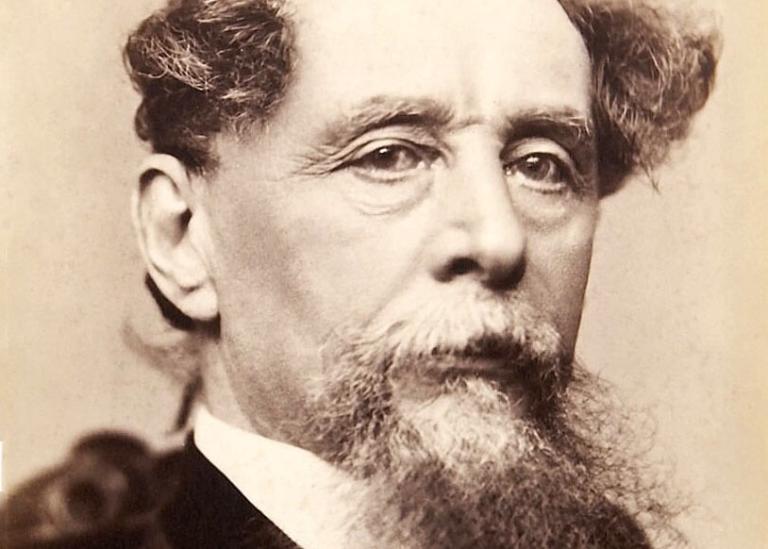
Charles Dickens in 1867 (Jeremiah Gurney, public domain)

A quick explanation about the dearth of posts lately. (At least by my own standards and wishes; perhaps you haven’t noticed.) I have been between jobs since last month and have been using the time to take care of some personal business and long-neglected tasks at home. I start new employment next week, which will be good for my head since I only function well under routine (and coffee measured in the gallons) and have found myself saying: “What day is this? What week is this? What month is this? Is it really almost November? How old am I? How long have I been asleep? Who were you again?” I agree with Flannery O’Connor: “Routine is a condition of survival.” Thus next week I can get myself back on a regular routine, including reading and writing, and that means I should be able to post about 3-4 times a week. The blog will start going in some varying directions, as well—not different directions, just additional ones long promised. So stay tuned, regular readers.
II.
When I was a graduate student, I made a conscious effort to try not to write in an academic style. My first year, I had used all the proper jargon, and all the expected academic logjam of syntax (snooze yawn zzzzz), and only ended up hating everything that I had written. When Sir Walter Scott wrote about Dr. Dryasdust, he knew whereof he spoke. I didn’t want to be Dr. Dryasdust. So I said to myself, “Why are you doing this? Why not write about literature as though you actually do love it and think it matters and ought to be read?” (I remember Joseph Heller’s wonderful line in Catch-22: “He knew everything there was to know about literature except how to enjoy it.”) Only one professor—Dr. George Goodin—understood what I was up to. Everyone else told me I was being overly subjective, but Dr. Goodin said to me, “You’re trying to do something that’s very difficult to do: write literary criticism the way Virginia Woolf and D.H. Lawrence do.” (He might have added G.K. Chesterton! Though actually, I was trying to imitate John Irving’s manner of writing about Charles Dickens.) “It’s easier,” Dr. Goodin said, “to write like professors write. But I hope you keep trying.”
It’s easier to do it that way, but keep trying to do it this way, the hard way: What better advice could there be? Dr. Goodin also told me that he would read anything I gave him, which was wonderful encouragement.
III.
Also at Southern Illinois University, I got some related advice from Dr. Jack Brown—God rest his soul—who taught excellent courses in Shakespeare and Milton. I think I learned more about how to read literature from Dr. Brown and Dr. Goodin than from anyone else. In Milton, Dr. Brown devoted one entire class session to reviewing some English history, as background to the proper understanding of Paradise Lost and Samson Agonistes and The Tenure of Kings and Magistrates and much of the rest of Milton we were going to read.
Many of students were bored with this; I suspect they wanted to complain about how Milton hated women. That’s all anyone did in graduate school in those days. For all I know, that’s all anyone does now. At any rate, after class was over, during office hours, I assured Dr. Brown I knew what he was up to: You can’t understand Milton without understanding English history. He noted that he had always tried, and failed, to have a course in English history be required for graduate students. It is not just Milton; it is hard-going to understand half of English literature without knowing the history. “Well, I’ll just learn it on my own,” I told him.
“And you can learn it on your own!” Dr. Brown told me. “People have this mistaken view that, in order to learn something, you need to take a course in it or get a degree in it. But the sensible thing to do, when you want to learn a subject, is just to read.”
If someone tells you to “Write about what you know,” they’re full of it. My motto is C.S. Lewis’s: “I write for the unlearned about things in which I am unlearned myself.” You don’t have to go out and lay waste to Troy before you can write a war novel. Who are all these people—like Ken Follett—writing historical novels set in the Middle Ages? Do they all have time machines? Do they all have Ph.D.’s in medieval history? No. It’s called research.
Dr. Brown’s soapbox was: Before you read anything else, read Virgil. I never understood why. He also preached what he called “the four essential English writers, plus one of your own choosing.” The four essential writers were Chaucer, Milton, Spenser, and Shakespeare. My fifth was Dickens.
Of course, Dr. Brown was a dinosaur. Which is why he was such a great teacher.
IV.
My mother has always told me that she knew I was going to become a writer when I was in third grade and I wrote a story about being locked in Jimmy Carter’s trash can.
I suspect that this story was a political allegory.
V.
The only thing I know about writing is this: that you have to work hard at writing the kind of stuff you want to write. It does no good, if you want to write 700 page novels, to listen to others tell you that people only read short stories anymore. Don’t listen to them; if you’re not coming up with short stories, you’re not a short story writer, and the quickest way to stop writing is to spend years trying to learn how to write something you don’t have it in you to write in the first place. Write the 700 page novel. Learn how to do that. Read 700 page novels; learn how they work, learn how they’re paced, learn what they sound like, learn how many characters are needed for a 700 page novel, learn how many subplots you need to keep going. If you’re a good writer, readers will find you even if you’ve written 2000 pages. And frankly, any novel by Charles Dickens or Leo Tolstoy reads faster than the three-page pontifications of Dr. Dryasdust. Les Miserables reads faster than a 250-page snoozer by Martin Amis. It’s also better.
Contrariwise, a friend once told me that the reason most of Hemingway’s novels are so lousy is because he was a short story writer trying to write novels. And it’s true; no one can convince me that The Sun Also Rises and A Farewell to Arms are better than “Hills Like White Elephants” and “A Clean, Well-Lighted Place.” I suspect the same is true of Flannery O’Connor, whose two novels don’t measure up to “A Good Man is Hard to Find” and “Good Country People.” But she didn’t live long enough for anyone to know. Faulkner may have just been a freak who could write both great short stories and great novels. But few of us are Faulkner.
Be the best at your kind of writing, not someone else’s. Figure out how you naturally write; then figure out how to be the best at that kind of writing, and not second- or third-best at some other. Your audience is the kind of people who read the kind of stuff you write. Write for that audience, not some different one. Find your audience, not another writer’s.
Apart from that, I don’t know a damn thing.
VI.
When Prof. Linda Hooper of the Dickens Project at UC-Santa Cruz was asked why Charles Dickens was such a great writer, she didn’t try to complicate matters: “One of the reasons why I believe he’s a great writer is because he wasn’t just a novelist. He was an editor, he was a journalist. He wrote letters all the time, he wrote plays, he wrote poems and songs. He’s someone who wrote all the time.”
The novelist John Irving has a different view. “There was a standard of language there,” he says. “Comic language; embellished, enhanced language; very complicated sentences; lots of asides, as if the writer were talking to several sides of his own personality at once, as if everything were parenthetical, set apart by dashes, semicolons galore, colons every four or five lines. None of this one comma, one period, and out Hemingway bullshit.”
The actor Ethan Hawke has a different view. “What I most admire about Charles Dickens is the sheer tenacity of him—how he just writes these stories after stories, and the bigness and the grandness of the stories, and yet he takes his time and all the small details are there.”
They’re all right.
VII.
Someone—I think it was Joseph Heller, but I can’t find the quotation; maybe it was Vonnegut—said that he never wrote anything funny where the comedy was the point. The point was always deadly serious, but he couldn’t approach serious without being unintentionally comic along the way, as though by reflex. I think that’s absolutely right. Dickens would have approved. Dr. Dryasdust would not.
***
If you like the content on this blog, your generous gift to the author helps to keep it active. I remember all my supporters in my Mass intentions each week.
Previous Post
October 21, 2013
Lies and the Lying Liars Who Accuse Others of Them
Next Post

October 28, 2013 The Church Is a Communion of Disciples in Mission
Browse Our Archives
Select a Category Abortion About Me Answers for Calvinists Answers to Media Fictions Answers to Objections Anti-Catholicism Apologetics Apostolic Succession Atonement Authority of the Church Baptism Benedictines Biblical Exegesis Blogging Book Reviews Books & Writing &c. Calvin's Institutes Capital Punishment Catholic Church Chastity Christology Church Fathers Church Social Doctrine Confession Contraception Conversion Stories Crusades Debates Depression & Suicide Deuterocanon Development of Doctrine Ecumenism English Language Eucharistic Adoration Exorcism Extra Ecclesiam Fisks & Rebuttals Freedom of Religion Freedom of Speech Fundamentalism Gender Politics Gender Theory Good Works Homosexuality Humor Idolatry Immaculate Conception In the News Inquisition ISIS Islam Just for Fun Just War Justification LCWR Limbo Liturgical Abuse Liturgical Year Magisterium Marriage and Family Mary Mortal Sin New Evangelization NFP Papacy Papal Documents Papal Infallibility Personal Narrative Politics Pope Francis Pope Francis Derangement Syndrome Population Control Praying to the "Dead" Priesthood Primacy of Peter Protestant Denominations Purgatory Radical Islam Radical Traditionalists Real Presence Right to Conscience RIght to Life Saints Same-Sex "Marriage" Seven Quick Takes Social Justice Social Media Sola Scriptura Spirit of Vatican II SSPX The Eucharist The Mass The Resurrection Traditionalism Vatican II Year of Mercy
Select a Month August 2019 July 2019 June 2019 May 2019 November 2018 October 2018 August 2018 July 2018 June 2018 April 2018 November 2017 October 2017 September 2017 May 2017 April 2017 March 2017 February 2017 November 2016 October 2016 September 2016 August 2016 July 2016 June 2016 May 2016 April 2016 March 2016 February 2016 January 2016 December 2015 November 2015 October 2015 September 2015 July 2015 June 2015 May 2015 April 2015 March 2015 February 2015 January 2015 December 2014 September 2014 August 2014 July 2014 June 2014 May 2014 April 2014 March 2014 February 2014 January 2014 December 2013 November 2013 October 2013 May 2013 April 2013 February 2013 January 2013
Follow Us!
TAKE THE
Religious Wisdom Quiz
Which disciple is known as 'the Twin'?
Select your answer to see how you score.
Philip Andrew Thomas James
Related posts from To Give a Defense

Is Premarital Kissing a Sin? and Other Quick...

Seven Reasons to Vote for Donald Trump. 7QT...

No, Virginia, Blogs are Not the Magisterium. 7QT...

TRENDING AT PATHEOS Catholic

Rejecting Doom: Christian Hope And Human Action
Christianity is a religion of hope. We are to have hope and...

It’s What Comes From Within Which Matters
One of the most difficult things for us to understand is why...

Why I Choose the Eucharist Over the Sermon
Choose the Eucharist, Not the Sermon What are we supposed to get...

5 Design Elements Found in Spiritually Rooted Homes
Putting Spirituality Into Home Decor Our homes are more than our living...

Credo: A Story of God Told with the...
About 10 years ago, I began to imagine a personal "Credo" that...

The Anatomy of Divine Revelation in Catholic Thought
The claim that God has made Himself known to human beings is...
view all Catholic blogs
Ad-Free & Subscriber Log-In Subscription Support
- About Us
- 2026 Calendar
- Videos
- Podcasts
- Library of World Religions
- Faith In Media Tracker
- Advertise With Us
- Write for Us
- Privacy Policy
- Terms of Service
- Do Not Sell My Data
- Contact Us
- Radiant Digital
- Manage Newsletter Subscriptions
- Unsubscribe From Notifications
- Sitemap
Copyright 2008-2026, Patheos. All rights reserved.
Subscription Support Ad-Free & Subscriber Log-In
Follow Patheos