
BuddhistCatholicContemplativeEvangelicalGeneral ChristianHinduJewishLatter-day SaintMuslimNew VisionsProgressive Christian
Beliefs
- Buddhist
- Catholic
- Contemplative
- Evangelical
- General Christian
- Hindu
- Jewish
- Latter-day Saint
- More Voices
- Muslim
- New Visions
- Pagan
- Progressive Christian
Topics
- Religion News
- Food and Religion
- Sports and Religion
- Religious Art
- Religious Music and Entertainment
- Religious Events
- History and Religion
- Style and Religion
- Politics and Religion
- Women in Religion
- Recreation Outdoors and Religion
- Business Finance and Religion
- Careers Workplace and Religion
- Education and Religion
- Family Parenting and Religion
- Health Fitness and Religion
- Home and Religion
- Relationships and Religion
- Technology and Religion
- Travel and Religion
Columnists
- Buddhist Columnists
- Business Finance and Religion Columnists
- Careers Workplace and Religion Columnists
- Catholic Columnists
- Contemplative Columnists
- Education and Religion Columnists
- Evangelists Columnists
- Family Parenting and Religion Columnists
- General Christian Columnists
- Health Fitness and Religion Columnists
- Hindu Columnists
- History and Religion Columnists
- Home and Religion Columnists
- Jewish Columnists
- More Voices Columnists
- Latter Day Columnists
- Muslim Columnists
- New Visions Columnists
- Nonreligious Columnists
- Pagan Columnists
- Politics and Religion Columnists
- Progressive Columnists
- Recreation Outdoors and Religion Columnists
- Relationships and Religion Columnists
- Religion News Columnists
- Religious Art Columnists
- Religious Events Columnists
- Religious Music and Entertainment Columnists
- Sports and Religion Columnists
- Style and Religion Columnists
- Technology and Religion Columnists
- Travel and Religion Columnists
- Women in Religion Columnists
Resource Library
- 2026 Calendar
- Library of World Religions
- The 100 Most Holy Places on Earth
- Patheos Answers
- Podcasts
- Videos
- Faith Leaders Database
- Anglican Episcopalian
- Bahai
- Baptist
- Buddhism
- Christianity
- Confucianism
- Eastern Orthodoxy
- Hinduism
- Holiness and Pentecostal
- ISKCON
- Islam
- Judaism
- Lutheran
- Methodist
- The Church of Jesus Christ of Latter-day Saints
- New Age
- Paganism
- Presbytarian and Reformed
- Protestantism
- Religion Behind the Scenes
- Roman Catholic
- Scientology
- Shia Islam
- Sikhism
- Sufism
- Sunni Islam
- Taoism
- Zen
- See all religions
Research Tools
 Ad-Free & Subscriber Log-In Subscription Support
Ad-Free & Subscriber Log-In Subscription Support
Follow Patheos 

- Trending:
- Forgiveness
- |
- Marriage
- |
- Consciousness
- |
- Death Penalty
- |
- Election
- |
- Halloween
 To Give a Defense
- Home
- Catholic
- The Apostles Are Also Theopneustos
The Apostles Are Also Theopneustos
Last updated on: March 13, 2017 at 11:11 pm by Scott Eric Alt
The Apostles Are Also Theopneustos 2017-03-13T23:11:23-04:00 Scott Eric Alt
Patheos Explore the world's faith through different perspectives on religion and spirituality! Patheos has the views of the prevalent religions and spiritualities of the world.
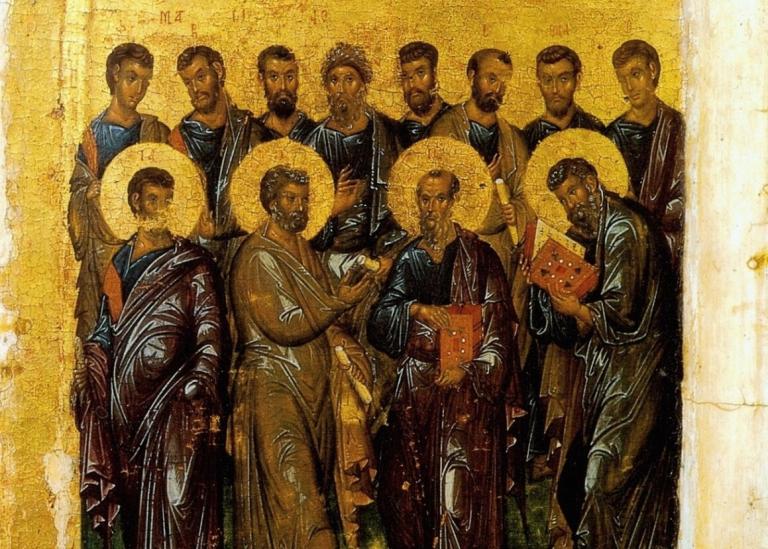
The Synaxis of the Twelve Apostles (public domain)

Note: Since this post was written, I have shut down comments from the site.
In the combox on this post, a reader named Rooney dares to dispute my claim that the Greek word theopneustos (θεóπνευστος; from 2 Tim. 3:16) applies as much to John 20:21-23. My point, from an earlier comment in the same thread, was that Dr.* James White (Th.D., D.Min., etc., etc.), of Alpha & Omega Sophistries (he calls it “Ministries”) is wrong to say that the Scriptures alone are “God-breathed.” He may say it until he runs out of breath—for that seems to be his goal—but he will still be wrong. As evidence, I quoted this singular passage from John, wherein Christ appears to the disciples after the Resurrection and breathes on them.
Then said Jesus to them again, Peace be unto you: as my Father hath sent me, even so send I you. And when he had said this, he breathed (ἐνεφύσησεν) on them, and saith unto them, Receive ye the Holy Ghost (πνεῦμα). Whose soever sins ye remit, they are remitted unto them; and whose soever sins ye retain, they are retained.
If Christ is God (and I doubt even Dr.* White is so bold as to deny the divinity of Christ), and if Christ breathes on the apostles, then the apostles are also θεóπνευστος.
i.
But Rooney thinks he can exegete this text in a way consistent with the mutterings of Dr.* White. Writes Rooney:
Maybe Christ breathed on the apostles the content of the gospel—
[No. Let me stop the man here. The Greek word for “gospel” is evangelion (εὐαγγέλιον), a different word than pneuma (πνεῦμα), which is what Christ actually breathed on them.]
—which they later wrote down as scripture or proclaimed by mouth, though the content of the oral stuff would be similar to that written down. Anything not written down, would be mere speculation.
Well, okay. One is amused by the complaint about “mere speculation” at the end of a passage that begins with the word “maybe.” But letting go that odd fit of sleep on his part, Rooney’s own “mere speculation” goes wrong on several accounts. The first is that the passage has nothing to do with Christ sending the apostles out to write Scripture. He is sending them out, rather, to forgive sins (ἀφῆτε). Verse 23 makes that plain. Christ says, “Those whose sins you forgive are forgiven”; He does not say, “Those books you write are alone infallible.”
A second problem with Rooney’s exegesis is that Christ breathes on all the apostles without exception, and yet only some of the them went on to write the New Testament. Where’s the Gospel According to Nathanael? Where are the general epistles of Simon the Zealot? What shirkers they were! St. Paul, by far, wrote the majority of the New Testament, and yet there’s no account of Christ breathing on him. (Nor on Luke, for that matter, who was known for stealing the wind right out of Andrew.) Turn to Acts 9:3-9, where Luke tells us about Paul’s surprise appointment with Jesus on the road to Damascus. You’ll find references to light (φῶς, phos) and a voice (φωνὴν, phonen)—but not a word about breath (πνεῦμα, pneuma).
ii.
Yet a third problem is that Christ prefaces this encounter with the apostles by saying, “As my Father hath sent me, even so send I you.” The apostles are being given the same commission that God the Father gave to Christ. But that was not to write infallible Scripture; so for Him to say to the apostles “as I so you”—Rooney’s exegesis is correct—would rather muddy the issue than otherwise. The fact remains: If Christ is God, and if Christ breathes on the apostles, then the apostles are also θεóπνευστος. Will Rooney deny the divinity of Christ? Will Dr.* White (Th.D., D.Min., etc., etc.)? Are they yet that bold? 2 Tim. 3:16 applies the word to “all” Scripture (πᾶσα, pasa)—not to “only” Scripture (μόνον, monon); thus the good Dr.* White’s exegesis relies on a misquotation of Paul. Paul says πᾶσα and he reads μόνον. Age does tricky things with the eyes; Dr.* White (Th.D., D.Min., etc., etc.) may want to see another doctor—preferably one whose optometry degree was not sent by mail.
In John 20, when Christ breathes on the apostles, He says to them, “Receive the Holy Spirit.” Now, you may ask at this point: Is there anywhere else, look through all of Sacred Scripture, where Christ speaks about the apostles receiving the Holy Spirit? Peradventure by looking at such related texts, as the WCF tells us we ought, we may be clear as to what is thereby conferred upon them. And glad I am you did ask, for in fact there is—the key text being John 16:12-14. Christ, speaking again to his disciples, prior to his arrest in Gesthemane, says:
I have yet many things to say unto you, but ye cannot bear them now. Howbeit when he, the Spirit of truth [πνεῦμα τῆς ἀληθείας] is come, he will guide you into all truth: for he shall not speak of himself; but whatsoever he shall hear, that shall he speak: and he will shew you things to come. He shall glorify me: for he shall receive of mine, and shall shew it unto you.
So when Christ speaks to his disciples about receiving the Holy Spirit, it is in the context of them being “guide[d] … into all truth.” The apostles will be able to discern all the truth, not because there is anything uniquely special about them as opposed to the rest of humanity, but only by the working of the Holy Spirit within them. It is a charism, not a characteristic.
In still one more passage, we read about the descent of the Holy Spirit upon the apostles on Pentecost. And here too make note of the reference to the breath of God; though, in this text, St. Luke describes it in the form of a simile.
And suddenly there came a sound from heaven as of a rushing mighty wind [πνοῆς], and it filled all the house where they were sitting. And there appeared unto them cloven tongues like as of fire, and it sat upon each of them. And they were all filled with the Holy Ghost, and began to speak with other tongues, as the Spirit gave them utterance. (Acts 2:2-4)
Here the Holy Spirit goes beyond giving the apostles the charism of infallibility; he gives them the additional gift of tongues: being able to teach the Gospel in people’s native language. That is not an insignificant charism to have if the purpose is to spread Christianity to as many people as possible as quickly as possible.
iii.
Dr.* White and I would agree that the sense of the word θεóπνευστος has to do with infallibility. Where we disagree is in its application. He—all Reformed apologists and theologians, in fact—apply it to Scripture alone; I—all Catholic apologists and theologians, in fact—apply it also to the Church. The difference lies in our view of apostolic succession. For Dr.* White, it is all well and good to say that the apostles were gifted with the authority to write and teach infallibly. He would not dispute that. But for him, the fact that revelation ended after the death of the last apostle means that the charism of infallibility does not continue by way of apostolic succession; not even if it be in merely an interpretive and exegetical capacity, not even if it is only to define and safeguard the deposit of faith. It is on this question that the Protestant and the Catholic part ways.
According to the Catholic Church, the charism of infallibility (in the context of the authority to teach the whole Church) is passed on to the successors of the apostles, through the laying on of hands, and is present in the pope and the bishops of the Church who teach in union with him. Here is how the Catechism of the Catholic Church puts it, in the section entitled “The Transmission of Divine Revelation” (§74-79):
Christ the Lord, in whom the entire Revelation of the most high God is summed up, commanded the apostles to preach the Gospel, which had been promised beforehand by the prophets, and which he fulfilled in his own person and promulgated with his own lips. In preaching the Gospel, they were to communicate the gifts of God to all men. This Gospel was to be the source of all saving truth and moral discipline. In keeping with the Lord’s command, the Gospel was handed on [both orally and in writing]. … “In order that the full and living Gospel might always be preserved in the Church the apostles left bishops as their successors. They gave them ‘their own position of teaching authority.'” Indeed, “the apostolic preaching, which is expressed in a special way in the inspired books, was to be preserved in a continuous line of succession until the end of time.” … The Father’s self-communication made through his Word in the Holy Spirit, remains present and active in the Church.
One will note, if one but reads the New Testament—and I doubt it nothing that both Rooney and Dr.* White (Th.D., D.Min., etc., etc.) have read every last infallible text in that reliable rock of a resource—that the laying on of hands (epithentes tas cheiras, ἐπιθέντες τὰς χεῖρας) was central to receiving a Church commission. In the Book of Acts, Saul and Barnabas receive theirs this way (Acts 13:3). And St. Paul, later, refers to Timothy’s apostolic gifts, which he received “when the elders laid their hands upon [him]” (1 Tim. 4:14; same expression, epitheseos ton cheiron). The laying on of hands was standard practice, and thus—as with St. Timothy—when the apostles’ successors had hands laid upon them, not only was authority passed on to them, but charism as well. (Note how the English word charism is closely related to the Greek word for “hands” in Acts 13:3 and 1 Timothy 4:14: cheiras.)
iv.
Now, that this was how the earliest Christians understood it, we know from several early Church writings. One of these is Irenaeus’s Against Heresies.
Wherefore it is incumbent to obey the presbyters [i.e., the priests] who are in the Church—those who, as I have shown, possess the succession from the apostles; those who, together with the succession of the episcopate, have received the certain gift of truth, according to the good pleasure of the Father. But [it is also incumbent] [N.B.] to hold in suspicion others who depart from the primitive succession, and assemble themselves together in any place whatsoever, [looking upon them] either as heretics of perverse minds, or as schismatics puffed up and self-pleasing. (IV.26)
In the view of Irenaeus—writing against the Gnostic heresy around the year 180 A.D. (well after the death of the last apostle)—not only was apostolic succession a reality, but so too was the charism of infallibility within their successors. “The certain gift of truth,” he calls it. More than that, Irenaeus has very strong words for those who would deny or depart from the authority of the bishops; he calls them “heretics,” “perverse minds,” and “schismatics” who are “puffed up and self-pleasing.” This does not sound good for the good Dr.* White (Th.D., D.Min., etc., etc.)
But Irenaeus is far from being alone in all this. St. Cyprian of Carthage, writing in the third century, speaks similar words, this time in reference to the primacy of Peter.
The Lord speaks to Peter [N.B., not to Peter “and the others.”] saying, “I say unto you, that you are Peter; and upon this rock I will build my Church, and the gates of hell shall not prevail against it. And I will give unto you the keys of the kingdom of heaven; and whatsoever you shall bind on earth shall be bound also in heaven, and whatsoever you shall loose on earth shall be loosed in heaven.” And again to the same [i.e., Peter alone.] He says, after His resurrection, “Feed my sheep.” And although to all the apostles, after His resurrection, He gives an equal power, and says, “As the Father has sent me, even so send I you: Receive the Holy Ghost: Whose soever sins you retain, they shall be retained”; yet, that He might set forth unity, He arranged by His authority the origin of that unity, as beginning from one. [i.e., Peter.] (On the Unity of the Church 4)
“That he might set forth unity,” Christ established, not sola scriptura, but apostolic succession. Cyprian reads not just John 20:22 in the light of apostolic succession, but Matt. 16:18 too. Reformed apologists, in fact, have an impossible task trying to find any Church Father at all from these first centuries who reads Matt. 16:18 the way they do. (Name one, Dr.* White.) Cyprian exegetes these passages the same way the Catholic Church does: in the light of the charism of infallibility, apostolic succession, and the unity of the Church.
But one could multiply examples with ease. Here, is Clement I, around A.D. 80:
Through countryside and city [the apostles] preached, and they appointed their earliest converts, testing them by the Spirit, to be the bishops and deacons of future believers. Nor was this a novelty, for bishops and deacons had been written about a long time earlier. … Our apostles knew through our Lord Jesus Christ that there would be strife for the office of bishop. For this reason, therefore, having received perfect foreknowledge, they appointed those who have already been mentioned and afterwards added the further provision that, if they should die, other approved men should succeed to their ministry. (Letter to the Corinthians 42:4–5; 44:1–3)
Because they knew there would be strife, they gave us—not sola scriptura, but teaching bishops in perpetuity.
And—I’ll give but one more—here is Tertullian, writing around the year 200 A.D., and pointing out, once more, that it is not merely authority that is passed on through apostolic succession but purity of doctrine as well.
But should [these heretics] even effect the contrivance [of composing a succession list for themselves], they will not advance a step. For their very doctrine, after comparison with that of the apostles [as contained in other churches], will declare, by its own diversity and contrariety, that it had for its author neither an apostle nor an apostolic man; because, as the apostles would never have taught things which were self-contradictory. (Against the Heretics 32)
If one puts all such evidence as this together, he would need invention to deny: (1) that the charism of infallibility was passed on to the apostles through the breath of Christ; (2) that the early Church understood that this charism continued, after Christ, through apostolic succession and the laying on of hands; (3) that the early Church likewise taught that the apostles’ successors were owed obedience for that reason. To part from them was to be—in Irenaeus’ words—a heretic and a schismatic.
It is not “Scripture alone”; but the apostles, and their present-day successors, are also θεóπνευστος.
***
If you like the content on this blog, your generous gift to the author helps to keep it active. I remember all my supporters in my Mass intentions each week.
Previous Post
January 27, 2013
Septuagesima: What Have I Withheld?
Next Post
February 3, 2013 Sexagesima: An Examination of Conscience
Browse Our Archives
Select a Category Abortion About Me Answers for Calvinists Answers to Media Fictions Answers to Objections Anti-Catholicism Apologetics Apostolic Succession Atonement Authority of the Church Baptism Benedictines Biblical Exegesis Blogging Book Reviews Books & Writing &c. Calvin's Institutes Capital Punishment Catholic Church Chastity Christology Church Fathers Church Social Doctrine Confession Contraception Conversion Stories Crusades Debates Depression & Suicide Deuterocanon Development of Doctrine Ecumenism English Language Eucharistic Adoration Exorcism Extra Ecclesiam Fisks & Rebuttals Freedom of Religion Freedom of Speech Fundamentalism Gender Politics Gender Theory Good Works Homosexuality Humor Idolatry Immaculate Conception In the News Inquisition ISIS Islam Just for Fun Just War Justification LCWR Limbo Liturgical Abuse Liturgical Year Magisterium Marriage and Family Mary Mortal Sin New Evangelization NFP Papacy Papal Documents Papal Infallibility Personal Narrative Politics Pope Francis Pope Francis Derangement Syndrome Population Control Praying to the "Dead" Priesthood Primacy of Peter Protestant Denominations Purgatory Radical Islam Radical Traditionalists Real Presence Right to Conscience RIght to Life Saints Same-Sex "Marriage" Seven Quick Takes Social Justice Social Media Sola Scriptura Spirit of Vatican II SSPX The Eucharist The Mass The Resurrection Traditionalism Vatican II Year of Mercy
Select a Month August 2019 July 2019 June 2019 May 2019 November 2018 October 2018 August 2018 July 2018 June 2018 April 2018 November 2017 October 2017 September 2017 May 2017 April 2017 March 2017 February 2017 November 2016 October 2016 September 2016 August 2016 July 2016 June 2016 May 2016 April 2016 March 2016 February 2016 January 2016 December 2015 November 2015 October 2015 September 2015 July 2015 June 2015 May 2015 April 2015 March 2015 February 2015 January 2015 December 2014 September 2014 August 2014 July 2014 June 2014 May 2014 April 2014 March 2014 February 2014 January 2014 December 2013 November 2013 October 2013 May 2013 April 2013 February 2013 January 2013
Follow Us!
TAKE THE
Religious Wisdom Quiz
According to Romans, how does faith come?
Select your answer to see how you score.
By hearing the word From the Holy Spirit By reading Scripture Through prayer
Related posts from To Give a Defense
Does the Mass "banish the remembrance of Christ's...

Pope Francis Derangement Syndrome Vol. XX: Death Penalty...
Yes, Virginia, The Catechism is a Magisterial Document

"Ultramontanism" and a Supposed Conflict Between Pope Francis...
TRENDING AT PATHEOS Catholic

Rejecting Doom: Christian Hope And Human Action
Christianity is a religion of hope. We are to have hope and...

It’s What Comes From Within Which Matters
One of the most difficult things for us to understand is why...

Why I Choose the Eucharist Over the Sermon
Choose the Eucharist, Not the Sermon What are we supposed to get...

5 Design Elements Found in Spiritually Rooted Homes
Putting Spirituality Into Home Decor Our homes are more than our living...

Credo: A Story of God Told with the...
About 10 years ago, I began to imagine a personal "Credo" that...

The Anatomy of Divine Revelation in Catholic Thought
The claim that God has made Himself known to human beings is...
view all Catholic blogs
Ad-Free & Subscriber Log-In Subscription Support
- About Us
- 2026 Calendar
- Videos
- Podcasts
- Library of World Religions
- Faith In Media Tracker
- Advertise With Us
- Write for Us
- Privacy Policy
- Terms of Service
- Do Not Sell My Data
- Contact Us
- Radiant Digital
- Manage Newsletter Subscriptions
- Unsubscribe From Notifications
- Sitemap
Copyright 2008-2026, Patheos. All rights reserved.
Subscription Support Ad-Free & Subscriber Log-In
Follow Patheos