
BuddhistCatholicContemplativeEvangelicalGeneral ChristianHinduJewishLatter-day SaintMuslimNew VisionsProgressive Christian
Beliefs
- Buddhist
- Catholic
- Contemplative
- Evangelical
- General Christian
- Hindu
- Jewish
- Latter-day Saint
- More Voices
- Muslim
- New Visions
- Pagan
- Progressive Christian
Topics
- Religion News
- Food and Religion
- Sports and Religion
- Religious Art
- Religious Music and Entertainment
- Religious Events
- History and Religion
- Style and Religion
- Politics and Religion
- Women in Religion
- Recreation Outdoors and Religion
- Business Finance and Religion
- Careers Workplace and Religion
- Education and Religion
- Family Parenting and Religion
- Health Fitness and Religion
- Home and Religion
- Relationships and Religion
- Technology and Religion
- Travel and Religion
Columnists
- Buddhist Columnists
- Business Finance and Religion Columnists
- Careers Workplace and Religion Columnists
- Catholic Columnists
- Contemplative Columnists
- Education and Religion Columnists
- Evangelists Columnists
- Family Parenting and Religion Columnists
- General Christian Columnists
- Health Fitness and Religion Columnists
- Hindu Columnists
- History and Religion Columnists
- Home and Religion Columnists
- Jewish Columnists
- More Voices Columnists
- Latter Day Columnists
- Muslim Columnists
- New Visions Columnists
- Nonreligious Columnists
- Pagan Columnists
- Politics and Religion Columnists
- Progressive Columnists
- Recreation Outdoors and Religion Columnists
- Relationships and Religion Columnists
- Religion News Columnists
- Religious Art Columnists
- Religious Events Columnists
- Religious Music and Entertainment Columnists
- Sports and Religion Columnists
- Style and Religion Columnists
- Technology and Religion Columnists
- Travel and Religion Columnists
- Women in Religion Columnists
Resource Library
- 2026 Calendar
- Library of World Religions
- The 100 Most Holy Places on Earth
- Patheos Answers
- Podcasts
- Videos
- Faith Leaders Database
- Anglican Episcopalian
- Bahai
- Baptist
- Buddhism
- Christianity
- Confucianism
- Eastern Orthodoxy
- Hinduism
- Holiness and Pentecostal
- ISKCON
- Islam
- Judaism
- Lutheran
- Methodist
- The Church of Jesus Christ of Latter-day Saints
- New Age
- Paganism
- Presbytarian and Reformed
- Protestantism
- Religion Behind the Scenes
- Roman Catholic
- Scientology
- Shia Islam
- Sikhism
- Sufism
- Sunni Islam
- Taoism
- Zen
- See all religions
Research Tools
 Ad-Free & Subscriber Log-In Subscription Support
Ad-Free & Subscriber Log-In Subscription Support
Follow Patheos 

- Trending:
- Forgiveness
- |
- Marriage
- |
- Consciousness
- |
- Death Penalty
- |
- Election
- |
- Halloween
 To Give a Defense
- Home
- Catholic
- That Life Exists and Identity: Thoughts on Robin Williams & Depression
That Life Exists and Identity: Thoughts on Robin Williams & Depression
Last updated on: March 9, 2017 at 1:31 am by Scott Eric Alt
That Life Exists and Identity: Thoughts on Robin Williams & Depression 2017-03-09T01:31:50-04:00 Scott Eric Alt
Patheos Explore the world's faith through different perspectives on religion and spirituality! Patheos has the views of the prevalent religions and spiritualities of the world.
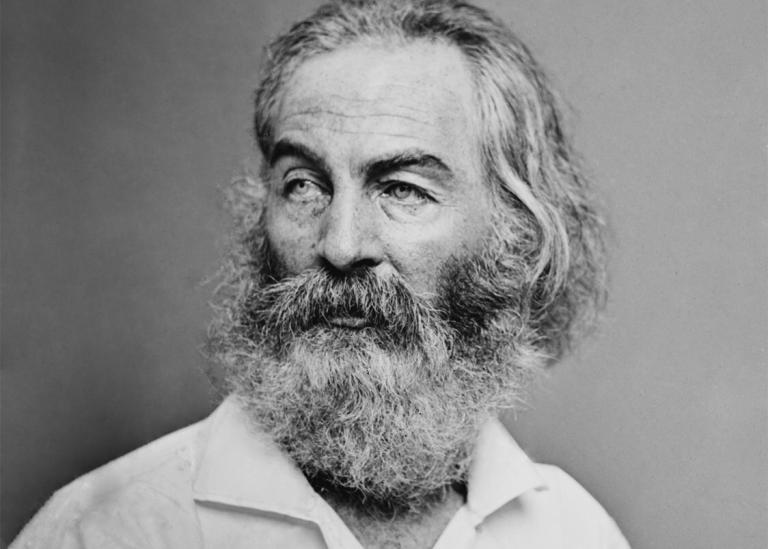
Walt Whitman, photographed by Matthew Brady
I went into the woods because I wished to live deliberately. … I wanted to live deep and suck out all the marrow of life … to put to rout all that was not life … and not, when I had come to die, discover that I had not lived.” — Henry David Thoreau
When Dead Poets Society first came out, I was in college and struggling as a political science major. (I marvel at that still today—not my struggle, but my choice of majors.) I got mainly C’s. I saw Dead Poets at a time when a summer job answering data requests in a large computer room left me with a lot of time to read; and what I was reading, that summer, was Dickens, Hugo, Hardy, Cervantes. Robin Williams cast a spell on me in his role as an inspiring English teacher who taught his students to follow their passion, to always look at things in another way, and that “words and ideas can change the world.” As I saw the young boys of Welton Academy run off at night, into the woods, to read from Thoreau, Keats, Tennyson (and even a comical rendition of Vachel Lindsay), an encounter with literature seemed very romantic to me. It seemed to satisfy a longing: which, I guess, is what the movie was trying to do. It spoke profoundly to a shy young teenager who was soon to turn 20. That fall, I changed my major to English. Finally I began to get A’s, and I decided I was going to be a writer.
THE SLIMY MUD OF WORDS
A quarter century later Robin Williams killed himself and suddenly all words became inadequate. It has left all the commentators utterly without anything original to say. So we marvel at how someone who had so much talent and wealth was so empty inside; as if we shouldn’t have learned long ago that these things do not make people happy, nor do they have the power to keep depression at bay.
Or, we argue about whether Mr. Williams’ suicide was the result of disease or choice; to what extent depression took away his free will; and whether the Church teaches that someone who commits suicide automatically goes to Hell.
And yes, some of that is important to talk about. But when we do, we bump up less against answers than against mystery and our own profound incertitude. Those sure are not comforting, least of all to our feeling that we should know what to say. (Or, still worse, our feeling that we should say something, anything, rather than just sit and weep and pray.)
We want to put off facing discomfort and the appalling horror that renders us mute. So we make pointless statements about political liberalism and whether or not media coverage of the suicide reveals a leftist worldview. We wrap ourselves in End Times paranoia and write dumb blog articles to say that Mr. Williams was possessed by demons. (The fact that this article comes from an anti-Catholic, King James Only Web site, and yet was linked with easy credulity by several Catholics on Facebook, has me particularly worried.) We scheme to be sure our headlines, when writing about it, will improve our SEO ratings. We live, at bottom, in a media culture in which everything—even something as profoundly dark and unsettling as suicide—is fodder for instant commentary and analysis. But it is when we are confronted with something so wildly beyond our ability to understand, such as this, that we resort to clichés and dumbness.
We are rendered helpless. There is so much we do not know. There is so much we can not say. Yet still, the culture of instant commentary tells us that surely, at this time, of all times, we have a duty to say something. We must go live, now, with analysis. We must post to our blogs, now. As though we have the words that will turn it all to sense. And a week, or two, later, we’ve talked ourselves hoarse. We’ve blogged ourselves clean out of words. We’ve explained what it all means. We’ve put it in a jar, labeled it “suicide: blogged about,” and moved on.
And many people, just like Robin Williams, are still stumped and empty. We have spoken many words and said very little.
I FELT A FUNERAL IN MY BRAIN
In his book The Noonday Demon
The birth and death that constitute depression occur at once. I returned, not long ago, to a wood in which I had played as a child and saw an oak, a hundred years dignified, in whose shade I used to play with my brother. In twenty years, a huge vine had attached itself to this confident tree and had nearly smothered it. It was hard to say where the tree left off and the vine began. The vine had twisted itself so entirely around the scaffolding of tree branches that its leaves seemed from a distance to be the leaves of the tree; only up close could you see how few living oak branches were left, and how a few desperate little budding sticks of oak stuck like a row of thumbs up the massive trunk, their leaves continuing to photosynthesize in the ignorant way of mechanical biology.
It is a powerful image, of an illness so strong and gripping that it wraps itself around you and chokes your life and being away. It robs you of self, of identity.
And though it does so, depression remains as individual as its sufferer. It has not felt like choking vines to me.
It has felt like four grey, stone walls, moving in closer, with no window, no door of escape.
It has felt like constant hurt, without specific pain, and a sluggish, and a halt, and crippled step.
It has felt like a deep and wounded, sick, and nauseous dread of two seconds from now.
It has felt like I of all people am left on Earth, and yet constantly pressed in, airless, by a roiling crowd. It has felt like being trapped in four tight walls of noise without cease.
Like losing a child, you do not understand it unless it comes to you. And then you weep astonished (as another writer has put it) “that life could include such suffering, or that you personally could have been permitted such pain.”
Still, those who have been through it, and written about it, and found the words after dark and silent struggle, tell us that the noonday demon can in fact be exorcised. Here is William Styron, in Darkness Visible:
If our lives had no other configuration but this, we should want, and perhaps deserve, to perish; if depression had no termination, then suicide would, indeed, be the only remedy. But one need not sound the false or inspirational note to stress the truth that depression is not the soul’s annihilation; men and women who have recovered from the disease—and they are countless—bear witness to what is probably its only saving grace: it is conquerable. …
There, whoever has been restored to health has almost always been restored to the capacity for serenity and joy.
If we may not understand such pain, there is prayer. For even saints have suffered depression, and have known the appalling silence of God, before liberation, and His embrace.
BREAK, BLOW, BURN, AND MAKE ME NEW
In graduate school, when suffering through my first (and gratefully very short-lived) episode of depression, I was appalled to learn how many writers suffer from it; and more than that, that they use their writing as a way of staying above the pain. Is that what awaited me and my words?
Charles Dickens had a desperately poor and miserable childhood. His father was imprisoned for debt; and, to keep the family going, young Charles went to work in a rat-infested shoe polish factory, placing labels on bottles, for twelve hours a day. He spent the rest of his life trying to write the pain of those years out of himself.
This professor, who told us all these happy things, said that Dickens’s well-known hyperactivity, and exuberant comedy, were also methods of staying above the pain. He noted, at the time, that Robin Williams suffered from depression. (“Good Will Hunting” had just come out.)
Patrick Coffin, movie buff and host of Catholic Answers Live, notes that Mr. Williams was often attracted to the role of a “wounded healer.” Think Awakenings. Think Good Will Hunting. Think The Fisher King. He sought healing through art, and in the roles he chose.
In that way, his art, and his comedy, became a way—not so much of “staying above” the pain, but of meeting it and transforming it.
I like that idea of what words and art can be for; of what they have the power to do. I’m sorry that was not enough to save him, in the end. I wish it had been. His great comedy and art surely have transformed us. They have acquainted us with life, and with laughter, and the powerful play.
AT LENGTH RENEW THEIR SMILE
In Dead Poets Society, John Keating, played by Mr. Williams, reads to his students this poem by Walt Whitman:
O me! O life! of the questions of these recurring,
Of the endless trains of the faithless, of cities fill’d with the foolish,
Of myself forever reproaching myself, (for who more foolish than I, and who more faithless?)
Of eyes that vainly crave the light, of the objects mean, of the struggle ever renew’d,
Of the poor results of all, of the plodding and sordid crowds I see around me,
Of the empty and useless years of the rest, with the rest me intertwined,
The question, O me! so sad, recurring—What good amid these, O me, O life?
Answer
That you are here—that life exists and identity,
That the powerful play goes on, and you may contribute a verse.
The powerful witness in all of this, in depression, in suicide, in loss, in unbearable confusion and grief and pain, is the witness of life. That life exists. That you are here, and that it matters.
The great horror and pain of depression is that it robs you of any sense of self and identity. And that may be why, in a cruel irony, some seek relief from it in self-annihilation. But they value their life, and they do not want it to end. They only want the pain to end.
I can speak from my own experience, though, when I say that one of the great joys of recovery from depression, when it has run its course, is the joy of discovering identity again, and who you are, and that you are. It is enough.
When words fail us, and what to say, or understand, we can turn to prayer and to Christ. I pray that is where Mr. Williams has gone; for if he has, he now knows the wounded healer. On the Cross, Christ knew Robin Williams. He made provision for his life, and his art; his suffering, and his death; and also his eternal life.
Goodnight, Captain.
***
If you like the content on this blog, your generous gift to the author helps to keep it active. I remember all my supporters in my Mass intentions each week.
Previous Post

August 13, 2014
Once More, Regarding the Monophysites & the Crusades
Next Post

September 12, 2014 Anti-Catholic Agitator Ian Paisley Dies
Browse Our Archives
Select a Category Abortion About Me Answers for Calvinists Answers to Media Fictions Answers to Objections Anti-Catholicism Apologetics Apostolic Succession Atonement Authority of the Church Baptism Benedictines Biblical Exegesis Blogging Book Reviews Books & Writing &c. Calvin's Institutes Capital Punishment Catholic Church Chastity Christology Church Fathers Church Social Doctrine Confession Contraception Conversion Stories Crusades Debates Depression & Suicide Deuterocanon Development of Doctrine Ecumenism English Language Eucharistic Adoration Exorcism Extra Ecclesiam Fisks & Rebuttals Freedom of Religion Freedom of Speech Fundamentalism Gender Politics Gender Theory Good Works Homosexuality Humor Idolatry Immaculate Conception In the News Inquisition ISIS Islam Just for Fun Just War Justification LCWR Limbo Liturgical Abuse Liturgical Year Magisterium Marriage and Family Mary Mortal Sin New Evangelization NFP Papacy Papal Documents Papal Infallibility Personal Narrative Politics Pope Francis Pope Francis Derangement Syndrome Population Control Praying to the "Dead" Priesthood Primacy of Peter Protestant Denominations Purgatory Radical Islam Radical Traditionalists Real Presence Right to Conscience RIght to Life Saints Same-Sex "Marriage" Seven Quick Takes Social Justice Social Media Sola Scriptura Spirit of Vatican II SSPX The Eucharist The Mass The Resurrection Traditionalism Vatican II Year of Mercy
Select a Month August 2019 July 2019 June 2019 May 2019 November 2018 October 2018 August 2018 July 2018 June 2018 April 2018 November 2017 October 2017 September 2017 May 2017 April 2017 March 2017 February 2017 November 2016 October 2016 September 2016 August 2016 July 2016 June 2016 May 2016 April 2016 March 2016 February 2016 January 2016 December 2015 November 2015 October 2015 September 2015 July 2015 June 2015 May 2015 April 2015 March 2015 February 2015 January 2015 December 2014 September 2014 August 2014 July 2014 June 2014 May 2014 April 2014 March 2014 February 2014 January 2014 December 2013 November 2013 October 2013 May 2013 April 2013 February 2013 January 2013
Follow Us!
TAKE THE
Religious Wisdom Quiz
Which disciple was exiled to the island of Patmos?
Select your answer to see how you score.
Paul Peter John Thomas
Related posts from To Give a Defense


The desperate need love and mercy, not judgment.
Clergy Sexual Assault Not About Homosexuality But Power

I, Scott Eric Alt, Forced Trump's Hand and...
TRENDING AT PATHEOS Catholic

Rejecting Doom: Christian Hope And Human Action
Christianity is a religion of hope. We are to have hope and...

It’s What Comes From Within Which Matters
One of the most difficult things for us to understand is why...

Why I Choose the Eucharist Over the Sermon
Choose the Eucharist, Not the Sermon What are we supposed to get...

5 Design Elements Found in Spiritually Rooted Homes
Putting Spirituality Into Home Decor Our homes are more than our living...

Credo: A Story of God Told with the...
About 10 years ago, I began to imagine a personal "Credo" that...

The Anatomy of Divine Revelation in Catholic Thought
The claim that God has made Himself known to human beings is...
view all Catholic blogs
Ad-Free & Subscriber Log-In Subscription Support
- About Us
- 2026 Calendar
- Videos
- Podcasts
- Library of World Religions
- Faith In Media Tracker
- Advertise With Us
- Write for Us
- Privacy Policy
- Terms of Service
- Do Not Sell My Data
- Contact Us
- Radiant Digital
- Manage Newsletter Subscriptions
- Unsubscribe From Notifications
- Sitemap
Copyright 2008-2026, Patheos. All rights reserved.
Subscription Support Ad-Free & Subscriber Log-In
Follow Patheos