
BuddhistCatholicContemplativeEvangelicalGeneral ChristianHinduJewishLatter-day SaintMuslimNew VisionsProgressive Christian
Beliefs
- Buddhist
- Catholic
- Contemplative
- Evangelical
- General Christian
- Hindu
- Jewish
- Latter-day Saint
- More Voices
- Muslim
- New Visions
- Pagan
- Progressive Christian
Topics
- Religion News
- Food and Religion
- Sports and Religion
- Religious Art
- Religious Music and Entertainment
- Religious Events
- History and Religion
- Style and Religion
- Politics and Religion
- Women in Religion
- Recreation Outdoors and Religion
- Business Finance and Religion
- Careers Workplace and Religion
- Education and Religion
- Family Parenting and Religion
- Health Fitness and Religion
- Home and Religion
- Relationships and Religion
- Technology and Religion
- Travel and Religion
Columnists
- Buddhist Columnists
- Business Finance and Religion Columnists
- Careers Workplace and Religion Columnists
- Catholic Columnists
- Contemplative Columnists
- Education and Religion Columnists
- Evangelists Columnists
- Family Parenting and Religion Columnists
- General Christian Columnists
- Health Fitness and Religion Columnists
- Hindu Columnists
- History and Religion Columnists
- Home and Religion Columnists
- Jewish Columnists
- More Voices Columnists
- Latter Day Columnists
- Muslim Columnists
- New Visions Columnists
- Nonreligious Columnists
- Pagan Columnists
- Politics and Religion Columnists
- Progressive Columnists
- Recreation Outdoors and Religion Columnists
- Relationships and Religion Columnists
- Religion News Columnists
- Religious Art Columnists
- Religious Events Columnists
- Religious Music and Entertainment Columnists
- Sports and Religion Columnists
- Style and Religion Columnists
- Technology and Religion Columnists
- Travel and Religion Columnists
- Women in Religion Columnists
Resource Library
- 2026 Calendar
- Library of World Religions
- The 100 Most Holy Places on Earth
- Patheos Answers
- Podcasts
- Videos
- Faith Leaders Database
- Anglican Episcopalian
- Bahai
- Baptist
- Buddhism
- Christianity
- Confucianism
- Eastern Orthodoxy
- Hinduism
- Holiness and Pentecostal
- ISKCON
- Islam
- Judaism
- Lutheran
- Methodist
- The Church of Jesus Christ of Latter-day Saints
- New Age
- Paganism
- Presbytarian and Reformed
- Protestantism
- Religion Behind the Scenes
- Roman Catholic
- Scientology
- Shia Islam
- Sikhism
- Sufism
- Sunni Islam
- Taoism
- Zen
- See all religions
Research Tools
 Ad-Free & Subscriber Log-In Subscription Support
Ad-Free & Subscriber Log-In Subscription Support
Follow Patheos 

- Trending:
- Forgiveness
- |
- Marriage
- |
- Consciousness
- |
- Death Penalty
- |
- Election
- |
- Halloween
 To Give a Defense
- Home
- Catholic
- Supremacy of Conscience, But Only If Formed By the Church
Supremacy of Conscience, But Only If Formed By the Church
Last updated on: March 9, 2018 at 10:53 pm by Scott Eric Alt
Supremacy of Conscience, But Only If Formed By the Church 2018-03-09T22:53:52-04:00 Scott Eric Alt
Patheos Explore the world's faith through different perspectives on religion and spirituality! Patheos has the views of the prevalent religions and spiritualities of the world.
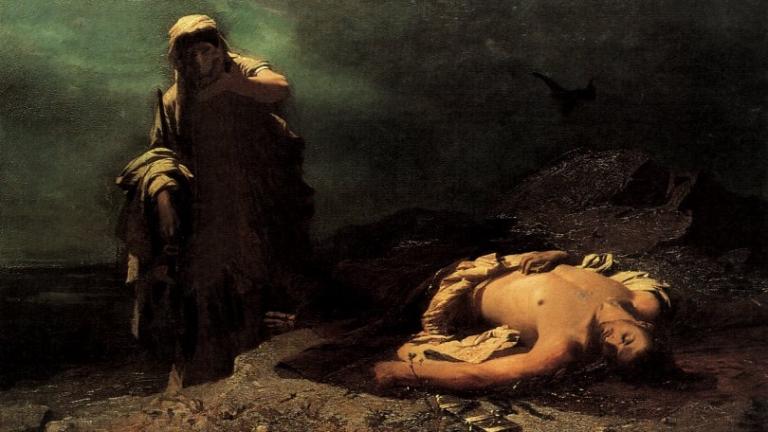
Nikiphoros Lytras, “Antigone and Polynices” (1865)
According to Donum Veritatis (which I also write about here, here, and here), conscience gives us no rationale to dissent from the Church. Conscience is “supreme,” but that does not mean it is subjective; nor is it is above the Church. “Argumentation appealing to the obligation to follow one’s own conscience,” the CDF says, “cannot legitimate dissent.” Although it is true that everyone must heed his own conscience,
he is also obliged to form it. Conscience is not an independent and infallible faculty. It is an act of moral judgement regarding a responsible choice. [This means that conscience is about doing what is right, not what one wills. What is right we learn from the teaching Church.] A right conscience is one duly illumined by faith and by the objective moral law and it presupposes, as well, the uprightness of the will in the pursuit of the true good. …
Setting up a supreme magisterium of conscience in opposition to the magisterium of the Church means adopting a principle of free examination incompatible with the economy of Revelation and its transmission in the Church.
The Holy Spirit guides the Church into all truth so that believers may form their consciences rightly.
With the aid of Newman, Cardinal Ratzinger develops this thought at length in “Conscience and Truth.”
According to Nemwan, the papacy is not separate from the primacy of conscience. Rather, it guarantees it. Ratzinger comments:
Modern man has difficulty understanding this. For him, conscience stands on the side of subjectivity and is the expression of the freedom of the subject. Authority, on the other hand, appears to him as the constraint on, threat to and even the negation of, freedom.
But modern man, of course, has it wrong. Authority (and the pope is the highest authority in the Church) is not the “negation of freedom.” Indeed, the Church alone guarantees conscience rightly formed. For conscience is “the demanding presence of the voice of truth.” All of us are obligated to do good and avoid evil, and good and evil are objective. They are not the property of the subjective self. There is no “my good” or “your good.” There is only the good.
Newman, as Ratzinger points out, converted to Catholicism because he “was much more taken by the necessity to obey recognized truth than his own preferences.” In other words, he had a conscience. His conscience led him to put truth above preference.
Nor can one appeal to “freedom” in order to justify preference over truth. True freedom is freedom, not so much of conscience, but the freedom to follow conscience.
The Church teaches that we have an obligation to form our conscience. The Catechism says:
Conscience must be informed and moral judgment enlightened. A well-formed conscience is upright and truthful. It formulates its judgments according to reason, in conformity with the true good willed by the wisdom of the Creator. The education of conscience is indispensable for human beings who are subjected to negative influences and tempted by sin to prefer their own judgment and to reject authoritative teachings. (1783)
A properly formed conscience, in other words, is a corrective to the “reject[ion of] authoritative teachings.” It is not an excuse for it. Nor does conscience mean making one’s own judgments.
The formation of conscience must be “guided by the authoritative teaching of the Church” (1785). When one rejects the Church’s authority, he may make an “erroneous judgment” (1790, 1792).
All of this is to say that conscience, in its right meaning, will prompt a person to obey the teaching of the Church. Only then can it be said to have “supremacy.”
***
Previous Post
March 28, 2017
Stop It Already With "But Paul Corrected Peter"
Next Post

March 30, 2017 Steve Skojec, Cafeteria Catholic
Browse Our Archives
Select a Category Abortion About Me Answers for Calvinists Answers to Media Fictions Answers to Objections Anti-Catholicism Apologetics Apostolic Succession Atonement Authority of the Church Baptism Benedictines Biblical Exegesis Blogging Book Reviews Books & Writing &c. Calvin's Institutes Capital Punishment Catholic Church Chastity Christology Church Fathers Church Social Doctrine Confession Contraception Conversion Stories Crusades Debates Depression & Suicide Deuterocanon Development of Doctrine Ecumenism English Language Eucharistic Adoration Exorcism Extra Ecclesiam Fisks & Rebuttals Freedom of Religion Freedom of Speech Fundamentalism Gender Politics Gender Theory Good Works Homosexuality Humor Idolatry Immaculate Conception In the News Inquisition ISIS Islam Just for Fun Just War Justification LCWR Limbo Liturgical Abuse Liturgical Year Magisterium Marriage and Family Mary Mortal Sin New Evangelization NFP Papacy Papal Documents Papal Infallibility Personal Narrative Politics Pope Francis Pope Francis Derangement Syndrome Population Control Praying to the "Dead" Priesthood Primacy of Peter Protestant Denominations Purgatory Radical Islam Radical Traditionalists Real Presence Right to Conscience RIght to Life Saints Same-Sex "Marriage" Seven Quick Takes Social Justice Social Media Sola Scriptura Spirit of Vatican II SSPX The Eucharist The Mass The Resurrection Traditionalism Vatican II Year of Mercy
Select a Month August 2019 July 2019 June 2019 May 2019 November 2018 October 2018 August 2018 July 2018 June 2018 April 2018 November 2017 October 2017 September 2017 May 2017 April 2017 March 2017 February 2017 November 2016 October 2016 September 2016 August 2016 July 2016 June 2016 May 2016 April 2016 March 2016 February 2016 January 2016 December 2015 November 2015 October 2015 September 2015 July 2015 June 2015 May 2015 April 2015 March 2015 February 2015 January 2015 December 2014 September 2014 August 2014 July 2014 June 2014 May 2014 April 2014 March 2014 February 2014 January 2014 December 2013 November 2013 October 2013 May 2013 April 2013 February 2013 January 2013
Follow Us!
TAKE THE
Religious Wisdom Quiz
I am a small member of the body, yet I boast great things. I am a fire, a world of iniquity. What am I?
Select your answer to see how you score.
The tongue The eye The heart The hand
Related posts from To Give a Defense
What Ratzinger and the CDF Really Said About...
Pope Francis Derangement Syndrome Vol. XX: Death Penalty...
Yes, Virginia, The Catechism is a Magisterial Document

"Ultramontanism" and a Supposed Conflict Between Pope Francis...
TRENDING AT PATHEOS Catholic

Rejecting Doom: Christian Hope And Human Action
Christianity is a religion of hope. We are to have hope and...

It’s What Comes From Within Which Matters
One of the most difficult things for us to understand is why...

Why I Choose the Eucharist Over the Sermon
Choose the Eucharist, Not the Sermon What are we supposed to get...

5 Design Elements Found in Spiritually Rooted Homes
Putting Spirituality Into Home Decor Our homes are more than our living...

Credo: A Story of God Told with the...
About 10 years ago, I began to imagine a personal "Credo" that...

The Anatomy of Divine Revelation in Catholic Thought
The claim that God has made Himself known to human beings is...
view all Catholic blogs
Ad-Free & Subscriber Log-In Subscription Support
- About Us
- 2026 Calendar
- Videos
- Podcasts
- Library of World Religions
- Faith In Media Tracker
- Advertise With Us
- Write for Us
- Privacy Policy
- Terms of Service
- Do Not Sell My Data
- Contact Us
- Radiant Digital
- Manage Newsletter Subscriptions
- Unsubscribe From Notifications
- Sitemap
Copyright 2008-2026, Patheos. All rights reserved.
Subscription Support Ad-Free & Subscriber Log-In
Follow Patheos