
BuddhistCatholicContemplativeEvangelicalGeneral ChristianHinduJewishLatter-day SaintMuslimNew VisionsProgressive Christian
Beliefs
- Buddhist
- Catholic
- Contemplative
- Evangelical
- General Christian
- Hindu
- Jewish
- Latter-day Saint
- More Voices
- Muslim
- New Visions
- Pagan
- Progressive Christian
Topics
- Religion News
- Food and Religion
- Sports and Religion
- Religious Art
- Religious Music and Entertainment
- Religious Events
- History and Religion
- Style and Religion
- Politics and Religion
- Women in Religion
- Recreation Outdoors and Religion
- Business Finance and Religion
- Careers Workplace and Religion
- Education and Religion
- Family Parenting and Religion
- Health Fitness and Religion
- Home and Religion
- Relationships and Religion
- Technology and Religion
- Travel and Religion
Columnists
- Buddhist Columnists
- Business Finance and Religion Columnists
- Careers Workplace and Religion Columnists
- Catholic Columnists
- Contemplative Columnists
- Education and Religion Columnists
- Evangelists Columnists
- Family Parenting and Religion Columnists
- General Christian Columnists
- Health Fitness and Religion Columnists
- Hindu Columnists
- History and Religion Columnists
- Home and Religion Columnists
- Jewish Columnists
- More Voices Columnists
- Latter Day Columnists
- Muslim Columnists
- New Visions Columnists
- Nonreligious Columnists
- Pagan Columnists
- Politics and Religion Columnists
- Progressive Columnists
- Recreation Outdoors and Religion Columnists
- Relationships and Religion Columnists
- Religion News Columnists
- Religious Art Columnists
- Religious Events Columnists
- Religious Music and Entertainment Columnists
- Sports and Religion Columnists
- Style and Religion Columnists
- Technology and Religion Columnists
- Travel and Religion Columnists
- Women in Religion Columnists
Resource Library
- 2026 Calendar
- Library of World Religions
- The 100 Most Holy Places on Earth
- Patheos Answers
- Podcasts
- Videos
- Faith Leaders Database
- Anglican Episcopalian
- Bahai
- Baptist
- Buddhism
- Christianity
- Confucianism
- Eastern Orthodoxy
- Hinduism
- Holiness and Pentecostal
- ISKCON
- Islam
- Judaism
- Lutheran
- Methodist
- The Church of Jesus Christ of Latter-day Saints
- New Age
- Paganism
- Presbytarian and Reformed
- Protestantism
- Religion Behind the Scenes
- Roman Catholic
- Scientology
- Shia Islam
- Sikhism
- Sufism
- Sunni Islam
- Taoism
- Zen
- See all religions
Research Tools
 Ad-Free & Subscriber Log-In Subscription Support
Ad-Free & Subscriber Log-In Subscription Support
Follow Patheos 

- Trending:
- Forgiveness
- |
- Marriage
- |
- Consciousness
- |
- Death Penalty
- |
- Election
- |
- Halloween
 To Give a Defense
- Home
- Catholic
- Steve Hays & the Parable of the Biltmore
Steve Hays & the Parable of the Biltmore
Last updated on: March 9, 2017 at 4:11 pm by Scott Eric Alt
Steve Hays & the Parable of the Biltmore 2017-03-09T16:11:29-04:00 Scott Eric Alt
Patheos Explore the world's faith through different perspectives on religion and spirituality! Patheos has the views of the prevalent religions and spiritualities of the world.
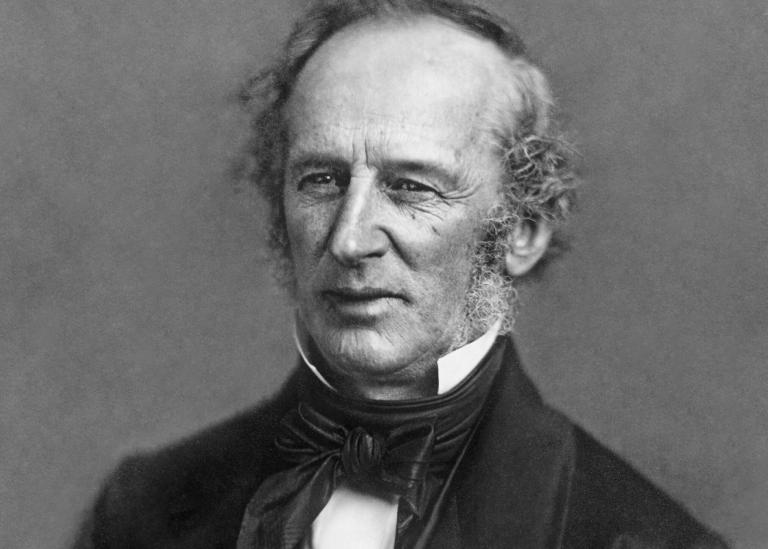
In Steve Hays’ Parable of the Biltmore, Cornelius Vanderbilt is God (Matthew Brady, public domain)

Neither Mr. X (who calls himself TurretinFan) nor the polemical rogue (who calls himself John Bugay) have dared to respond yet to my last article on sola scriptura. I say they have not dared to respond, even though the article was addressed to their habits of invention and avoidance on one essential question: Where is sola scriptura in the Bible? Mr. X runs a mad dash through Sacred Scripture, citing any verse that he can bend out of sense, and says, “See! Here! Sola Scriptura! Refute that, Romanists!” Meanwhile Mr. Bugay, who hath no peer for prevarication, denies he has to find it at all, and claims that the question is “dishonest.” Catholic apologists really ought to shut up if they know what is good for them. Otherwise, Mr. Bugay might write another blog article. The horror! the horror! But no; as I said, neither responded. For indeed, why should they? Leave that dirty work for another—in this case, no less a personage than Steve “Purple” Hays, also of Failablogue. (He calls it Triablogue, which I think is optimistic.) Mr. Hays did not link to my article (which is fine, I guess, since he only quoted my first sentence, and ignored the rest). If I were a suspicious man, which I am not, I would wonder whether Mr. Hays desired that his reader be unable to find my article, forasmuch as it is far too devastating to his own position. Perpend: He did not link to it; he did not mention me by name (only as “a Catholic apologist”—as though I might be Dave Armstrong, or that meretricious apostate Jason Stellman). It is as though Mr. Hays had something to hide—but no, I am not suspicious, and will not pursue this vain line of insinuation. Sufficient it is to say that I willingly link to Mr. Hays’ dumb article; and you, dear reader, may go and see for yourself what silliness lurks in the blogs of Calvinists. The article is not long: perhaps because Mr. Hays felt it circumspect not to say too much, lest he trap himself further.
THE LOGIC OF A SYLLOGISM
But I have too much fun. Before I get into the gist of Mr. Hays’ article, I wish to take a moment to ’splain why the question is so damaging to the Protestant position on sola scriptura. The question, again (since you have, no doubt, forgot it by now, in your fit of laughter), is this: Where is sola scriptura in the Bible? (Really, though, I must confess, the spectacle of Mr. Bugay and Mr. Hays asking, “Why do I have to prove it from the Bible?” is just too much ironic fun.) The honest Christian will recall one of the key characteristics of the traditional definition of sola scriptura; namely, that whatever is not explicitly set forth in Scripture, or whatever may not logically be inferred from Scripture, is not binding upon Christians. Scripture alone, the doctrine says, is the source for what must be believed by Christians. We are bound only by what is in Scripture; we are not bound by what is absent. (Should I repeat this one more time for the assistance of Mr. Hays?)
So we might begin a syllogism, thus:
1. The Bible alone is the source of all doctrine that is binding upon Christians;
2. Sola scriptura is a doctrine that is binding upon Christians;
3. Therefore—
Well, dear reader, how would you complete that syllogism? If you did not say, “Therefore, sola scriptura must be in the Bible,” you should fail Logic 101 and be solemnly ushered back to the sixth grade.
And that is why Catholic apologists ask the question “Where is sola scriptura in the Bible?” And that is why neither Mr. Bugay nor Mr Hays are going to intimidate us into not asking it. If Protestantism had but one Achilles’ heel, this would be it.
PURPLE’S PARABLE
Mr. Hays, however, ’plains that it is the “wrong question.” In a mad, mad, mad, mad effort to explain why, he concocts invents supplies the following odd parable. He imagines a presumably Catholic tourist—perhaps the aforementioned Mr. Armstrong, or Mr. Stellman—arriving at the Biltmore and complaining, thus:
I went to Asheville to see the Biltmore. I even bought a ticket. But try as I might, I never saw the Biltmore. The tour guide took us through room after room, but I could never find the Biltmore. I peered into closets; not there! I peered into cupboards; not there! I peered into cabinets, bureaus, and desk drawers; not there! Where was the Biltmore?
Now, the reason this is a strange, and frankly idiotic, analogy (for I am thus bound to be honest), is because no Catholic apologist I know of has ever asked “Where is the Bible in the Bible?” Not even Robert Sungenis has said that, and his views of late have been wild. But here is why, in Mr. Hays’ view, the Parable of the Biltmore is sage. As he puts it, “The Biltmore isn’t in the Biltmore. [You don’t say.] Rather, the Biltmore is the Biltmore. [How profound.] … Why assume that sola scriptura is only true if you can find [it] in the Bible? What if sola scriptura simply is the Bible?”
The Biltmore is the Biltmore! The Bible is the Bible! And sola scriptura is just another term for the Bible itself! Checkmate, Catholic apologists! Get in your boats and cross the Tiber to the other side before we encounter more slapdowns like that one.
(By the way, did you catch Mr. Hays’ admission that sola scriptura is not in the Bible? I hope you did. If it were in the Bible, he would have told us where, and the argument would be over. Because it is not, he must bluff.)
Jeremy Lott, the editor of Real Clear Religion, has one word for Hays’ argument. On my Facebook page, he wrote: “It’s silly.” That it is “silly” would be, in a sane world, self-evident, and any sane man embarrassed to have written it. But we are living in the age of blogs, when anyone with a pair of underwear and a basement may opine on anything at all and pretend it’s sense. Thus are many confused. And thus I will patiently explain, in the same gentle way one would address the ravings of the deranged.
Here is the difference between the Bible and sola scriptura: The Bible is a collection of books, whereas sola scriptura is a doctrine about the exclusive authority of that collection. They are not one and the same, cannot be, and never have been. And it is less than honest for Mr. Hays, by sleight-of-hand, to pretend that they are the same in an effort to bluff his way out of an apologetics jam.
The true parable would have had the Catholic apologist go looking about the Biltmore for evidence that the Biltmore alone was built by God, and that the Biltmore alone contains all that is necessary for a sufficient night’s rest, and that whatever is not in the Biltmore will lead to insomnia. No one is asking Mr. Hays, or Mr. Bugay, or Mr. X, or anyone else, to find the Bible in the Bible. That was never the question, for it was never the doctrine. Truth be told (as it must and shall), it is a sense-free tautology: The Bible alone is the Bible alone. It amounts to surrender; it amounts to an admission that sola scriptura is not in the Bible. Mr. Hays has given the game away, though he attempts to deny it by changing the definition of sola scriptura to a never-before-suggested circumlocution.
THAT SOLA PUT A SPELL ON HAYS
In fact—and I am grateful to Steven Greydanus for these particular references—not only is sola scriptura not in the Bible, but it is denied by the Bible. It is as though Mr. Armstrong, or Mr. Stellman, upon touring the Biltmore, found an authoritative inscription that said, “Vanderbilt has other homes!” Thus in 2 Thess. 2:15, St. Paul puts oral tradition on an equal authority with the written word:
So then, brethren, stand firm and hold to the traditions, which you were taught by us, either by word of mouth or by letter.
But not only that. As Mr. Greydanus points out, the apostles understood Jewish tradition—outside of the Old Testament—to be an authoritative source of divine teaching. Acts 7:53, Gal. 3:19, and Heb. 2:2 all allude to the Jewish tradition that the Torah was “spoken by angels” (to use the expression in Hebrews). This tradition is not to be found in the Old Testament.
Some, such as Dr.* James White (Th.D., D.Min., etc., etc.), of Alpha & Omega Sophistries, have attempted to extricate themselves from this difficulty by positing that sola scriptura is a “normative condition” of the Church, which only came into existence after the canon was closed. I addressed that claim here and here. The problem—as I stated then, and reiterate now—is that Dr.* White fails to name one source, before himself, who refers to sola scriptura as a “normative condition.” If that is how sola scriptura is to be understood, why is Dr.* White the first to know about it? If sola scriptura is just the Bible itself, why are Mr. Bugay and Mr. Hays the first to know about it?
If Vanderbilt gave up his other mansions when the Biltmore was complete, why would he leave behind word about his other residences? Would he not have removed those inscriptions, lest many be confused? Would he not have included something to indicate, “This is the only place Vanderbilt lives; the Biltmore alone is my dwelling place”?
At bottom, Mr. Hays is trying, however cleverly, to avoid a question he knows, and admits, he cannot answer. Bluff may work when you’re a college sophomore, but it does not work in the world of men. If sola scriptura is not in the Bible, and no one should expect it to be, then Mr. Hays should pass the message on to Mr. X; for that dauntless Calvinist is still wildly flipping through the pages of Sacred Scripture trying to strangle sola scriptura out of any verse he thinks he can get away with abusing. If sola scriptura is not in the Bible, if even Mr. Hays and Mr. Bugay have given up looking, why is Mr. X still holding on to his strong delusion?
Remember the aptness of a syllogism: If sola scriptura is not in the Bible, then it fails its own test. In truth, the Bible is a collection of 73 books—Protestants falsely say 66—whose authority is attested externally. That is to say, the Bible does not give its own table of contents. What books are to be included is the determination of an authority outside the Scripture itself. R.C. Sproul calls the Bible “a fallible collection of infallible books,” but that is just another attempt to avoid facing the fundamental flaw of sola scriptura. Protestants, even as they assert sola scriptura, must accept extra-biblical authority when declaring the canon, and extra-biblical authority when they assert sola scriptura itself. For however sola scriptura is defined, so long as Mr. Hays admits it is not in the Bible, he must have an authority outside the Bible to tell him it is so. What is that authority? Mr. Hays does not say. But if he were honest, he would admit that his authority is nothing but his own tradition.
The truth is this: Not only is sola scriptura false, it is impossible. For, just as there must be an external authority to tell us what is in the canon, so there must be an external authority to tell us what the Bible means. Our fallible interpretations must needs be kept in check. Were it not so, that would mean Christians had been abandoned, by God, to an eternal confusion about (1) what the infallible books are and (2) what they mean. And unless that external authority is itself infallible, true doctrine and false doctrine could never be known for sure. All we would have is the assurance of whoever could argue his case with the most gusto, or the most clever deception, or both.
That is the conundrum all advocates of sola scriptura must address. Denial and avoidance, which Mr. Bugay and Mr. Hays now engage in, are no answer. The Parable of the Biltmore is cleverness in search of coherence.
***
If you like the content on this blog, your generous gift to the author helps to keep it active. I remember all my supporters in my Mass intentions each week.
Previous Post
January 20, 2014
Through the Year With Pope Francis
Next Post
January 23, 2014 TurretinFan Interprets the Lightning
Browse Our Archives
Select a Category Abortion About Me Answers for Calvinists Answers to Media Fictions Answers to Objections Anti-Catholicism Apologetics Apostolic Succession Atonement Authority of the Church Baptism Benedictines Biblical Exegesis Blogging Book Reviews Books & Writing &c. Calvin's Institutes Capital Punishment Catholic Church Chastity Christology Church Fathers Church Social Doctrine Confession Contraception Conversion Stories Crusades Debates Depression & Suicide Deuterocanon Development of Doctrine Ecumenism English Language Eucharistic Adoration Exorcism Extra Ecclesiam Fisks & Rebuttals Freedom of Religion Freedom of Speech Fundamentalism Gender Politics Gender Theory Good Works Homosexuality Humor Idolatry Immaculate Conception In the News Inquisition ISIS Islam Just for Fun Just War Justification LCWR Limbo Liturgical Abuse Liturgical Year Magisterium Marriage and Family Mary Mortal Sin New Evangelization NFP Papacy Papal Documents Papal Infallibility Personal Narrative Politics Pope Francis Pope Francis Derangement Syndrome Population Control Praying to the "Dead" Priesthood Primacy of Peter Protestant Denominations Purgatory Radical Islam Radical Traditionalists Real Presence Right to Conscience RIght to Life Saints Same-Sex "Marriage" Seven Quick Takes Social Justice Social Media Sola Scriptura Spirit of Vatican II SSPX The Eucharist The Mass The Resurrection Traditionalism Vatican II Year of Mercy
Select a Month August 2019 July 2019 June 2019 May 2019 November 2018 October 2018 August 2018 July 2018 June 2018 April 2018 November 2017 October 2017 September 2017 May 2017 April 2017 March 2017 February 2017 November 2016 October 2016 September 2016 August 2016 July 2016 June 2016 May 2016 April 2016 March 2016 February 2016 January 2016 December 2015 November 2015 October 2015 September 2015 July 2015 June 2015 May 2015 April 2015 March 2015 February 2015 January 2015 December 2014 September 2014 August 2014 July 2014 June 2014 May 2014 April 2014 March 2014 February 2014 January 2014 December 2013 November 2013 October 2013 May 2013 April 2013 February 2013 January 2013
Follow Us!
TAKE THE
Religious Wisdom Quiz
How many years did Solomon's temple construction take?
Select your answer to see how you score.
5 years 6 years 10 years 7 years
Related posts from To Give a Defense
Does the Mass "banish the remembrance of Christ's...

Dear James White: Thanks for the Applause. You...
Calvinist Blogger Reads James; Discovers That We Must...
Two Highly Illogical Arguments for Sola Scriptura.
TRENDING AT PATHEOS Catholic

The Parable Of The Sower And The Word...
One of Christ’s most famous parables is that of the sower who...

Rejecting Doom: Christian Hope And Human Action
Christianity is a religion of hope. We are to have hope and...

Why I Choose the Eucharist Over the Sermon
Choose the Eucharist, Not the Sermon What are we supposed to get...

5 Design Elements Found in Spiritually Rooted Homes
Putting Spirituality Into Home Decor Our homes are more than our living...

Credo: A Story of God Told with the...
About 10 years ago, I began to imagine a personal "Credo" that...

The Anatomy of Divine Revelation in Catholic Thought
The claim that God has made Himself known to human beings is...
view all Catholic blogs
Ad-Free & Subscriber Log-In Subscription Support
- About Us
- 2026 Calendar
- Videos
- Podcasts
- Library of World Religions
- Faith In Media Tracker
- Advertise With Us
- Write for Us
- Privacy Policy
- Terms of Service
- Do Not Sell My Data
- Contact Us
- Radiant Digital
- Manage Newsletter Subscriptions
- Unsubscribe From Notifications
- Sitemap
Copyright 2008-2026, Patheos. All rights reserved.
Subscription Support Ad-Free & Subscriber Log-In
Follow Patheos