
BuddhistCatholicContemplativeEvangelicalGeneral ChristianHinduJewishLatter-day SaintMuslimNew VisionsProgressive Christian
Beliefs
- Buddhist
- Catholic
- Contemplative
- Evangelical
- General Christian
- Hindu
- Jewish
- Latter-day Saint
- More Voices
- Muslim
- New Visions
- Pagan
- Progressive Christian
Topics
- Religion News
- Food and Religion
- Sports and Religion
- Religious Art
- Religious Music and Entertainment
- Religious Events
- History and Religion
- Style and Religion
- Politics and Religion
- Women in Religion
- Recreation Outdoors and Religion
- Business Finance and Religion
- Careers Workplace and Religion
- Education and Religion
- Family Parenting and Religion
- Health Fitness and Religion
- Home and Religion
- Relationships and Religion
- Technology and Religion
- Travel and Religion
Columnists
- Buddhist Columnists
- Business Finance and Religion Columnists
- Careers Workplace and Religion Columnists
- Catholic Columnists
- Contemplative Columnists
- Education and Religion Columnists
- Evangelists Columnists
- Family Parenting and Religion Columnists
- General Christian Columnists
- Health Fitness and Religion Columnists
- Hindu Columnists
- History and Religion Columnists
- Home and Religion Columnists
- Jewish Columnists
- More Voices Columnists
- Latter Day Columnists
- Muslim Columnists
- New Visions Columnists
- Nonreligious Columnists
- Pagan Columnists
- Politics and Religion Columnists
- Progressive Columnists
- Recreation Outdoors and Religion Columnists
- Relationships and Religion Columnists
- Religion News Columnists
- Religious Art Columnists
- Religious Events Columnists
- Religious Music and Entertainment Columnists
- Sports and Religion Columnists
- Style and Religion Columnists
- Technology and Religion Columnists
- Travel and Religion Columnists
- Women in Religion Columnists
Resource Library
- 2026 Calendar
- Library of World Religions
- The 100 Most Holy Places on Earth
- Patheos Answers
- Podcasts
- Videos
- Faith Leaders Database
- Anglican Episcopalian
- Bahai
- Baptist
- Buddhism
- Christianity
- Confucianism
- Eastern Orthodoxy
- Hinduism
- Holiness and Pentecostal
- ISKCON
- Islam
- Judaism
- Lutheran
- Methodist
- The Church of Jesus Christ of Latter-day Saints
- New Age
- Paganism
- Presbytarian and Reformed
- Protestantism
- Religion Behind the Scenes
- Roman Catholic
- Scientology
- Shia Islam
- Sikhism
- Sufism
- Sunni Islam
- Taoism
- Zen
- See all religions
Research Tools
 Ad-Free & Subscriber Log-In Subscription Support
Ad-Free & Subscriber Log-In Subscription Support
Follow Patheos 

- Trending:
- Forgiveness
- |
- Marriage
- |
- Consciousness
- |
- Death Penalty
- |
- Election
- |
- Halloween
 To Give a Defense
- Home
- Catholic
- Steve Hays posits false dichotomy between authority and reason.
Steve Hays posits false dichotomy between authority and reason.
Last updated on: August 10, 2019 at 9:34 pm by Scott Eric Alt
Steve Hays posits false dichotomy between authority and reason. 2019-08-10T21:34:45-04:00 Scott Eric Alt
Patheos Explore the world's faith through different perspectives on religion and spirituality! Patheos has the views of the prevalent religions and spiritualities of the world.
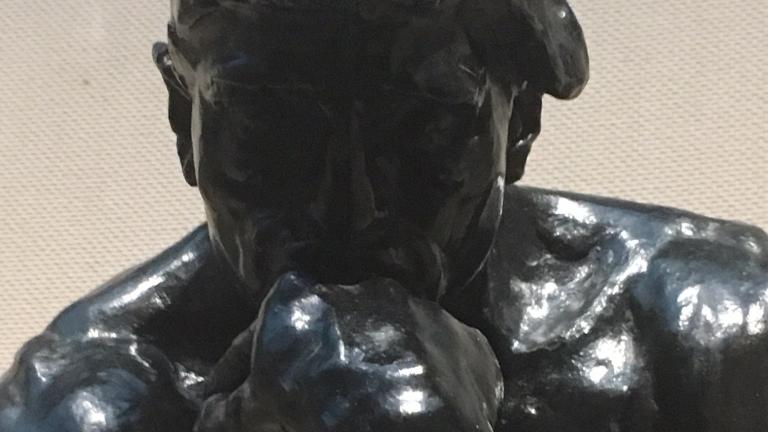
Rodin, “The Thinker”; Toledo Museum of Art. Photo by the author.
My advice to the anti-Catholic apologist is: Stop trying to be clever, you just end up silly. Steve “Purple” Hays of Failablogue is a case in point of this sad state of affairs. (He calls his site Triablogue, for optimistic reasons known to him alone.) His latest screed is entitled “Catholic apologetics is self-destructive”—which must explain why it’s been around since Justin Martyr. When you begin that way, you’re in for trouble.
“There’s a significant difference,” Mr. Hays writes in the lede, “between Catholic and Protestant apologetics.” [Shocker.] “Catholic apologetics suffers from an inner tension lacking in Protestant apologetics. That’s because the Catholic faith is far more reliant on the argument from authority than the Protestant faith.”
At this point I am curious. Have Protestant apologists given up on sola scriptura? Maybe I’ve been otherwise engaged in recent years and missed the news. But I thought that the authority of Bible—and just the Bible, that’s it, sir—was one of the pillars of the Protestant Reformation. We judge everything by the authority of those 73—I mean, 66—books. Every doctrine must be found there or it’s just a vile tradition of men. Have Protestants given this up now? I only ask questions.
•••
Mr. Hays goes on. “Notice how often Catholic apologist reframes an issue in terms of authority … Human reason is so untrustworthy that we need the pope to play referee.”
Well, yes and no. I don’t really need to pull out Proverbs 14:12 here. If Mr. Hays and I are in an argument about sola scriptura, it’s fair for me to point out that the Bible must be interpreted and how does he know his interpretation is right? The meaning is not just there; the Bible does not interpret itself, Westminster notwithstanding. After all, Protestants differ even among themselves about many key verses; if that were not so, Arminians and Calvinists could not both be Protestant. That’s how unreliable “the Bible alone” is.
But that does not mean that Catholics have abandoned, or even given small importance to, “human reason.” Consider that a common complaint, among Eastern Orthodox apologists, is that Roman Catholicism has given far too much weight to Western philosophy. We read Augustine and Aquinas—hell, even Plato and Aristotle—far too much. Does Mr. Hays have reason to believe that the Orthodox behave like Calvinist bloggers and just make stuff up as they go?
Also it’s a caricature to say that the pope plays referee all the time between warring Catholics. Not in my experience. First of all, Catholics don’t have that kind of hotline to the Vatican. Half the time, we can’t even get the local bishop to pay us any mind. Second, too many Catholics these days have far too much pride to listen to anything the pope says. Pope Francis Derangement Syndrome is a real problem. But Catholics don’t send the pope an email every time Boodle and Coodle get in an argument about Luke 22:36 and the second amendment. The pope’s role as teacher of the whole Church is more about preserving the unity of the faith than answering every question that comes up. (See this post.)
•••
Mr. Hays goes on. “Apologetics,” he says,
defends a faith-tradition by giving evidence for its claims or providing explanations for why the claims are logical and true. But once you do that, it shifts the question from an argument from authority to an argument from reason. Giving evidence or giving an explanation is an appeal to reason, not authority. So it then depends on how persuasive the reader finds the explanation or the purported evidence.
And here, dear reader, is where the false dichotomy emerges. To give evidence at all means that the evidence has some authority, in your view.
Let’s imagine that Mr. Doodle says his mother was 75 when he was born. “Impossible!” says Mr. Foodle. “A woman can’t conceive at that age!” And so Doodle pulls out both his own birth certificate and his mother’s. He seems to think:
- The birth certificates have authority;
- Mr. Foodle accepts the authority of birth certificates
Or say Goodle and Hoodle, who are Protestant, disagree about the truth of some doctrine. To prove that it is true, Goodle. opens the Bible to Matthew and shows Hoodle that Christ taught this very thing. Goodle does this because he believes Christ taught with authority and that Hoodle accepts Christ’s authority.
Likewise say that Joodle and Moodle, who are Catholic, get in a fight about some point of Catholicism. Moodle opens the Catechism, or an encyclical of Pope Benedict XVI, to support his argument. He accepts the authority of the Catechism, and Benedict, and knows that Joodle does too.
Both an appeal to authority, and reason, are going on here at the same time. We wouldn’t believe that certain evidence carries authority unless we had reached that conclusion from reason. Citation of evidence is an appeal to authority. Forensic evidence is admissible in Court because the government reasons that such evidence has lock>authority.
•••
Mr. Hays goes on.
[T]ake transubstantiation. Aquinas wasn’t content to say the real presence is church dogma. That may be because the real presence is so counterintuitive. If the bread and wine become Jesus, why don’t they appear to be Jesus? So he proposed a theory to reconcile the hiatus [sic] between appearance and reality. But once he provides an explanation, his explanation invites rational scrutiny.
Apart from not knowing the meaning of “hiatus”—incongruity is closer to Mr. Hays’ meaning—no Catholic apologist I know defends, say, the Marian dogmas by telling us that the Church teaches the Marian dogmas and stopping there. The Catholic apologist does that no more than the Protestant apologist says “The Bible is true because it says so in the Bible.” It’s fair to assume that whoever we are trying to convince already knows that the Church, or the Bible, teaches these things. So we go further. I’m not going to convince Mr. Noodle that Mary was assumed into Heaven by saying, “Pope Pius XII taught this.” Noodle already knows.
But if Catholics do little more than appeal to “Church says” rather than reason, Mr. Hays has a lot to explain when he cites how Thomas Aquinas as someone who appealed to reason. Aquinas was Catholic, wasn’t he? In a similar way, when Pope St. John Paul II wrote in defense of the teaching that the priesthood is restricted to men (Ordinatio Sacerdotalis), he didn’t say “the Church has always taught this” and stop there. He explained why the Church has always taught it.
And when Pope St. Paul VI reiterated the ban on artificial contraception (Humanae Vitae), he gave several arguments from reason, including an appeal to natural law. It is worth adding here that Benedict XVI has said that, though he of course accepted Paul VI’s teaching, he was not convinced by his reasons. The rationale mattered to Benedict XVI, not just “Simon Peter says.”
•••
Mr. Hays concludes:
The dilemma for Catholic apologetics is that it tries to mount arguments from reason to defend ecclesiastical authority, yet the argument from reason cuts the ground out from under the argument from authority. The competence of reason sabotages the appeal to the pope to play tiebreaker.
Unfortunately, you can’t separate the appeal to reason from the appeal to authority. Even if one were to cite no texts at all—no Bible, no Catechism, no papal bull—and simply use logic, you are appealing to the authority of some logical formula. I’ll give an example of what I mean.
- Every doctrine required of Christians is taught in the Bible;
- Sola scriptura is a doctrine required of Christians;
- Therefore, sola scriptura must be taught in the Bible
To use that argument at all means I am appealing to the authority of syllogisms. It means I think you accept syllogistic reasoning. One can not possibly argue anything at all if there weren’t first an agreement about what counts as proof. That’s what authority is.
Next Post

August 17, 2019 Pope Francis Derangement Syndrome XXIV: Cardinal Burke's Rebel Yell.
Browse Our Archives
Select a Category Abortion About Me Answers for Calvinists Answers to Media Fictions Answers to Objections Anti-Catholicism Apologetics Apostolic Succession Atonement Authority of the Church Baptism Benedictines Biblical Exegesis Blogging Book Reviews Books & Writing &c. Calvin's Institutes Capital Punishment Catholic Church Chastity Christology Church Fathers Church Social Doctrine Confession Contraception Conversion Stories Crusades Debates Depression & Suicide Deuterocanon Development of Doctrine Ecumenism English Language Eucharistic Adoration Exorcism Extra Ecclesiam Fisks & Rebuttals Freedom of Religion Freedom of Speech Fundamentalism Gender Politics Gender Theory Good Works Homosexuality Humor Idolatry Immaculate Conception In the News Inquisition ISIS Islam Just for Fun Just War Justification LCWR Limbo Liturgical Abuse Liturgical Year Magisterium Marriage and Family Mary Mortal Sin New Evangelization NFP Papacy Papal Documents Papal Infallibility Personal Narrative Politics Pope Francis Pope Francis Derangement Syndrome Population Control Praying to the "Dead" Priesthood Primacy of Peter Protestant Denominations Purgatory Radical Islam Radical Traditionalists Real Presence Right to Conscience RIght to Life Saints Same-Sex "Marriage" Seven Quick Takes Social Justice Social Media Sola Scriptura Spirit of Vatican II SSPX The Eucharist The Mass The Resurrection Traditionalism Vatican II Year of Mercy
Select a Month August 2019 July 2019 June 2019 May 2019 November 2018 October 2018 August 2018 July 2018 June 2018 April 2018 November 2017 October 2017 September 2017 May 2017 April 2017 March 2017 February 2017 November 2016 October 2016 September 2016 August 2016 July 2016 June 2016 May 2016 April 2016 March 2016 February 2016 January 2016 December 2015 November 2015 October 2015 September 2015 July 2015 June 2015 May 2015 April 2015 March 2015 February 2015 January 2015 December 2014 September 2014 August 2014 July 2014 June 2014 May 2014 April 2014 March 2014 February 2014 January 2014 December 2013 November 2013 October 2013 May 2013 April 2013 February 2013 January 2013
Follow Us!
TAKE THE
Religious Wisdom Quiz
Who said: "You are a chosen people, a royal priesthood, a holy nation, God's special possession"?
Select your answer to see how you score.
Peter Moses Paul James
Related posts from To Give a Defense
"Not Infallible" does not mean "Contains Errors."
Do Catholics think God owes them a debt?...

Protestant asks: When would Catholics know they're in...
Of course the Church can ordain women.
TRENDING AT PATHEOS Catholic

Rejecting Doom: Christian Hope And Human Action
Christianity is a religion of hope. We are to have hope and...

It’s What Comes From Within Which Matters
One of the most difficult things for us to understand is why...

Why I Choose the Eucharist Over the Sermon
Choose the Eucharist, Not the Sermon What are we supposed to get...

5 Design Elements Found in Spiritually Rooted Homes
Putting Spirituality Into Home Decor Our homes are more than our living...

Credo: A Story of God Told with the...
About 10 years ago, I began to imagine a personal "Credo" that...

The Anatomy of Divine Revelation in Catholic Thought
The claim that God has made Himself known to human beings is...
view all Catholic blogs
Ad-Free & Subscriber Log-In Subscription Support
- About Us
- 2026 Calendar
- Videos
- Podcasts
- Library of World Religions
- Faith In Media Tracker
- Advertise With Us
- Write for Us
- Privacy Policy
- Terms of Service
- Do Not Sell My Data
- Contact Us
- Radiant Digital
- Manage Newsletter Subscriptions
- Unsubscribe From Notifications
- Sitemap
Copyright 2008-2026, Patheos. All rights reserved.
Subscription Support Ad-Free & Subscriber Log-In
Follow Patheos