
BuddhistCatholicContemplativeEvangelicalGeneral ChristianHinduJewishLatter-day SaintMuslimNew VisionsProgressive Christian
Beliefs
- Buddhist
- Catholic
- Contemplative
- Evangelical
- General Christian
- Hindu
- Jewish
- Latter-day Saint
- More Voices
- Muslim
- New Visions
- Pagan
- Progressive Christian
Topics
- Religion News
- Food and Religion
- Sports and Religion
- Religious Art
- Religious Music and Entertainment
- Religious Events
- History and Religion
- Style and Religion
- Politics and Religion
- Women in Religion
- Recreation Outdoors and Religion
- Business Finance and Religion
- Careers Workplace and Religion
- Education and Religion
- Family Parenting and Religion
- Health Fitness and Religion
- Home and Religion
- Relationships and Religion
- Technology and Religion
- Travel and Religion
Columnists
- Buddhist Columnists
- Business Finance and Religion Columnists
- Careers Workplace and Religion Columnists
- Catholic Columnists
- Contemplative Columnists
- Education and Religion Columnists
- Evangelists Columnists
- Family Parenting and Religion Columnists
- General Christian Columnists
- Health Fitness and Religion Columnists
- Hindu Columnists
- History and Religion Columnists
- Home and Religion Columnists
- Jewish Columnists
- More Voices Columnists
- Latter Day Columnists
- Muslim Columnists
- New Visions Columnists
- Nonreligious Columnists
- Pagan Columnists
- Politics and Religion Columnists
- Progressive Columnists
- Recreation Outdoors and Religion Columnists
- Relationships and Religion Columnists
- Religion News Columnists
- Religious Art Columnists
- Religious Events Columnists
- Religious Music and Entertainment Columnists
- Sports and Religion Columnists
- Style and Religion Columnists
- Technology and Religion Columnists
- Travel and Religion Columnists
- Women in Religion Columnists
Resource Library
- 2026 Calendar
- Library of World Religions
- The 100 Most Holy Places on Earth
- Patheos Answers
- Podcasts
- Videos
- Faith Leaders Database
- Anglican Episcopalian
- Bahai
- Baptist
- Buddhism
- Christianity
- Confucianism
- Eastern Orthodoxy
- Hinduism
- Holiness and Pentecostal
- ISKCON
- Islam
- Judaism
- Lutheran
- Methodist
- The Church of Jesus Christ of Latter-day Saints
- New Age
- Paganism
- Presbytarian and Reformed
- Protestantism
- Religion Behind the Scenes
- Roman Catholic
- Scientology
- Shia Islam
- Sikhism
- Sufism
- Sunni Islam
- Taoism
- Zen
- See all religions
Research Tools
 Ad-Free & Subscriber Log-In Subscription Support
Ad-Free & Subscriber Log-In Subscription Support
Follow Patheos 

- Trending:
- Forgiveness
- |
- Marriage
- |
- Consciousness
- |
- Death Penalty
- |
- Election
- |
- Halloween
 To Give a Defense
- Home
- Catholic
- St. Francis and Pope Francis: To Teach By Gesture
St. Francis and Pope Francis: To Teach By Gesture
Last updated on: March 14, 2017 at 12:27 am by Scott Eric Alt
St. Francis and Pope Francis: To Teach By Gesture 2017-03-14T00:27:13-04:00 Scott Eric Alt
Patheos Explore the world's faith through different perspectives on religion and spirituality! Patheos has the views of the prevalent religions and spiritualities of the world.
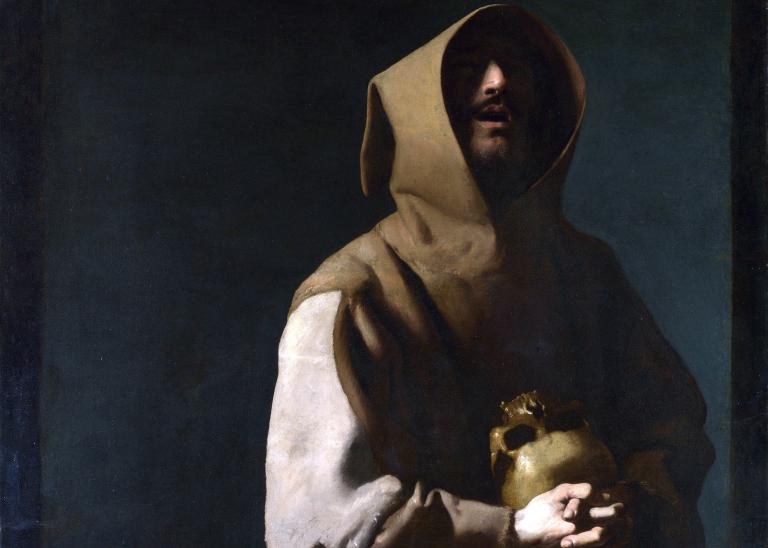
Francisco de Zurbaran, “St. Francis in Meditation,” 1630s
Ever since the election of Pope Francis, it has been bemusing to watch the reaction to the unusual style of his papacy, young though it is. Left-leaning commentators in the secular press, many of whom possess no clear, rational, or even sensate comprehension of the Catholic hurch, seem fondly to imagine that Francis’s non-Ratzingerian style, and his advocacy for the poor, will lead to a New Liberal Utopia.
i.
In the Daily Screech, which I cite as but one example, A.N. Wilson (author of a deconstructionist biography of Jesus) vainly speculates that the “golden opportunity for change,” the “relief,” brought about by a “new man,” might even mean the eventual renunciation of papal infallibility. Mr. Wilson admits that to put such a hope into print would be “cheeky”; but where would the author of Jesus: A Life be were it not for cheek? The only evidence Wilson has to go on in putting this mad fantasia of his into print is that Bergoglio is not Ratzinger. Of course, an intelligent flea might have pointed that out. But here’s the key passage in Mr. Wilson’s loopy article:
Pope Francis is highly traditional in his interpretation of the church’s teaching on such matters as gay marriage, women priests, and abortion. But he is also radical enough to believe that these matters, much as they occupy the minds of headline writers in the newspapers, are not the essence of the Christian Gospel. Christ lived among the poor, he was himself a poor man, and he told his disciples that insofar as they had fed the hungry, clothed the naked, visited the prisoners, they had done it to him, the Incarnate God. This is the Christ worshipped and served by the new pope.
Someone might kindly point out to Mr. Wilson, in the way you would point out things to a small child, that this is also the Christ who was worshipped and served by the former pope. And regardless of whether one thinks that the issues of gay marriage, women priests, and abortion are the “essence” of the Gospel, they are hardly negligible either. Pope Francis, in fact, called the push for gay marriage “a machination of the father of lies”—hardly the kind of thing you’d say if you thought the topic was inessential.
Moreover Francis, much as he has spoken, in the early days of his pontificate, about our obligation to the poor, has also spoken quite frequently about warfare against Satan. And while Christ said, “Whatever you did to the least of these you did to me” (Matt. 25:45), he also defined marriage in the context of God creating us male and female (Mark 10:6), and he said that it were better for a millstone to be tied around your neck than that you would harm a child (Luke 17:2). Is A.N. Wilson the one to decide which of Christ’s words are essential to the Gospel, and which are inessential? I certainly don’t recall Pope Francis making any differentiation of the kind.
ii.
Meanwhile, as the liberals have been gleefully attempting to misread Pope Francis as being one of themselves, some (I emphasize some) traditionally- and liturgically-minded conservatives in the Church are attempting to misread Francis as though he were the very embodiment of modernism and the “Spirit of Vatican II” [1]. Not one day into Francis’s pontificate, some bloggers were sounding the alarm that the pope, when he was Cardinal Bergoglio, had attempted to suppress Summorum Pontificum, Benedict XVI’s motu proprio allowing the Latin Mass to be said without prior permission. Such was the concern about this that Fr. Tim Finigan at The Hermeneutic of Continuity—a blog no one would confuse as a bastion of Novus Ordo modernism—took the time to document the existence of the usus antiquior in Buenos Aires. For whatever reason, that did not stop the did-he-or-didn’t-he back-and-forth within the Catholic blogosphere.
The traditionalist panic attacks and angst (sic transit gloria mundi) have also been fed by horror over the pope’s toned-down, Novus Ordo liturgies (ad populum), his decision to do without the traditional red shoes and mozzetta [2], and his decision to wash the feet of a few Muslim women on Holy Thursday [3]. Certainly I sympathize with the unease of many. Papal accoutrements such as the red shoes and the mozzetta are not bling; they have important symbolic meanings. The pope wears red shoes because red is the color of blood; the pope walks in the blood of the martyrs, ready to face martyrdom himself for the faith if required. They are not about the man but about the papacy. To paraphrase C.S. Lewis, you don’t put on the red shoes because you’re haughty but because you’re humble and obedient to the divinely-established Chair of Peter [4]. Benedict XVI understood that; and it is right to not want the papacy diminished at a time when it is so poorly understood and respected as it is.
iii.
However, I also believe that many of these fears—judging by how they have manifested themselves rhetorically—are misplaced; and I would urge my fellow bloggers to examine their conscience and put greater trust in the wisdom, guidance, and protection of the Holy Spirit. God knows what He is doing. And even through—perhaps especially through—some of our disappointments and perplexities, we need to consent to be taught.
I would be greatly astonied if Francis suppressed Summorum Pontificum. Some seem to live in mortal fear of this. I would be astonied too if he interfered with the ability of those who so desire it to have the Tridentine Mass, or high and solemn liturgies. Yes, it is true, the pope teaches by example and gesture, and the pope’s informality and jettisoning of liturgical rubrics sends uncertain signals.
But there are not going to be any clown Masses or pantomimes, and there’s a problem when the intensity of our discussion about these matters gets out of hand and leads to uncharity and lack of faith in the pope and the Holy Spirit. One blogger I read went so far as to accuse the pope of dividing Catholics against each other; another very uncharitably (and sinfully) pointed out that that Pope Francis, being 76, might not be around for that long anyway. It is rhetoric like this that led Patheos blogger Katrina Fernandez, who admits she’s been having a tough time with the transition, to sternly call for a cease fire:
I’ve had to give up reading some of my most favorite blogs. The stink of the novusordoist disease is everywhere and there’s nowhere to go? Pope Francis is destroying the Church? The very idea exudes a heartbreaking lack of hope and Catholics are anything but hopeless. Please, stop it. Everyone. Just stop. The spiritual harm you are causing is far greater than anything Pope Francis has done thus far in his short time as pope. … I love you all, passionate lovers of the Church, but for the love of all that’s holy shut it.
It is important to understand that not everyone who has written on these topics, or expressed loving concerns, is guilty of the “spiritual harm” that the blessed and passionate Ms. Fernandez calls out. Not all traditionalists have harshly and uncharitably judged the pope too early in his pontificate. Not all have failed to look for the good that the Holy Spirit has in mind for the Church, or failed to trust in the divine providence promised in Matthew 16:18. Not everyone is seeking to sow the seeds of doubt in the pope. But—and I have no inclination to name names or blogs—enough are guilty of it that Ms. Fernandez and Taylor Marshall have seen the need to call it out. Catholic traditionalists, your love of the Church is without question, and I would ask that you examine your conscience on this matter, and that you would consent to be taught by the Holy Spirit acting through the vicar of Christ. Give Francis the benefit of whatever doubts or concerns you may have.
iv.
Which brings me to the real point of this post; namely, what I consider to be the best way of understanding the young papacy of Pope Francis. I have been thinking of this for some time in relation to Cardinal Bergoglio having gone to St. Francis of Assisi for a papal name. Most of the discussion of this that I have heard has centered either on their mutual devotion to the poor; or, in consideration of the thorough curial reform that is needed, on St. Francis’s having heard Christ say to him, “Rebuild my Church.” And while both of these connections certainly have a truth to them, there is another connection that has been less-often mentioned. It is these words, often attributed to St. Francis: “Preach the Gospel at all times; if necessary, use words.” That, I would say, is the key to understanding both what Pope Francis has been doing thus far, and the real gift he is bringing to the Church.
I certainly do not want to diminish any one of the words that the pope has said. And Catholic bloggers will need to be vigilant in pointing them out—both to delusional, daydreaming liberals who fancy that the time for heresy is nigh; and to anxious, phobic traditionalists, who dread that the time for consecrating Pepsi is nigh. The pope’s repeated talk of spiritual warfare is very important, and words like these should be a signal of warning to liberals and reassurance to traditionalists:
There has been, throughout the history of the people, this temptation: to chop off a piece of the Faith. … But when we start to cut down the Faith, to negotiate the Faith, a little like selling it to the highest bidder, we take the path of apostasy, of disloyalty to the Lord. [5]
Words like these prove that Francis is not going to change the teaching of the Church. As the Holy Spirit promised it would be. His devotion to orthodoxy is solid and strong, as is his willingness to speak it; liberals should be be wary and traditionalists should be comforted. But I think the essence of what the pope is giving to the Church, and what the Holy Spirit has determined that the Church needs right now, is of a different nature. Fr. Z, calling Francis the “real deal,” speculates that this may be “more of a praying pontificate than a teaching pontificate.” But there are more ways to have a “teaching pontificate” than by writing encyclicals and books.
By no means am I attempting to diminish the theology and the writing of John Paul II or Benedict XVI. I love their writing immensely; I believe they are both destined to be made Doctors of the Church; and what they have taught us will be with the Church always and should be studied and pondered by all. But—and I am using this as possibly the most beautiful example—who can forget the now-famous picture of the pope embracing Dominic Gondreau, a child with cerebral palsy? Drudge had the most wonderful caption I can think of for that picture: “To turn hatred into love.” Francis was, like his namesake, preaching the Gospel without the need for words. That papal embrace was Evangelium Vitae without the encyclical.
Here’s the point: We live in a visual culture more than we do a print culture. I am not entirely comfortable with that. But when we consider how souls are to be reached, isn’t the point of the episode in Acts of “talking in tongues” that we are to reach people through the language they happen to speak? John Paul II and Benedict XVI used their “teaching pontificates” to explain and elucidate what the Church teaches. Francis is showing us what that looks like. Already there are indications that Francis is inducing lapsed Catholics to return to the Church—not by negotiating away the faith, not by instituting clown masses, but by showing us what the Gospel looks like. We need to see the Gospel. That is what Pope Francis is about.
And if that is what the Holy Spirit has determined that the Church needs right now, who are any of us to question the Holy Spirit? So let us consent to be taught.
ENDNOTES
[1] Because I greatly admire and respect my fellow Catholic bloggers, and sympathize at least with the root—if not the manifestation—of many of their concerns, I am not going to “call them out” by name and link to them here. Readers who are interested should easily be able to find articles of the kind I mention via their search engines.
[2] Elizabeth Scalia had to call bullshit on one vicious rumor about Francis’s refusal of the mozzetta, which some in the Catholic blogosphere had been giving credence to. Vatican Insider confirmed that the rumor was what Ms. Scalia said.
[3] To tell the truth, after some initial uncertainty and impulse to say “Who cares?” I have come to agree with those who were disappointed and have criticized the foot-washing incident. I am of the opinion that—at least with respect to Holy Thursday—the point of the rite is a celebration of Christ’s institution of the Priesthood, and that it should therefore be reserved for priests and deacons. Jimmy Akin, although walking a fine line, has a different point of view. Fr. Z, the whole of whose commentary on Francis has been spot-on, has written several valuable posts on the foot-washing incident (here, here, here, and, very interestingly, here). Canonist Ed Peters also opines here.
[4] Here is the full quotation from Lewis’s Preface to Paradise Lost: “A celebrant approaching the altar, a princess led out by a king to dance a minuet, a general officer on a ceremonial parade, a major-domo preceding the boar’s head at a Christmas feast—all these wear unusual clothes and move with calculated dignity. This does not mean that they are vain, but that they are obedient; they are obeying the [custom] which presides over every solemnity. The modern habit of doing ceremonial things unceremoniously is no proof of humility; rather it proves the offender’s inability to forget himself in the rite, and his readiness to spoil for every one else the proper pleasure of ritual.”
[5] For more on this, see Fr. Z’s article here.
***
If you like the content on this blog, your generous gift to the author helps to keep it active. I remember all my supporters in my Mass intentions each week.
Previous Post
April 10, 2013
The Necessity Argument Against the Papacy
Next Post
April 12, 2013 The Papacy, Necessity, and Unbroken Succession: A Reply to Mr. X
Browse Our Archives
Select a Category Abortion About Me Answers for Calvinists Answers to Media Fictions Answers to Objections Anti-Catholicism Apologetics Apostolic Succession Atonement Authority of the Church Baptism Benedictines Biblical Exegesis Blogging Book Reviews Books & Writing &c. Calvin's Institutes Capital Punishment Catholic Church Chastity Christology Church Fathers Church Social Doctrine Confession Contraception Conversion Stories Crusades Debates Depression & Suicide Deuterocanon Development of Doctrine Ecumenism English Language Eucharistic Adoration Exorcism Extra Ecclesiam Fisks & Rebuttals Freedom of Religion Freedom of Speech Fundamentalism Gender Politics Gender Theory Good Works Homosexuality Humor Idolatry Immaculate Conception In the News Inquisition ISIS Islam Just for Fun Just War Justification LCWR Limbo Liturgical Abuse Liturgical Year Magisterium Marriage and Family Mary Mortal Sin New Evangelization NFP Papacy Papal Documents Papal Infallibility Personal Narrative Politics Pope Francis Pope Francis Derangement Syndrome Population Control Praying to the "Dead" Priesthood Primacy of Peter Protestant Denominations Purgatory Radical Islam Radical Traditionalists Real Presence Right to Conscience RIght to Life Saints Same-Sex "Marriage" Seven Quick Takes Social Justice Social Media Sola Scriptura Spirit of Vatican II SSPX The Eucharist The Mass The Resurrection Traditionalism Vatican II Year of Mercy
Select a Month August 2019 July 2019 June 2019 May 2019 November 2018 October 2018 August 2018 July 2018 June 2018 April 2018 November 2017 October 2017 September 2017 May 2017 April 2017 March 2017 February 2017 November 2016 October 2016 September 2016 August 2016 July 2016 June 2016 May 2016 April 2016 March 2016 February 2016 January 2016 December 2015 November 2015 October 2015 September 2015 July 2015 June 2015 May 2015 April 2015 March 2015 February 2015 January 2015 December 2014 September 2014 August 2014 July 2014 June 2014 May 2014 April 2014 March 2014 February 2014 January 2014 December 2013 November 2013 October 2013 May 2013 April 2013 February 2013 January 2013
Follow Us!
TAKE THE
Religious Wisdom Quiz
Who said, "Lord, I am not worthy to have you come under my roof" but asked Jesus to heal his servant?
Select your answer to see how you score.
A Roman centurion A Pharisee Peter A scribe
Related posts from To Give a Defense

Documentation of Taylor Marshall's attacks on Pope Francis...
Infallibility is true, but (almost) useless. With some...

Crisis!!! Plays Benedict vs. Francis on Amoris Laetitia
If Pope Francis Resigns, It Will Not Be...
TRENDING AT PATHEOS Catholic

Rejecting Doom: Christian Hope And Human Action
Christianity is a religion of hope. We are to have hope and...

It’s What Comes From Within Which Matters
One of the most difficult things for us to understand is why...

Why I Choose the Eucharist Over the Sermon
Choose the Eucharist, Not the Sermon What are we supposed to get...

5 Design Elements Found in Spiritually Rooted Homes
Putting Spirituality Into Home Decor Our homes are more than our living...

Credo: A Story of God Told with the...
About 10 years ago, I began to imagine a personal "Credo" that...

The Anatomy of Divine Revelation in Catholic Thought
The claim that God has made Himself known to human beings is...
view all Catholic blogs
Ad-Free & Subscriber Log-In Subscription Support
- About Us
- 2026 Calendar
- Videos
- Podcasts
- Library of World Religions
- Faith In Media Tracker
- Advertise With Us
- Write for Us
- Privacy Policy
- Terms of Service
- Do Not Sell My Data
- Contact Us
- Radiant Digital
- Manage Newsletter Subscriptions
- Unsubscribe From Notifications
- Sitemap
Copyright 2008-2026, Patheos. All rights reserved.
Subscription Support Ad-Free & Subscriber Log-In
Follow Patheos