
BuddhistCatholicContemplativeEvangelicalGeneral ChristianHinduJewishLatter-day SaintMuslimNew VisionsProgressive Christian
Beliefs
- Buddhist
- Catholic
- Contemplative
- Evangelical
- General Christian
- Hindu
- Jewish
- Latter-day Saint
- More Voices
- Muslim
- New Visions
- Pagan
- Progressive Christian
Topics
- Religion News
- Food and Religion
- Sports and Religion
- Religious Art
- Religious Music and Entertainment
- Religious Events
- History and Religion
- Style and Religion
- Politics and Religion
- Women in Religion
- Recreation Outdoors and Religion
- Business Finance and Religion
- Careers Workplace and Religion
- Education and Religion
- Family Parenting and Religion
- Health Fitness and Religion
- Home and Religion
- Relationships and Religion
- Technology and Religion
- Travel and Religion
Columnists
- Buddhist Columnists
- Business Finance and Religion Columnists
- Careers Workplace and Religion Columnists
- Catholic Columnists
- Contemplative Columnists
- Education and Religion Columnists
- Evangelists Columnists
- Family Parenting and Religion Columnists
- General Christian Columnists
- Health Fitness and Religion Columnists
- Hindu Columnists
- History and Religion Columnists
- Home and Religion Columnists
- Jewish Columnists
- More Voices Columnists
- Latter Day Columnists
- Muslim Columnists
- New Visions Columnists
- Nonreligious Columnists
- Pagan Columnists
- Politics and Religion Columnists
- Progressive Columnists
- Recreation Outdoors and Religion Columnists
- Relationships and Religion Columnists
- Religion News Columnists
- Religious Art Columnists
- Religious Events Columnists
- Religious Music and Entertainment Columnists
- Sports and Religion Columnists
- Style and Religion Columnists
- Technology and Religion Columnists
- Travel and Religion Columnists
- Women in Religion Columnists
Resource Library
- 2026 Calendar
- Library of World Religions
- The 100 Most Holy Places on Earth
- Patheos Answers
- Podcasts
- Videos
- Faith Leaders Database
- Anglican Episcopalian
- Bahai
- Baptist
- Buddhism
- Christianity
- Confucianism
- Eastern Orthodoxy
- Hinduism
- Holiness and Pentecostal
- ISKCON
- Islam
- Judaism
- Lutheran
- Methodist
- The Church of Jesus Christ of Latter-day Saints
- New Age
- Paganism
- Presbytarian and Reformed
- Protestantism
- Religion Behind the Scenes
- Roman Catholic
- Scientology
- Shia Islam
- Sikhism
- Sufism
- Sunni Islam
- Taoism
- Zen
- See all religions
Research Tools
 Ad-Free & Subscriber Log-In Subscription Support
Ad-Free & Subscriber Log-In Subscription Support
Follow Patheos 

- Trending:
- Forgiveness
- |
- Marriage
- |
- Consciousness
- |
- Death Penalty
- |
- Election
- |
- Halloween
 To Give a Defense
- Home
- Catholic
- Some Further Responses to Limbo Apologists
Some Further Responses to Limbo Apologists
Last updated on: March 15, 2018 at 11:02 pm by Scott Eric Alt
Some Further Responses to Limbo Apologists 2018-03-15T23:02:35-04:00 Scott Eric Alt
Patheos Explore the world's faith through different perspectives on religion and spirituality! Patheos has the views of the prevalent religions and spiritualities of the world.
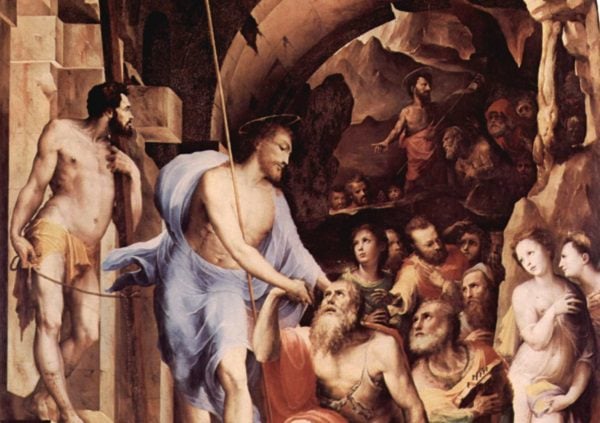
Domenico Beccafumi, “Christ in Limbo,” 1530-1535
At the National Catholic Register, Dr. R. Jared Staudt has responded to my two articles there about Limbo [first / second]. In order to avoid back-and-forth blog posts at the Register, I am going to use this blog to reply to some of the points Dr. Staudt raises.
Before I do that, though, I want to clarify, once again, what I do not say. I made these same disclaimers in the second of my two posts; but a few folks in the comment section were too busy being scandalized to read all of what scandalized them; and so, I will repeat myself.
- First, I do NOT say that the Church has taught one way or the other about Limbo, or the fate of infants who die with no possibility of baptism.
What I DO say is that, because the Church has no such dogma, Catholics are free to speculate as they wish. (Provided, of course, that they do not deny anything the Church has taught.) My two articles—in particular, the second—were my attempt to speculate. The Church permits me to do so. At no time did I try, nor would I, to impose my views on other Catholics or to claim I speak for the Church. If people who inhabit a combox choose to be scandalized by a liberty the Church allows, that is not my grief of spirit.
- Second, I do NOT say that parents may delay having their living children baptized. I specifically said: Do not do that. I specifically said: Do not presume upon God’s mercy.
Indeed, I was specifically addressing the question of infants who die with no possibility of baptism—miscarried children, stillborn children, aborted children. You can’t just leap from that discussion to the conclusion that baptism may be delayed where it is possible. That’s a different situation altogether.
- Third, I do NOT deny original sin. One person suggested to me (since evidently I know nothing of such things) that I read up on the Pelagian heresy. I am not sure why. My argument is not about the reality or effects of original sin; but about whether, in the absence of baptism, God removes it in some other way. Catholics who deny Limbo agree that original sin needs to be removed somehow; that part is not in dispute.
I say all this one last time, lest Limbo apologists spend much breath trying to educate me on points I know perfectly well and in no way deny.
***
Dr. Staudt composes his article as a list of points, and so I will take them up one by one.
- His first point is that Limbo is not “a distinct, fourth place in the afterlife” but “a part of Hell.”
Which is true; and in my first article I quoted Kevin Kukla, who described Limbo as being “on the edge of Hell.” And so, one more time: I know.
Dr. Staudt goes on:
The teaching on Limbo simply acknowledges that those who die without sanctifying grace, and thus may not enter heaven, have not merited punishment for sin. This point is found in the Magisterium of the Church, at the Ecumenical Councils of Lyons and Florence. This point follows from an understanding that there is a gradation both of punishment in hell and reward in heaven (cf. 1 Cor 15:41-42).
But wait. If by “Limbo” Dr. Staudt simply means a mild gradation of punishment in Hell for “those who die without sanctifying grace,” I do not deny that; but that as not my topic. I wrote about the supposed Limbo of Infants, not the existence of greater and lesser punishment in Hell.
Let us avoid shifting the definitions of terms.
Let me point out, too, that the assumption that children who had no possibility of baptism die “without sanctifying grace” is the very thing that’s in dispute. Dr. Staudt refers to the Council of Lyons and the Council of Florence as though they have settled the matter; but he begs the question. Where there is no possibility of baptism, does God supply sanctifying grace in some other way? Is God limited by the sacraments, or no? That is the question. Dr. Staudt avoids it.
Dr. Staudt goes on:
This point is not theological speculation. The Church has definitely taught in two Ecumenical Councils that there is a distinct punishment for those who die only with original sin and not actual sin [Begs the question.] (which is what is meant by the word limbo). The theological opinion related to limbo pertains to the assertion that all unborn children necessarily would enter this state.
Actually, “Limbo” does not mean “distinct punishment” but “outer edge.” And I thought that the Limbo of Infants was a place with no punishment: No punishment is merited, for there was no actual sin. It is a “place of perfect natural happiness,” only apart from the Beatific Vision.
Limbo apologists can’t seem to make up their mind what Limbo even is.
One last point here: When I said that Limbo is a “theological hypothesis,” I was quoting Cardinal Ratzinger in the Ratzinger Report:
Limbo was never a defined truth of the faith [and] I would abandon it since it was only a theological hypothesis. It formed part of a secondary thesis in support of a truth which is absolutely of first significance for the faith, namely, the importance of baptism. [T]he very theologians who proposed “limbo” also said that parents could spare the child limbo by desiring its baptism through prayer.
So he certainly seemed to think that it is Limbo itself that is the “hypothesis,” not who will end up there. I will accept the word of Cardinal Ratzinger on this.
- Dr. Staudt’s second point is to wonder whether there might be a “Limbo” for unbaptized children who die outside the womb but before the age of reason. Or what about the unbaptized who are mentally impaired in such a way that they never could be responsible for actual sin?
Dr. Staudt refers us to Pope Pius VI’s bull Auctorum Fidei (1794), in which, he says, “the Magisterium has spoken definitively on this point.”
In Auctorum Fidei, Pope Pius VI condemns the errors of the Synod of Pistoia, and here is what he says on the question at hand. (Note my own emphasis.)
The doctrine which rejects as a Pelagian fable that place of the lower regions (which the faithful generally designate by the name of limbo of the children) in which the souls of those departing with the sole guilt of original sin are punished with the punishment of the condemned, exclusive of the punishment of fire […] is false, rash, injurious to Catholic schools.
If this is a definitive, Magisterial teaching that the “limbo of the children” does exist, one naturally wonders how Joseph Cardinal Ratzinger missed it. And I emphasize the word “doctrine” in what Pius VI writes since it is the key word that must not be missed: What he condemns is the denial of Limbo as a doctrine. That’s a nuance that we must not miss.
I don’t pass off my denial of Limbo as a doctrine that must be held by all Catholics. If I did that, then I would be under the condemnation of Pius VI. But since I happily concede that I am writing nothing other than my own opinion, Auctorum Fidei has no application to me.
[See the update below on this point.]
- Dr. Staudt’s third point need not delay me too long, since in it he merely worries that those who reject Limbo might “deny the reality of original sin” and assume that salvation is something we have “automatically.”
I say nothing of the sort, of course; nor does any other Catholic I know who disputes Limbo; and so I won’t linger but move on.
- His fourth point is to claim that the Baptism of Desire applies “only to catechumens.”
He says:
It is, of course, possible to make an argument for how this teaching could be extended to children who die without the grace of Baptism, but an argument is necessary. We cannot simply take texts out of context and apply them to a different situation. How is an unborn child like a catechumen? Obviously a key point is the intention of the parent, but it is the intention of another, not one’s own entrance into the catechumenate. The intention of the parents and the faith of Church suffices for infant Baptism and so we can see how this same principle could apply. But has the Magisterium made this point explicit?
Well, I’m not sure that the Magisterium needs to make it “explicit.” Since the Church declares no dogma of Limbo, but permits speculation, wouldn’t that be superfluous?
But let us back up to Dr. Staudt’s claim that the Baptism of Desire is “for catechumens.” That is not what Cardinal Ratzinger said. Let me quote him again:
[T]he very theologians who proposed “limbo” also said that parents could spare the child limbo by desiring its baptism through prayer.
Was Cardinal Ratzinger wrong? I would be very careful to look into the matter further before making that claim. And indeed, Cardinal Cajetan, in his commentary on the Summa III.68.11, said “that children still within the womb of their mother are able to be saved … through the sacrament of baptism that is received, not in reality, but in the desire of the parents.” Aquinas’s original observation was that, though children cannot be baptized inside the womb, “[t]hey can, however, be subject to the action of God, in Whose sight they live, so as, by a kind of privilege, to receive the grace of sanctification.”
So we need not wonder “how this teaching could be extended to children who die without the grace of Baptism,” since Aquinas and Cajetan have already done so.
I will go by what I read in Aquinas and Cajetan.
- Dr. Staudt’s fifth point also need not delay me. I have said myself that the Magisterium has not “definitively asserted” that unbaptized infants will be saved.
The section of the Catechism Dr. Staudt quotes to establish this point, I quoted myself in the first of my two articles at the Register. The Church limits itself to what it knows for certain, and does not decide questions about which I can speculate to my heart’s content. It urges prayerful hope; I give reasons for my prayer and my hope.
- In his sixth point, Dr. Staudt wonders about infants whose parents (not being Christian) do not desire baptism for them.
This is a question worth considering; but it would take too much length to do so here, since there is a second issue involved: the salvation of non-Christians. That complicates the question beyond the limited scope of my original articles. So I am content to defer it for now.
***
Dr. Staudt ends his article by worrying that the denial of Limbo might be an occasion for “overstep” which would “presume the salvation of unborn children” and therefore prevent us from praying for them and offering Masses for them.
On that question, I can only speak for myself and say that I have Masses said for my daughter, Caitlyn, who was stillborn in the seventh month. I would strongly urge parents who have lost children to have Masses said for them. I can believe that Caitlyn enjoys the Beatific Vision even as I write this, without presuming that I know it with infallible certainty. And so I pray for her and have Masses said for her. Of course I do: She’s my daughter; I love her.
At the same time, I do ask her to pray for me. Every day.
***
Update: See the Facebook discussion on this post, in which Jonathan Prejean adds a correction:
“I would … dispute your second point on the Council of Pistoia. The fact that the condemnation says ‘doctrine’ is irrelevant; with respect to errors, doctrine is simply an erroneous belief. You’ve treated it as if there were parity between true doctrine and false doctrine, so that the error is only if one teaches as doctrine … that Limbo is false. But that is not really the error that the Pope is condemning. The error that is being condemned is the false belief that Limbo must necessarily involve punishment by fire in order to avoid Pelagianism. In other words, the Pope is condemning the idea that punishment must always involve punishment by fire in order to avoid Pelagianism.
“You are suggesting that you are off the hook from the condemnation because you are speculating, not teaching your rejection of Limbo as doctrine. That would not be enough to avoid the condemnation. Rather, you simply don’t hold the belief that is condemned, viz. the belief that even original sin must be punished by fire.”
***
Previous Post

April 19, 2016
Life Site News Gets a Pope Story Wrong. Again.
Next Post

April 25, 2016 Is Amoris Laetitia's Discussion of Culpability a "Serious Problem"?
Browse Our Archives
Select a Category Abortion About Me Answers for Calvinists Answers to Media Fictions Answers to Objections Anti-Catholicism Apologetics Apostolic Succession Atonement Authority of the Church Baptism Benedictines Biblical Exegesis Blogging Book Reviews Books & Writing &c. Calvin's Institutes Capital Punishment Catholic Church Chastity Christology Church Fathers Church Social Doctrine Confession Contraception Conversion Stories Crusades Debates Depression & Suicide Deuterocanon Development of Doctrine Ecumenism English Language Eucharistic Adoration Exorcism Extra Ecclesiam Fisks & Rebuttals Freedom of Religion Freedom of Speech Fundamentalism Gender Politics Gender Theory Good Works Homosexuality Humor Idolatry Immaculate Conception In the News Inquisition ISIS Islam Just for Fun Just War Justification LCWR Limbo Liturgical Abuse Liturgical Year Magisterium Marriage and Family Mary Mortal Sin New Evangelization NFP Papacy Papal Documents Papal Infallibility Personal Narrative Politics Pope Francis Pope Francis Derangement Syndrome Population Control Praying to the "Dead" Priesthood Primacy of Peter Protestant Denominations Purgatory Radical Islam Radical Traditionalists Real Presence Right to Conscience RIght to Life Saints Same-Sex "Marriage" Seven Quick Takes Social Justice Social Media Sola Scriptura Spirit of Vatican II SSPX The Eucharist The Mass The Resurrection Traditionalism Vatican II Year of Mercy
Select a Month August 2019 July 2019 June 2019 May 2019 November 2018 October 2018 August 2018 July 2018 June 2018 April 2018 November 2017 October 2017 September 2017 May 2017 April 2017 March 2017 February 2017 November 2016 October 2016 September 2016 August 2016 July 2016 June 2016 May 2016 April 2016 March 2016 February 2016 January 2016 December 2015 November 2015 October 2015 September 2015 July 2015 June 2015 May 2015 April 2015 March 2015 February 2015 January 2015 December 2014 September 2014 August 2014 July 2014 June 2014 May 2014 April 2014 March 2014 February 2014 January 2014 December 2013 November 2013 October 2013 May 2013 April 2013 February 2013 January 2013
Follow Us!
TAKE THE
Religious Wisdom Quiz
Which prophet raised a dead boy to life for the Shunammite woman?
Select your answer to see how you score.
Elisha Elijah Isaiah Samuel
Related posts from To Give a Defense

What Ratzinger and the CDF Really Said About...
Don't Call Abortion a Holocaust, Says Pope Benedict...
Kwasniewski, Fr. Murray, Death Site News Promote Falsehoods...
This Paul VI Encyclical Really Deserves a Birthday...
TRENDING AT PATHEOS Catholic

Rejecting Doom: Christian Hope And Human Action
Christianity is a religion of hope. We are to have hope and...

It’s What Comes From Within Which Matters
One of the most difficult things for us to understand is why...

Why I Choose the Eucharist Over the Sermon
Choose the Eucharist, Not the Sermon What are we supposed to get...

5 Design Elements Found in Spiritually Rooted Homes
Putting Spirituality Into Home Decor Our homes are more than our living...

Credo: A Story of God Told with the...
About 10 years ago, I began to imagine a personal "Credo" that...

The Anatomy of Divine Revelation in Catholic Thought
The claim that God has made Himself known to human beings is...
view all Catholic blogs
Ad-Free & Subscriber Log-In Subscription Support
- About Us
- 2026 Calendar
- Videos
- Podcasts
- Library of World Religions
- Faith In Media Tracker
- Advertise With Us
- Write for Us
- Privacy Policy
- Terms of Service
- Do Not Sell My Data
- Contact Us
- Radiant Digital
- Manage Newsletter Subscriptions
- Unsubscribe From Notifications
- Sitemap
Copyright 2008-2026, Patheos. All rights reserved.
Subscription Support Ad-Free & Subscriber Log-In
Follow Patheos