
BuddhistCatholicContemplativeEvangelicalGeneral ChristianHinduJewishLatter-day SaintMuslimNew VisionsProgressive Christian
Beliefs
- Buddhist
- Catholic
- Contemplative
- Evangelical
- General Christian
- Hindu
- Jewish
- Latter-day Saint
- More Voices
- Muslim
- New Visions
- Pagan
- Progressive Christian
Topics
- Religion News
- Food and Religion
- Sports and Religion
- Religious Art
- Religious Music and Entertainment
- Religious Events
- History and Religion
- Style and Religion
- Politics and Religion
- Women in Religion
- Recreation Outdoors and Religion
- Business Finance and Religion
- Careers Workplace and Religion
- Education and Religion
- Family Parenting and Religion
- Health Fitness and Religion
- Home and Religion
- Relationships and Religion
- Technology and Religion
- Travel and Religion
Columnists
- Buddhist Columnists
- Business Finance and Religion Columnists
- Careers Workplace and Religion Columnists
- Catholic Columnists
- Contemplative Columnists
- Education and Religion Columnists
- Evangelists Columnists
- Family Parenting and Religion Columnists
- General Christian Columnists
- Health Fitness and Religion Columnists
- Hindu Columnists
- History and Religion Columnists
- Home and Religion Columnists
- Jewish Columnists
- More Voices Columnists
- Latter Day Columnists
- Muslim Columnists
- New Visions Columnists
- Nonreligious Columnists
- Pagan Columnists
- Politics and Religion Columnists
- Progressive Columnists
- Recreation Outdoors and Religion Columnists
- Relationships and Religion Columnists
- Religion News Columnists
- Religious Art Columnists
- Religious Events Columnists
- Religious Music and Entertainment Columnists
- Sports and Religion Columnists
- Style and Religion Columnists
- Technology and Religion Columnists
- Travel and Religion Columnists
- Women in Religion Columnists
Resource Library
- 2026 Calendar
- Library of World Religions
- The 100 Most Holy Places on Earth
- Patheos Answers
- Podcasts
- Videos
- Faith Leaders Database
- Anglican Episcopalian
- Bahai
- Baptist
- Buddhism
- Christianity
- Confucianism
- Eastern Orthodoxy
- Hinduism
- Holiness and Pentecostal
- ISKCON
- Islam
- Judaism
- Lutheran
- Methodist
- The Church of Jesus Christ of Latter-day Saints
- New Age
- Paganism
- Presbytarian and Reformed
- Protestantism
- Religion Behind the Scenes
- Roman Catholic
- Scientology
- Shia Islam
- Sikhism
- Sufism
- Sunni Islam
- Taoism
- Zen
- See all religions
Research Tools
 Ad-Free & Subscriber Log-In Subscription Support
Ad-Free & Subscriber Log-In Subscription Support
Follow Patheos 

- Trending:
- Forgiveness
- |
- Marriage
- |
- Consciousness
- |
- Death Penalty
- |
- Election
- |
- Halloween
 To Give a Defense
- Home
- Catholic
- Seven Reflections at the End of a Novitiate: 7QT XV Seriatim
Seven Reflections at the End of a Novitiate: 7QT XV Seriatim
Last updated on: April 7, 2018 at 12:46 am by Scott Eric Alt
Seven Reflections at the End of a Novitiate: 7QT XV Seriatim 2018-04-07T00:46:14-04:00 Scott Eric Alt
Patheos Explore the world's faith through different perspectives on religion and spirituality! Patheos has the views of the prevalent religions and spiritualities of the world.
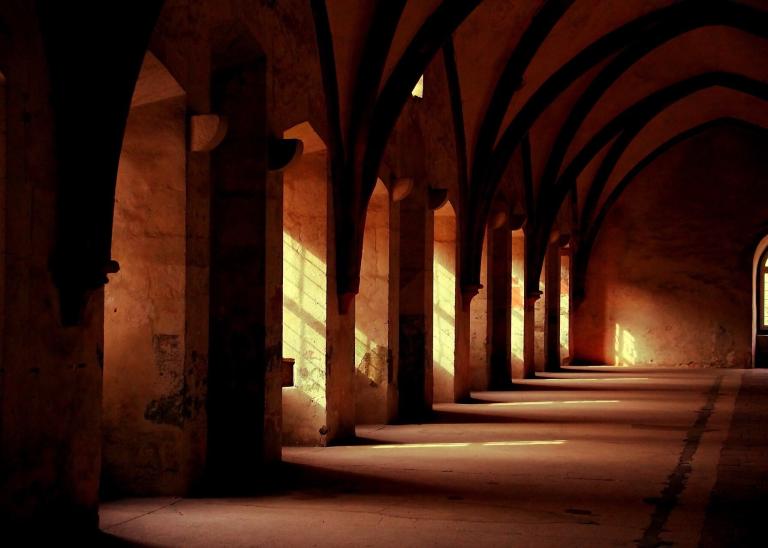
Image via Pixabay
In 2002, on the advice of a friend, I read The Cloister Walk
At the time, and being 33, I was looking for a more radical commitment to God than I had found in mainstream, surface-level, once-a-week Protestantism. I sought something wholly interior and wholly contemplative. “In the world but not of the world” has never interested me. I prefer St. Jerome.
Years before, I had already been more than undone by reading St. Teresa of Avila and St. John of the Cross in graduate school, who introduced me, stupefied, to the possibility of an interior retreat into prayer and solitude with God. Was there in fact more, and found in a small cell or the space within? I was a Methodist; no one tells you these things. But I could not just rise and join a monastery and leave what all. I was not Catholic, and folks already looked at me askance anyway as one keeping too much of himself apart.
So you may imagine what this book did to a man who had no idea that Third Orders were possible or existed. I can actually be a monk without going off into a monastery? I can just say, “I’m a Benedictine now,” pray and read and contemplate daily, and find the Lord in stillness, and continue to live in the world just as before? Why had I not known this?
II.
But no. It is not just that simple. God will have His way, and change us.
A Third Order Benedictine, or an oblate, does not leave his life or possessions and enter a monastery. But he—and she too, in this case—does join a particular monastery, while continuing to live in the world. The oblate spends a novitiate year discerning whether or not he has it in him to offer himself and his prayer (an oblation is an offering) to one particular monastery for life.
A Third Order Benedictine makes a promise to live the charism of the Benedictines in his daily life. He reads from the rule of St. Benedict every day. He prays the Liturgy of the Hours, the daily prayer of the Church, every day. He practices lectio divina—the contemplative and prayerful reading of Scripture—every day. He promises to serve his parish as he is called. His prayer and his contemplation, and his service to his church, sanctify his daily work, and draw him deeper into relationship with God and into the universal call to holiness. It makes us larger and deeper.
It sounds so simple, this order and routine: ora et labora, pray and work.
But try a year like that, in a novitiate, and you find yourself daily knocked about by slamming into the thick walls of such simplicity.
III.
No. There is another way to say it.
Routine and orderliness appeal to me; I like the expected. I don’t like plans that change, or plans that are made last-minute; if you want to invite me somewhere, tell me a week in advance, at least. Preferably a year. It may mean I have to move mountains of routine and spend the last two days, or months, psychologically preparing for the cataclysm.
Flannery O’Connor once said that “Routine is a condition of survival.” I like her greatly. I should have met a woman like that at twenty-three.
So this is not difficult for me, these promises of routine, prayer at fixed times, study at fixed times, reading at fixed times, work at fixed times. What could be more simple, what to yearn for more?
IV.
But no: Life, as it will do, turned complicated and took twists. I moved from Delaware to Cincinnati; I got married; I lost my daughter; I got divorced; I bounced from United Church of Christ to Presbyterian Church-USA; to Lutheran Church Missouri Synod; I found again lost liturgical longings and became Catholic. That is a short way of describing ten years of detour and failed hopes and weak purpose.
Then I found, as I was becoming Catholic, that a friend from work attended the same parish I had wandered into. (She thought I was screamingly anti-Catholic and said Hail Marys for me and was shocked to bump into me after Mass.) And I found that her parents, who attend the same parish, were Benedictine oblates. What had been attractive and abandoned became present and possible again.
V.
But no. In fact, it is not simple to say “Prayer at the sixth hour, and then again at the ninth.” The will rebels, and what seems easy and natural and desired, because it is routine after all, becomes blasted hard to do.
What do you mean pray again? I don’t want to pray again. I just did pray again, and now I’m supposed to pray again, again?
No.
Which is, of course, why you need it and why you do it.
VI.
It changes you. In my naivete twelve years ago I suspected that being a Benedictine oblate was no more than to rise one morning with the cock and say, “I pronounce myself an oblate attached to the monastery of myself,” to recite a few prayers, read a few verses, and go on as I had gone on and would go on, world without end, Amen.
But no.
It is a Rule and a Rule is meant to keep you on a path rather than zigzagging about. Without the center line I’ll smash into a truck or veer into a cow. As I have before, ever and oft. Well, look: I pray and I don’t pray; I read a couple chapters in the Bible and then forget it for a year, or a score.
And I say I love routine, which means that I love the idea of routine. But I find in practice that my will rebels, because it is a wet and soft sponge. And that is why I need routine, which is different than to say I want it only. What I desire I, in fact, do; but what I need requires a Rule and a heroic—not merely a common—act of will.
Benedictine oblates follow the Rule, and our promises, because we need a daily reminder. Yes, I just said those prayers yesterday. But did I not just forget them a half hour later, because I’m middle aged now and the cat just tore down the hall and leaped the coffee table with a roll of bath tissue in his mouth and the cell rang and the dinner is about to burn and I couldn’t tell you what day of the week it is or where I was yesterday let alone anything about that psalm I prayed last hour.
But by a Rule, and a supreme and courageous act of will, we in fact are changed, because we are reminded and made new each morning; and we recall ourselves throughout the day; and we tell ourselves before we go to sleep; and we repeat it again tomorrow.
It changes us so profoundly that we must change even our name. Choosing a name for one’s final oblation is more than just a sentimental act of finding a saint that appeals to us and to whom we can say “Pray for me.” Rather, to choose our new name is to be slapped upside our will and turned upside down and inside out and backward and told: “You were once named Scott, but you are now Gregory.”
I have not chosen St. Gregory; St. Gregory has chosen me. (More on which.)
VII.
But no, I am not ready. Could I be, or anyone?
That is what the novitiate year, the year of discernment, when you live the Rule and the promises (or try and fail, and try again) is meant for you to ask: Can I do this? Am I ready?
But no, I am not ready; and I can not do this, not of my own power, or my own will. As much as I say, “by an act of will,” I do not have the will in me. Will must be borrowed by grace.
Yet it is exactly because I am not ready that I am making my final oblation.
For one is never “ready.” That is the wrong question. Rather, I do ask myself: Am I compelled?
And to that question I say yes. I have wanted this for twelve years, in wanderlust and return. And so on Sunday, February 23, 2014, I will make my final oblation as a Benedictine oblate and become attached to the monks of St. Meinrad Archabbey. I take the name Gregory, after Pope St. Gregory the Great. And I make the oblation and the promises, and find the will to pray through the act of prayer itself; the will to contemplate through contemplation; the will to study through study; the will to work through work; and holiness through a supreme and quiet act of turning inward to be with God.
Pray for me.
Read more of this week’s quick takes at Conversion Diary.
***


Browse Our Archives
Select a Category Abortion About Me Answers for Calvinists Answers to Media Fictions Answers to Objections Anti-Catholicism Apologetics Apostolic Succession Atonement Authority of the Church Baptism Benedictines Biblical Exegesis Blogging Book Reviews Books & Writing &c. Calvin's Institutes Capital Punishment Catholic Church Chastity Christology Church Fathers Church Social Doctrine Confession Contraception Conversion Stories Crusades Debates Depression & Suicide Deuterocanon Development of Doctrine Ecumenism English Language Eucharistic Adoration Exorcism Extra Ecclesiam Fisks & Rebuttals Freedom of Religion Freedom of Speech Fundamentalism Gender Politics Gender Theory Good Works Homosexuality Humor Idolatry Immaculate Conception In the News Inquisition ISIS Islam Just for Fun Just War Justification LCWR Limbo Liturgical Abuse Liturgical Year Magisterium Marriage and Family Mary Mortal Sin New Evangelization NFP Papacy Papal Documents Papal Infallibility Personal Narrative Politics Pope Francis Pope Francis Derangement Syndrome Population Control Praying to the "Dead" Priesthood Primacy of Peter Protestant Denominations Purgatory Radical Islam Radical Traditionalists Real Presence Right to Conscience RIght to Life Saints Same-Sex "Marriage" Seven Quick Takes Social Justice Social Media Sola Scriptura Spirit of Vatican II SSPX The Eucharist The Mass The Resurrection Traditionalism Vatican II Year of Mercy
Select a Month August 2019 July 2019 June 2019 May 2019 November 2018 October 2018 August 2018 July 2018 June 2018 April 2018 November 2017 October 2017 September 2017 May 2017 April 2017 March 2017 February 2017 November 2016 October 2016 September 2016 August 2016 July 2016 June 2016 May 2016 April 2016 March 2016 February 2016 January 2016 December 2015 November 2015 October 2015 September 2015 July 2015 June 2015 May 2015 April 2015 March 2015 February 2015 January 2015 December 2014 September 2014 August 2014 July 2014 June 2014 May 2014 April 2014 March 2014 February 2014 January 2014 December 2013 November 2013 October 2013 May 2013 April 2013 February 2013 January 2013
Follow Us!
TAKE THE
Religious Wisdom Quiz
Who received a coat of many colors?
Select your answer to see how you score.
Jacob Joseph Moses David
Related posts from To Give a Defense

Is Premarital Kissing a Sin? and Other Quick...

Seven Reasons to Vote for Donald Trump. 7QT...
No, Virginia, Blogs are Not the Magisterium. 7QT...
TRENDING AT PATHEOS Catholic

Rejecting Doom: Christian Hope And Human Action
Christianity is a religion of hope. We are to have hope and...

It’s What Comes From Within Which Matters
One of the most difficult things for us to understand is why...

Why I Choose the Eucharist Over the Sermon
Choose the Eucharist, Not the Sermon What are we supposed to get...

5 Design Elements Found in Spiritually Rooted Homes
Putting Spirituality Into Home Decor Our homes are more than our living...

Credo: A Story of God Told with the...
About 10 years ago, I began to imagine a personal "Credo" that...

The Anatomy of Divine Revelation in Catholic Thought
The claim that God has made Himself known to human beings is...
view all Catholic blogs
Ad-Free & Subscriber Log-In Subscription Support
- About Us
- 2026 Calendar
- Videos
- Podcasts
- Library of World Religions
- Faith In Media Tracker
- Advertise With Us
- Write for Us
- Privacy Policy
- Terms of Service
- Do Not Sell My Data
- Contact Us
- Radiant Digital
- Manage Newsletter Subscriptions
- Unsubscribe From Notifications
- Sitemap
Copyright 2008-2026, Patheos. All rights reserved.
Subscription Support Ad-Free & Subscriber Log-In
Follow Patheos