
BuddhistCatholicContemplativeEvangelicalGeneral ChristianHinduJewishLatter-day SaintMuslimNew VisionsProgressive Christian
Beliefs
- Buddhist
- Catholic
- Contemplative
- Evangelical
- General Christian
- Hindu
- Jewish
- Latter-day Saint
- More Voices
- Muslim
- New Visions
- Pagan
- Progressive Christian
Topics
- Religion News
- Food and Religion
- Sports and Religion
- Religious Art
- Religious Music and Entertainment
- Religious Events
- History and Religion
- Style and Religion
- Politics and Religion
- Women in Religion
- Recreation Outdoors and Religion
- Business Finance and Religion
- Careers Workplace and Religion
- Education and Religion
- Family Parenting and Religion
- Health Fitness and Religion
- Home and Religion
- Relationships and Religion
- Technology and Religion
- Travel and Religion
Columnists
- Buddhist Columnists
- Business Finance and Religion Columnists
- Careers Workplace and Religion Columnists
- Catholic Columnists
- Contemplative Columnists
- Education and Religion Columnists
- Evangelists Columnists
- Family Parenting and Religion Columnists
- General Christian Columnists
- Health Fitness and Religion Columnists
- Hindu Columnists
- History and Religion Columnists
- Home and Religion Columnists
- Jewish Columnists
- More Voices Columnists
- Latter Day Columnists
- Muslim Columnists
- New Visions Columnists
- Nonreligious Columnists
- Pagan Columnists
- Politics and Religion Columnists
- Progressive Columnists
- Recreation Outdoors and Religion Columnists
- Relationships and Religion Columnists
- Religion News Columnists
- Religious Art Columnists
- Religious Events Columnists
- Religious Music and Entertainment Columnists
- Sports and Religion Columnists
- Style and Religion Columnists
- Technology and Religion Columnists
- Travel and Religion Columnists
- Women in Religion Columnists
Resource Library
- 2026 Calendar
- Library of World Religions
- The 100 Most Holy Places on Earth
- Patheos Answers
- Podcasts
- Videos
- Faith Leaders Database
- Anglican Episcopalian
- Bahai
- Baptist
- Buddhism
- Christianity
- Confucianism
- Eastern Orthodoxy
- Hinduism
- Holiness and Pentecostal
- ISKCON
- Islam
- Judaism
- Lutheran
- Methodist
- The Church of Jesus Christ of Latter-day Saints
- New Age
- Paganism
- Presbytarian and Reformed
- Protestantism
- Religion Behind the Scenes
- Roman Catholic
- Scientology
- Shia Islam
- Sikhism
- Sufism
- Sunni Islam
- Taoism
- Zen
- See all religions
Research Tools
 Ad-Free & Subscriber Log-In Subscription Support
Ad-Free & Subscriber Log-In Subscription Support
Follow Patheos 

- Trending:
- Forgiveness
- |
- Marriage
- |
- Consciousness
- |
- Death Penalty
- |
- Election
- |
- Halloween
 To Give a Defense
- Home
- Catholic
- Seven Reasons to Reject Catholic Fundamentalism About the Arts: 7QT XI Seriatim
Seven Reasons to Reject Catholic Fundamentalism About the Arts: 7QT XI Seriatim
Last updated on: March 9, 2017 at 4:09 pm by Scott Eric Alt
Seven Reasons to Reject Catholic Fundamentalism About the Arts: 7QT XI Seriatim 2017-03-09T16:09:09-04:00 Scott Eric Alt
Patheos Explore the world's faith through different perspectives on religion and spirituality! Patheos has the views of the prevalent religions and spiritualities of the world.
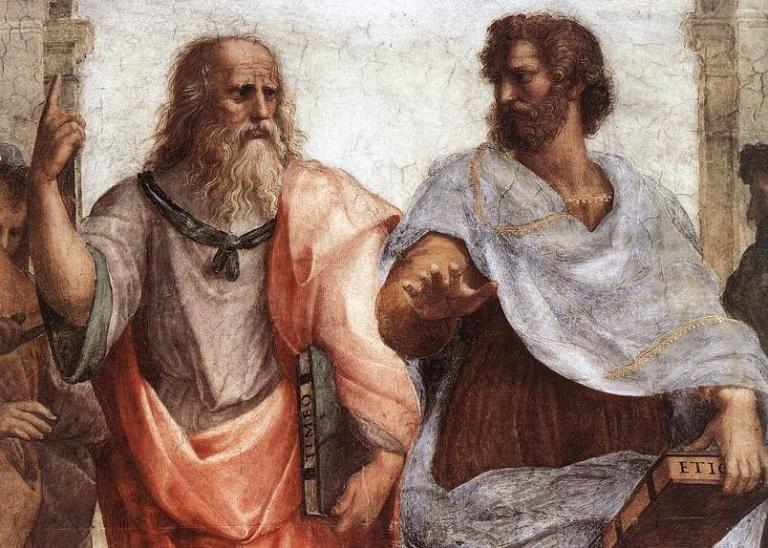
Raphael, “The School of Athens” (1509; detail: Plato & Aristotle)
This is a follow-up post, of sorts, to an earlier one I wrote about the Beatles, which drew a lot of hits and some interesting comments this week. In it I was responding to Dr. Taylor Marshall, who earlier this month claimed that the controversial “butcher cover” from the Beatles’ album Yesterday and Today was intended to promote abortion.
I respect Dr. Marshall greatly, but he was egregiously and importantly wrong. His first mistake was to rush to judgment and attribute a pro-abortion message to a photograph that had nothing at all to do with abortion. A little research might have told him so much.
His second error was to dismiss the complex musical and lyrical genius of the Beatles as no more than “intellectual poison” and “straight-up evil.” Along the way, Dr. Marshall relied upon a shameless guilt-by-association tactic, particularly when it comes to the group of people on the Sgt. Pepper cover. (If a Satanist was on the cover, the Beatles must have promoted Satanism. If Lewis Carroll was on the cover, they must have been all into kiddie porn.) Thus did he misread both the Beatles and their music, dumbly.
To reject Dr. Marshall’s approach does not mean one should approve of everything an artist creates. Nor does it mean we should deny that truly wicked cradles of filth do exist in pop culture and disguise themselves as art. Filth ought to be exposed. But to do that, with fairness and depth, means that we start by asking what the artist is trying to do. It means we analyze with discernment and discretion. It means we admit that many things we might dislike, or disagree with, or find baneful, do have real artistic value that should be understood rightly. It means we know that just because some artist was a wretch of a human being does not mean that what he created has no merit worth our praise. Edgar Allan Poe was a dissolute drunk, but he was also a genius and his short stories masterpieces of Gothic fiction. For Dr. Marshall to call him just a “dark writer” only shows that he knows nothing at all about Poe or why his short stories are classics.
Here are seven reasons to reject Catholic fundamentalism in our approach to the arts.
I.
The Church’s traditional attitude toward pagan culture was not to destroy it but to preserve it. It was the barbarians who destroyed Greek and Roman culture; it was monks who helped preserve it. And it was good that they did: The Renaissance would not have happened unless Catholic artists and scholars had those Greek and Roman models. In a similar way, if a Catholic revival in the arts is to happen again, it may very well rely on what the modern world has given us.
Tertullian’s famous rhetorical question “What has Athens to do with Jerusalem?” was, at heart, a false dichotomy. Catholics are a both-and people. And as James McGrath points out here, Tertullian had small room to talk.
Tertullian seems to have been the first to use the language of substance in relation to what provided the underlying unity of the Father, Son and Holy Spirit. What must be noted is that Tertullian’s background was in Stoic philosophy, and without that background he most likely could never have suggested this terminology.
In much the same way, when Aquinas wrote of “substance” and “accidents” to explain transubstantiation, he owed a debt to Aristotle. It was a Protestant—Martin Luther—who rejected all that. But Catholic artists, philosophers, theologians sought to understand what the Greeks and Romans had given us. They found value in it and transformed it into a truly Christian philosophy and aesthetic. Raphael did not call Plato “intellectual poison.”
II.
It is counterproductive. It alienates the people one is trying to reach. When we sound no different than a Bible-thumper from down in them woods, railing against Satanic messages if the song is played backward, people tune us out. They should: People who say those kind of things sound like fools, mainly because they are. By contrast, when we analyze with some specificity and knowledge and depth, we have a chance to reach the culture with our own message. We are able to engage the culture on a thoughtful level that many will respect. At the least, their ears won’t be shut upon us at once.
III.
It is anti-art. It likes art, not for its complexity, or its originality, or it genius, or its ability to incite thought and reflection, or its aesthetic value, but only for its utility in promoting what you already think is so. It treats art as nothing more than an exercise in bland self-validation. But Kafka was right: The point of a work of art is to be an ice pick to disturb and unsettle. The point of art is to question.
IV.
It gives us no standard by which to tell the difference between Michelangelo’s David and a porn photo. It cannot tell us why The Chronicles of Narnia does not promote witchcraft. (Some say that it does. These are the same folks who think that one should read nothing but the King James Bible.) It cannot tell us why Flannery O’Connor was not on the Misfit’s side. But the fact that John Paul II had to rebuke the prudish souls who covered up Michaelangelo’s David is a sign that Catholic critics need to do a better job explaining the difference between art and sin, or idolatry of the body. The fundie approach does not permit us to do that.
V.
Its criticism is misplaced. It wrongfully criticizes the work of art itself rather than (or on top of) the ideas which stand behind it. As an example of this, I can do no better than mention John Irving’s novel The Cider House Rules. It is pro-abortion. It turns an ether-addicted abortionist into a hero. Both are justly condemned. But it is also a very fine novel, which is worth reading for its incredibly strong writing, its attention to detail, its characterization, and its skillful plot. One can hold both views at the same time.
By contrast, Mr. Irving’s most recent novel, In One Person, is not only a pro-gay sex polemic, but is a very poorly-written novel with graphic and brutal descriptions of anal sex. (Mr. Irving has long been in decline as a writer, but that is a separate discussion from a criticism of his liberal advocacy. His politics have not changed, but his skill as a writer has.)
VI.
It oversimplifies the artistic process. It is too easy to say that “Lucy in the Sky With Diamonds” is about an LSD trip. True, the imagery is strange. True, the Beatles dropped acid. True, the title shares the same initials. But these are facts without relevance. Beatles lyrics are not some secret code that the critic is supposed to reveal as though he were Dan Brown. In truth, the title came from an elementary school painting that Lennon’s son Julian drew. More than that, those who attempt to explain “Lucy” as a song about LSD utterly disregard Lennon’s well-known love of wordplay, as well as his indebtedness to Dylan Thomas and Lewis Carroll. That explains what Lennon was up to more than a coincidence of initials does.
It is too easy to say that “Puff the Magic Dragon” is about smoking pot. There is no doubt that “magic dragon” is a slang term for marijuana. But the lyrics of the song have nothing at all to do with smoking pot. You can only make that argument if you go out of your way to. The song is about a young boy’s fantasy world and make-believe friend, which he abandons when he grows up. If you could say anything, you could say that the title of the song is a joke.
But urban legends die hard to those who grind their ax.
VII.
It gives the Devil too much credit. Satan likes it when we fear him, for the more power we give him the more power he has. How he must laugh at those who dream that he is coding secret messages into pop songs in order to dupe souls. As St. Teresa of Avila said (H/T to Terry Nelson of the Abbey Roads blog for the quotation), “I fear those who have such great fear of the devil more than I do the devil himself.” Inside the heart of everyone, no matter how corrupt, there is a desire for God. And often, without even being aware of it, that desire can come out—particularly in artists. As critics, we should do our best to find that desire for God and praise it and point out its true source. Blanket condemnation will never allow us to do that, and thus we miss a chance to evangelize.
Read more of this week’s quick takes at Conversion Diary here.
***
If you like the content on this blog, your generous gift to the author helps to keep it active. I remember all my supporters in my Mass intentions each week.
Previous Post

January 23, 2014
TurretinFan Interprets the Lightning

Browse Our Archives
Select a Category Abortion About Me Answers for Calvinists Answers to Media Fictions Answers to Objections Anti-Catholicism Apologetics Apostolic Succession Atonement Authority of the Church Baptism Benedictines Biblical Exegesis Blogging Book Reviews Books & Writing &c. Calvin's Institutes Capital Punishment Catholic Church Chastity Christology Church Fathers Church Social Doctrine Confession Contraception Conversion Stories Crusades Debates Depression & Suicide Deuterocanon Development of Doctrine Ecumenism English Language Eucharistic Adoration Exorcism Extra Ecclesiam Fisks & Rebuttals Freedom of Religion Freedom of Speech Fundamentalism Gender Politics Gender Theory Good Works Homosexuality Humor Idolatry Immaculate Conception In the News Inquisition ISIS Islam Just for Fun Just War Justification LCWR Limbo Liturgical Abuse Liturgical Year Magisterium Marriage and Family Mary Mortal Sin New Evangelization NFP Papacy Papal Documents Papal Infallibility Personal Narrative Politics Pope Francis Pope Francis Derangement Syndrome Population Control Praying to the "Dead" Priesthood Primacy of Peter Protestant Denominations Purgatory Radical Islam Radical Traditionalists Real Presence Right to Conscience RIght to Life Saints Same-Sex "Marriage" Seven Quick Takes Social Justice Social Media Sola Scriptura Spirit of Vatican II SSPX The Eucharist The Mass The Resurrection Traditionalism Vatican II Year of Mercy
Select a Month August 2019 July 2019 June 2019 May 2019 November 2018 October 2018 August 2018 July 2018 June 2018 April 2018 November 2017 October 2017 September 2017 May 2017 April 2017 March 2017 February 2017 November 2016 October 2016 September 2016 August 2016 July 2016 June 2016 May 2016 April 2016 March 2016 February 2016 January 2016 December 2015 November 2015 October 2015 September 2015 July 2015 June 2015 May 2015 April 2015 March 2015 February 2015 January 2015 December 2014 September 2014 August 2014 July 2014 June 2014 May 2014 April 2014 March 2014 February 2014 January 2014 December 2013 November 2013 October 2013 May 2013 April 2013 February 2013 January 2013
Follow Us!
TAKE THE
Religious Wisdom Quiz
I sent an army of singers before my army, and God set ambushes against our enemies. Who am I?
Select your answer to see how you score.
David Jehoshaphat Hezekiah Asa
Related posts from To Give a Defense

Is Premarital Kissing a Sin? and Other Quick...

Seven Reasons to Vote for Donald Trump. 7QT...

No, Virginia, Blogs are Not the Magisterium. 7QT...

TRENDING AT PATHEOS Catholic

The Parable Of The Sower And The Word...
One of Christ’s most famous parables is that of the sower who...

Rejecting Doom: Christian Hope And Human Action
Christianity is a religion of hope. We are to have hope and...

Why I Choose the Eucharist Over the Sermon
Choose the Eucharist, Not the Sermon What are we supposed to get...

5 Design Elements Found in Spiritually Rooted Homes
Putting Spirituality Into Home Decor Our homes are more than our living...

Credo: A Story of God Told with the...
About 10 years ago, I began to imagine a personal "Credo" that...

The Anatomy of Divine Revelation in Catholic Thought
The claim that God has made Himself known to human beings is...
view all Catholic blogs
Ad-Free & Subscriber Log-In Subscription Support
- About Us
- 2026 Calendar
- Videos
- Podcasts
- Library of World Religions
- Faith In Media Tracker
- Advertise With Us
- Write for Us
- Privacy Policy
- Terms of Service
- Do Not Sell My Data
- Contact Us
- Radiant Digital
- Manage Newsletter Subscriptions
- Unsubscribe From Notifications
- Sitemap
Copyright 2008-2026, Patheos. All rights reserved.
Subscription Support Ad-Free & Subscriber Log-In
Follow Patheos