
BuddhistCatholicContemplativeEvangelicalGeneral ChristianHinduJewishLatter-day SaintMuslimNew VisionsProgressive Christian
Beliefs
- Buddhist
- Catholic
- Contemplative
- Evangelical
- General Christian
- Hindu
- Jewish
- Latter-day Saint
- More Voices
- Muslim
- New Visions
- Pagan
- Progressive Christian
Topics
- Religion News
- Food and Religion
- Sports and Religion
- Religious Art
- Religious Music and Entertainment
- Religious Events
- History and Religion
- Style and Religion
- Politics and Religion
- Women in Religion
- Recreation Outdoors and Religion
- Business Finance and Religion
- Careers Workplace and Religion
- Education and Religion
- Family Parenting and Religion
- Health Fitness and Religion
- Home and Religion
- Relationships and Religion
- Technology and Religion
- Travel and Religion
Columnists
- Buddhist Columnists
- Business Finance and Religion Columnists
- Careers Workplace and Religion Columnists
- Catholic Columnists
- Contemplative Columnists
- Education and Religion Columnists
- Evangelists Columnists
- Family Parenting and Religion Columnists
- General Christian Columnists
- Health Fitness and Religion Columnists
- Hindu Columnists
- History and Religion Columnists
- Home and Religion Columnists
- Jewish Columnists
- More Voices Columnists
- Latter Day Columnists
- Muslim Columnists
- New Visions Columnists
- Nonreligious Columnists
- Pagan Columnists
- Politics and Religion Columnists
- Progressive Columnists
- Recreation Outdoors and Religion Columnists
- Relationships and Religion Columnists
- Religion News Columnists
- Religious Art Columnists
- Religious Events Columnists
- Religious Music and Entertainment Columnists
- Sports and Religion Columnists
- Style and Religion Columnists
- Technology and Religion Columnists
- Travel and Religion Columnists
- Women in Religion Columnists
Resource Library
- 2026 Calendar
- Library of World Religions
- The 100 Most Holy Places on Earth
- Patheos Answers
- Podcasts
- Videos
- Faith Leaders Database
- Anglican Episcopalian
- Bahai
- Baptist
- Buddhism
- Christianity
- Confucianism
- Eastern Orthodoxy
- Hinduism
- Holiness and Pentecostal
- ISKCON
- Islam
- Judaism
- Lutheran
- Methodist
- The Church of Jesus Christ of Latter-day Saints
- New Age
- Paganism
- Presbytarian and Reformed
- Protestantism
- Religion Behind the Scenes
- Roman Catholic
- Scientology
- Shia Islam
- Sikhism
- Sufism
- Sunni Islam
- Taoism
- Zen
- See all religions
Research Tools
 Ad-Free & Subscriber Log-In Subscription Support
Ad-Free & Subscriber Log-In Subscription Support
Follow Patheos 

- Trending:
- Forgiveness
- |
- Marriage
- |
- Consciousness
- |
- Death Penalty
- |
- Election
- |
- Halloween
 To Give a Defense
- Home
- Catholic
- Seven More Books That Changed My Life: 7QT VI Seriatim
Seven More Books That Changed My Life: 7QT VI Seriatim
Last updated on: March 9, 2017 at 4:50 pm by Scott Eric Alt
Seven More Books That Changed My Life: 7QT VI Seriatim 2017-03-09T16:50:02-04:00 Scott Eric Alt
Patheos Explore the world's faith through different perspectives on religion and spirituality! Patheos has the views of the prevalent religions and spiritualities of the world.
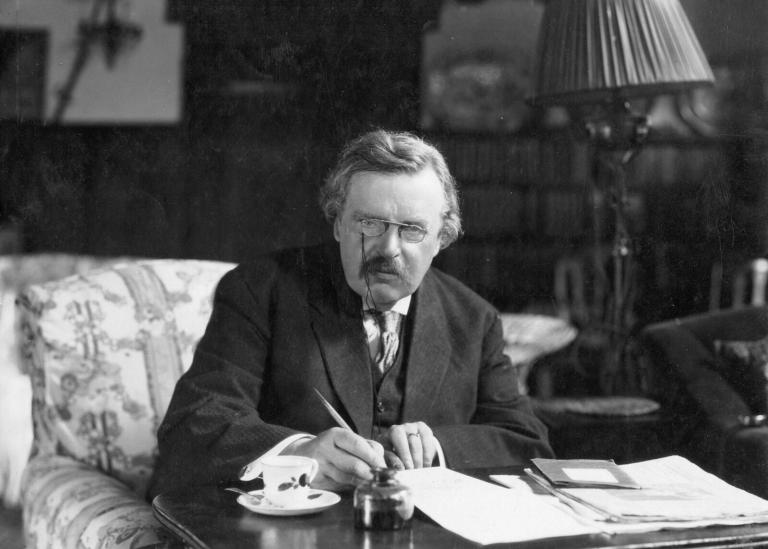
G.K. Chesterton (public domain)
As I am working on some posts that are taking a very long time to write, and since my last post on books turned out to be very popular, I thought I would follow it up with a sequel—though this will end up being the only such. This list was much harder to come up with than the previous one. When you’re talking about books that changed your life, that’s a strict standard; and a total of fourteen—even after half a lifetime of reading—is difficult to conceive. But here the other seven are.
I. THE ORDER OF OUR DAYSTHE BOOK OF COMMON PRAYER


There were any number of books that helped make me Catholic, but The Book of Common Prayer was one of only two (the other is later on this list) that hurled me in that direction.
I came to this Episcopal prayer book by chance when I saw it at Borders. Since I remembered it being mentioned in A Prayer for Owen Meany, I decided to pick it up and give it a chance. It made a powerful impact on me, because I had no idea what liturgical prayer or liturgical worship were. That might sound odd coming from someone who was raised United Methodist, because John Wesley in fact revised the Anglican prayer book for use in his new denomination. The United Methodists are liturgical, but you can spend years there and never figure that out. They are quiet about it.
Thus when I opened the Book of Common Prayer I had no idea what I was looking at or how to read it. But once I figured it out, the impact was immediate and powerful: the idea of ordering one’s days and years on a rhythm of prayer that is fixed, and changes through the hours and seasons, but returns to the same place. It fit with yearnings I did not know I had.
So I would argue with myself, for years, thus:
“If only I could find a church to belong to that is liturgical but not crazy-liberal like the Episcopalians. Where do I find that?”
“Well, there’s the Catholic Church.”
“No! No, no, no; I can’t do that.”
Yes. I could.
II. TO BE SANE IS MORE DRAMATIC THAN TO BE MAD ORTHODOXY BY G.K. CHESTERTON


I did not know G.K. Chesterton as a Catholic; I knew him only as a literary critic whose books on Charles Dickens I first read when I was in graduate school and writing my M.A. thesis. Then I discovered Orthodoxy and was stupefied by the kind of writer who, in a book defending Christianity, could up with chapter titles like “In Defence of Everything Else,” “The Maniac,” and “The Ethics of Elfland.”
There is no way to summarize this book, because there is no way to summarize one of its sentences. G.K. Chesterton can write the kind of pithy sentence that is large while it is small, and true while it is a paradox, and refreshingly sane while it clears up confusion and makes the truth sound simple and obvious. Here, for example, is Chesterton on why the modern interpretation of freedom as anarchy is wrong:
Anarchism adjures us to be bold creative artists, and care for no laws or limits. But it is impossible to be an artist and not care for laws or limits. Art is limitation; the essence of every picture is the frame. If you draw a giraffe, you must draw him with a long neck. If, in your bold creative way, you hold yourself free to draw a giraffe with a short neck, you find you are not free to draw a giraffe. The moment you step into the world of facts, you step into a world of limits. You can free things from alien or accidental laws, but not from the laws of their own nature. You may, if you like, free a tiger from his bars; but do not free him from his stripes. Do not free a camel from the burden of his hump: you may be freeing him from being a camel. Do not go about as a demagogue, encouraging triangles to break out of the prison of their three sides. If a triangle breaks out of its three sides, his life comes to a lamentable end. … [I]f triangles were ever loved, they were loved for being triangular.
Ultimately, Chesterton has an unmatched ability to make sanity joyful and exciting and not dull; for, as he understands, “to be sane is more dramatic than to be mad.” Orthodoxy is a book that returns us to sanity in a delightful, simple, and elegantly logical way. And although he makes his writing sound effortlessly natural and self-evident, it is harder to write, or to think, like Chesterton than it appears.
III. NO SOUL THAT SERIOUSLY AND CONSTANTLY DESIRES JOY WILL EVER MISS IT THE GREAT DIVORCE BY C.S. LEWIS


This is the book that convinced me more than anything else of the freedom of the will, and I speak as someone who has always strenuously believed in the freedom of the will. I was never a Calvinist, and even during the single year I was a Lutheran “the bondage of the will” struck me as absurd.
Lewis’s beliefs, which are spoken in this novel by George MacDonald, are superior to Calvinism: “All who are in Hell choose it. Without that self-choice, there can be no Hell.”
Lewis dares to write a book in which people choose Hell time after time, even as they know without doubt what they are choosing; the reader pities them, but his joy never wanes. How does Lewis pull that off? Perhaps it is because he tells us (or, rather, MacDonald does) why our joy must not wane. In the book, the fictional Lewis asks MacDonald why the final damnation of souls does not ruin the joy of those who are saved.
[I]t must be one way or the other. Either the day must come when joy prevails and all the makers of misery are no longer able to infect it: or else for ever and ever the makers of misery can destroy in others the happiness they reject for themselves. I know it has a grand sound to say ye’ll accept no salvation which leaves even one creature in the dark outside. [Is this “no soul left behind”?] But watch that sophistry or ye’ll make a Dog in a Manger the tyrant of the universe.
The reason why people choose Hell, MacDonald says, is that “there is always something else that they prefer to joy.” But for those who do desire joy, “seriously and constantly,” they will never miss out on it. If all of Heaven is grace, then grace is choice.
IV. THE LOVE THAT MOVES THE SUN AND THE OTHER STARS THE DIVINE COMEDY BY DANTE


I had never before heard of such a thing as “the Beatific Vision” when I first read this book for a college course in medieval literature. I grew up in a “Jesus loves me” Protestantism; in my view, Jesus loving me was the supreme joy. The joy that comes by beholding the image of God never crossed my mind. So The Divine Comedy introduced me to the concept that the Beatific Vision was in fact the end of all desire, and the fulfillment of all real desire.
You could say that this is a poem about a midlife crisis; or that it is about a journey; or that it is no more than a gratuitous description of the strange pains of Hell and all the popes that Dante put there. But Dante’s real subject is the desire that can only be fulfilled by God. As it happened, I was in the throes of unrequited love at the time I read the book. To be reminded that God is our true longing, and higher than Beatrice, was helpful to me at that young and naive age.
We were only required to read the Inferno and the Paradiso for class. During winter break, I read the Purgatorio on my own. I found Purgatory to be an interesting fantasy. …
V. PLEASE LET ME NOT FORGET HOW TO READ AND WRITE FLOWERS FOR ALGERNON BY DANIEL KEYES


I first read this hearbreaking novel in sixth grade. It is the story of a retarded man who has an operation that turns him into a genius, but which also, in the end, causes him to regress to his original condition.
I used to teach this novel, and it is always interesting to hear different people’s opinions of what it is about. I used to think it was about how much books and learning and ideas and intelligence matter. And it is. But I think now that it is mainly about how the human person matters, whatever its burdens. You can get into interesting discussions with a college English class about whether it was ethical for Charly Gordon’s intelligence to be artificially increased. But does the ethics change because he lost his intelligence at the end? Or would it have been okay if there had been a way for Charly to remain a genius? Whatever your answer to that question, Keyes is quite clear that Charly has the same value whether he’s retarded or a genius.
The tragedy of this story is in Charly’s being able to see the process of regress from its start, and then to grasp, with all he has in him, to hold on to the life of the mind. I have watched people I love acquire dementia, and there is a point when they know what’s happening to them. I fear it more than anything else. But in reading this great story, I know that even should we lose the thing we value and love the most in ourselves, we are still ourselves.
VI. LOVE THAT ENLARGES US BEYOND MEASURE THE CLOISTER WALK BY KATHLEEN NORRIS


This wonderful book was a natural companion to The Book of Common Prayer in hurling me headlong toward the Catholic Church. The best and most providential thing about it was that it came into my life at the same time as the prayer book.
Kathleen Norris writes about a year in her life as a Benedictine oblate. If the life of an oblate—who embraces the monastic charism and rhythm of daily prayer in a secular world—appealed to me, it was because I was learning to love liturgy through the prayer book; and it was also because my spiritual longings were moving in the direction of something deeper, and with greater integrity. (By “integrity,” I don’t mean “virtue” or “honesty,” but “being completely integrated.”) The Cloister Walk not only made these things attractive and desirable, but it showed me a path whereby they could be achieved. So not only am I now a Catholic, but I am also a Benedictine oblate in my novice year, and I owe that to this book.
Norris has integrity because she yearns for something deeper than the world alone can provide, yet she does not abandon the world. She discovers that monasticism is not separation from the world, but the path by which the world is to be salted. Thus the world, in this book, is rich and full of light precisely because Norris goes into an internal desert of contemplation and prayer.
VII. YOU MUST NOT FORGET ANYTHING PATRIMONY BY PHILIP ROTH


It is the rare and wondrous book that will make me cry. Though Patrimony is by the novelist Philip Roth, it is not a novel; it is a true story about Mr. Roth watching his father fight the brain tumor that, in the end, will kill him. Along the way, as he cares for his dying father, he considers the “patrimony” that he has been left.
The emotions in the book are understated, and the book is often funny, but at the end Mr. Roth turns serious and considers his anxieties and nightmares, particularly as he wrestles with the “unseemly” fact that he wrote part of the book while his father was still alive and dying. He wrestles with his sense that he can never live up to the grandeur of what his father was to him. “I would live perennially as his little son,” he writes at the end, “with the conscience of a little son, just as he would remain alive there not only as my father, but as the father, sitting in judgment on whatever I do.”
This book has helped me to better understand my relationship with my own father, and my feeling that I will never live up to the measure of who he is and has been to me.
The only patrimony, of fathers or sons or writers, is that “you must not forget anything.”
Read more of this week’s quick takes at Conversion Diary.
***
If you like the content on this blog, your generous gift to the author helps to keep it active. I remember all my supporters in my Mass intentions each week.



Browse Our Archives
Select a Category Abortion About Me Answers for Calvinists Answers to Media Fictions Answers to Objections Anti-Catholicism Apologetics Apostolic Succession Atonement Authority of the Church Baptism Benedictines Biblical Exegesis Blogging Book Reviews Books & Writing &c. Calvin's Institutes Capital Punishment Catholic Church Chastity Christology Church Fathers Church Social Doctrine Confession Contraception Conversion Stories Crusades Debates Depression & Suicide Deuterocanon Development of Doctrine Ecumenism English Language Eucharistic Adoration Exorcism Extra Ecclesiam Fisks & Rebuttals Freedom of Religion Freedom of Speech Fundamentalism Gender Politics Gender Theory Good Works Homosexuality Humor Idolatry Immaculate Conception In the News Inquisition ISIS Islam Just for Fun Just War Justification LCWR Limbo Liturgical Abuse Liturgical Year Magisterium Marriage and Family Mary Mortal Sin New Evangelization NFP Papacy Papal Documents Papal Infallibility Personal Narrative Politics Pope Francis Pope Francis Derangement Syndrome Population Control Praying to the "Dead" Priesthood Primacy of Peter Protestant Denominations Purgatory Radical Islam Radical Traditionalists Real Presence Right to Conscience RIght to Life Saints Same-Sex "Marriage" Seven Quick Takes Social Justice Social Media Sola Scriptura Spirit of Vatican II SSPX The Eucharist The Mass The Resurrection Traditionalism Vatican II Year of Mercy
Select a Month August 2019 July 2019 June 2019 May 2019 November 2018 October 2018 August 2018 July 2018 June 2018 April 2018 November 2017 October 2017 September 2017 May 2017 April 2017 March 2017 February 2017 November 2016 October 2016 September 2016 August 2016 July 2016 June 2016 May 2016 April 2016 March 2016 February 2016 January 2016 December 2015 November 2015 October 2015 September 2015 July 2015 June 2015 May 2015 April 2015 March 2015 February 2015 January 2015 December 2014 September 2014 August 2014 July 2014 June 2014 May 2014 April 2014 March 2014 February 2014 January 2014 December 2013 November 2013 October 2013 May 2013 April 2013 February 2013 January 2013
Follow Us!
TAKE THE
Religious Wisdom Quiz
An angel appeared to a priest burning incense in the temple, announcing his wife would bear a son despite her old age. Who was this priest?
Select your answer to see how you score.
Simeon Joseph Eli Zechariah
Related posts from To Give a Defense

Is Premarital Kissing a Sin? and Other Quick...

Seven Reasons to Vote for Donald Trump. 7QT...
No, Virginia, Blogs are Not the Magisterium. 7QT...

TRENDING AT PATHEOS Catholic

Rejecting Doom: Christian Hope And Human Action
Christianity is a religion of hope. We are to have hope and...

It’s What Comes From Within Which Matters
One of the most difficult things for us to understand is why...

Why I Choose the Eucharist Over the Sermon
Choose the Eucharist, Not the Sermon What are we supposed to get...

5 Design Elements Found in Spiritually Rooted Homes
Putting Spirituality Into Home Decor Our homes are more than our living...

Credo: A Story of God Told with the...
About 10 years ago, I began to imagine a personal "Credo" that...

The Anatomy of Divine Revelation in Catholic Thought
The claim that God has made Himself known to human beings is...
view all Catholic blogs
Ad-Free & Subscriber Log-In Subscription Support
- About Us
- 2026 Calendar
- Videos
- Podcasts
- Library of World Religions
- Faith In Media Tracker
- Advertise With Us
- Write for Us
- Privacy Policy
- Terms of Service
- Do Not Sell My Data
- Contact Us
- Radiant Digital
- Manage Newsletter Subscriptions
- Unsubscribe From Notifications
- Sitemap
Copyright 2008-2026, Patheos. All rights reserved.
Subscription Support Ad-Free & Subscriber Log-In
Follow Patheos