
BuddhistCatholicContemplativeEvangelicalGeneral ChristianHinduJewishLatter-day SaintMuslimNew VisionsProgressive Christian
Beliefs
- Buddhist
- Catholic
- Contemplative
- Evangelical
- General Christian
- Hindu
- Jewish
- Latter-day Saint
- More Voices
- Muslim
- New Visions
- Pagan
- Progressive Christian
Topics
- Religion News
- Food and Religion
- Sports and Religion
- Religious Art
- Religious Music and Entertainment
- Religious Events
- History and Religion
- Style and Religion
- Politics and Religion
- Women in Religion
- Recreation Outdoors and Religion
- Business Finance and Religion
- Careers Workplace and Religion
- Education and Religion
- Family Parenting and Religion
- Health Fitness and Religion
- Home and Religion
- Relationships and Religion
- Technology and Religion
- Travel and Religion
Columnists
- Buddhist Columnists
- Business Finance and Religion Columnists
- Careers Workplace and Religion Columnists
- Catholic Columnists
- Contemplative Columnists
- Education and Religion Columnists
- Evangelists Columnists
- Family Parenting and Religion Columnists
- General Christian Columnists
- Health Fitness and Religion Columnists
- Hindu Columnists
- History and Religion Columnists
- Home and Religion Columnists
- Jewish Columnists
- More Voices Columnists
- Latter Day Columnists
- Muslim Columnists
- New Visions Columnists
- Nonreligious Columnists
- Pagan Columnists
- Politics and Religion Columnists
- Progressive Columnists
- Recreation Outdoors and Religion Columnists
- Relationships and Religion Columnists
- Religion News Columnists
- Religious Art Columnists
- Religious Events Columnists
- Religious Music and Entertainment Columnists
- Sports and Religion Columnists
- Style and Religion Columnists
- Technology and Religion Columnists
- Travel and Religion Columnists
- Women in Religion Columnists
Resource Library
- 2026 Calendar
- Library of World Religions
- The 100 Most Holy Places on Earth
- Patheos Answers
- Podcasts
- Videos
- Faith Leaders Database
- Anglican Episcopalian
- Bahai
- Baptist
- Buddhism
- Christianity
- Confucianism
- Eastern Orthodoxy
- Hinduism
- Holiness and Pentecostal
- ISKCON
- Islam
- Judaism
- Lutheran
- Methodist
- The Church of Jesus Christ of Latter-day Saints
- New Age
- Paganism
- Presbytarian and Reformed
- Protestantism
- Religion Behind the Scenes
- Roman Catholic
- Scientology
- Shia Islam
- Sikhism
- Sufism
- Sunni Islam
- Taoism
- Zen
- See all religions
Research Tools
 Ad-Free & Subscriber Log-In Subscription Support
Ad-Free & Subscriber Log-In Subscription Support
Follow Patheos 

- Trending:
- Forgiveness
- |
- Marriage
- |
- Consciousness
- |
- Death Penalty
- |
- Election
- |
- Halloween
 To Give a Defense
- Home
- Catholic
- Seven Epiphanies That Made Me Catholic: 7QT VII Seriatim
Seven Epiphanies That Made Me Catholic: 7QT VII Seriatim
Last updated on: March 9, 2017 at 4:30 pm by Scott Eric Alt
Seven Epiphanies That Made Me Catholic: 7QT VII Seriatim 2017-03-09T16:30:35-04:00 Scott Eric Alt
Patheos Explore the world's faith through different perspectives on religion and spirituality! Patheos has the views of the prevalent religions and spiritualities of the world.
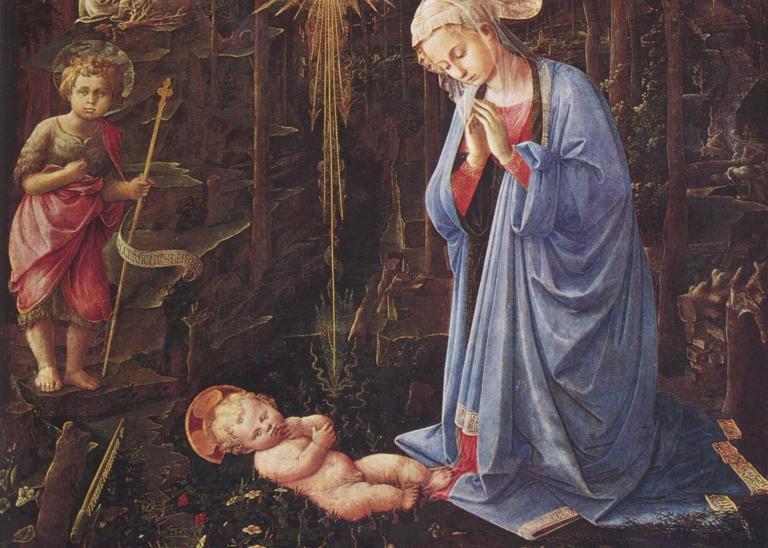
Fra Filippo Lippi, “The Nativity,” ca. 1459
Definitions matter, and words mean things. But sloppy usages abound, and they encourage confused thinking and make-believe. If I say, “I am Catholic,” I ought to mean something more than that I show up at a particular building on Sundays. I ought to mean more, even, than that I agree with a certain set of doctrines.
Recently, Catholic converts like Bryan Cross and Jason Stellman have used the term “paradigm shift” to describe what conversion means. More than the church you happen to “belong to,” more than a series of beliefs on a checklist, being Catholic implies a particular way of understanding reality. More than what you believe, it is how you think.
If someone said, “I am a capitalist,” but thought and acted as though Marxism were true, would you think he was anything other than a deluded fool? Would you suspect he was applying the label “capitalist” to himself for ulterior motives? Would you not say, “You know, you can’t just call yourself a capitalist but believe these other things. You can’t call yourself a capitalist if you understand reality through a Marxist paradigm.” If words are no longer used to describe reality, if they have nothing fixed to which they point, then reality can no longer be known. For reality is known through the words we use to describe it.
So I have started with a tangent and a soapbox. But my conversion to the Catholic Church entailed a series of epiphanies, whereby a man who once understood the world looking west turned around and faced east. If you’ve stood on your head your whole life, things look very different when you finally stand upright. That can be a disconcerting experience; it can also carry a great deal of wonder and joy. I am Catholic today not because I jumped through a series of hoops and then went through a particular ceremony on a particular night; I am Catholic today because I once understood reality that way, and now I understand it this way. I come at life from a very different set of assumptions about the way things are.
MY CHURCH MUST NOT CONFORM TO ME. I MUST CONFORM TO MY CHURCH.
I used to church hop a lot. I grew up United Methodist, but starting in my twenties (after I had recovered from a hazy soup of New Ageism), my church attendance was like darts scattered across a sectarian map. At one time or another, I was Methodist, I was Presbyterian, I was Baptist. I was Episcopalian, I was Lutheran. I was United Church of Christ, Disciples of Christ, Assemblies of God.
There were different and complicated reasons for all that scattershot worship, but the most important was this: In the back of my mind, I had composed a list of the things I already believed, and I was looking, oft in vain, for the church that taught all those things. I would compare the varying beliefs of the different sects, and I would go down the list and say, “Yes, that’s right”; “No, that’s wrong.”
Then one day I realized I had it backward. By that time, I had already taken a different approach to the possibility of becoming Catholic. In other words, I made a list of everything the Church taught and, rather than saying “Yes that’s right” or “No that’s wrong,” I asked, “Could that be right after all?” Eventually I got to a point of surrender. I said, Well, if Christ has ensured that the Church will never teach error, then any difficulties I have with x, y, or z must be my own error, not the Church’s, and I’ll just have to work it out. I’ll have to figure out where I am wrong. I must conform to the Church Christ gave us, not the other way around.
THE CHRISTIAN LIFE NEEDS MODELS AND WITNESSES
One of the great errors of Protestantism is that it has a cramped view of history. I mean this: The few who look to Christian history for models generally look to the great preachers and the great reformers. Preaching and reform are not bad of themselves. But the problem arises when Calvin and Luther and Wesley become valuable only for what they taught, not for how they lived, or whether they lived well at all. (Calvin and Luther were particularly nasty.) In other words, Protestants may have intellectual models, but not spiritual ones. They often forget who has come before.
I remember when I first read about the life of Gianna Beretta Molla and knew that I had been robbed. What I mean by that is that the Catholic practice of declaring certain men and women saints is about more than the doctrine of the Church Triumphant and that we have intercessors in Heaven to call upon. It is about giving us models and examples of how to live.
The Christian life needs models. We need a cloud of witnesses (Heb. 12:1). We need to know that others have faced the same dark night as ourselves, and that they have been saints anyway. We need examples to show us why the universal call to holiness matters. By removing saints from their lexicon, Protestants have removed examples and witnesses, and each new generation must figure out how to live the Christian life ab ovo.
THE CENTER OF CHRISTIAN WORSHIP IS SACRIFICE, NOT PREACHING
Whatever they might want to claim, Protestantism is not about Jesus—at least, not about Jesus Himself. Rather, it is about what has been said about Jesus. The center of their worship is a book and the exegesis of that book. In other words, Protestantism is not so much about a Person to be known as it is about things that have been said. A Protestant who attended Mass with me once said, “The sermon was too short.”
And lengthy sermons were the expectation I grew up with. When I went to Church, I sought a powerful sermon and the preaching of “the Word” (by which I meant the Bible). Only later would I realize a simple truth: God did not become man so that He could preach The Sermon on the Mount. Christ’s parables did not redeem us. God became man for the Cross. The Cross redeemed us. And although what Christ taught is, properly, part of worship, and exegesis has an important place, it is not the center of worship. The center of worship is Calvary. The center of worship is the Sacrifice of the Mass.
THE WORD OF GOD IS A PERSON
This one sounds obvious, because it is said in Sacred Scripture more than once: “The Word became flesh, and dwelt among us” (John 1:14). But as I said: Whenever I spoke about “the word of God,” I meant the Bible. The danger is that you reduce the word of God to a single bound object, in which you encounter, not Christ, but words.
What prepared me to understand that the word of God is a Person was my constant feeling that something was missing. The irony of that was that I would read the Bible over and over, in hopes that I would find the missing thing there. But the more I read the Bible, the more I lacked it. For all that I had loved and memorized the Scriptures, I was missing an encounter with Christ Himself. I do not mean to diminish the importance of the Bible, but only to say that the Bible is meant to direct us to Christ, not to substitute for the encounter. And we encounter Christ in the Eucharist.
THE SACRAMENTS ARE MATTER REDEEMED
I used to have a Gnostic and Manichean bias: I suspected that ideal worship involved bare walls, wooden pews, one lectern, a small cross (empty), a hymnal, a Bible (preferably the King James), and a preacher dressed for the office. I thought that material things were mean, or at least that they were only for secular use. When Christ said to pray in your closet, I suspected that it was an empty closet and smelled of mothballs. Why mothballs would have been needed in an empty closet, I did not ask myself.
What brought me to sacramental faith was the realization that Christ’s death redeemed matter too. Matter did not stay corrupt after the Resurrection. It had been corrupted in the first place only by the sin of Adam and Eve; but Christ did not redeem the world by half. Thus matter plays a part in our sanctification, and that is what the Sacraments are. It is why God gives us grace through water, through oil, through a priest’s hands, through bread, through wine, through sacramentals.
MARY IS THE AUTHOR OF THE INCARNATION
I used to think only seldom about Mary. I remembered her at Christmas. Other than getting Jesus here, she had no significance or purpose and I could forget her. She was a used woman.
In truth, I would get nervous at any discussion about Mary. In my view, Mary was a Jewish woman who was Catholic and had no business being Protestant. Then a Catholic I once knew fifteen years ago spoke to me just one sentence: “God chose her to come to us.” I knew that, but I didn’t know that.
And here was the powerful truth hidden like a time-bomb in those words: God could have achieved the Incarnation any way he wanted. But he chose to come through a woman’s conception, and he chose that woman, and no other who would ever live. That makes Mary important in salvation. There is salvation because there was Incarnation, and there was Incarnation because of Mary. When God became man, he became man inside her. The Incarnation took place in her womb. Inside her, she carried God.
God could not possibly have said, “I guess Mary will have to do.” What He said was, “I have created Mary specifically for this grace. I have created Mary so that, through her, I will come and redeem the world.” And yet somehow, of all the people in the Bible, she is the one Protestants talk about the least. When was the last time a Protestant pastor gave a sermon about Mary, except it be to say that Catholics are all wrong?
So I realized that the Catholics were right to honor Mary as highly as they do. For they could not possibly honor her more than God already has.
THE ESSENCE OF FAITH IS MYSTERY
As a Protestant, my faith involved a constant search for understanding and knowledge. Those aren’t bad things, but the intellect has limits. The smartest person to ever live was St. Thomas Aquinas, and he rightly said that everything he wrote was “straw.”
What saved me from intellectual pride (though I still struggle with it) was the realization that not my intellect, nor all the books I’ve read, nor everything I know, will ever satisfy my hunger. Spiritual hunger can only be satisfied by an encounter with mystery. It is in the ineffable that we find truth. The true desire of man is not to say, “Okay, now I understand,” but to always be able to say, “Wow.”
In truth, I was too bored as a Protestant. I always got to the end of what there was to know and understand. But I will never get to the bottom of all there is to discover in the Catholic faith, even if I had seven hundred lifetimes. And I suspect that, even in Heaven, perfected, we will never get to the bottom of God, and that Heaven will be an eternal experience of “Wow! Really? Is it really as wonderful as all that?” Only to find a deeper and more wonderful “Wow” the next moment.
Read more of this week’s quick takes at Conversion Diary.
***
If you like the content on this blog, your generous gift to the author helps to keep it active. I remember all my supporters in my Mass intentions each week.
Next Post
November 24, 2013 The Solemnity of Christ the King: The End of All Things is at Hand
Browse Our Archives
Select a Category Abortion About Me Answers for Calvinists Answers to Media Fictions Answers to Objections Anti-Catholicism Apologetics Apostolic Succession Atonement Authority of the Church Baptism Benedictines Biblical Exegesis Blogging Book Reviews Books & Writing &c. Calvin's Institutes Capital Punishment Catholic Church Chastity Christology Church Fathers Church Social Doctrine Confession Contraception Conversion Stories Crusades Debates Depression & Suicide Deuterocanon Development of Doctrine Ecumenism English Language Eucharistic Adoration Exorcism Extra Ecclesiam Fisks & Rebuttals Freedom of Religion Freedom of Speech Fundamentalism Gender Politics Gender Theory Good Works Homosexuality Humor Idolatry Immaculate Conception In the News Inquisition ISIS Islam Just for Fun Just War Justification LCWR Limbo Liturgical Abuse Liturgical Year Magisterium Marriage and Family Mary Mortal Sin New Evangelization NFP Papacy Papal Documents Papal Infallibility Personal Narrative Politics Pope Francis Pope Francis Derangement Syndrome Population Control Praying to the "Dead" Priesthood Primacy of Peter Protestant Denominations Purgatory Radical Islam Radical Traditionalists Real Presence Right to Conscience RIght to Life Saints Same-Sex "Marriage" Seven Quick Takes Social Justice Social Media Sola Scriptura Spirit of Vatican II SSPX The Eucharist The Mass The Resurrection Traditionalism Vatican II Year of Mercy
Select a Month August 2019 July 2019 June 2019 May 2019 November 2018 October 2018 August 2018 July 2018 June 2018 April 2018 November 2017 October 2017 September 2017 May 2017 April 2017 March 2017 February 2017 November 2016 October 2016 September 2016 August 2016 July 2016 June 2016 May 2016 April 2016 March 2016 February 2016 January 2016 December 2015 November 2015 October 2015 September 2015 July 2015 June 2015 May 2015 April 2015 March 2015 February 2015 January 2015 December 2014 September 2014 August 2014 July 2014 June 2014 May 2014 April 2014 March 2014 February 2014 January 2014 December 2013 November 2013 October 2013 May 2013 April 2013 February 2013 January 2013
Follow Us!
TAKE THE
Religious Wisdom Quiz
What is the name of the first book in the New Testament?
Select your answer to see how you score.
Mark Matthew Luke John
Related posts from To Give a Defense
Is Premarital Kissing a Sin? and Other Quick...

Seven Reasons to Vote for Donald Trump. 7QT...
No, Virginia, Blogs are Not the Magisterium. 7QT...
TRENDING AT PATHEOS Catholic

Rejecting Doom: Christian Hope And Human Action
Christianity is a religion of hope. We are to have hope and...

It’s What Comes From Within Which Matters
One of the most difficult things for us to understand is why...

Why I Choose the Eucharist Over the Sermon
Choose the Eucharist, Not the Sermon What are we supposed to get...

5 Design Elements Found in Spiritually Rooted Homes
Putting Spirituality Into Home Decor Our homes are more than our living...

Credo: A Story of God Told with the...
About 10 years ago, I began to imagine a personal "Credo" that...

The Anatomy of Divine Revelation in Catholic Thought
The claim that God has made Himself known to human beings is...
view all Catholic blogs
Ad-Free & Subscriber Log-In Subscription Support
- About Us
- 2026 Calendar
- Videos
- Podcasts
- Library of World Religions
- Faith In Media Tracker
- Advertise With Us
- Write for Us
- Privacy Policy
- Terms of Service
- Do Not Sell My Data
- Contact Us
- Radiant Digital
- Manage Newsletter Subscriptions
- Unsubscribe From Notifications
- Sitemap
Copyright 2008-2026, Patheos. All rights reserved.
Subscription Support Ad-Free & Subscriber Log-In
Follow Patheos