
BuddhistCatholicContemplativeEvangelicalGeneral ChristianHinduJewishLatter-day SaintMuslimNew VisionsProgressive Christian
Beliefs
- Buddhist
- Catholic
- Contemplative
- Evangelical
- General Christian
- Hindu
- Jewish
- Latter-day Saint
- More Voices
- Muslim
- New Visions
- Pagan
- Progressive Christian
Topics
- Religion News
- Food and Religion
- Sports and Religion
- Religious Art
- Religious Music and Entertainment
- Religious Events
- History and Religion
- Style and Religion
- Politics and Religion
- Women in Religion
- Recreation Outdoors and Religion
- Business Finance and Religion
- Careers Workplace and Religion
- Education and Religion
- Family Parenting and Religion
- Health Fitness and Religion
- Home and Religion
- Relationships and Religion
- Technology and Religion
- Travel and Religion
Columnists
- Buddhist Columnists
- Business Finance and Religion Columnists
- Careers Workplace and Religion Columnists
- Catholic Columnists
- Contemplative Columnists
- Education and Religion Columnists
- Evangelists Columnists
- Family Parenting and Religion Columnists
- General Christian Columnists
- Health Fitness and Religion Columnists
- Hindu Columnists
- History and Religion Columnists
- Home and Religion Columnists
- Jewish Columnists
- More Voices Columnists
- Latter Day Columnists
- Muslim Columnists
- New Visions Columnists
- Nonreligious Columnists
- Pagan Columnists
- Politics and Religion Columnists
- Progressive Columnists
- Recreation Outdoors and Religion Columnists
- Relationships and Religion Columnists
- Religion News Columnists
- Religious Art Columnists
- Religious Events Columnists
- Religious Music and Entertainment Columnists
- Sports and Religion Columnists
- Style and Religion Columnists
- Technology and Religion Columnists
- Travel and Religion Columnists
- Women in Religion Columnists
Resource Library
- 2026 Calendar
- Library of World Religions
- The 100 Most Holy Places on Earth
- Patheos Answers
- Podcasts
- Videos
- Faith Leaders Database
- Anglican Episcopalian
- Bahai
- Baptist
- Buddhism
- Christianity
- Confucianism
- Eastern Orthodoxy
- Hinduism
- Holiness and Pentecostal
- ISKCON
- Islam
- Judaism
- Lutheran
- Methodist
- The Church of Jesus Christ of Latter-day Saints
- New Age
- Paganism
- Presbytarian and Reformed
- Protestantism
- Religion Behind the Scenes
- Roman Catholic
- Scientology
- Shia Islam
- Sikhism
- Sufism
- Sunni Islam
- Taoism
- Zen
- See all religions
Research Tools
 Ad-Free & Subscriber Log-In Subscription Support
Ad-Free & Subscriber Log-In Subscription Support
Follow Patheos 

- Trending:
- Forgiveness
- |
- Marriage
- |
- Consciousness
- |
- Death Penalty
- |
- Election
- |
- Halloween
 To Give a Defense
- Home
- Catholic
- Seven Books That Changed My Life: 7QT V Seriatim
Seven Books That Changed My Life: 7QT V Seriatim
Last updated on: March 9, 2017 at 4:53 pm by Scott Eric Alt
Seven Books That Changed My Life: 7QT V Seriatim 2017-03-09T16:53:45-04:00 Scott Eric Alt
Patheos Explore the world's faith through different perspectives on religion and spirituality! Patheos has the views of the prevalent religions and spiritualities of the world.
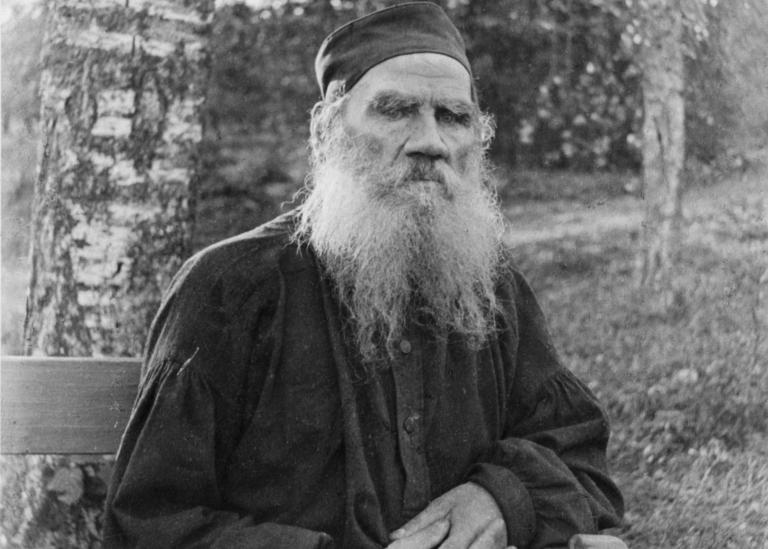
Leo Tolstoy, author of The Death of Ivan Ilych, in 1897 (F.W. Taylor, public domain)
The French novelist Jean Malaquais once said, “The only time I know something is true is the moment I discover it in the act of writing.” As it happens, Malaquais was a Communist; which makes me question the truth of the observation. I don’t know whether the statement becomes any more or less accurate if I change it this way: “The only time I know something is true is the moment I discover it in the act of reading.” I like the thought, even if the truth may be less than pristine. I suspect—or at least I hope very earnestly—that there will be libraries in heaven, where the truth will never be in question. Until then, I often like to think of a different, and still wondrous, category of books; and the only difficulty, for the sake of this particular post, was in narrowing them to seven. So the list is unduly selective.
I. FAITH TAKES PRACTICE
A PRAYER FOR OWEN MEANY
BY JOHN IRVING


This novel has the best and most daring first sentence that I have ever read: “I am doomed to remember a boy with a wrecked voice—not because of his voice, or because he was the smallest person I ever knew, or even because he was the instrument of my mother’s death, but because he is the reason I believe in God; I am a Christian because of Owen Meany.”
For many years, this was my favorite book; and even though another has since displaced it, I have read it eleven times. A Prayer for Owen Meany loses nothing through rereading. The ending is no longer a surprise, but even after eleven readings I marvel at how Irving was able to pull it off. Every detail—and I mean every detail—and every plot element is a set up for the climax, so Irving forces you to pay attention to everything. I admire writers who demand that I skip not a single sentence.
The plot begins when little Owen Meany, who never grows taller than five feet and whose trachea is in the position of a “permanent scream,” hits a foul ball that kills his best friend’s mother. Later, Owen claims to have seen his own name and his own date of death on a tombstone; later still, he has a dream in which he sees the circumstances of his own death. Part of the plot also involves the narrator’s search for his missing father and his efforts to keep death from coming to his best friend. The ending, while inevitable, is wholly surprising and wholly fitting. I have never known a writer, other than Dickens, who can walk the line so well between the farcical and the serious while moving toward an emotionally satisfying ending. At times, when Irving is at his most farcical, he is also at his most deadly serious. This is the funniest novel that I have ever read; it is also the most moving.
Mr. Irving has said that he began thinking of writing this novel when he asked himself: “What would be the magnitude of the miracle that would convince me of religious faith?” He decided that such a miracle, while it might convince him, would also destroy him. Johnny Wheelwright, the narrator and Owen’s best friend, wrestles with faith the same as Mr. Irving has. He longs for faith more than he ever finds it. Yet it is precisely because of his longing that we discover just how important faith is to him. Faith is, as Johnny tells us, quoting Kierkegaard, “the greatest and most difficult of all things.” Among the many strengths of the novel is that it is a book of deep faith that does not hide how hard faith is. Even Owen Meany, who has the greatest faith of any character in the book, tells us as much: “Faith takes practice.”
I came to this book (how very fitting) the very year I decided that I was an atheist. I read it most frequently in that four-year time period than I have since; which tells me, in hindsight, that I was never entirely comfortable being an atheist, and that I was looking for a reason—any reason—not to be. A Prayer for Owen Meany expressed, in ways I was not able to at the time, just how much faith meant to me.
II. INSTEAD OF DEATH THERE WAS LIGHT
THE DEATH OF IVAN ILYCH
BY LEO TOLSTOY


Imagine a book that can make death, forgiveness, and letting go both extraordinarily painful and and extraordinarily joyful, and then read The Death of Ivan Ilych and discover a book that exceeds the best that you have imagined. That is, in fact, the mark of a great writer: not that he has an extraordinary imagination, but that he exceeds the imagination. The Death of Ivan Ilych exceeds the imagination more than anything I have read.
John Irving, whose favorite writer is Charles Dickens, has left one Dickens novel—Our Mutual Friend—unread. As a measure of how much he admires Dickens, he’s saving up one unread novel for the right moment. Mr. Irving once said that he would like it if Our Mutual Friend was the last book he read before he dies, as though he has it in his power to choose any such thing.
At any rate, I bring this up because I also have a novel that I have been saving: Dostoevsky’s The Brothers Karamazov. Many friends have told me it is the one unread book I most need to read, which is why I have been saving it. But I also imagine, and easily, that I would want The Death of Ivan Ilych to be my last.
The subject of this short novel is how to die. Which makes it necessary to read while we are young and have life and health, but also necessary to return to as we march on toward the inevitable day. Teach me to live, that I may dread / The grave as little as my bed / Teach me to die …
III. THE TWIN SILVER TRUMPETS OF PRAISE
PILGRIM AT TINKER CREEK
BY ANNIE DILLARD


It is impossible for me to read Annie Dillard without coming away convinced that the English language was made so that she would write it.
I remember a conversation with a friend in graduate school, wherein we were striving to find the best way to contrast Annie Dillard and Joan Didion. I don’t remember why we conceived of such an odd duo of writers. Perhaps it’s just because we were in graduate school at the time, and that’s the kind of thing that comes up in coffee shops and bars in a university town.
At any rate, the comparison I made between the two was that Ms. Didion closes her arms and hides her face from the world in horror and dismay, whereas Ms. Dillard opens her arms and exults: “What joy!” That is why Pilgrim at Tinker Creek is one of those special and remarkable books that changed my life, and why I reread Annie Dillard to this day, and why I cannot bear to even look at the cover of a book by Joan Didion.
Pilgrim at Tinker Creek is Annie Dillard’s book of Psalms, written in prose, and with the sensibility of a naturalist wandering around all day observing the creation. It taught me the only proper attitude toward everything that God created: wonder and joy and awe. It is a book that shows us how to see the world, even down to its tiniest atom, and not miss it. It is a book that teaches us to look at the simplest of created things, from cracks in mountains to praying mantises, as though we were children again seeing them for the first time. If you miss out on this book, your life will be less.
IV. MY HEART SINGS ANEW THE GOODNESS OF THE LORD
ROME SWEET HOME
BY SCOTT & KIMBERLY HAHN


I know: Rome Sweet Home is obligatory and cliche for Catholic bloggers. But having considered the multiplicity of books I read during my conversion—and I read some great ones—I can not think of a better. There is, after all, a reason why Rome Sweet Home is cited by all of us converts.
But I will be honest: I resisted reading this book for a long time. Very early in my conversion, I listened to audio of Scott Hahn, and I could not for the life of me figure out why Catholics were so in awe of him. In my intellectual pride, I found his arguments easy and trite. “C’mon, Dr. Hahn, you don’t expect me to buy that, do you? Who do you take me for?” That was the kind of thing I would yell at the MP3 player.
But when I finally came around and gave Rome Sweet Home a chance, here is what I learned: I learned that a genuine intellectual conversion to the Catholic Church was possible; in other words, that converts weren’t just caught up in emotion, and that genuine arguments for Catholicism could be made. And I learned—which was a wondrous discovery—that giving up everything that you once believed and thought was true could, in fact, be an experience of joy.
V. JARGON, WORMWOOD, NOT ARGUMENT, IS YOUR BEST ALLY
THE SCREWTAPE LETTERS
BY C.S. LEWIS


I know that it is counterintuitive for a former atheist not to choose Mere Christianity. But here is the reason why this series of fictional letters between a demonic tempter and his hapless apprentice is the only choice for me: Every single one of the snares that Screwtape suggests to Wormwood—every method the devil uses to confuse us—has trapped and confused me, at one time or another. Especially the ones having to do with intellectual pride. And I continue to fall victim, which is why I continue to reread the book: It keeps me aware.
C.S. Lewis said that this was the book that he enjoyed writing the least, because it made him feel dirty to try to get into the head of a devil. I suppose that would be true. And yet the book is a masterpiece of literary irony. It is a masterpiece of informing Christians how they are tempted, and thus how they may avoid temptation. And, in the end, it is a wonderful story of salvation.
I was also fascinated to discover, through this book, that the devil is an intellectual. That strikes me as exactly right.
VI. THE MOST PRECIOUS THING IN THIS WORLD IS A MAN’S LIFE AND HIS FREEDOM
BABI YAR
BY ANATOLY KUZNETSOV


I first read this book when I was eighteen. I am surprised I managed to get through all of it at that age; and I was not able to bring myself to read it again until I was more than forty. (I’m 44 now, since I’m giving these things away.) There is no more direct, or stark, or uncompromising a portrait of human evil than in this book. Schindler’s List does not match it; Cormac McCarthy’s Blood Meridian does not match it; King Lear does not match it. Certain scenes in this book are not to be read unless you have an extraordinarily strong stomach; they involve the massacre of Soviet Jews during World War II, and they are graphic in detail beyond anything to be found anywhere else.
And yet it remains an incredibly timely and important book to read, because the capacity human beings have for evil has not diminished, and because ultimately the real point of the book is in one of its last sentences: “The most precious thing in this world is a man’s life and his freedom.” At a very early age, this book impressed upon me the importance of truth, the importance of not losing one’s history, and the sacred value of all life.
VII. BAPTIZED BY FIRE INTO THE BLADELIKE ARMS OF GOD
HOLY THE FIRM
BY ANNIE DILLARD


I have saved my favorite, and the greatest of all, for last.
If Pilgrim at Tinker Creek is Annie Dillard’s Book of Psalms, Holy the Firm is her Book of Job. It is incredibly short—just 60 pages that took Annie Dillard fourteen months to write, working full time. But in spite of its shortness, it is an incredibly rich and complex meditation on the suffering of the innocent and the fierceness of God, at the center of which stand two events: a moth that Dillard watched burn to to death in a candle wick, and a six-year-old girl whose face was burned off in an airplane accident. (In the book, Dillard changes the girl’s real name to “Julie Norwich,” after the Catholic mystic.)
Dillard reaches the same conclusion that the Book of Job does: “Who are we to demand explanations of God?” She reaches the conclusion that the purpose of life is to be a wick, and to have our heads “on fire with prayer,” and that it is not the life but the prayer that matters.
When the candle is burning, who looks at the wick? When the candle is out, who needs it? But the world without light is wasteland and chaos, and a life without sacrifice is abomination.
When I first read this wonderful and incredibly complex book (Dillard has said there are parts of it she doesn’t fully understand herself), I was not Catholic, and I was not aware that Dillard is a Catholic convert. Having become Catholic, I now realize how fully Catholic Dillard’s sensibility is, and I realize that the Carmelite spirituality of the book—the sense of a life of deep prayer lived wholly on fire for God—was preparing my heart and my mind to finally embrace the Catholic Church.
I could read this book a thousand times and never reach the bottom of it. I think I could read ten thousand more books before I die and never encounter prose poetry that is as good, or shot through with depth, as in this book. I do not think it is possible to write the English language better than Annie Dillard does here. I read her sentences and marvel. I can do no better to illustrate how good the writing in this book is than to quote the first paragraph.
Every day is a god, each day is a god, and holiness holds forth in time. I worship each god, I praise each day splintered down, splintered down and wrapped in time like a husk, a husk of many colors spreading, at dawn fast over the mountains split.
The greatest compliment I can give to any writer is to say, “I wish I could write like that,” and to know I never will.
You can never summarize a great book. Flannery O’Connor told us so much in Mystery and Manners, when she said that a great book “resists paraphrase.”
Thus I despair of the paraphrases that I have given above. The only way to really describe any of the books above is to read the whole thing. And that can’t be done in a blog post. But I hope that what I have written is enough to inspire you to choose some of these wonderful books and read them; or, if you have read them, to return to them.
Because another mark of a great book is not just that it invites rereading but that it demands it.
Good writing is slow, and careful. Good reading is also slow, and careful, and the obsession many have with “speed reading” is a psychological illness. Woody Allen has the best description of the effects of speed reading: “I took a speed reading course where you run your finger down the middle of the page. I read War and Peace in 20 minutes. It’s about Russia.”
Imagine saying, “I just don’t have the time.” What poverty. Books hath the power to change your life. Take the time for them, and take your time with them.
Read more of this week’s quick takes at Conversion Diary.
***
If you like the content on this blog, your generous gift to the author helps to keep it active. I remember all my supporters in my Mass intentions each week.
Previous Post
November 3, 2013
Pope Francis Derangement Syndrome Vol. II
Next Post

November 10, 2013 Peter Leithart Founds New Protestant Sect: "Reformational Catholicism"
Browse Our Archives
Select a Category Abortion About Me Answers for Calvinists Answers to Media Fictions Answers to Objections Anti-Catholicism Apologetics Apostolic Succession Atonement Authority of the Church Baptism Benedictines Biblical Exegesis Blogging Book Reviews Books & Writing &c. Calvin's Institutes Capital Punishment Catholic Church Chastity Christology Church Fathers Church Social Doctrine Confession Contraception Conversion Stories Crusades Debates Depression & Suicide Deuterocanon Development of Doctrine Ecumenism English Language Eucharistic Adoration Exorcism Extra Ecclesiam Fisks & Rebuttals Freedom of Religion Freedom of Speech Fundamentalism Gender Politics Gender Theory Good Works Homosexuality Humor Idolatry Immaculate Conception In the News Inquisition ISIS Islam Just for Fun Just War Justification LCWR Limbo Liturgical Abuse Liturgical Year Magisterium Marriage and Family Mary Mortal Sin New Evangelization NFP Papacy Papal Documents Papal Infallibility Personal Narrative Politics Pope Francis Pope Francis Derangement Syndrome Population Control Praying to the "Dead" Priesthood Primacy of Peter Protestant Denominations Purgatory Radical Islam Radical Traditionalists Real Presence Right to Conscience RIght to Life Saints Same-Sex "Marriage" Seven Quick Takes Social Justice Social Media Sola Scriptura Spirit of Vatican II SSPX The Eucharist The Mass The Resurrection Traditionalism Vatican II Year of Mercy
Select a Month August 2019 July 2019 June 2019 May 2019 November 2018 October 2018 August 2018 July 2018 June 2018 April 2018 November 2017 October 2017 September 2017 May 2017 April 2017 March 2017 February 2017 November 2016 October 2016 September 2016 August 2016 July 2016 June 2016 May 2016 April 2016 March 2016 February 2016 January 2016 December 2015 November 2015 October 2015 September 2015 July 2015 June 2015 May 2015 April 2015 March 2015 February 2015 January 2015 December 2014 September 2014 August 2014 July 2014 June 2014 May 2014 April 2014 March 2014 February 2014 January 2014 December 2013 November 2013 October 2013 May 2013 April 2013 February 2013 January 2013
Follow Us!
TAKE THE
Religious Wisdom Quiz
Which prophet raised a dead boy to life for the Shunammite woman?
Select your answer to see how you score.
Elisha Elijah Isaiah Samuel
Related posts from To Give a Defense
Is Premarital Kissing a Sin? and Other Quick...

Seven Reasons to Vote for Donald Trump. 7QT...
No, Virginia, Blogs are Not the Magisterium. 7QT...
TRENDING AT PATHEOS Catholic

Rejecting Doom: Christian Hope And Human Action
Christianity is a religion of hope. We are to have hope and...

It’s What Comes From Within Which Matters
One of the most difficult things for us to understand is why...

Why I Choose the Eucharist Over the Sermon
Choose the Eucharist, Not the Sermon What are we supposed to get...

5 Design Elements Found in Spiritually Rooted Homes
Putting Spirituality Into Home Decor Our homes are more than our living...

Credo: A Story of God Told with the...
About 10 years ago, I began to imagine a personal "Credo" that...

The Anatomy of Divine Revelation in Catholic Thought
The claim that God has made Himself known to human beings is...
view all Catholic blogs
Ad-Free & Subscriber Log-In Subscription Support
- About Us
- 2026 Calendar
- Videos
- Podcasts
- Library of World Religions
- Faith In Media Tracker
- Advertise With Us
- Write for Us
- Privacy Policy
- Terms of Service
- Do Not Sell My Data
- Contact Us
- Radiant Digital
- Manage Newsletter Subscriptions
- Unsubscribe From Notifications
- Sitemap
Copyright 2008-2026, Patheos. All rights reserved.
Subscription Support Ad-Free & Subscriber Log-In
Follow Patheos