
BuddhistCatholicContemplativeEvangelicalGeneral ChristianHinduJewishLatter-day SaintMuslimNew VisionsProgressive Christian
Beliefs
- Buddhist
- Catholic
- Contemplative
- Evangelical
- General Christian
- Hindu
- Jewish
- Latter-day Saint
- More Voices
- Muslim
- New Visions
- Pagan
- Progressive Christian
Topics
- Religion News
- Food and Religion
- Sports and Religion
- Religious Art
- Religious Music and Entertainment
- Religious Events
- History and Religion
- Style and Religion
- Politics and Religion
- Women in Religion
- Recreation Outdoors and Religion
- Business Finance and Religion
- Careers Workplace and Religion
- Education and Religion
- Family Parenting and Religion
- Health Fitness and Religion
- Home and Religion
- Relationships and Religion
- Technology and Religion
- Travel and Religion
Columnists
- Buddhist Columnists
- Business Finance and Religion Columnists
- Careers Workplace and Religion Columnists
- Catholic Columnists
- Contemplative Columnists
- Education and Religion Columnists
- Evangelists Columnists
- Family Parenting and Religion Columnists
- General Christian Columnists
- Health Fitness and Religion Columnists
- Hindu Columnists
- History and Religion Columnists
- Home and Religion Columnists
- Jewish Columnists
- More Voices Columnists
- Latter Day Columnists
- Muslim Columnists
- New Visions Columnists
- Nonreligious Columnists
- Pagan Columnists
- Politics and Religion Columnists
- Progressive Columnists
- Recreation Outdoors and Religion Columnists
- Relationships and Religion Columnists
- Religion News Columnists
- Religious Art Columnists
- Religious Events Columnists
- Religious Music and Entertainment Columnists
- Sports and Religion Columnists
- Style and Religion Columnists
- Technology and Religion Columnists
- Travel and Religion Columnists
- Women in Religion Columnists
Resource Library
- 2026 Calendar
- Library of World Religions
- The 100 Most Holy Places on Earth
- Patheos Answers
- Podcasts
- Videos
- Faith Leaders Database
- Anglican Episcopalian
- Bahai
- Baptist
- Buddhism
- Christianity
- Confucianism
- Eastern Orthodoxy
- Hinduism
- Holiness and Pentecostal
- ISKCON
- Islam
- Judaism
- Lutheran
- Methodist
- The Church of Jesus Christ of Latter-day Saints
- New Age
- Paganism
- Presbytarian and Reformed
- Protestantism
- Religion Behind the Scenes
- Roman Catholic
- Scientology
- Shia Islam
- Sikhism
- Sufism
- Sunni Islam
- Taoism
- Zen
- See all religions
Research Tools
 Ad-Free & Subscriber Log-In Subscription Support
Ad-Free & Subscriber Log-In Subscription Support
Follow Patheos 

- Trending:
- Forgiveness
- |
- Marriage
- |
- Consciousness
- |
- Death Penalty
- |
- Election
- |
- Halloween
 To Give a Defense
- Home
- Catholic
- Rolling Stoned on Pope Francis, Part III
Rolling Stoned on Pope Francis, Part III
Last updated on: March 4, 2018 at 6:54 pm by Scott Eric Alt
Rolling Stoned on Pope Francis, Part III 2018-03-04T18:54:20-04:00 Scott Eric Alt
Patheos Explore the world's faith through different perspectives on religion and spirituality! Patheos has the views of the prevalent religions and spiritualities of the world.
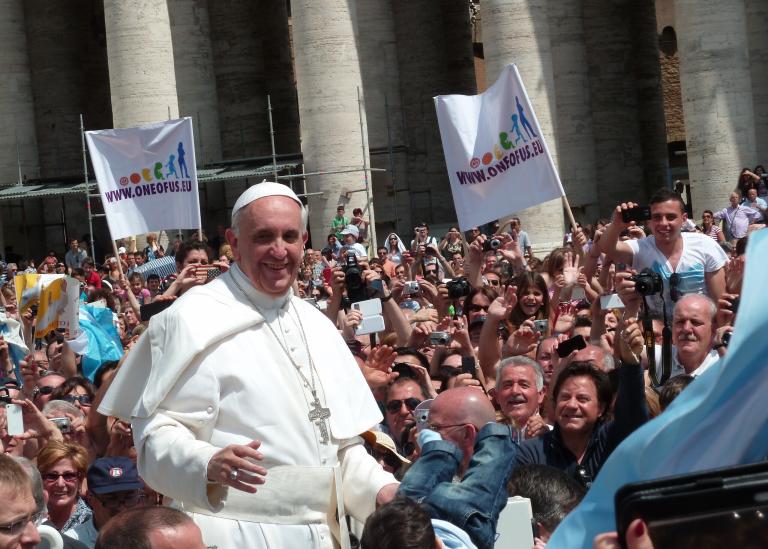
Photo credit: Edgar Jimenez, Creative Commons

Of Mark Binelli’s claim in Rolling Stoned (here)—that the pope’s critique of “unchecked free-market capitalism” in Evangelii Gaudium is the “most astonishing” aspect of his papacy thus far—not much need be said in this post. I had at first thought to write a review of the bulk of Catholic social teaching to help out Mr. Binelli (for I assure you he reads each word). I blithely thought I could do that in two thousand words or less, but it soon began to grow like the blog (I mean blob). So I leave all that for a different day and a different series. It is enough, for now, to make just these few notes. He that hath ears to hear, let him hear.
First, as has been pointed out by Catholic bloggers to the point of sleep (and I need more coffee too), Pope Francis does not once use the word “capitalism” in Evangelii Gaudium. (See here for one such post.) It is not there. Go to the Vatican Web site. Find the text. Search the text. Seek and ye shall not find. Search as oft and deep as ye shall like; it is not there.
In fact, the phrase “unfettered capitalism” does not come from Francis, but from this article in Reuters. The article was Rush Limbaugh’s one and only source for his brazen attack on the pope as a “Marxist.” Reuters at least was honest enough not to put the words in quotation marks. Though he was invited (and he admitted as much) to run a keyword search of the document on the Vatican Web site, Mr. Limbaugh would not do so. He had his drive-by media article and he was keeping his foot on the gas, no matter the wreck of truth he would make. As a result, a myth has emerged about the object of the pope’s critique; and like all myths, facts do not kill it no matter how oft they are told.
Yet I will repeat: It is not there. The phrase the pope does use is “unbridled consumerism.” And that is not the same. The pope does not use the word “capitalism” even once, but he uses the word “consumerism” three times. Here is one such place in the text:
The great danger in today’s world, pervaded as it is by [What’s the word?] consumerism, is the desolation and anguish of a complacent yet covetous heart [That means greed.], the feverish pursuit of frivolous pleasures, and a blunted conscience. (§2)
Far from being an attack on free markets, this is an attack on the endless pursuit of stuff. Greed is well known to be a problem in all economies, at all times, from A to Z, dawn to dusk, north to south, Adam to Armageddon. The gist of what the pope says here is not that markets are bad, but that greed does not satisfy the human heart and blunts the conscience. However enamored he is of capitalism, I doubt that even Mr. Limbaugh would deny that greed is a sin.
And an attack on greed is far from new; popes have been attacking greed since there have been popes. Francis calls it “the idolatry of money.” To say that it is a sin is part of something called Christianity. Mr. Binelli may have heard of it: “The love of money is the root of all evil” (1 Tim. 6:10). It was St. Paul who said that. “You cannot serve God and money” (Luke 16:13). It was Christ who said that. You may search for popes who taught something else, if you have such time, but you will not find one.
Second, even if the pope had used the word “capitalism” (for he does attack “free” markets when they are fueled by greed), other popes have said much harder things on the subject. Take, for example—oh, I don’t know—Benedict XVI. When Mr. Binelli tells us that the new pope’s attack on “unchecked free-market capitalism” is “astonishing,” he seems to want us to believe that the old pope was as capitalist as Mr. Limbaugh himself; yea, even Ayn Rand and John Galt and the Brothers Koch and the vast oil lobby that fueled the Bush years and burned the poor and sent storms into the Gulf. But Mr. Binelli should take one more look (if not his first) at these words:
[T]he world is sadly marked by hotbeds of tension and conflict caused by growing instances of inequality between rich and poor, by the prevalence of a selfish and individualistic mindset which also finds expression in [Watch this, now.] an unregulated financial capitalism.
Did you catch that, Mr. Binelli? Pope Benedict XVI—the dour, nightmarish Freddy Krueger of Catholicism, who will slash you as you sleep and steal mites from pious crones—blasts “inequality between rich and poor.” He says that “unregulated financial capitalism” is “selfish.” How—oh, I don’t know—astonishing! That sounds so very much like … Francis! Why did Stoned not seek its muse to sing the praise of Benedict? Were all of the nine dumb that day?
Third, no pope—not Francis, not Benedict, nor any pope before—ever attacks capitalism per se. Rather, what they attack is capitalism unchecked by our moral obligation to the poor. What they attack is capitalism as a path to the getting of more and more stuff. The Catechism puts it well; perhaps as an act of charity, or penance, one should send this to Stoned.
A theory that makes profit the exclusive norm and ultimate end of economic activity is morally unacceptable. The [Note.] disordered desire for money cannot but produce perverse effects. It is one of the causes of the many conflicts which disturb the social order. A system that “subordinates the basic rights of individuals and of groups to the collective organization of production” is contrary to human dignity. [Strong words.] Every practice that reduces persons to nothing more than a means of profit enslaves man, leads to [Watch now.] idolizing money, and contributes to the spread of atheism. “You cannot serve God and mammon.” (CCC 2424)
It sounds like our fuzzy new pope might have writ all of that. Odd, then, to find it in the authoritative source for what the Church has always taught! How could that be, and Stoned not know?
Fourth, the attack on “unchecked” capitalism does not mean, as many fear on the right and hope on the left, that the Church—or some pope—is for socialism or Marxism. (As though the pope thinks that religion is “the opiate of the Masses.”) The Catechism goes on to say:
The Church has rejected the totalitarian and atheistic ideologies associated in modern times with “communism” or “socialism.” She has likewise refused to accept, in the practice of “capitalism,” individualism and the absolute primacy of the law of the marketplace over human labor. (CCC 2425)
Take out your red pen and mark this. Score it thrice and put stars in the margin. The Church has always rejected both socialism and “unfettered” capitalism. What the pope says is not any different from what has always been said. The Francis of Mr. Binelli’s daydreams, no less than the previous popes of his nightmares, has called Marxism an “opiate” that “does not allow the people to progress.” (See this article for the source.)
Fifth, the Church’s social teaching in this regard—that both socialism and unchecked capitalism are evils to avoid—has been the same since Pope Leo XIII first wrote on the topic, in Rerum Novarum, in 1891. In that encyclical, Leo called socialism a form of robbery. It is “manifestly against justice,” he says. “For every man has by nature the right to possess property as his” (§6).
At the same time, says Leo, we all have the duty to care for the poor and to not gather wealth at the expense of others. “To misuse men,” he says, “as though they were things in the pursuit of gain … is truly shameful and inhuman.” An employer’s “great and principle duty is to give every one what is just” (§20). Moreover—and this is a key passage:
[T]he rich should tremble at the teachings of Jesus Christ. [The new pope has said nothing as strong as that.] [A] most strict account should be given to the supreme Judge for all we possess. … It is one thing to have a right to the possession of money and another to have a right to use money as one wills. (§22)
Sixth, all this has been the teaching, not once changed, of every pope who has taken up the question since Leo XIII. It was the teaching of Pius XI (here); of John XXIII (here and here); of the Second Vatican Council (here and here); of Paul VI (here, here, and here); of John Paul II (here, here, and here); of Benedict XVI (here); and now of Francis (here).
Those who know Catholic social teaching like they should know that the Church favors neither Marxism nor capitalism, but instead the “third way” of distributism. Leo XIII and his successors have set forth the principles of it at great length and detail. Distributism is a scandal to both right and left, who insist on thinking in the false dichotomy of capitalism vs. socialism. It is a scandal to those who want to paint Dorothy Day as a communist, although she was not. And it is a scandal to those who want to paint a picture of Francis as somehow “astonishingly” at odds with his predecessor; which he too is not.
***
If you like the content on this blog, your generous gift to the author helps to keep it active. I remember all my supporters in my Mass intentions each week.
Previous Post
February 2, 2014
A Modest Proposal for Increasing the Relevance of Holy Mass
Next Post

February 5, 2014 United Nations to Pope Francis: Change Your Doctrine
Browse Our Archives
Select a Category Abortion About Me Answers for Calvinists Answers to Media Fictions Answers to Objections Anti-Catholicism Apologetics Apostolic Succession Atonement Authority of the Church Baptism Benedictines Biblical Exegesis Blogging Book Reviews Books & Writing &c. Calvin's Institutes Capital Punishment Catholic Church Chastity Christology Church Fathers Church Social Doctrine Confession Contraception Conversion Stories Crusades Debates Depression & Suicide Deuterocanon Development of Doctrine Ecumenism English Language Eucharistic Adoration Exorcism Extra Ecclesiam Fisks & Rebuttals Freedom of Religion Freedom of Speech Fundamentalism Gender Politics Gender Theory Good Works Homosexuality Humor Idolatry Immaculate Conception In the News Inquisition ISIS Islam Just for Fun Just War Justification LCWR Limbo Liturgical Abuse Liturgical Year Magisterium Marriage and Family Mary Mortal Sin New Evangelization NFP Papacy Papal Documents Papal Infallibility Personal Narrative Politics Pope Francis Pope Francis Derangement Syndrome Population Control Praying to the "Dead" Priesthood Primacy of Peter Protestant Denominations Purgatory Radical Islam Radical Traditionalists Real Presence Right to Conscience RIght to Life Saints Same-Sex "Marriage" Seven Quick Takes Social Justice Social Media Sola Scriptura Spirit of Vatican II SSPX The Eucharist The Mass The Resurrection Traditionalism Vatican II Year of Mercy
Select a Month August 2019 July 2019 June 2019 May 2019 November 2018 October 2018 August 2018 July 2018 June 2018 April 2018 November 2017 October 2017 September 2017 May 2017 April 2017 March 2017 February 2017 November 2016 October 2016 September 2016 August 2016 July 2016 June 2016 May 2016 April 2016 March 2016 February 2016 January 2016 December 2015 November 2015 October 2015 September 2015 July 2015 June 2015 May 2015 April 2015 March 2015 February 2015 January 2015 December 2014 September 2014 August 2014 July 2014 June 2014 May 2014 April 2014 March 2014 February 2014 January 2014 December 2013 November 2013 October 2013 May 2013 April 2013 February 2013 January 2013
Follow Us!
TAKE THE
Religious Wisdom Quiz
What is the last book of the Old Testament?
Select your answer to see how you score.
Malachi Haggai Micah Zechariah
Related posts from To Give a Defense

Documentation of Taylor Marshall's attacks on Pope Francis...
Health care is a human right that precedes...

But Alt! The Church Says Nations Have a...

Yes, I'm a Social Justice Warrior. Why Aren't...
TRENDING AT PATHEOS Catholic

Rejecting Doom: Christian Hope And Human Action
Christianity is a religion of hope. We are to have hope and...

It’s What Comes From Within Which Matters
One of the most difficult things for us to understand is why...

Why I Choose the Eucharist Over the Sermon
Choose the Eucharist, Not the Sermon What are we supposed to get...

5 Design Elements Found in Spiritually Rooted Homes
Putting Spirituality Into Home Decor Our homes are more than our living...

Credo: A Story of God Told with the...
About 10 years ago, I began to imagine a personal "Credo" that...

The Anatomy of Divine Revelation in Catholic Thought
The claim that God has made Himself known to human beings is...
view all Catholic blogs
Ad-Free & Subscriber Log-In Subscription Support
- About Us
- 2026 Calendar
- Videos
- Podcasts
- Library of World Religions
- Faith In Media Tracker
- Advertise With Us
- Write for Us
- Privacy Policy
- Terms of Service
- Do Not Sell My Data
- Contact Us
- Radiant Digital
- Manage Newsletter Subscriptions
- Unsubscribe From Notifications
- Sitemap
Copyright 2008-2026, Patheos. All rights reserved.
Subscription Support Ad-Free & Subscriber Log-In
Follow Patheos