
BuddhistCatholicContemplativeEvangelicalGeneral ChristianHinduJewishLatter-day SaintMuslimNew VisionsProgressive Christian
Beliefs
- Buddhist
- Catholic
- Contemplative
- Evangelical
- General Christian
- Hindu
- Jewish
- Latter-day Saint
- More Voices
- Muslim
- New Visions
- Pagan
- Progressive Christian
Topics
- Religion News
- Food and Religion
- Sports and Religion
- Religious Art
- Religious Music and Entertainment
- Religious Events
- History and Religion
- Style and Religion
- Politics and Religion
- Women in Religion
- Recreation Outdoors and Religion
- Business Finance and Religion
- Careers Workplace and Religion
- Education and Religion
- Family Parenting and Religion
- Health Fitness and Religion
- Home and Religion
- Relationships and Religion
- Technology and Religion
- Travel and Religion
Columnists
- Buddhist Columnists
- Business Finance and Religion Columnists
- Careers Workplace and Religion Columnists
- Catholic Columnists
- Contemplative Columnists
- Education and Religion Columnists
- Evangelists Columnists
- Family Parenting and Religion Columnists
- General Christian Columnists
- Health Fitness and Religion Columnists
- Hindu Columnists
- History and Religion Columnists
- Home and Religion Columnists
- Jewish Columnists
- More Voices Columnists
- Latter Day Columnists
- Muslim Columnists
- New Visions Columnists
- Nonreligious Columnists
- Pagan Columnists
- Politics and Religion Columnists
- Progressive Columnists
- Recreation Outdoors and Religion Columnists
- Relationships and Religion Columnists
- Religion News Columnists
- Religious Art Columnists
- Religious Events Columnists
- Religious Music and Entertainment Columnists
- Sports and Religion Columnists
- Style and Religion Columnists
- Technology and Religion Columnists
- Travel and Religion Columnists
- Women in Religion Columnists
Resource Library
- 2026 Calendar
- Library of World Religions
- The 100 Most Holy Places on Earth
- Patheos Answers
- Podcasts
- Videos
- Faith Leaders Database
- Anglican Episcopalian
- Bahai
- Baptist
- Buddhism
- Christianity
- Confucianism
- Eastern Orthodoxy
- Hinduism
- Holiness and Pentecostal
- ISKCON
- Islam
- Judaism
- Lutheran
- Methodist
- The Church of Jesus Christ of Latter-day Saints
- New Age
- Paganism
- Presbytarian and Reformed
- Protestantism
- Religion Behind the Scenes
- Roman Catholic
- Scientology
- Shia Islam
- Sikhism
- Sufism
- Sunni Islam
- Taoism
- Zen
- See all religions
Research Tools
 Ad-Free & Subscriber Log-In Subscription Support
Ad-Free & Subscriber Log-In Subscription Support
Follow Patheos 

- Trending:
- Forgiveness
- |
- Marriage
- |
- Consciousness
- |
- Death Penalty
- |
- Election
- |
- Halloween
 To Give a Defense
- Home
- Catholic
- Remember Your Baptism
Remember Your Baptism
Last updated on: March 13, 2017 at 10:22 pm by Scott Eric Alt
Remember Your Baptism 2017-03-13T22:22:53-04:00 Scott Eric Alt
Patheos Explore the world's faith through different perspectives on religion and spirituality! Patheos has the views of the prevalent religions and spiritualities of the world.
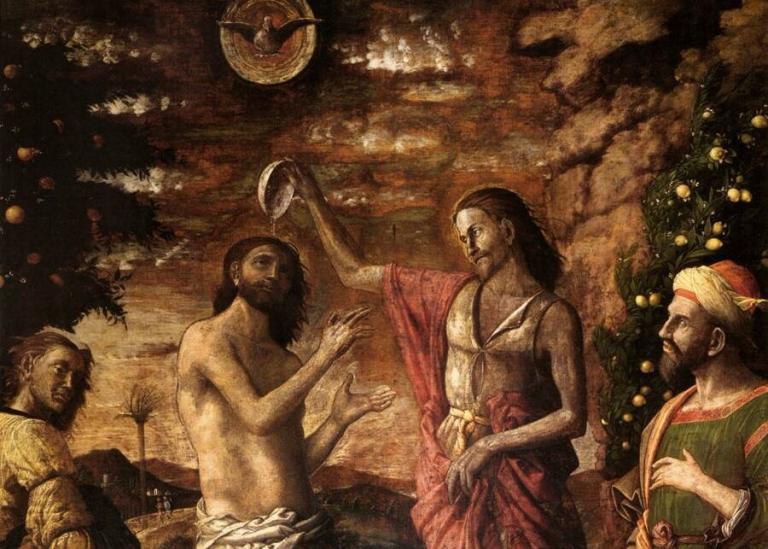
Andrea Mantegna, “Baptism of Christ,” ca. 1505
God has a remarkable proclivity for accomplishing his work through the material things of this earth–but foremost among them, possibly, is water. At the very beginning of creation, God is said to be “moving over the face of the waters” (Gen. 1:2). Before God has created anything specific or concrete, water exists. He creates the “heavens and the earth,” but as yet they are “without form and void.” They are just the raw materials, created ex nihilo. But there is water; when God says, “let there be light,” his spirit is upon the waters. And then, God’s very next creative act is to “separate the waters from the waters” (Gen. 1:6). Water exists with God from the beginning.
i.
Who can list all the examples, through all of Sacred Scripture, in which God uses water to accomplish his purposes? Once when I was in Sunday School as a United Methodist, the teacher gave us the assignment to find all the examples we could where the word “love” was used in the Bible. We had a week. We may as well have been told to find all the examples where God uses water. If human beings cannot survive without water, it would seem that God cannot do some of his greatest acts except through water. Or, he could, but he doesn’t, which suggests to me that these acts are best achieved through water.
Thousands of years after the creation God, through Moses, is leading the descendants of Abraham away from Egypt after being freed by Pharoah. Pharoah has decided he made a mistake in letting them go; after all, they meant wealth to Egypt. He sends his chariots after them. The Israelites are unarmed and on foot. Exodus 14:26-29 continues the story.
Then the Lord said to Moses, “Stretch out your hand over the sea, that the water may come back upon the Egyptians, upon their chariots, and upon their horsemen.” So Moses stretched forth his hand over the sea, and the sea returned to its wonted flow when the morning appeared; and the Egyptians fled into it, and the Lord routed the Egyptians in the midst of the sea. The waters returned and covered the chariots and the horsemen and all the host of Pharoah that had followed them into the sea; not so much as one of them remained. But the people of Israel walked on dry ground through the sea, the waters being a wall to them on their right hand and on their left*.*
Did you catch that? “The waters being a wall to them on their right hand and on their left”: Where have you heard that before? Right from the beginning, in fact: “And God said, ‘Let there be a firmament in the midst of the waters, and let it separate the waters from the waters‘” (Gen. 1:6). God creates the Earth by separating the waters, and God creates the nation of Israel by separating the waters. Later, God creates the Church through another separation of water, after Christ has died but before he has been removed from the Cross: “But one of the soldiers pierced his side with a spear, and at once there came out blood and water” (John 19:34). The world, the nation of Israel, and the Church are all created through a separation of water. Something important–a great mystery–would seem to be involved in all that.
ii.
One last example from the Old Testament would bear looking at, and that is the healing of Naaman of leprosy in 2 Kings. In the Old Testament, leprosy is a figure of sin: In the same way that sin separates us from God, leprosy separates one from the community. Possibly the connection was made because of the greatly contagious nature of both. Naaman was “commander of the army of the king of Syria,” and highly-favored by his master because of his victories in battle. As the writer of 2 Kings tells it, Naaman was “a mighty man of valor.” But he had leprosy, and so he goes to the prophet Elisha seeking to be healed. Elisha tells him, “Go and wash in the Jordan seven times, and your flesh shall be restored, and you shall be clean” (2 Kings 5:10).
Naaman does not take the suggestion well. His thought was that Elisha would merely “call on the name of the Lord his God, and wave his hand all over the place” (2 Kings 5:11). If I didn’t know any better, I would suspect that Naaman had been watching too many faith-healing programs on the Christian Broadcasting Network. Naaman has a further complaint, which has to do with his notion of the dirtiness of the Jordan River. “Are not Abana and Pharpar, the rivers of Damascus, better than all the waters of Israel?” he says. “Could I not wash in them, and be clean?” And thus, because God refuses to heal Naaman in the manner that Naaman thinks God ought to heal him, “he turned and went away in a rage.” Well, it is funny, but if the doctor told me that I was in need of surgery, I’m sure my first reaction would be, “Couldn’t you just give me a pill for that?”
Saner heads prevail among Naaman’s servants, who instruct Naaman that if Elisha had told him to lead men into a great battle and he would be healed, surely Naaman would have done that. “How much rather, then, when he says to you, ‘Wash, and be clean?'” (2 Kings 5:13). Just take a bath, already, Naaman; why must you protest because God doesn’t want to heal you your way? So Naaman does, “and his flesh was restored like the flesh of a little child, and he was clean” (1 Kings 5:14).
God heals us with water; and if leprosy is, in the Old Testament, a figure of sin, would it not be surprising if God were to heal our sin with water too? Some people do have trouble grasping that.
iii.
Jesus came to the same river—the Jordan—seeking to be baptized. He didn’t have leprosy, and he didn’t have sin, so John the Baptist is surprised and protests. “I need to be baptized by you, and you come to me?” (Matt. 3:14). In the movies these lines could be delivered in a variety of ways, though I normally see the actor deliver them with humility, in recognition that he has been given a great honor to be the one who baptizes Christ. That is exactly right. In the Guido Reni painting, both Christ and John are in a posture of humility: Christ with his hands folded in prayer and his gaze toward the earth; John with his gaze down as well, but his right knee bent in a kneeling posture. Christ’s answer to John is significant: “Let it be so now; for thus it is fitting for us to fulfil all righteousness” (Matt. 3:15). This is a sacramental answer; by being baptized, in some mysterious way we fulfil righteousness.
Some Protestant denominations–mainly Reformed churches, as well as some other Baptist groups that reject Calvinism–think of baptism as an “ordinance.” They reject a sacramental understanding of Christianity, and so they talk about two “ordinances” established by Christ: baptism and The Lord’s Supper (which is how they refer to the Eucharist). To my ears, it is as though Christ is the mayor of the local church body, and he might issue a citation if you’re not baptized (as an adult, of course). I think that the legalism in this is a byproduct of how Reformed churches think of justification–that it is a legal imputation of Christ’s righteousness. Thus they can refer to what Catholics understand as sacramental in the cold and legal terminology of “ordinances.” But this is not how Christ spoke of baptism when he spoke of it as “fulfilling righteousness”; legalistic language does not follow from his words to Nicodemus in John 3, when he spoke of being “born of water” in the context of “having eternal life.”
In his first epistle, St. Peter spoke of baptism in sacramental language as well. In chapter 3, St. Peter develops what might be described as a theology of water.
God’s patience waited in the days of Noah, during the building of the ark, in which a few, that is, eight persons, were saved through water. Baptism, which corresponds to this, now saves you, not as a removal of dirt from the body but as an appeal to God for a clear conscience, through the resurrection of Jesus Christ (1 Peter 3:20-21).
Baptism, in Peter’s words, is not merely “a removal of dirt from the body.” He’s speaking here of physical dirt, not moral dirt. It doesn’t merely have physical properties; it has sacramental, salvific properties. He speaks of Noah and his family being “saved through water.” By the waters of the flood, God destroyed the earth but saved a righteous people. That is to say, through water, God removed sin and restored righteousness. Baptism, as Peter explains, “corresponds to this.” It “saves”–just as righteousness was saved through the flood–and Peter appeals to the very Resurrection as testimony for that. It might be said that 1 Peter 3:20-21 is an exegesis of Christ’s words about baptism “fulfilling all righteousness.”
Through the waters of birth, we are born into life. Through the waters of baptism, we are born into the Kingdom of God. Baptism now saves you.
iv.
Martin Luther—who was right about some things; he did understand baptism as both sacramental and salvific—is often known for his words “Remember your baptism.” When you wash your face in the morning, when you wash your face at night: Remember your baptism. It’s a good practice. There was a time when I seriously contemplated joining a Baptist church. But I knew that to do so I would need to be rebaptized, because I was baptized as a child; Baptists do not believe in infant baptism. I also knew, however, that my grandfather baptized me. He was a United Methodist minister. That was far too special a point of knowledge on my part to ever contemplate undergoing an act that I felt would “redo” or “undo” what my grandfather had given me. I didn’t have a fully-worked-out theology of baptism wherein I necessarily thought of it as a once-for-all act. I do now. But I knew that my grandfather had baptized me. That was enough.
I don’t mean to suggest that I would never ultimately have become Catholic if I had made that move. I know I would have. But I would also have brought with me the knowledge that in some way I had undone what my grandfather had given me, and that would be too great a pain–particularly with the knowledge that the refusal of infant baptism, and the act of anabaptism, are both heresy.
Thus I am able, every morning and ever night, to remember my baptism, despite it having occurred when I was only two months old.
Remember yours.
***
If you like the content on this blog, your generous gift to the author helps to keep it active. I remember all my supporters in my Mass intentions each week.
Previous Post

January 11, 2013
John Bugay's Eisegetical Creativity
Next Post
January 14, 2013 I See Men as Trees Walking Part III: The Allegory of Fear
Browse Our Archives
Select a Category Abortion About Me Answers for Calvinists Answers to Media Fictions Answers to Objections Anti-Catholicism Apologetics Apostolic Succession Atonement Authority of the Church Baptism Benedictines Biblical Exegesis Blogging Book Reviews Books & Writing &c. Calvin's Institutes Capital Punishment Catholic Church Chastity Christology Church Fathers Church Social Doctrine Confession Contraception Conversion Stories Crusades Debates Depression & Suicide Deuterocanon Development of Doctrine Ecumenism English Language Eucharistic Adoration Exorcism Extra Ecclesiam Fisks & Rebuttals Freedom of Religion Freedom of Speech Fundamentalism Gender Politics Gender Theory Good Works Homosexuality Humor Idolatry Immaculate Conception In the News Inquisition ISIS Islam Just for Fun Just War Justification LCWR Limbo Liturgical Abuse Liturgical Year Magisterium Marriage and Family Mary Mortal Sin New Evangelization NFP Papacy Papal Documents Papal Infallibility Personal Narrative Politics Pope Francis Pope Francis Derangement Syndrome Population Control Praying to the "Dead" Priesthood Primacy of Peter Protestant Denominations Purgatory Radical Islam Radical Traditionalists Real Presence Right to Conscience RIght to Life Saints Same-Sex "Marriage" Seven Quick Takes Social Justice Social Media Sola Scriptura Spirit of Vatican II SSPX The Eucharist The Mass The Resurrection Traditionalism Vatican II Year of Mercy
Select a Month August 2019 July 2019 June 2019 May 2019 November 2018 October 2018 August 2018 July 2018 June 2018 April 2018 November 2017 October 2017 September 2017 May 2017 April 2017 March 2017 February 2017 November 2016 October 2016 September 2016 August 2016 July 2016 June 2016 May 2016 April 2016 March 2016 February 2016 January 2016 December 2015 November 2015 October 2015 September 2015 July 2015 June 2015 May 2015 April 2015 March 2015 February 2015 January 2015 December 2014 September 2014 August 2014 July 2014 June 2014 May 2014 April 2014 March 2014 February 2014 January 2014 December 2013 November 2013 October 2013 May 2013 April 2013 February 2013 January 2013
Follow Us!
TAKE THE
Religious Wisdom Quiz
My name is Amos, before God called me to prophesy against Israel what was my occupation?
Select your answer to see how you score.
Priest in the temple Spinner of cloth Fisherman Shepherd and farmer
Related posts from To Give a Defense
Infant Baptism is Not in the Bible! Answers...
Did Pius V Condemn Cajetan on the Baptism...
A Clarification On the Salvation of Infants Who...

Documentation of Taylor Marshall's attacks on Pope Francis...
TRENDING AT PATHEOS Catholic

Rejecting Doom: Christian Hope And Human Action
Christianity is a religion of hope. We are to have hope and...

It’s What Comes From Within Which Matters
One of the most difficult things for us to understand is why...

Why I Choose the Eucharist Over the Sermon
Choose the Eucharist, Not the Sermon What are we supposed to get...

5 Design Elements Found in Spiritually Rooted Homes
Putting Spirituality Into Home Decor Our homes are more than our living...

Credo: A Story of God Told with the...
About 10 years ago, I began to imagine a personal "Credo" that...

The Anatomy of Divine Revelation in Catholic Thought
The claim that God has made Himself known to human beings is...
view all Catholic blogs
Ad-Free & Subscriber Log-In Subscription Support
- About Us
- 2026 Calendar
- Videos
- Podcasts
- Library of World Religions
- Faith In Media Tracker
- Advertise With Us
- Write for Us
- Privacy Policy
- Terms of Service
- Do Not Sell My Data
- Contact Us
- Radiant Digital
- Manage Newsletter Subscriptions
- Unsubscribe From Notifications
- Sitemap
Copyright 2008-2026, Patheos. All rights reserved.
Subscription Support Ad-Free & Subscriber Log-In
Follow Patheos