
BuddhistCatholicContemplativeEvangelicalGeneral ChristianHinduJewishLatter-day SaintMuslimNew VisionsProgressive Christian
Beliefs
- Buddhist
- Catholic
- Contemplative
- Evangelical
- General Christian
- Hindu
- Jewish
- Latter-day Saint
- More Voices
- Muslim
- New Visions
- Pagan
- Progressive Christian
Topics
- Religion News
- Food and Religion
- Sports and Religion
- Religious Art
- Religious Music and Entertainment
- Religious Events
- History and Religion
- Style and Religion
- Politics and Religion
- Women in Religion
- Recreation Outdoors and Religion
- Business Finance and Religion
- Careers Workplace and Religion
- Education and Religion
- Family Parenting and Religion
- Health Fitness and Religion
- Home and Religion
- Relationships and Religion
- Technology and Religion
- Travel and Religion
Columnists
- Buddhist Columnists
- Business Finance and Religion Columnists
- Careers Workplace and Religion Columnists
- Catholic Columnists
- Contemplative Columnists
- Education and Religion Columnists
- Evangelists Columnists
- Family Parenting and Religion Columnists
- General Christian Columnists
- Health Fitness and Religion Columnists
- Hindu Columnists
- History and Religion Columnists
- Home and Religion Columnists
- Jewish Columnists
- More Voices Columnists
- Latter Day Columnists
- Muslim Columnists
- New Visions Columnists
- Nonreligious Columnists
- Pagan Columnists
- Politics and Religion Columnists
- Progressive Columnists
- Recreation Outdoors and Religion Columnists
- Relationships and Religion Columnists
- Religion News Columnists
- Religious Art Columnists
- Religious Events Columnists
- Religious Music and Entertainment Columnists
- Sports and Religion Columnists
- Style and Religion Columnists
- Technology and Religion Columnists
- Travel and Religion Columnists
- Women in Religion Columnists
Resource Library
- 2026 Calendar
- Library of World Religions
- The 100 Most Holy Places on Earth
- Patheos Answers
- Podcasts
- Videos
- Faith Leaders Database
- Anglican Episcopalian
- Bahai
- Baptist
- Buddhism
- Christianity
- Confucianism
- Eastern Orthodoxy
- Hinduism
- Holiness and Pentecostal
- ISKCON
- Islam
- Judaism
- Lutheran
- Methodist
- The Church of Jesus Christ of Latter-day Saints
- New Age
- Paganism
- Presbytarian and Reformed
- Protestantism
- Religion Behind the Scenes
- Roman Catholic
- Scientology
- Shia Islam
- Sikhism
- Sufism
- Sunni Islam
- Taoism
- Zen
- See all religions
Research Tools
 Ad-Free & Subscriber Log-In Subscription Support
Ad-Free & Subscriber Log-In Subscription Support
Follow Patheos 

- Trending:
- Forgiveness
- |
- Marriage
- |
- Consciousness
- |
- Death Penalty
- |
- Election
- |
- Halloween
 To Give a Defense
- Home
- Catholic
- The Pope, an Anglican, and a Pentecostal Walk Into a Bar; Or, the State of Ecumenism at the Present Time
The Pope, an Anglican, and a Pentecostal Walk Into a Bar; Or, the State of Ecumenism at the Present Time
Last updated on: March 9, 2017 at 2:08 am by Scott Eric Alt
The Pope, an Anglican, and a Pentecostal Walk Into a Bar; Or, the State of Ecumenism at the Present Time 2017-03-09T02:08:30-04:00 Scott Eric Alt
Patheos Explore the world's faith through different perspectives on religion and spirituality! Patheos has the views of the prevalent religions and spiritualities of the world.
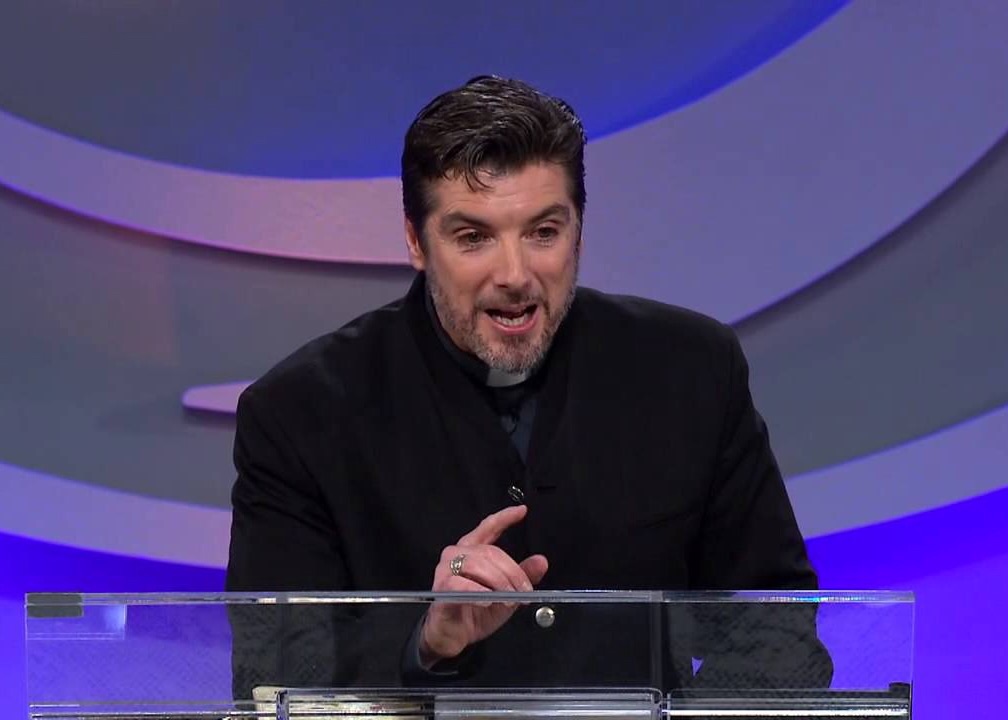
So the pope recorded a video on an iPhone for a meeting of Pentecostals led by TV evangelist Kenneth Copeland. You may have heard this. His theme was ecumenism and the brotherhood of all Christians. It was an informal, honest, and deeply-felt plea for unity; and it was indeed moving to see a Protestant audience praying for the pope as a fellow Christian. Who writes that script? Catholic blogs and social media talked about it all weekend, after Aggie Catholics posted the original story on Thursday. Some (like Elizabeth Scalia) were moved to tears of joy. Others (like Fr. Dwight Longenecker here and here and Brantly Millegan here) urged caution—not because of the pope but because of the middleman. Others, of an über-Traditionalist bent, predictably rent their garments. (See this article by Louie Verrecchio of Harvesting the Nuts.)
Here is how it all came to pass. Tony Palmer, an Anglican bishop of the Communion of Evangelical Episcopal Churches (CEEC), is a longtime friend of both Mr. Copeland and Pope Francis. He has worked for years in the interest of ecumenical dialogue between Protestants and Catholics. When last in Rome, he met with the pope and told him of the work he was doing with Kenneth Copeland Ministries. The pope for his part said he would record some words for KCM as a gesture of Christian fraternity and good will and the hope that we may once more be one. The bishop then brought the video, edited and with subtitles, to be played at one of Mr. Copeland’s recorded gatherings.
The full video, which is 45 minutes long but should be watched in full, is (to be frank) a complex and remarkable mix of truth, good will, genuine ecumenical longing, but at the same time dangerous error. None of the error, however, was on the part of the pope; almost all of it was on the part of Bishop Palmer. But it was he who provided Mr. Copeland’s audience with the context and framing of the pope’s words (before they were played), and thus it was he who had the power to shape their impression of all that the pope thought and meant.
WHAT THE POPE SAID
For this reason, we must come to the pope’s words first, apart from how the bishop framed them. Mr. Verrecchio calls them “confusing, a danger to souls, and utterly irresponsible,” but that’s a very hard judgment to sustain against what is little more than the heartfelt desire for Christian unity. If we are not praying along with Christ that we may all be one, we should peer into our own hearts to see how black. Francis does not say what he thinks would be required for unity to actually take place.
Here is what the pope did say, along with my own [emendations] and [comments]:
[The pope begins by apologizing that he cannot speak English, but says that he will speak from the heart.]
[There are] two rules: Love God above all, and love the other because he is your brother and sister [Matt. 22:36-40]. With these two rules we can go ahead.
[That sounds very much as though the pope means only this: that to say we are brothers is a starting point for further dialogue.]
I am here with my brother bishop Tony Palmer. [This “brother bishop” part was what most perturbed Mr. Verrecchio.] We’ve been friends for years. He told me about your conference … and it’s my pleasure to greet you—a greeting both joyful and [full of longing.
It is] joyful because it gives me joy that you have come together to worship Jesus Christ the only Lord and to pray to the Father and receive the Spirit. [Whatever else our differences, our brotherhood is based on shared belief in Jesus Christ.] This brings me joy because we can see that God is working all over the world.
[It is full of longing] because [like many families] we are, permit me to say, separated. It is sin that has separated us—all our sins [and] misunderstandings throughout history. It has been a long road of sins that we [have] all shared in. Who is to blame? We all share the blame. We have all sinned. There is only one blameless, the Lord.
[Although the Catholic Church has the fullness of truth, it is self-righteous to blame only the sins of Protestants for what has kept us apart these last 500 years.]
I long that this separation comes to an end and gives us communion. I yearn for that embrace. [And anyone who would not is like the bitter brother in the parable.]
[Here the pope, to illustrate his point, tells the story of Joseph and his brothers.]
We have a lot of cultural riches and religious riches, and we have diverse traditions. But we have to encounter one another as brothers. [That is the heart of the pope’s message to Pentecostals.] We must cry together like Joseph did. These tears will unite us. … I am speaking to you as a brother; I speak to you in a simple way, with joy and yearning. Let us allow our yearning to grow because this will propel us to find each other, to embrace one another and together to worship Jesus Christ as the only Lord of history.
[Here the pope thanks the audience for listening to him and asks that they pray for each other.]
And let’s pray to the Lord that He unites us all. Come on, we are brothers.
I find nothing “confusing” or “dangerous” or “irresponsible” about any of that. The pope says that Protestants are our brothers—separated, but brothers—which the very Catechism itself affirms. Here are paragraphs 818-819:
[O]ne cannot charge with the sin of the separation those who at present are born into these communities [that resulted from such separation] and in them are brought up in the faith of Christ, and the Catholic Church accepts them with respect and affection as brothers. [That would include Bishop Palmer and Mr. Copeland.]
… All who have been justified by faith in Baptism are incorporated into Christ; they therefore have a right to be called Christians, and with good reason are accepted as brothers in the Lord by the children of the Catholic Church.”
“Furthermore, many elements of sanctification and of truth” are found outside the visible confines of the Catholic Church: “the written Word of God; the life of grace; faith, hope, and charity, with the other interior gifts of the Holy Spirit, as well as visible elements.”
[Note this, now.] Christ’s Spirit uses these Churches and ecclesial communities as means of salvation, whose power derives from the fullness of grace and truth that Christ has entrusted to the Catholic Church. All these blessings come from Christ and lead to him, and are in themselves calls to “Catholic unity.”
The pope says that the basis for our brotherhood is our shared faith in Jesus Christ, and he expresses a desire for our divisions to come to an end. That is not confusing, dangerous, or irresponsible. It is what the Catechism says, and it is the same prayer Christ Himself prayed in John 17:21. St. Paul asks the same of us (1 Cor. 1:10).
Mr. Verrecchio wants us all to know how egregious he thinks it is that the pope would call “a manifest heretic” his brother bishop. I am lost as to where Francis says anything one way or another about Bishop Palmer’s doctrine, and I am content to accept that he meant the word “brother” in the same sense the Catechism means it. Mr. Verrecchio, all of law and none of grace, has no basis to imply otherwise.
WHAT THE BISHOP SAID
But what Bishop Palmer said does need to be refuted, the more so because he defined for Mr. Copeland’s audience of Pentecostals the sense in which they should understand the pope’s words. And he made three statements that, it should be clear, are manifest error. The first is that the Lutheran-Catholic debate on how one is made right before God is over. The second is that the Catholic Church in Luther’s time taught that we are justified by works. And the third is that our doctrines do not matter and that, so long as we are one, God will sort them out when we get to Heaven.
On the first point, Bishop Palmer quoted these words (article 15) from the Joint Declaration on the Doctrine of Justification, signed by both the Lutheran World Federation and the Catholic Church:
By grace alone, in faith in Christ’s saving work and not because of any merit on our part, we are accepted by God and receive the Holy Spirit, which renews our hearts while equipping and calling us to good works.
“The protest is over!” Bishop Palmer baldly declared—which would be news to not a few Protestants, as well as the Catholic Church itself. For what he did not say was that the Church issued a corrective statement to point out that “we cannot yet speak of a consensus” between Lutherans and Catholics on the topic of justification. For though “the level of agreement is high,”
it does not yet allow us to affirm that all differences separating Catholics and Lutherans in the doctrine concerning justification are simply a question of emphasis or language. …. [T]he divergences on other points must … be overcome before we can affirm … that these points no longer incur the condemnations of the Council of Trent.
That is important, that Trent is not null. The Catholic Church does not now teach that we are justified by faith alone. “The good works of justification,” the Church says, “are also the fruit of man, justified and interiorly transformed. We can therefore say that eternal life is, at one and the same time, grace and the reward given by God for good works and merits.”
Nor did the Catholic Church at any time teach that we are justified by works. That is the heresy of Pelagianism, and it was condemned by the Council of Carthage in 418. The Council of Trent likewise condemned it, in its very first canon on justification.
If anyone saith, that man may be justified before God by his own works, whether done through the teaching of human nature, or that of the law, without the grace of God through Jesus Christ; let him be anathema.
So the bishop misleads his audience about the Catholic teaching on how we are justified, as well as the present state of the discussion between Catholics and Lutherans on this point. In charity, that was likely not a deliberate falsehood, and the bishop is probably just confused. The problem is that the audience may well interpret all of that as the current teaching of Pope Francis and the Catholic Church, even though it is not. The pope has said nothing of the kind. And Church teaching has not, does not, and can not change.
Moroever, it is a damnable heresy that our differences on doctrine do not matter and that God will sort them all out in Heaven. Christ tells us (John 4:24) that God must be worshipped in spirit and in truth. If doctrine did not matter, then there would have been no need for Christ to send the Holy Spirit to lead the Church “into all the truth” (John 16:13). If doctrine does not matter in the context of Christian unity, then what did Paul mean when he said that we must be unified “in one mind and one judgment” (1 Cor. 1:10)?
It matters a great deal, for example, whether we accept the doctrine of the Trinity. It matters a great deal whether we accept that Jesus Christ is God. It matters a great deal what our canon of Scripture is, and whether we hold it to be infallible. It matters a great deal what our doctrine is on the authority of the pope. St. Paul certainly thought it mattered that the Galatians had been seduced by “another gospel” (Gal. 1:8). There is no basis in Scripture, or in the teaching of the Church, for this idea that doctrine does not matter. Christ sends the Church the Holy Spirit so that our doctrine can be sorted out here, in this life.
Moreover, whatever the opinion of Bishop Palmer, Pope Francis has clearly said that fidelity to the whole of Church teaching is an important part of what it means to belong to the Church. Doctrine, he said (as recently as January) must be “safeguarded.” So it is misleading for the bishop to have introduced Pope Francis’s words with a discursion on how doctrine is a side issue.
Indeed, the very fact that Catholics and Lutherans have spent so much time discussing their differences on how we are justified implies that before we can be in communion with each other we must first work out the truth of this point. We may be brothers, but without doctrinal unity we remain separated brothers.
To cry together, to say we are brothers, to long to be one, is good and necessary. But there is no reason to mislead Protestants and Catholics into the thought that unity is no more than warm feelings, or that it does not require long and tough arguments. Love will get us through the tough arguments, but we must have the tough arguments and the frank ones.
WHAT THE PENTECOSTAL SAID
I want to say a few words here about praying in tongues, because there is confusion about what the Catholic position is on this point. The Catholic position is (as Tim Staples points out on Catholic Answers Live) that there is none. The Church has never dogmatically defined the issue, which means that Catholics are at liberty to believe what they choose.
But my own position on tongues (do not take it for dogma) is the same as that of St. Augustine and St. Thomas Aquinas. Both said that the charism of tongues was for the first century Church and that it has since passed away. St. Paul said that the gift of tongues would pass away (1 Cor. 13:8), and he gave other rules for their use that are not observed by Pentecostal churches today. It is clear, when you read the New Testament, that to speak in tongues meant to speak, all of a sudden, in a real and known language that the speaker never spoke before. The purpose, at the time, was the evangelization of other nations who spoke other languages. Tongues never meant gibberish and should never have come to mean gibberish. Those who talk in “tongues” today “speak into the air” (1 Cor. 14:9).
Still, we must not—as Mr. Verrechio does—sneer at Mr. Copeland’s use of tongues when praying for the pope. The gesture must be understood in light of what Mr. Copeland believes he is doing when he prays in tongues. He truly believes he is calling down the Holy Spirit’s gifts and care upon the pope.
An analogy will help. Many Protestants think that the Mass is gibberish, and thus take offense when a Catholic has a Mass said for them. Many take offense when a Catholic simply prays for them. They recoil at the mere thought. But what this sort of anti-Catholic does not understand is that, from the Catholic point of view, to have a Mass said for someone is the highest act of love that can be imagined. Or, if he does understand, he spurns love.
Likewise, for a Pentecostal to pray for you in tongues is the highest spiritual act that he can conceive. So the sight of Kenneth Copeland praying in tongues for the pope is remarkable in a way that transcends doctrinal differences on this point. For it is an assent, on Mr Copeland’s part, that the pope is Christian, that his witness matters, that he ought to be prayed for, and that “the unity of the body of Christ” is a high goal. I was not brought up in an especially anti-Catholic church, but we never thought to pray for the pope. This is a big deal.
WHAT ARE WE TO SAY?
What we must not say is what Mr. Verrecchio says, which is that the bishop is “a manifest heretic” and therefore not our brother. To say that is to be the bitter brother in the parable of the Prodigal Son. The prodigal son was still a son and still a brother in spite of his separation. In 1994, when the document Evangelicals and Catholics Together was signed, many anti-Catholics railed about how “the Roman Catholic is not my brother in Christ.” They would not sign it. They wrote books and preached venom. When Traditionalists like Mr. Verrecchio say the same today in response to words of fraternity and charity by the pope, they are no better than our bitter anti-Catholic brothers. (However far gone they are in hatred of the Catholic Church, they are still our brothers and should have our prayers.)
Mutual consent between Protestants and Catholics that they are brothers separated by sin and a lot of false doctrine, and that we should pray and work for unity, is a strong and important first step. It ought to be rejoiced in.
At the same time, the natural and necessary right to rejoice should not make us naive or lead us into delusions. The fact does remain that Bishop Palmer’s words were full of error and false hope. Doctrine does matter; and though we affirm our brotherhood in Christ, those differences need to be addressed. What we see in the video is that the import of the pope’s words are first misconstrued by the bishop, and then (in spite of Mr. Copeland’s admirable good intentions) used as an occasion for prayer that is, objectively speaking, gibberish.
If ecumenism is to go forward—and one always prays it does—it will not go well along such paths.
The pope, an Anglican, and a Pentecostal walk into a bar. The pope says, “Come, we are brothers.” The Anglican says, “Doctrine does not matter.” The Pentecostal says, “Falle campara la pe muro teley ashcasay.”
That is the state of ecumenism at the present time.
***
If you like the content on this blog, your generous gift to the author helps to keep it active. I remember all my supporters in my Mass intentions each week.
Previous Post

February 21, 2014
Seven Reflections at the End of a Novitiate: 7QT XV Seriatim
Next Post

February 27, 2014 Writing Negative Reviews: A Defense
Browse Our Archives
Select a Category Abortion About Me Answers for Calvinists Answers to Media Fictions Answers to Objections Anti-Catholicism Apologetics Apostolic Succession Atonement Authority of the Church Baptism Benedictines Biblical Exegesis Blogging Book Reviews Books & Writing &c. Calvin's Institutes Capital Punishment Catholic Church Chastity Christology Church Fathers Church Social Doctrine Confession Contraception Conversion Stories Crusades Debates Depression & Suicide Deuterocanon Development of Doctrine Ecumenism English Language Eucharistic Adoration Exorcism Extra Ecclesiam Fisks & Rebuttals Freedom of Religion Freedom of Speech Fundamentalism Gender Politics Gender Theory Good Works Homosexuality Humor Idolatry Immaculate Conception In the News Inquisition ISIS Islam Just for Fun Just War Justification LCWR Limbo Liturgical Abuse Liturgical Year Magisterium Marriage and Family Mary Mortal Sin New Evangelization NFP Papacy Papal Documents Papal Infallibility Personal Narrative Politics Pope Francis Pope Francis Derangement Syndrome Population Control Praying to the "Dead" Priesthood Primacy of Peter Protestant Denominations Purgatory Radical Islam Radical Traditionalists Real Presence Right to Conscience RIght to Life Saints Same-Sex "Marriage" Seven Quick Takes Social Justice Social Media Sola Scriptura Spirit of Vatican II SSPX The Eucharist The Mass The Resurrection Traditionalism Vatican II Year of Mercy
Select a Month August 2019 July 2019 June 2019 May 2019 November 2018 October 2018 August 2018 July 2018 June 2018 April 2018 November 2017 October 2017 September 2017 May 2017 April 2017 March 2017 February 2017 November 2016 October 2016 September 2016 August 2016 July 2016 June 2016 May 2016 April 2016 March 2016 February 2016 January 2016 December 2015 November 2015 October 2015 September 2015 July 2015 June 2015 May 2015 April 2015 March 2015 February 2015 January 2015 December 2014 September 2014 August 2014 July 2014 June 2014 May 2014 April 2014 March 2014 February 2014 January 2014 December 2013 November 2013 October 2013 May 2013 April 2013 February 2013 January 2013
Follow Us!
TAKE THE
Religious Wisdom Quiz
What does "Rabboni" mean?
Select your answer to see how you score.
Holy One Master My Teacher Savior
Related posts from To Give a Defense

Documentation of Taylor Marshall's attacks on Pope Francis...

Crisis!!! Plays Benedict vs. Francis on Amoris Laetitia
If Pope Francis Resigns, It Will Not Be...
Kwasniewski, Fr. Murray, Death Site News Promote Falsehoods...
TRENDING AT PATHEOS Catholic

Rejecting Doom: Christian Hope And Human Action
Christianity is a religion of hope. We are to have hope and...

It’s What Comes From Within Which Matters
One of the most difficult things for us to understand is why...

Why I Choose the Eucharist Over the Sermon
Choose the Eucharist, Not the Sermon What are we supposed to get...

5 Design Elements Found in Spiritually Rooted Homes
Putting Spirituality Into Home Decor Our homes are more than our living...

Credo: A Story of God Told with the...
About 10 years ago, I began to imagine a personal "Credo" that...

The Anatomy of Divine Revelation in Catholic Thought
The claim that God has made Himself known to human beings is...
view all Catholic blogs
Ad-Free & Subscriber Log-In Subscription Support
- About Us
- 2026 Calendar
- Videos
- Podcasts
- Library of World Religions
- Faith In Media Tracker
- Advertise With Us
- Write for Us
- Privacy Policy
- Terms of Service
- Do Not Sell My Data
- Contact Us
- Radiant Digital
- Manage Newsletter Subscriptions
- Unsubscribe From Notifications
- Sitemap
Copyright 2008-2026, Patheos. All rights reserved.
Subscription Support Ad-Free & Subscriber Log-In
Follow Patheos